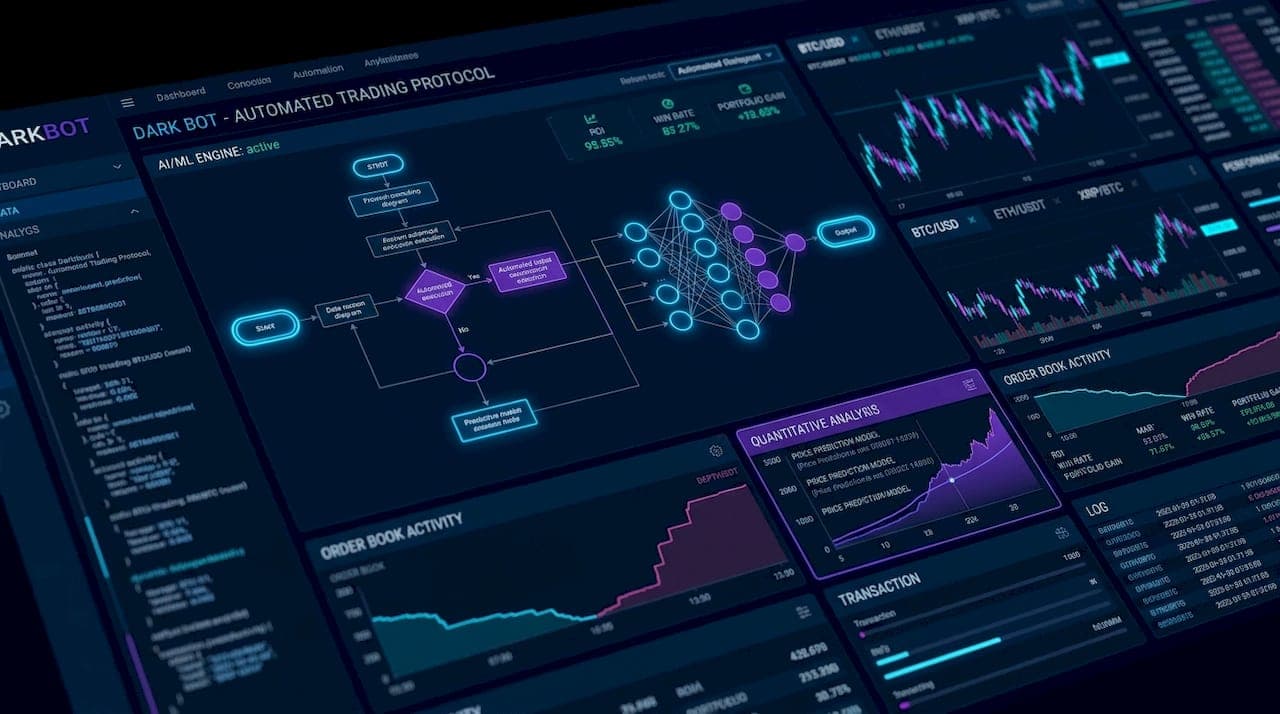
6 Steps to Build Your Automated Trading Strategies Checklist

Automating your cryptocurrency trading sounds convenient, but starting without a clear strategy can easily lead to confusion and costly errors. Many traders struggle to set practical goals, choose proper integration methods, and keep their bots running efficiently as markets shift. If you want your automated approach to deliver real results, you need more than just software—you need smart planning and reliable execution. This list breaks down the crucial steps for building a system that works, from pinpointing your trading objectives to monitoring performance with real-time analytics. Get ready for actionable advice that will help you avoid common mistakes and create a disciplined strategy that fits your financial goals.
Quick Summary
| Takeaway | Explanation |
|---|---|
| 1. Define Specific Trading Goals | Clear trading objectives guide your strategy and prevent emotional decisions during market fluctuations. |
| 2. Ensure Reliable Exchange Integration | Effective integration is crucial for real-time data feed and low-latency order execution, impacting your bot’s performance. |
| 3. Choose Appropriate Trading Algorithms | Match your trading algorithm to market conditions and personal risk tolerance for optimal results in trading. |
| 4. Implement Strict Risk Management | Establish hard loss limits and profit targets to safeguard your account against unexpected losses and volatility. |
| 5. Regularly Rebalance Your Portfolio | Maintain your desired asset allocation through periodic adjustments, preventing concentration risk and aligning with your goals. |
1. Define Your Trading Goals and Time Commitment
Before you automate anything, you need to know what you’re actually trying to achieve. Vague aspirations like “make money” won’t cut it when building a trading strategy.
Your trading goals form the foundation for every decision that follows. Clear objectives determine which markets you’ll trade, what risk levels you’ll accept, and how much time you’ll need to spend managing your automation.
Why precise goals matter:
- Guide entry and exit decisions based on your objectives
- Reduce emotional decision-making when markets move
- Help you choose the right trading style for your situation
- Enable you to measure actual performance against expectations
A comprehensive trading plan requires realistic, measurable, and time-bound objectives that align with your financial situation. Without this clarity, you’ll chase random opportunities instead of executing a disciplined strategy.
Time commitment is equally critical. Building and testing automated strategies takes real effort upfront. You’ll spend hours defining rules, backtesting against historical data, monitoring performance, and adjusting parameters as market conditions shift. Some traders dedicate 10-15 hours weekly; others spend 5 hours maintaining established bots.
Ask yourself these questions:
- What’s your primary objective: steady income, capital growth, or portfolio hedging?
- What’s your acceptable loss per trade or per month?
- How many hours weekly can you dedicate to setup and monitoring?
- Which crypto markets or trading pairs align with your knowledge?
- What’s your time horizon: days, weeks, months?
Clear goals eliminate confusion. You’ll know immediately whether a strategy aligns with your plan or wastes your time.
Your answers determine whether you build a day-trading bot requiring constant oversight or a longer-term strategy that runs more passively. The more specific you are now, the faster you’ll reach step two of building your strategy.
Pro tip: Write your goals down as measurable targets (e.g., “generate $200 monthly passive income with maximum 5% portfolio drawdown”) rather than vague statements, then revisit them monthly to confirm your time commitment and strategy still align with your actual situation.
2. Choose Reliable Exchange Integration Methods
Your trading strategy is only as strong as its connection to the market. A poorly integrated exchange connection can cost you trades, expose you to security risks, or cause delays that turn profitable opportunities into losses.
Exchange integration is the technical bridge between your automated bot and the cryptocurrency exchanges where it executes trades. The quality of this integration directly affects reliability, speed, and your ability to respond to market conditions.
Why does this matter so much? Your bot needs three critical capabilities to function properly.
Real-time data feeds deliver current price information and order status updates to your system. Without accurate, fast data, your bot makes decisions based on stale information, which leads to slippage and missed entries.
Low-latency order execution ensures your orders reach the exchange quickly. Even milliseconds matter in crypto trading. A 500-millisecond delay might mean the difference between filling at your target price or getting rejected entirely.
Robust risk controls built into your integration protect against communication failures and unexpected market moves. These prevent runaway trades or stranded orders that execute when you don’t expect them.
Most modern platforms handle these through secure API connections between your bot and the exchange. Your trading bot uses your exchange API keys to read account data, monitor prices, and submit orders automatically.
Key factors when choosing integration methods:
- Verify the exchange supports WebSocket connections for real-time data feeds
- Check API documentation for rate limits and historical uptime statistics
- Confirm the platform handles order cancellation reliably if your strategy needs to exit quickly
- Test execution speed during normal and volatile market periods
- Review security features like IP whitelisting and read-only API key options
Real-time data processing and rapid order execution frameworks are essential for maintaining performance when markets move fast. When your integration is unreliable, you lose opportunities or face unexpected slippage.
Stable integration prevents costly mistakes. Your strategy is worthless if orders don’t execute or data arrives too slowly to matter.
Your platform should make this straightforward. Look for exchanges that your automation platform officially supports and integrates with out of the box, rather than requiring custom development.
Pro tip: Start with a small test trade using your integrated connection to verify real-time data accuracy and order execution speed before running your full strategy, ensuring everything performs as expected under live market conditions.
3. Select Suitable Trading Algorithms for Your Needs
Not all trading algorithms work the same way. Choosing the right one for your situation determines whether your automated strategy thrives or stumbles in live markets.
An algorithm is simply a set of coded rules that tells your bot when to enter and exit trades based on specific market conditions. Different algorithms respond to different market behaviors, so matching yours to your goals and market outlook is critical.
The main algorithmic approaches fall into several categories.
Mean reversion strategies assume prices that move too far from average will snap back. This works well in range-bound markets where prices oscillate within predictable bands. If Bitcoin swings between $40,000 and $42,000 repeatedly, a mean reversion bot buys near $40,000 and sells near $42,000.
Momentum strategies do the opposite. They buy assets already moving upward, betting the trend continues. These work better in trending markets where price moves in one direction for sustained periods. This approach trades with the flow rather than against it.
Arbitrage algorithms look for price differences across exchanges or trading pairs. If Bitcoin trades at $40,000 on Exchange A and $40,200 on Exchange B, the bot buys on A and sells on B, pocketing the difference. This requires fast execution and minimal fees to be profitable.
Market making algorithms continuously place buy and sell orders slightly above and below current price, capturing the spread. These require capital to sit in orders and work best on liquid, stable assets.
Choosing your algorithm depends on several factors:
- Your market outlook (trending or ranging prices)
- Available capital and risk tolerance
- Time commitment for monitoring and adjustments
- Technical infrastructure and execution speed
- Market volatility and liquidity where you trade
Algorithmic trading strategies depend on personal goals, market characteristics, and risk tolerance for optimal selection. Each algorithm has distinct strengths and weaknesses. Mean reversion excels in choppy markets but fails during strong trends. Momentum trading captures big moves but whipsaw in sideways markets.
Algorithm alignment matters more than sophistication. A simple strategy matching your market outlook beats complex logic fighting market conditions.
Before committing to any algorithm, backtest it thoroughly on historical data relevant to current market conditions. Test how it performed during bull runs, crashes, and ranging periods. This reveals whether it matches your actual trading environment.
Pro tip: Start with one algorithm that matches your market bias, backtest for at least 6-12 months of historical data across multiple market cycles, then run a small real trade to validate performance before scaling up your position.
4. Set Up Risk Management and Profit Targets
Without risk controls, your automated bot can destroy your account in minutes. A single system error or unexpected market move could wipe out weeks of gains. Risk management is what separates traders who survive long term from those who blow up accounts.
Risk management means defining hard limits on how much you’re willing to lose and enforcing those limits automatically. Profit targets define when your bot should lock in gains. Together, they create guardrails that keep your trading disciplined regardless of market conditions.
Think of risk controls as circuit breakers for your strategy. Just like electrical systems shut down to prevent fires, your bot needs safeguards that stop trading when things go wrong.
Key risk controls to implement:
- Maximum loss per trade (stop loss)
- Maximum daily or weekly loss before bot pauses
- Maximum position size relative to account balance
- Maximum leverage or borrowed funds allowed
- Time-based kill switches that close all positions at day end
Your stop loss is the most critical control. This is the price level at which your bot automatically exits a losing trade. If you buy Bitcoin at $40,000 and set a stop at $39,000, the bot sells automatically if price drops that far, limiting your loss to $1,000 per coin.
Profit targets work the same way. You define target prices where the bot sells winning positions. This locks in gains instead of hoping for bigger moves. If your profit target is $41,000 on that $40,000 Bitcoin purchase, the bot sells automatically at the target, guaranteeing your $1,000 profit.
Comprehensive risk controls include maximum order sizes, position caps, and kill switches to prevent excessive losses from system errors or volatility. These safeguards align your automated strategy with actual capital preservation.
Calculate your position size carefully. A common approach uses 1 percent to 2 percent of account balance per trade. If your account is $10,000, risk $100 to $200 maximum per trade. This means if your stop loss triggers, you lose only that amount.
Risk controls are non-negotiable. No profit target is worth risking your entire account on a single trade.
Set profit targets that match your strategy. Momentum traders might set wider targets and hold longer. Scalping bots might close after 0.5 percent gains. Align targets to your algorithm and acceptable drawdown.
Pro tip: Test your risk parameters on historical data using backtest results, then start with half your intended position size in live trading to confirm your stops and profit targets execute as expected before committing full capital.
5. Customize and Rebalance Portfolio Regularly
Your portfolio doesn’t stay balanced on its own. Over time, winning positions grow while losing ones shrink, pushing your allocation away from your original plan. Regular rebalancing keeps your strategy on track and prevents concentration risk from derailing your goals.
Portfolio rebalancing means adjusting your holdings back to target allocations. If you started with 50 percent Bitcoin and 50 percent Ethereum, but Bitcoin surged to 70 percent of your portfolio value, rebalancing sells some Bitcoin and buys Ethereum to restore 50/50 balance.
Why does this matter? Without rebalancing, your portfolio drifts toward overweighting winners. This feels good during bull markets but leaves you overexposed to assets that have already moved significantly. When the trend reverses, you suffer larger losses because you’re concentrated in positions that have already peaked.
Rebalancing forces a disciplined approach. It makes you sell winners that feel unstoppable and buy losers that feel hopeless. This feels uncomfortable, but it’s how professional traders maintain consistent risk levels.
Customization means tailoring your portfolio to your specific situation:
- Define target allocations for each cryptocurrency or trading pair
- Set rebalancing triggers based on time (monthly, quarterly) or drift (when allocation drifts 5 percent from target)
- Adjust allocations as your risk tolerance or financial situation changes
- Account for transaction fees when calculating rebalancing frequency
- Consider tax implications if you trade in taxable accounts
Automated rebalancing maintains target allocations and mitigates portfolio drift through systematic analysis across market conditions. Machine learning models can optimize which assets to hold based on risk-adjusted returns, improving performance beyond simple static allocations.
Example: You allocate 40 percent Bitcoin, 30 percent Ethereum, and 30 percent altcoins. Bitcoin rallies hard and now represents 55 percent of your portfolio. Your bot automatically sells 15 percent of Bitcoin holdings and uses proceeds to buy Ethereum and altcoins, restoring your original 40/30/30 mix.
Rebalancing prevents concentration risk. Disciplined adjustments keep you from riding winners too far into territory where losses accelerate quickly.
Set rebalancing rules before you start trading. Decide whether you’ll rebalance monthly, when drift hits 5 percent, or on another schedule. Automation makes this consistent without emotional interference.
Pro tip: Start with quarterly rebalancing on a fixed schedule to keep implementation simple, then adjust frequency based on actual drift patterns after three months of live trading data.
6. Monitor Performance with Real-Time Analytics
You can’t improve what you don’t measure. Real-time analytics transforms your trading from a black box into a transparent system where you see exactly what’s working and what needs adjustment.
Real-time analytics means continuously tracking your bot’s performance as trades execute. Instead of waiting until month end to review results, you monitor profitability, win rates, average trade duration, and drawdowns as they happen. This visibility enables rapid adjustments when something goes wrong.
Why is this critical? Markets change constantly. A strategy that worked in sideways markets can fail during volatile rallies. Real-time monitoring lets you detect these shifts immediately instead of losing money for days before discovering a problem.
Think of analytics as your bot’s performance dashboard. You’re watching live data that shows:
- Total profit or loss from trades
- Win rate (percentage of profitable trades)
- Average win size versus average loss size
- Maximum drawdown (biggest peak-to-trough loss)
- Sharpe ratio (risk-adjusted returns)
- Trade frequency and execution speed
Real-time data processing enables rapid detection of market changes and adaptive strategy adjustments that enhance profitability and risk management. Continuous monitoring of order execution quality, latency, and anomalies prevents costly operational errors.
Example: Your bot starts the week with a 2 percent daily profit target. On Tuesday, it generates 15 trades but only wins 3 of them. Real-time analytics immediately flags that win rate dropped from 65 percent to 20 percent. This signals the market changed. You can pause the bot, investigate whether conditions shifted, and adjust parameters before losses accumulate.
Key metrics to track:
- Daily and weekly profit or loss totals
- Consecutive winning and losing trades
- Time between entries and exits
- Slippage between planned and actual execution prices
- Exchange fees versus expected costs
Real-time visibility prevents catastrophic losses. You catch problems within hours instead of weeks.
Set alerts that notify you when specific metrics deviate from expectations. If your win rate drops below 50 percent or daily loss exceeds 2 percent, your bot should pause and alert you for review.
Pro tip: Review your analytics dashboard daily for the first week of live trading, then shift to weekly reviews once you confirm your strategy executes consistently and metrics remain stable.
Below is a comprehensive table summarizing the essential strategies and considerations for successful trading automation discussed in the article.
| Area | Key Points | Advantages |
|---|---|---|
| Trading Goals | Define clear, measurable, and time-bound objectives to align strategies and guide decisions. | Reduces confusion, improves performance tracking, and enables strategy alignment. |
| Exchange Integration | Ensure reliable connections using APIs for real-time data, low latency, and robust risk controls. | Minimizes slippage, enhances security, and ensures smooth execution. |
| Algorithm Selection | Choose algorithms (e.g., mean reversion, momentum, arbitrage) based on goals and market conditions. | Matches strategy to specific markets and improves overall effectiveness. |
| Risk Management | Implement stop losses, caps on position size, and profit targets for disciplined trading. | Prevents significant losses and ensures consistent capital preservation. |
| Portfolio Management | Regularly rebalance holdings to maintain initial asset allocation ratios. | Reduces concentration risk and retains diversified exposure. |
| Performance Monitoring | Use real-time analytics to track metrics like profitability, win rates, and drawdowns. | Enables quick adjustments and strategy optimization based on live data. |
Take Control of Your Automated Trading Strategy with Darkbot.io
Building a successful automated trading strategy requires clear goals, reliable exchange integration, smart algorithm choices, and robust risk management. If you find yourself overwhelmed by complex setup steps like real-time analytics and portfolio rebalancing, you are not alone. Many traders struggle to convert their checklist into live profits without the right tools.
Darkbot.io is designed to solve these exact challenges by offering an all-in-one SaaS platform that streamlines every step from strategy customization to execution across multiple crypto exchanges. With seamless API integration, advanced AI-driven algorithms, and automated risk controls, you can confidently build, test, and monitor your bots without wasting hours on manual adjustments.
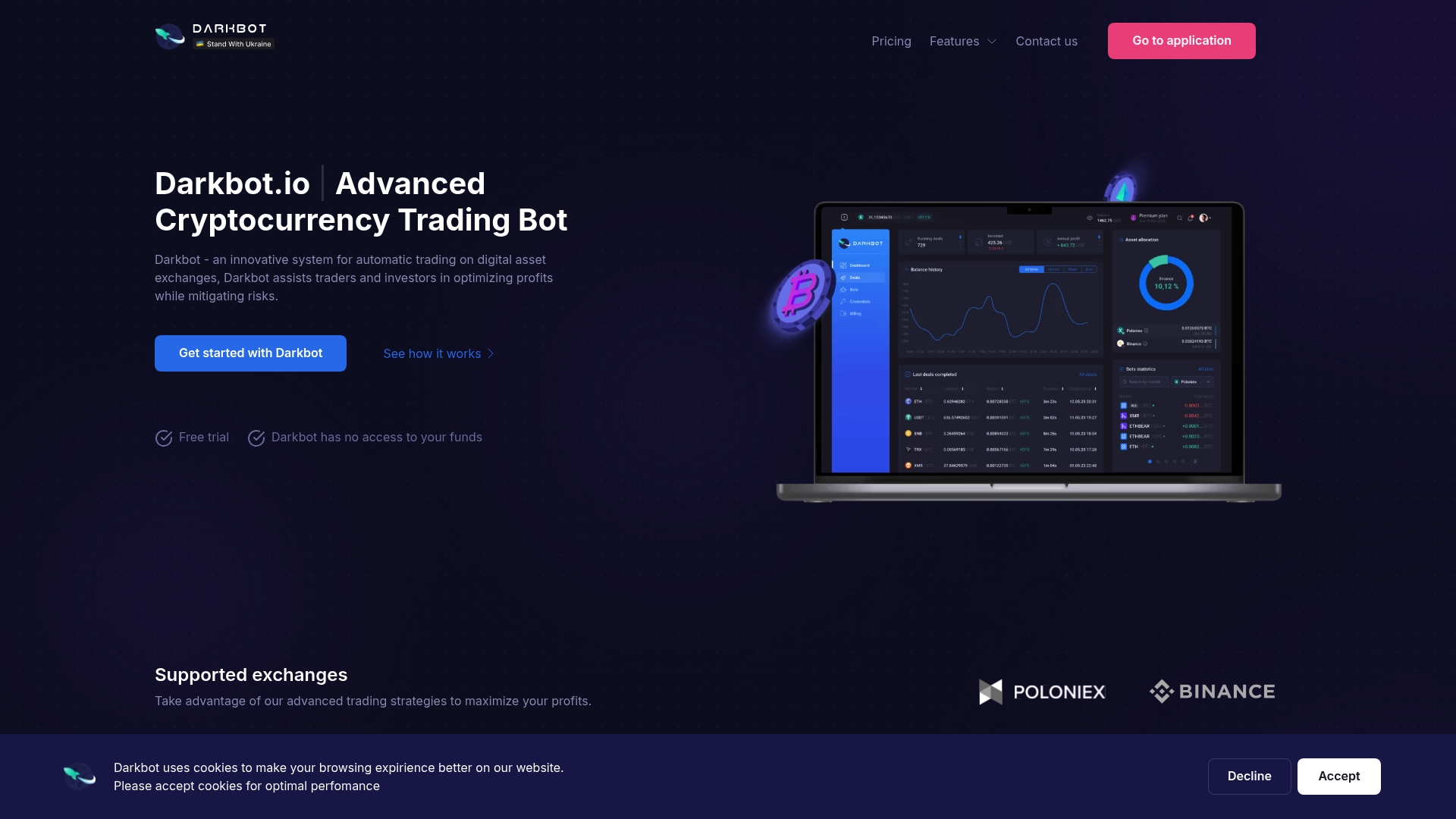
Ready to transform your trading checklist into results? Discover how easy it is to automate your trading process with Darkbot.io. Experience the freedom of managing multiple strategies simultaneously, automate portfolio rebalancing, and track live performance through intuitive dashboards. Take the next step now and start optimizing your crypto trades with dependable, secure automation designed for traders at every level.
Frequently Asked Questions
What are the first steps to build my automated trading strategy?
Start by defining your trading goals and time commitment. Clearly outline what you want to achieve, such as generating a specific monthly income or minimizing losses, and determine the number of hours you can devote to monitoring your strategies each week.
How do I choose the right exchange integration method for my trading bot?
Select reliable exchange integration methods by verifying that the exchange supports real-time data feeds and low-latency order execution. Ensure to test the connection with a small trade to confirm it functions correctly before fully committing your capital.
What types of trading algorithms should I consider using?
Consider using mean reversion, momentum, arbitrage, or market making algorithms based on your market outlook and risk tolerance. Start with one algorithm that aligns with your trading goals and backtest it with at least 6-12 months of historical data.
How can I implement risk management and profit targets in my strategy?
Establish clear risk management measures, such as setting maximum losses per trade and defining profit targets. For example, decide to limit your losses to 1-2% of your account balance per trade and set specific price levels at which to take profits.
How often should I rebalance my trading portfolio?
Rebalance your trading portfolio regularly, ideally every month or when allocations drift by more than 5% from your target. This practice keeps your portfolio aligned with your original strategy and mitigates concentration risk.
What key metrics should I monitor in real-time for my automated trading strategies?
Monitor metrics such as total profit or loss, win rate, and maximum drawdown in real-time. Establish alerts for when these metrics deviate from expected ranges, allowing you to make timely adjustments to your strategy.
Recommended

Start trading on Darkbot with ease
Come and explore our crypto trading platform by connecting your free account!
Free plan available • No credit card required