7 Essential Examples of AI Trading Strategies Explained

Building a successful trading strategy in cryptocurrency markets can feel overwhelming. Price swings are lightning fast, and human observation alone is not enough to spot every opportunity or dodge sudden risk. You want a smarter way to trade that cuts through the noise and helps you act with confidence—not just hope.
Artificial intelligence now brings advanced automation to complex tasks like market analysis, risk management, and opportunity detection. Instead of guessing, you can put research-backed techniques to work for you. These approaches use AI to identify trends, exploit short-term mispricings, and adapt to new conditions, helping you achieve consistency no matter how unpredictable the markets get.
Get ready to discover specific, actionable AI strategies that can transform how you trade digital assets. Each method on this list offers you clear steps and new tools to help you trade with greater accuracy, speed, and control.
Quick Summary
| Takeaway | Explanation |
|---|---|
| 1. Leverage AI for Faster Trend Detection | AI identifies momentum shifts before traditional methods, providing quicker entry signals for trades. |
| 2. Use AI for Systematic Mean Reversion Strategies | AI quantifies price deviations and executes trades when statistical reversion thresholds are met, removing guesswork. |
| 3. Automate Arbitrage to Capture Price Discrepancies | AI scans multiple exchanges for quick arbitrage opportunities, validating profitability and executing trades rapidly. |
| 4. Integrate Sentiment Analysis for Trading Signals | AI processes news and social media sentiment to detect market shifts early, allowing timely responses before price changes. |
| 5. Employ Reinforcement Learning for Adaptive Strategies | RL bots constantly learn from market conditions, enhancing trading decisions as dynamics shift, avoiding reliance on static rules. |
1. Momentum Trading: Using AI to Spot Market Trends
Momentum trading capitalizes on the tendency of assets to continue moving in their current direction. Instead of relying on manual observation, AI accelerates this process by identifying trend shifts faster and more accurately than human traders working alone.
Traditional momentum traders watch price charts for hours, searching for directional patterns. AI changes the equation entirely. Machine learning models can analyze thousands of price movements simultaneously across multiple timeframes, detecting subtle trend accelerations that precede major market moves. The result is faster entry signals with greater consistency.
Research demonstrates that momentum trading strategies powered by deep neural networks can deliver measurable outperformance. These systems jointly optimize portfolio construction while forecasting volatility, creating a dual advantage. Your trading system doesn’t just spot the trend, it simultaneously calculates optimal position sizing for that specific trend’s risk profile.
Why does this matter for your trading? Traditional momentum traders react to trends that are already visible. AI systems with improved trend spotting capabilities detect momentum shifts while they are emerging, not after confirmation appears on every chart. This timing advantage compounds across dozens of trades annually.
The practical benefit extends beyond speed. AI momentum systems remove emotional decision making from trend identification. Your algorithm either detects the momentum conditions your rules define, or it doesn’t. No second guessing. No hesitation during volatile intraday swings. When conditions match your defined parameters, the system executes with mechanical precision.
Pro tip: Set momentum thresholds that ignore brief price reversals within larger trends, as temporary pullbacks during bull runs often trigger false momentum signals if your parameters are too sensitive.
2. Mean Reversion: AI-Driven Price Normalization Tactics
Mean reversion operates on a fundamental market principle: prices that deviate significantly from historical averages tend to snap back. When Bitcoin trades 40 percent above its 200-day average, or a trading pair’s spread widens beyond normal ranges, mean reversion strategies capitalize on the return to equilibrium.
AI transforms mean reversion from a simple observation into a systematic, measurable approach. Traditional traders might notice a price looks expensive and hope it falls. AI systems quantify exactly how far prices have strayed from normal ranges, calculate the probability of reversion within specific timeframes, and execute when statistical thresholds are met. This removes guesswork entirely.
Reinforcement learning models optimize mean reversion strategies by learning from actual price behavior rather than rigid rules. These adaptive systems identify which assets revert fastest, how long reversion typically takes, and when the spread between correlated assets presents exploitable opportunities. Your trading automation continuously improves its timing based on empirical data.
The practical application works through statistical arbitrage, where your AI identifies paired assets that historically move together. When that relationship temporarily breaks, one asset becomes overpriced relative to the other. The system spots this deviation and establishes positions designed to profit when prices normalize back to their historical correlation. Statistical methods including regression and weighted optimization identify these mispricings more accurately than manual analysis.
What makes this powerful is consistency. Mean reversion doesn’t require price predictions. It requires identifying temporary imbalances and betting on normalization. AI handles this repetitively across hundreds of asset pairs simultaneously. While human traders might catch three or four setups monthly, your automated system identifies and executes dozens, compounding small edge gains into measurable results.
Pro tip: Set reversion timeframes based on historical data for your specific assets rather than using generic windows, as cryptocurrency pairs revert faster than traditional markets and shorter-duration reversions reduce capital exposure time.
3. Arbitrage: Automated Opportunity Detection Across Exchanges
Arbitrage exploits price discrepancies for the same asset across different markets. When Bitcoin trades at $42,500 on one exchange and $42,800 on another, the spread represents a risk-free profit opportunity if you can execute fast enough. Manual traders struggle to find these fleeting gaps. AI doesn’t.
The challenge with arbitrage lies in speed and complexity. You need to monitor hundreds of trading pairs simultaneously across multiple exchanges, calculate transaction fees and withdrawal costs, confirm liquidity availability, and execute before prices converge. A human trader cannot process this information quickly enough. AI systems scan all variables in milliseconds, identifying profitable paths humans would miss entirely.
Neural networks detect arbitrage opportunities more effectively than traditional mathematical methods in complex markets. These AI models quickly identify and execute profitable strategies across many traded securities, learning which patterns typically yield exploitable pricing inefficiencies. Your automation doesn’t just spot the opportunity, it validates profitability instantly.
Advanced algorithms compound this advantage further. Graph theory combined with modified shortest path techniques identifies more profitable arbitrage loops across decentralized exchanges than conventional methods. Instead of simple buy-sell pairs, these systems recognize complex multi-leg arbitrage paths that generate substantially larger returns. What previously required manual optimization now executes algorithmically.
The practical benefit is continuous profit extraction without active monitoring. Your system runs 24/7, analyzing price feeds from multiple exchanges simultaneously. When conditions align, it routes orders through the optimal execution path, capturing the spread before prices normalize. Unlike momentum or mean reversion, arbitrage requires no market prediction. It only requires identifying real, immediate pricing discrepancies and executing faster than competition.
The protection against market volatility is substantial. Arbitrage profits don’t depend on price direction. They depend on identifying temporary imbalances and closing them before they disappear. This creates a fundamentally different risk profile than directional trading strategies.
Pro tip: Account for all transaction costs including exchange fees, withdrawal delays, and slippage when your AI evaluates arbitrage spreads, as many small spreads become unprofitable once execution costs are factored into calculations.
4. Sentiment Analysis: Interpreting News and Social Data
Sentiment analysis transforms subjective human opinions into quantifiable trading signals. When news breaks about regulatory changes or technology updates, market participants react emotionally. These reactions appear first in social media posts and financial news before price movements fully reflect the information. AI captures this sentiment shift before the broader market responds.
Traditional lexicon-based sentiment methods classify text as positive or negative using predefined word lists. This approach fails spectacularly with financial nuance. A statement like “Ethereum could face regulatory challenges” contains warning indicators but might be classified as neutral by basic systems. Advanced language models like BERT and FinBERT significantly outperform traditional methods by understanding context, financial terminology, and the specific implications of language. These neural networks recognize subtlety that simpler tools miss entirely.
The practical value emerges from speed and scale. Your AI monitors thousands of news sources and social media feeds simultaneously, processing millions of posts in real time. When sentiment shifts detectably, your system quantifies the change and correlates it with price movements. This happens at machine speed, capturing opportunities before human traders finish reading the headline.
Social media sentiment from Twitter demonstrates strong predictive power for intraday stock price movements across global markets. Research analyzing millions of posts confirms that investor emotional indicators derived from social platforms illuminate critical trading opportunities. Your AI system doesn’t argue about whether sentiment matters. It measures whether specific sentiment patterns preceded profitable price movements in your historical data.
The implementation combines multiple data streams. News headlines feed one sentiment analysis model. Social media posts feed another. Community discussions and forums provide additional context. Your system weights these signals based on historical accuracy, learning which sources predict price movement most reliably for your specific assets and timeframes.
What distinguishes this from gambling is measurable correlation. You don’t trade on hunches about what the market feels. You trade on empirical patterns showing that specific sentiment signals preceded profitable opportunities in the past. The AI quantifies this relationship and executes only when conditions match statistically significant patterns.
Pro tip: Filter sentiment signals by source credibility and historical accuracy rather than treating all social media equally, as bot accounts and automated posting services generate noise that reduces signal quality.
5. Reinforcement Learning Bots for Adaptive Trading
Reinforcement learning represents a fundamentally different approach to trading automation. Rather than following static rules, RL bots learn optimal decision making by testing actions, observing results, and adjusting strategies based on what generates the best outcomes. Your bot improves continuously as it encounters new market conditions.
The core mechanism works like this: your RL agent observes current market conditions, evaluates available actions, executes a trade decision, and receives feedback on whether that decision was profitable. Over thousands of iterations across different market states, the bot learns which actions tend to generate positive results in specific situations. This learned behavior adapts as market dynamics shift, which static strategies cannot do.
What separates RL from rule-based systems is adaptability under volatility. A traditional rule-based bot might specify “buy when RSI drops below 30.” This works until market regime changes and the RSI threshold no longer predicts reversals. RL agents integrate financial indicators with continuous learning to adapt dynamically to changing market conditions, adjusting their decision thresholds and tactics as they accumulate evidence about what works. Your system doesn’t stubbornly follow yesterday’s rules when the market behaves differently today.
Advanced RL approaches using actor-critic methods represent both long-term and short-term asset relationships, enabling the bot to make decisions accounting for both immediate price movements and broader market structure. These bots outperform existing approaches by adapting their strategy selection in real time based on current market volatility and asset behavior patterns.
The practical benefit emerges during market transitions. When cryptocurrency volatility spikes or correlation structures shift, your RL bot recognizes these changes and adjusts accordingly. While other traders scramble to update their strategies, your system is already learning and adapting automatically. The bot doesn’t need a software update to handle new conditions because learning happens continuously.
This adaptability comes with a cost: RL bots require more initial training and validation than rule-based systems. You cannot deploy them immediately. Your bot must accumulate trading history across various market conditions before its learned behavior becomes reliable. The investment in development pays dividends through improved performance during regime changes that destroy static strategies.
Pro tip: Set clear learning boundaries for your RL bot by defining maximum acceptable drawdowns during the learning phase, preventing the system from learning costly lessons at full position sizes while it optimizes decision making.
6. Portfolio Rebalancing Automation with Machine Learning
Portfolio rebalancing maintains your target asset allocation as prices move. When Bitcoin appreciates significantly, it becomes overweight in your portfolio. Rebalancing sells Bitcoin and buys underweight assets to restore your intended allocation. Manual rebalancing happens occasionally. Machine learning automates it intelligently while minimizing costs.
The challenge with rebalancing is hidden complexity. Every trade incurs fees, slippage, and potential tax consequences. Rebalancing too frequently burns capital through transaction costs. Rebalancing too infrequently allows your portfolio to drift from targets, increasing unintended risk exposure. Finding the optimal rebalancing frequency and execution path requires analyzing thousands of possible sequences and their associated costs.
Traditional approaches use fixed schedules or percentage thresholds. These ignore transaction cost dynamics and market microstructure. Machine learning changes this equation fundamentally. Graph Neural Networks predict transaction costs in real time while Dijkstra’s algorithm identifies the most cost-efficient rebalancing paths, adapting to current market conditions. Your system doesn’t follow a calendar. It rebalances exactly when doing so makes financial sense given current market spreads and fees.
The practical advantage becomes visible in portfolio performance. Consider a portfolio worth $100,000 that requires rebalancing quarterly. If each rebalancing costs 0.5 percent through fees and slippage, that totals $2,000 annually in friction costs. AI-optimized rebalancing can reduce those costs by 30 to 50 percent by identifying execution paths that minimize overall cost while maintaining allocation targets. Over years, this compounds into meaningful performance improvement.
The system learns which execution sequences work best across different market conditions. Should you sell Bitcoin directly for Ethereum, or route through stablecoins first? Should you execute all at once or scale in over minutes? ML models answer these questions by analyzing historical data on how different approaches performed. Your rebalancing executes automatically when thresholds are reached and does so in the most cost-efficient manner.
This automation removes emotional decisions from portfolio management. You don’t debate whether now is a good time to rebalance. Your system measures deviation from targets and executes when rebalancing benefits exceed costs. The result is consistent adherence to your intended allocation without the psychological resistance that makes humans avoid necessary adjustments.
Pro tip: Configure your ML rebalancing system to skip execution when transaction costs exceed the benefit of realigning to targets, preventing expensive rebalancing during illiquid market conditions when spreads are artificially wide.
7. Risk Management: AI Techniques for Loss Minimization
Risk management separates traders who survive market cycles from those who blow up accounts. Traditional risk management relies on static rules like stop losses at fixed percentages or maximum position sizes. AI transforms risk management from static guardrails into dynamic, adaptive systems that evolve as market conditions shift and new data accumulates.
The fundamental challenge is that market risk changes constantly. Volatility spikes during unexpected news events. Correlations break down during market stress. Asset liquidity dries up at the worst times. Static risk parameters that worked yesterday may be dangerously inadequate tomorrow. Agentic systems combining language models with advanced mathematical techniques discover refined risk metrics dynamically, adapting to current market conditions rather than relying on historical assumptions.
AI risk systems operate through continuous measurement and refinement. Your system analyzes current price volatility, correlation structures, order book depth, and broader market conditions. It calculates the actual risk exposure given these conditions and adjusts position sizes automatically. When volatility doubles, maximum position sizes shrink proportionally. When liquidity dries up on your preferred trading pairs, your system recognizes reduced exit certainty and reduces exposure accordingly.
The practical benefit emerges during crisis moments. While other traders panic and liquidate at terrible prices, your AI system already reduced exposure as risk metrics deteriorated. You suffer smaller losses because your framework adapted proactively rather than reacting after losses mounted. This protection compounds across years of trading, preventing the catastrophic drawdowns that destroy long-term wealth.
AI risk management also prevents overconfidence during winning periods. After profitable trades, humans tend to increase position sizes aggressively. AI systems instead measure whether winning conditions still exist or whether market structure has changed. This prevents the trap of betting big on yesterday’s edge that no longer works.
Implementing AI risk management requires defining your maximum acceptable loss, position sizing rules, and exit thresholds. Your system continuously monitors whether current positions satisfy these requirements given evolving market conditions. When conditions deteriorate, positions automatically reduce. This removes emotional resistance to cutting losses and enforces discipline automatically.
Pro tip: Validate your AI risk framework against historical crisis periods like the 2020 pandemic crash or 2022 crypto winter to confirm it would have reduced drawdowns meaningfully rather than providing false confidence.
NO_TABLE
Unlock Your Full Trading Potential with AI-Driven Automation
Navigating the complexities of AI trading strategies like momentum trading, mean reversion, or reinforcement learning can feel overwhelming. The challenge lies in executing these sophisticated concepts consistently while managing risks and reducing emotional biases. Darkbot.io offers a powerful solution designed to help traders and investors overcome these hurdles. With seamless exchange integration, customizable AI bots, and advanced portfolio management, you can automate proven strategies, reduce manual effort, and respond dynamically to market changes.
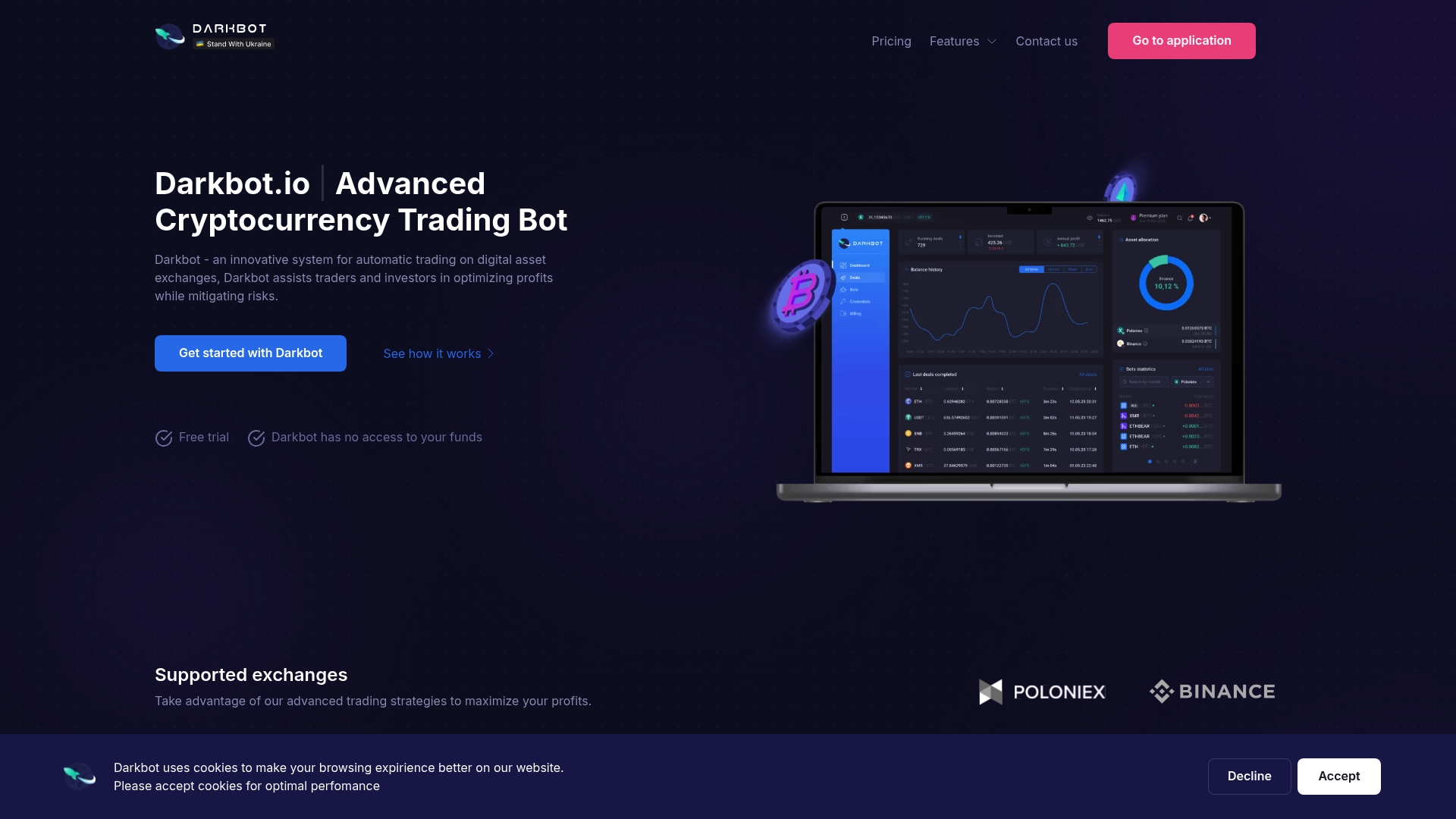
Take control and elevate your trading results today. Explore how Darkbot.io’s intuitive platform supports multiple simultaneous bots, real-time analytics, and automated rebalancing to optimize profits while managing risks effectively. Start building your adaptive AI-powered trading system now by visiting Darkbot.io and unlock the next level of cryptocurrency trading automation. Learn more about our features and plans at Darkbot.io and begin your journey toward smarter, more reliable trading.
Frequently Asked Questions
What is momentum trading in AI strategies?
Momentum trading is an approach that utilizes AI to identify and capitalize on market trends as they emerge. Implement an AI system that can analyze multiple price movements quickly to spot potential profitable trades before human traders can react.
How does mean reversion work in AI trading?
Mean reversion is a strategy where AI identifies assets that have deviated from historical price averages and predicts a return to those averages. To use this strategy effectively, configure your AI to calculate the probabilities of price normalizations based on real-time market data.
What is arbitrage in AI trading strategies?
Arbitrage involves taking advantage of price discrepancies of the same asset across different exchanges using AI for rapid execution. Set up your AI system to monitor various exchanges continuously and execute trades immediately when profitable price gaps are detected.
How can I implement sentiment analysis in trading?
Sentiment analysis translates emotional market reactions into quantifiable trading signals using AI to analyze news and social media. Start by integrating multiple data sources into your AI to measure sentiment shifts and correlate those changes with potential price movements.
What are reinforcement learning bots in AI trading?
Reinforcement learning bots utilize machine learning to learn optimal trading strategies through trial and error. Deploy these bots to continuously analyze market conditions and adjust their strategies in real-time based on observed outcomes from previous trades.
How does AI improve portfolio rebalancing?
AI enhances portfolio rebalancing by automating the process to maintain your target asset allocation while minimizing transaction costs. Set your AI rebalancing system to evaluate market conditions and execute trades only when the costs of rebalancing are outweighed by the benefits.
Recommended

Start trading on Darkbot with ease
Come and explore our crypto trading platform by connecting your free account!
Free plan available • No credit card required