Machine Learning in Crypto Trading: Impact and Advantages

Most American crypto traders are searching for an edge as the market changes faster than ever. With over $1 trillion in global cryptocurrency assets traded every day, machine learning has become a powerful tool for analyzing shifting trends and automating decisions. Understanding how these technologies work can help you recognize valuable opportunities and manage risk in a marketplace where speed and precision give real advantages.
Key Takeaways
| Point | Details |
|---|---|
| Machine Learning Enhances Trading | Machine learning algorithms allow trading systems to autonomously adapt and refine strategies by analyzing complex market data. |
| Diverse Algorithm Utilization | A range of algorithms, including supervised and reinforcement learning, can be applied to detect patterns and improve predictions in cryptocurrency markets. |
| Risk Management is Crucial | Effective risk management strategies should integrate machine learning to dynamically adjust portfolios and monitor market volatility. |
| Continuous Strategy Validation | Backtesting and rigorous performance evaluation are essential before implementing machine learning strategies in real trading environments. |
Core Concepts of Machine Learning in Crypto Trading
Machine learning represents a sophisticated computational approach that enables trading systems to analyze complex market dynamics and adapt strategies autonomously. Unlike traditional algorithmic trading methods, machine learning algorithms can dynamically learn from market data, identifying intricate patterns and relationships that human traders might overlook. These systems leverage advanced statistical techniques and neural network architectures to process massive volumes of historical and real-time cryptocurrency market information.

The core mechanisms of machine learning in crypto trading involve several key computational strategies. Predictive models developed through advanced machine learning techniques can analyze multiple market indicators simultaneously, such as price movements, trading volumes, market sentiment, and macroeconomic signals. These models utilize sophisticated algorithms like neural networks, support vector machines, and reinforcement learning to generate probabilistic predictions about potential market trends. Crucially, these systems continuously refine their predictive capabilities by learning from past performance and adapting to changing market conditions.
Cryptocurrency markets present unique challenges for machine learning applications, including extreme volatility, limited historical data, and complex interconnected market dynamics. Advanced machine learning approaches tackle these challenges through techniques like ensemble learning, where multiple predictive models are combined to improve overall accuracy and reduce individual model biases. Reinforcement learning models, in particular, have shown promising results in developing adaptive trading strategies that can quickly respond to market fluctuations. These systems essentially create a feedback loop where trading performance directly informs and improves future decision-making algorithms.
Pro Trading Insight: Always validate machine learning trading models through rigorous backtesting and paper trading before deploying real capital, ensuring the algorithm’s performance matches theoretical predictions and risk management requirements.
Types of Machine Learning Algorithms Used
Cryptocurrency trading leverages a diverse array of machine learning algorithms, each designed to extract unique insights from complex market data. Supervised learning algorithms form the backbone of predictive trading models, utilizing historical price, volume, and market sentiment data to train neural networks that can forecast potential market movements. These algorithms include classic techniques like linear regression, support vector machines, and more advanced deep learning architectures that can capture intricate market relationships.
Advanced machine learning techniques like convolutional neural networks and long short-term memory networks have demonstrated remarkable capabilities in analyzing cryptocurrency price dynamics. Specifically, deep learning models such as Multilayer Perceptrons (MLPs), Convolutional Neural Networks (CNNs), and Long Short-Term Memory (LSTM) networks can process time-series data with unprecedented sophistication. These algorithms excel at detecting non-linear patterns, handling high-dimensional financial datasets, and generating probabilistic predictions about potential market trends.
Reinforcement learning and unsupervised learning algorithms represent cutting-edge approaches in crypto trading machine learning. Generative Adversarial Networks (GANs) and autoencoders enable traders to generate synthetic market data, simulate trading scenarios, and uncover hidden market patterns that traditional analysis might miss. Reinforcement learning models, in particular, can develop adaptive trading strategies by continuously learning from market interactions, allowing algorithmic systems to refine their decision-making processes in real-time based on performance feedback.
Pro Trading Insight: Develop a comprehensive understanding of multiple machine learning algorithms and their specific strengths, focusing on ensemble techniques that combine diverse models to improve overall predictive accuracy and risk management in cryptocurrency trading.
Here’s a quick comparison of major machine learning algorithm categories used in crypto trading:
| Algorithm Type | Typical Use Case | Strengths | Common Challenges |
|---|---|---|---|
| Supervised Learning | Price prediction models | Interpretable, strong with labeled data | Needs extensive historical data |
| Unsupervised Learning | Market anomaly detection | Finds hidden structures, unsupervised | Difficult to validate results |
| Reinforcement Learning | Adaptive trading strategies | Learns from market interactions | Prone to instability, complex tuning |
| Generative Models | Synthetic data generation | Simulates new scenarios, fills gaps | Risk of unrealistic outputs |
Automating Trading Strategies With AI
Automating trading strategies through artificial intelligence represents a sophisticated approach to cryptocurrency market engagement, transforming traditional manual trading processes into intelligent, adaptive systems. Algorithmic trading powered by AI enables traders to execute complex strategies with unprecedented speed and precision, removing emotional decision-making and implementing consistently disciplined trading approaches. These automated systems can simultaneously analyze multiple market indicators, execute trades across different exchanges, and adjust strategies in real-time based on emerging market conditions.
Advanced hierarchical reinforcement learning frameworks have revolutionized cryptocurrency trading automation by developing intelligent systems capable of making nuanced trading decisions. These AI-driven strategies can dynamically optimize portfolio allocation, manage risk exposure, and identify profitable trading opportunities faster than human traders. By incorporating machine learning algorithms, automated trading systems can continuously learn from market interactions, refining their decision-making processes and developing increasingly sophisticated trading strategies that adapt to changing market dynamics.
The implementation of AI-powered trading automation involves several critical components, including robust data preprocessing, sophisticated machine learning models, and comprehensive risk management protocols. Traders can develop automated strategies that range from simple trend-following approaches to complex multi-factor trading algorithms that integrate technical analysis, sentiment analysis, and predictive modeling. Crucially, these AI systems can operate 24/7, monitoring global cryptocurrency markets across multiple timeframes and executing trades with millisecond-level precision that would be impossible for human traders.
Pro Trading Insight: Develop a comprehensive backtesting framework that rigorously evaluates AI trading strategies across diverse market conditions, ensuring statistical validity and robust performance before deploying real capital into automated trading systems.
Below is a summary of key machine learning features that automate cryptocurrency trading:
| Feature | Description | Business Impact |
|---|---|---|
| Real-Time Execution | Enacts trades in milliseconds | Captures market opportunities |
| Adaptive Strategies | Adjusts actions based on new data | Maximizes response to trends |
| Portfolio Optimization | Allocates capital across assets dynamically | Enhances returns, reduces risk |
| Automated Risk Controls | Applies stop-loss and exposure limits | Limits losses automatically |
Managing Risks and Portfolio Performance
Risk management in cryptocurrency trading represents a critical component of successful investment strategies, particularly given the inherent volatility of digital asset markets. Machine learning techniques provide sophisticated approaches to quantifying, monitoring, and mitigating potential investment risks through advanced predictive modeling and dynamic portfolio allocation strategies. These intelligent systems can analyze complex market interactions, identify potential volatility patterns, and implement automated risk control mechanisms that adapt in real-time to changing market conditions.
Hierarchical risk management approaches leverage advanced machine learning clustering techniques to optimize portfolio diversification and minimize potential downside exposure. By systematically analyzing correlations between different cryptocurrency assets, these intelligent systems can develop more robust investment strategies that balance risk across multiple dimensions. Machine learning algorithms can dynamically adjust portfolio weightings, implement sophisticated stop-loss mechanisms, and continuously rebalance asset allocations to maintain optimal risk-return profiles.
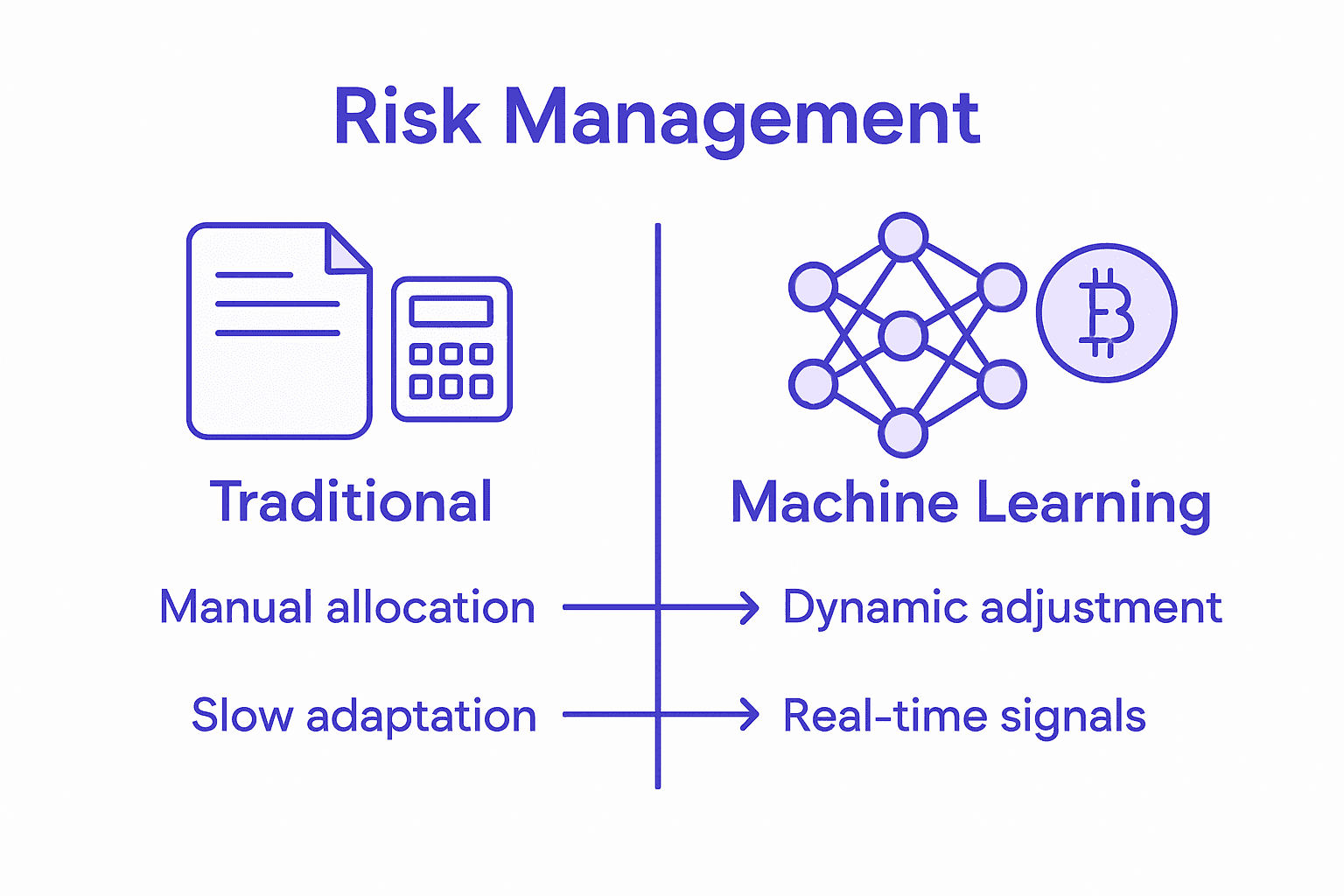
The implementation of machine learning in risk management extends beyond traditional portfolio optimization techniques. Advanced AI models can simulate thousands of potential market scenarios, stress-test trading strategies, and generate probabilistic risk assessments that provide traders with comprehensive insights into potential portfolio vulnerabilities. These systems can integrate multiple risk indicators, including market volatility, liquidity constraints, correlation metrics, and macro-economic signals, to develop a holistic understanding of potential investment risks that would be impossible through manual analysis.
Pro Trading Insight: Develop a multi-layered risk management framework that combines quantitative machine learning models with human oversight, ensuring that automated risk control strategies remain adaptable and responsive to unexpected market developments.
Challenges and Limitations in Crypto Markets
The cryptocurrency trading landscape presents unique computational and analytical challenges that significantly complicate machine learning applications. Market unpredictability remains the most substantial obstacle, with digital asset markets characterized by extreme volatility, limited historical data, and complex nonlinear behavioral patterns that defy traditional predictive modeling approaches. Machine learning algorithms must continuously adapt to rapidly changing market dynamics, making consistent performance optimization an intricate technical challenge.
Advanced reinforcement learning techniques confronting high-frequency trading limitations highlight the fundamental complexities of developing robust cryptocurrency trading models. Specific challenges include managing long computational trajectories, handling sudden market fluctuations, and maintaining algorithmic stability across diverse trading environments. Machine learning systems must overcome significant hurdles such as data sparsity, high noise-to-signal ratios, and the inherent unpredictability of cryptocurrency price movements, which can render traditional statistical approaches ineffective.
Furthermore, cryptocurrency markets present distinctive structural limitations that challenge machine learning implementations. Regulatory uncertainty, fragmented market infrastructure, limited liquidity in certain trading pairs, and significant variation across global exchanges create substantial barriers to developing universally applicable trading algorithms. Machine learning models must incorporate sophisticated risk management techniques to account for potential black swan events, sudden regulatory changes, and the unique psychological dynamics that drive cryptocurrency market behaviors.
Pro Trading Insight: Develop a flexible machine learning framework that emphasizes adaptive risk management, continuous model retraining, and robust error handling mechanisms to effectively navigate the inherent uncertainties of cryptocurrency trading environments.
Harness the Power of Machine Learning to Automate Your Crypto Trading
Navigating the complexities of cryptocurrency markets demands advanced tools that can analyze volatile data, adapt quickly, and optimize trading strategies in real-time. The article highlights critical challenges such as extreme market volatility, the need for dynamic risk management, and the benefits of reinforcement learning and ensemble models in crafting adaptive trading systems. If you want to overcome the difficulties of manual trading and leverage AI-driven algorithms designed to refine your portfolio performance while minimizing risk, Darkbot.io offers the automated trading solution you need.

Experience the next level of crypto trading automation with Darkbot.io, where you can customize intelligent strategies, automate portfolio rebalancing, and deploy multiple bots across exchanges with ease. Benefit now from real-time analytics and risk controls tailored to volatile markets. Start transforming your trading approach today by visiting Darkbot.io and empower your crypto investing with machine learning-backed automation.
Frequently Asked Questions
What is the impact of machine learning on crypto trading?
Machine learning significantly enhances crypto trading by enabling sophisticated analysis of market dynamics, allowing for adaptive strategies that can identify patterns and make predictions that human traders might miss.
How do machine learning algorithms improve trading strategies?
Machine learning algorithms analyze vast amounts of historical and real-time data, refining their predictions through continuous learning. This results in more accurate forecasting of market trends and improved decision-making in trading.
What types of machine learning algorithms are commonly used in crypto trading?
Common algorithms include supervised learning models like linear regression and neural networks, as well as unsupervised learning approaches like clustering and generative models, which help uncover hidden patterns in the market.
How does machine learning handle risk management in cryptocurrency trading?
Machine learning enhances risk management by quantifying potential risks, simulating market scenarios, and implementing dynamic portfolio adjustments to mitigate exposure, thus maintaining a stronger risk-return profile.
Recommended

Start trading on Darkbot with ease
Come and explore our crypto trading platform by connecting your free account!
Free plan available • No credit card required