Machine Learning in Cryptocurrency: Smarter Automated Trading

Most American crypto traders know that machine learning is reshaping how digital assets are bought and sold. In high-inflation countries, automated systems offer a lifeline, taking the guesswork out of unpredictable markets and freeing traders from constant screen time. With over 80 percent of active cryptocurrency investors now exploring machine learning strategies, this guide reveals how these technologies help optimize profits and manage risk while enhancing trading discipline for a global audience.
Key Takeaways
| Point | Details |
|---|---|
| Machine Learning Enhances Trading | Machine learning enables traders to analyze vast datasets quickly, improving price predictions and automated risk management. |
| Adaptability of Models | Machine learning models continuously improve their decision-making by learning from new market data, making them more effective than traditional analysis methods. |
| Importance of Data Quality | Traders must ensure high-quality data to avoid issues like model overfitting and incorrect predictions, which can lead to significant losses. |
| Security and Compliance Considerations | Implement robust security practices and stay informed about legal regulations to protect assets and adhere to market integrity standards. |
Defining Machine Learning in Cryptocurrency
Machine learning represents a transformative approach to analyzing and predicting cryptocurrency market dynamics through advanced computational techniques. At its core, machine learning enables algorithmic systems to learn from complex financial datasets without being explicitly programmed for every scenario. Blockchain data generation creates unprecedented opportunities for applying sophisticated analytical methods to crypto markets.
In cryptocurrency contexts, machine learning involves training computational models to recognize intricate patterns within transaction histories, market movements, trading volumes, and investor behaviors. These algorithms can process massive amounts of historical and real-time data, identifying subtle correlations that human traders might overlook. The process involves statistical modeling, neural networks, and predictive analytics that continuously adapt and improve their decision-making capabilities based on incoming market information.
The primary applications of machine learning in cryptocurrency trading include trend prediction, risk assessment, anomaly detection, and automated trading strategy optimization. Advanced models can analyze multiple indicators simultaneously - including price fluctuations, social media sentiment, blockchain network activity, and macroeconomic trends - to generate probabilistic insights about potential market movements. Unlike traditional analysis, machine learning approaches can dynamically adjust their predictive models, learning from both successful and unsuccessful trading scenarios.
Pro tip: Start by experimenting with small, controlled machine learning trading models and gradually increase complexity as you understand their performance characteristics.
Types of Machine Learning Used in Crypto Trading
Cryptocurrency trading leverages multiple machine learning approaches, each designed to address specific analytical challenges in the volatile digital asset markets. Sophisticated machine learning models provide comprehensive trading strategies that range from predictive analytics to complex decision-making algorithms. These models can be broadly categorized into supervised learning, unsupervised learning, and deep learning techniques.
Supervised learning methods dominate cryptocurrency trading applications, utilizing historical data to train models for predicting price movements and market trends. Techniques like Random Forest, Gradient Boosting, and Support Vector Machines enable traders to build predictive models that can classify potential market behaviors and estimate future price trajectories. Regression algorithms help quantify potential price ranges, while classification models identify potential buy or sell signals based on complex historical patterns and current market conditions.
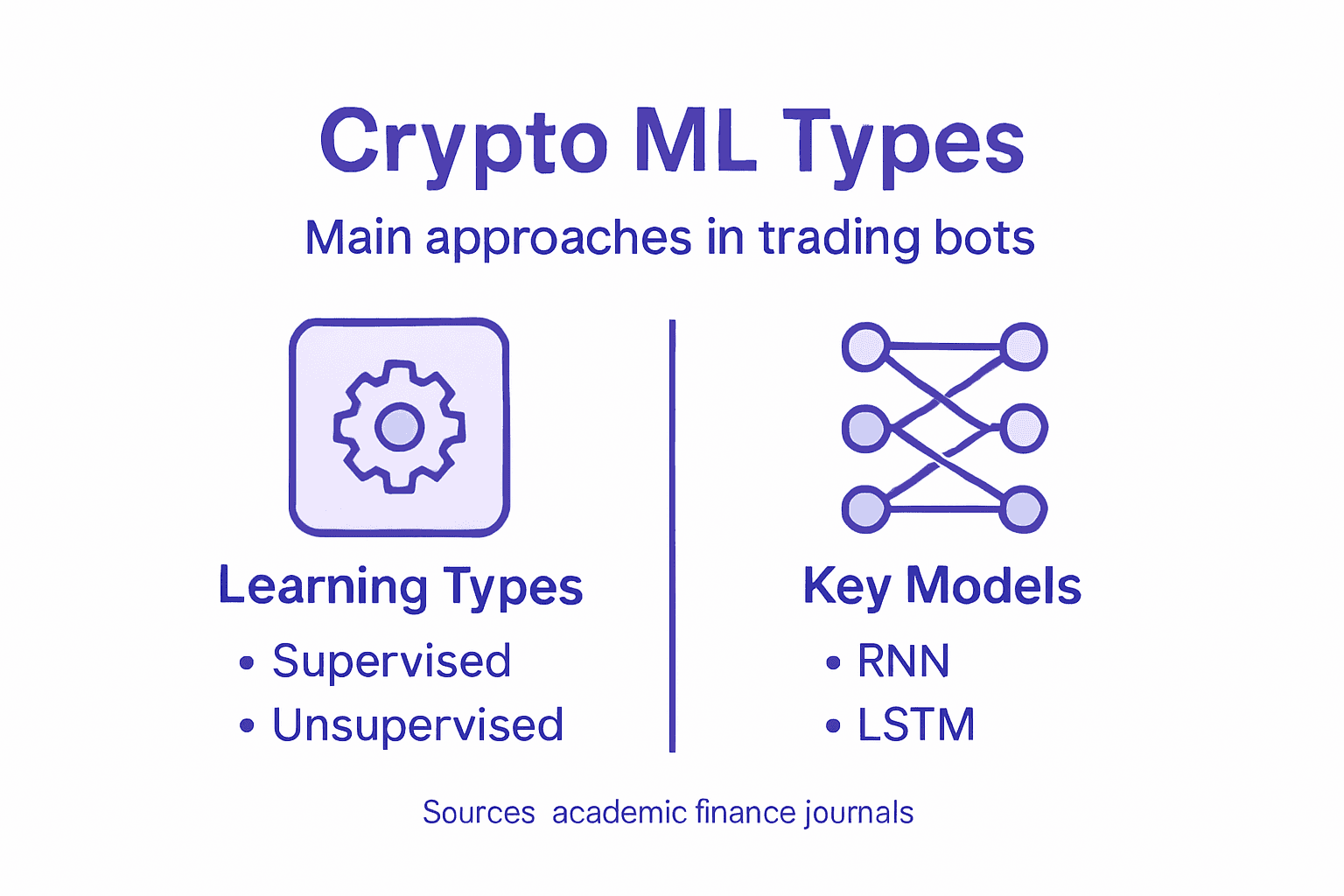
Deep learning approaches, particularly neural networks like Recurrent Neural Networks (RNNs) and Long Short-Term Memory (LSTM) networks, offer advanced capabilities for analyzing time-series cryptocurrency data. Advanced neural network architectures enable sophisticated market analysis by processing multiple complex variables simultaneously. These models excel at detecting intricate patterns across large datasets, capturing non-linear relationships that traditional statistical methods might miss, and adapting dynamically to changing market conditions.
Pro tip: Start by testing machine learning models on historical cryptocurrency data using small investment amounts to understand their predictive capabilities and potential limitations.
Here’s a comparison of key machine learning approaches used in cryptocurrency trading:
| Approach | Typical Use Case | Main Benefit | Notable Limitation |
|---|---|---|---|
| Supervised Learning | Predicting price movement | High accuracy with labeled data | Needs extensive historical data |
| Unsupervised Learning | Discovering hidden market clusters | Reveals unknown patterns | Results harder to interpret |
| Deep Learning | Analyzing time-series and trends | Captures complex relationships | Computationally intensive |
How Algorithmic Trading Bots Operate
Algorithmic trading bots represent sophisticated software systems designed to execute cryptocurrency trades automatically with minimal human intervention. Operational frameworks enable systematic trading strategies that leverage advanced computational techniques to monitor, analyze, and respond to market conditions in real time. These automated systems follow a structured process involving data collection, signal generation, risk assessment, and trade execution.
The core operational mechanism of trading bots involves multiple interconnected stages. First, the bot continuously aggregates market data from various cryptocurrency exchanges, collecting price information, trading volumes, order book dynamics, and relevant blockchain network signals. Machine learning algorithms then process this raw data, identifying potential trading opportunities by analyzing historical patterns, technical indicators, and emerging market trends. Advanced data preprocessing techniques support complex decision making through sophisticated feature engineering and predictive modeling.

Critical to bot functionality is the risk management and execution phase. Once a potential trade is identified, the algorithm evaluates multiple risk parameters, including potential loss thresholds, portfolio diversification, and market volatility. Successful bots implement strict stop-loss mechanisms and position sizing rules to protect investor capital. The final step involves API-based trade execution, where the bot automatically generates and submits trading orders to connected cryptocurrency exchanges, ensuring rapid and precise transaction implementation without emotional interference.
Pro tip: Always configure your trading bot with conservative risk parameters and start with small investment amounts to understand its actual performance characteristics.
Key Benefits and Challenges for Crypto Traders
Machine learning technologies offer cryptocurrency traders substantial advantages while simultaneously presenting complex challenges in modern digital asset markets. Advanced predictive models enhance trading capabilities by reducing emotional decision-making and providing data-driven insights that traditional trading approaches cannot match. The integration of sophisticated algorithms enables traders to process massive amounts of market information with unprecedented speed and accuracy.
Key benefits of machine learning in cryptocurrency trading include enhanced price prediction, automated risk management, and reduced human emotional interference. These systems can analyze multiple market indicators simultaneously, identifying potential trading opportunities that human traders might overlook. Sophisticated volatility forecasting techniques allow traders to develop more robust and adaptive trading strategies, potentially mitigating significant market risks through intelligent pattern recognition and predictive modeling.
However, machine learning approaches are not without significant challenges. Cryptocurrency markets present unique complexities, including extreme price volatility, limited historical data, and rapidly changing market dynamics. Machine learning models must continuously adapt to these unpredictable conditions, requiring constant refinement and sophisticated algorithmic design. Traders must remain vigilant about potential issues such as model overfitting, data quality limitations, and the computational resources required to maintain advanced trading systems.
Pro tip: Develop a comprehensive backtesting strategy that evaluates your machine learning trading model across multiple market conditions before committing significant capital.
The table below summarizes major benefits and challenges faced by crypto traders using machine learning:
| Benefit | Why It Matters | Challenge | Why Risk Exists |
|---|---|---|---|
| Automated risk management | Minimizes loss potential | Data quality issues | Poor data skews results |
| Enhanced price prediction | Informs smarter decisions | Extreme market volatility | Rapid changes confuse models |
| Reduced emotional bias | Improves trading discipline | Model overfitting | Incorrect predictions |
Security Risks, Legal Concerns, and Safe Practices
Cryptocurrency trading platforms and automated systems introduce complex security challenges that require comprehensive risk management strategies. Advanced security protocols mitigate potential vulnerabilities by addressing potential hacking attempts, data privacy breaches, and systemic algorithmic weaknesses. Investors and traders must understand these risks to protect their digital assets and maintain robust trading infrastructure.
The primary security risks in machine learning-driven cryptocurrency trading include potential vulnerabilities in trading bot architectures, API connection points, and data processing systems. Adversarial attacks can manipulate machine learning models by introducing subtle data variations designed to trick algorithmic decision-making processes. These sophisticated techniques might cause trading bots to execute suboptimal or potentially harmful transactions, compromising investment strategies and potentially exposing sensitive financial information.
Legal considerations surrounding cryptocurrency trading technologies remain complex and evolving across different global jurisdictions. Regulatory frameworks continue to develop, addressing concerns about model transparency, algorithmic accountability, and investor protection. Traders must remain vigilant about compliance requirements, understanding that machine learning trading systems must adhere to emerging legal standards that aim to prevent market manipulation, ensure data privacy, and maintain overall market integrity. Successful implementation requires continuous monitoring, adaptive risk management, and proactive engagement with regulatory developments.
Pro tip: Implement multi-factor authentication, use hardware security keys, and regularly update your trading bot’s security protocols to minimize potential vulnerabilities.
Optimize Your Crypto Trading with Smart Automation
Navigating the fast-paced and volatile cryptocurrency market requires tools built for precision and adaptability. This article highlights the challenges of managing risk, recognizing market patterns, and overcoming emotional biases through machine learning and algorithmic trading. Darkbot.io offers a powerful automated trading platform that leverages cutting-edge AI and machine learning to help you conquer these hurdles effortlessly. With seamless API integration across multiple exchanges, customizable strategies, and real-time analytics, you can automate your trades while maintaining full control and security.
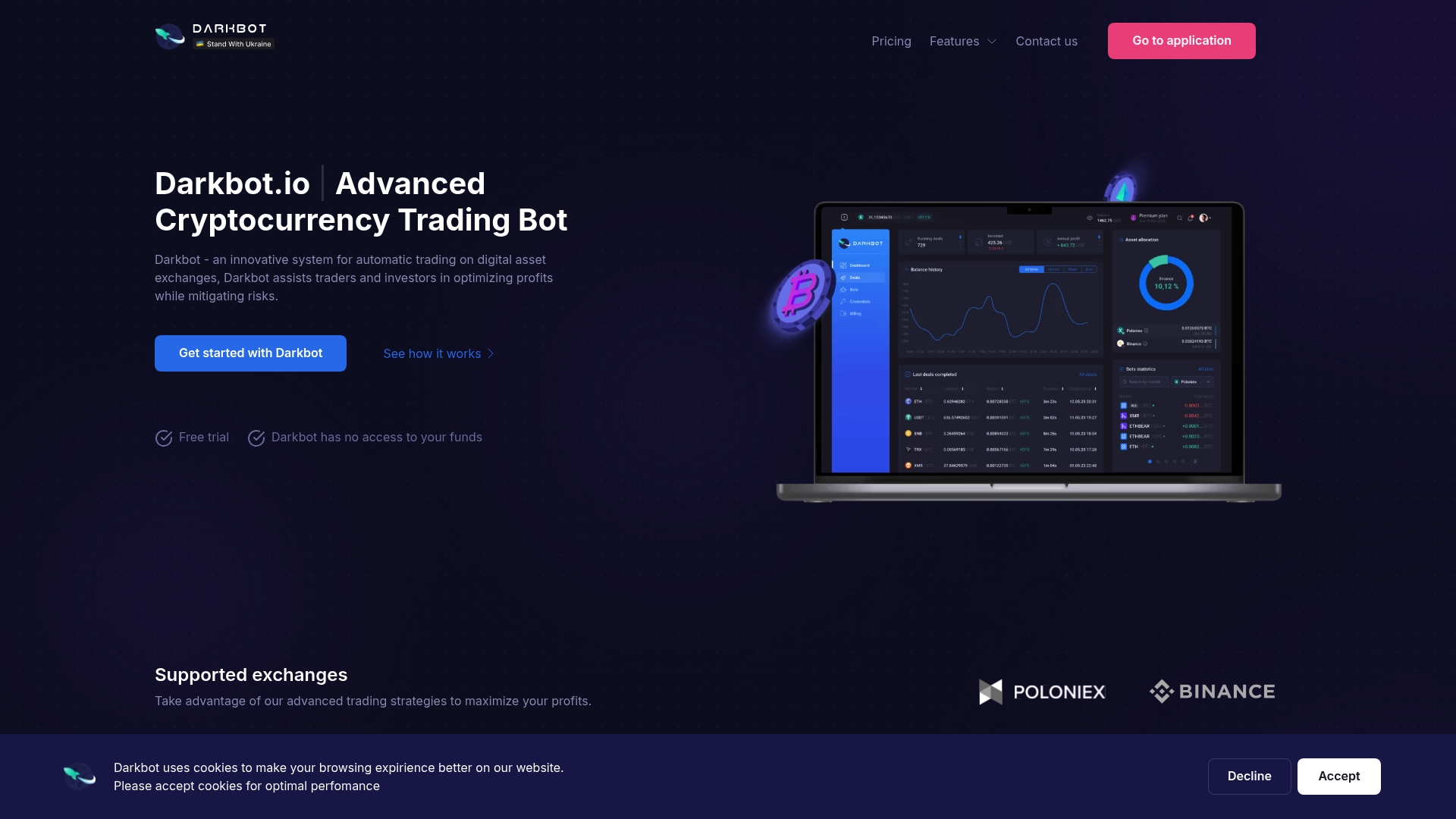
Experience the future of cryptocurrency trading today by harnessing the same principles of machine learning discussed here. Whether you are a novice or an experienced trader, start by customizing your approach on Darkbot.io, explore our strategy customization features, and take advantage of automated portfolio management to make smarter, faster trading decisions. Don’t wait for market opportunities to pass. Visit Darkbot.io now and take your crypto trading to the next level with confidence.
Frequently Asked Questions
What is machine learning in cryptocurrency trading?
Machine learning in cryptocurrency trading refers to the use of advanced algorithms and computational techniques to analyze financial data, recognize patterns, and predict market dynamics without being explicitly programmed for each scenario.
What types of machine learning approaches are commonly used in crypto trading?
Common machine learning approaches in crypto trading include supervised learning, unsupervised learning, and deep learning techniques. Supervised learning is often used for predicting price movements, while deep learning methods enhance the analysis of time-series data.
How do algorithmic trading bots work in cryptocurrency?
Algorithmic trading bots use automated systems to execute trades based on market data analysis. They continuously collect market information, identify trading opportunities through machine learning algorithms, and execute trades without emotional interference, following pre-defined risk management rules.
What are the key benefits and challenges of using machine learning in cryptocurrency trading?
The key benefits include enhanced price prediction, automated risk management, and reduced emotional bias. However, challenges such as data quality issues, market volatility, and the need for continuous model refinement also exist.
Recommended

Start trading on Darkbot with ease
Come and explore our crypto trading platform by connecting your free account!
Free plan available • No credit card required