Machine Learning in Trading 2025: Smarter Crypto Strategies
Managing risk and finding an edge in volatile cryptocurrency markets can challenge even the most experienced traders. As interest in automated crypto trading grows, understanding how machine learning transforms analysis and strategy becomes critical. This article explores what makes machine learning so powerful for crypto investors and professional traders, highlighting the leading models and techniques that deliver real-time insights and competitive advantages worldwide.
Key Takeaways
| Point | Details |
|---|---|
| Machine Learning Enhances Trading Efficiency | Advanced algorithms enable the analysis of vast datasets in real-time, identifying trading opportunities that human analysts may overlook. |
| Diverse Learning Strategies Improve Adaptability | Employing supervised, unsupervised, and reinforcement learning allows traders to develop responsive strategies suited for the volatile crypto market. |
| Automation Reduces Human Error | Strategy automation facilitates faster decision-making and removes emotional biases, leading to more consistent trading outcomes. |
| Risk Management Remains Critical | While machine learning offers powerful tools, traders must enforce rigorous security protocols and model validation to mitigate potential risks. |
Defining Machine Learning in Crypto Trading
Machine learning represents a sophisticated computational approach that enables trading systems to analyze complex financial data and adapt strategies dynamically in cryptocurrency markets. By leveraging advanced algorithms, these systems can process massive datasets far beyond human analytical capabilities, identifying nuanced patterns and potential trading opportunities.
The core mechanism of machine learning in crypto trading involves predictive modeling using historical market data. Advanced analytical techniques enable sophisticated models like neural networks and ensemble methods to extract meaningful signals from price movements, trading volumes, and market sentiment. These models continuously learn and refine their understanding, transforming raw data into actionable trading insights.
Machine learning approaches in cryptocurrency trading typically encompass three primary learning strategies: supervised learning (using labeled historical data), unsupervised learning (discovering hidden market patterns), and reinforcement learning (developing adaptive trading strategies through iterative decision making). Each approach offers unique capabilities for navigating the inherently volatile crypto ecosystem, allowing traders to develop more intelligent and responsive trading systems.
Here’s a quick comparison of primary machine learning strategies in crypto trading:
| Learning Strategy | Typical Use Case | Key Advantage | Limitation |
|---|---|---|---|
| Supervised Learning | Price prediction with labeled data | High accuracy | Needs large labeled dataset |
| Unsupervised Learning | Detecting market patterns | Reveals hidden trends | Can be difficult to validate |
| Reinforcement Learning | Adaptive trade optimization | Learns from feedback | Complex to implement |
Pro tip: Always validate machine learning models using rigorous backtesting and out-of-sample performance metrics to ensure genuine predictive reliability in real-world trading scenarios.
Popular ML Models and Approaches Today
Machine learning models in cryptocurrency trading represent sophisticated computational techniques designed to extract meaningful insights from complex market data. These advanced algorithms enable traders to develop more intelligent and adaptive strategies by processing massive datasets and identifying nuanced trading signals that traditional analysis methods might overlook.
Advanced machine learning models for crypto trading typically include powerful techniques such as Gradient Boosting, XGBoost, Support Vector Regression, and Long Short-Term Memory (LSTM) networks. Each model offers unique capabilities for addressing different aspects of market prediction and risk management. Gradient Boosting and XGBoost, for instance, excel at generating precise trading signals by combining multiple weak predictive models into a robust ensemble approach that can capture complex, non-linear market relationships.
The cryptocurrency trading landscape features several prominent machine learning approaches, including supervised learning models like Random Forest and Stochastic Gradient Descent, which leverage historical labeled data to predict future price movements. Unsupervised learning techniques help discover hidden market patterns, while reinforcement learning models dynamically adapt trading strategies based on continuous market feedback. These approaches enable traders to develop more sophisticated, data-driven decision-making frameworks that can quickly respond to the inherent volatility of cryptocurrency markets.
Pro tip: Regularly validate and retrain machine learning models using diverse datasets to maintain their predictive accuracy and adapt to evolving market conditions.
Core Applications: Prediction and Risk Control
Machine learning in cryptocurrency trading has revolutionized how investors approach market analysis, offering unprecedented capabilities in predicting price movements and managing complex financial risks. The integration of advanced computational techniques enables traders to develop more sophisticated and adaptive strategies that go beyond traditional market analysis methods.
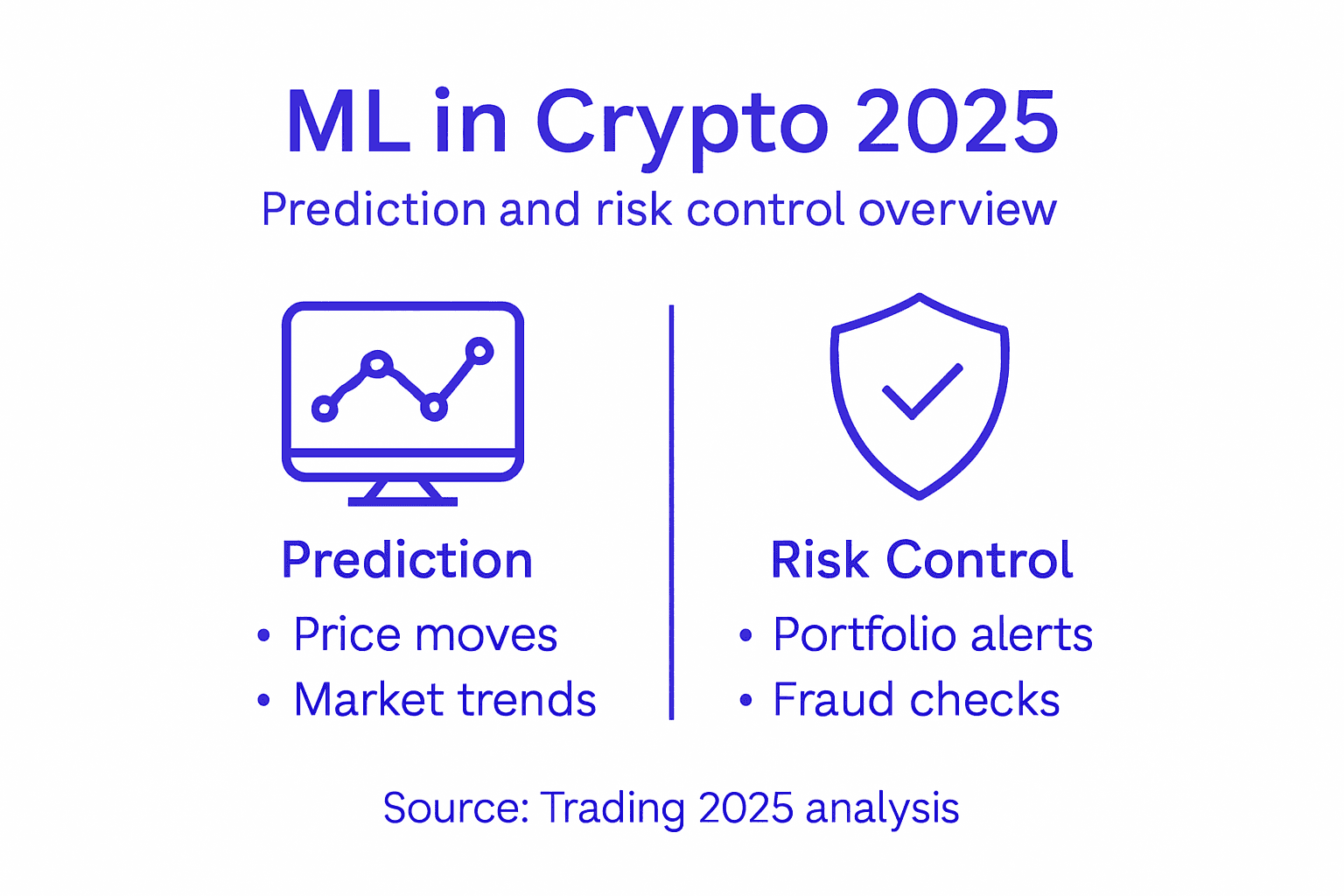
Reinforcement learning models have emerged as powerful tools for active cryptocurrency trading, demonstrating remarkable potential in reducing downside risk and generating more consistent investment returns. These intelligent systems utilize complex algorithms that continuously learn from market data, dynamically adjusting trading parameters to optimize performance and minimize potential losses. By analyzing multiple technical indicators, volume patterns, and historical price trends simultaneously, machine learning models can generate more nuanced and probabilistic trading signals.
The core applications of machine learning in crypto trading fundamentally transform risk management approaches. Advanced predictive models integrate technical analysis, sentiment evaluation, and probabilistic forecasting to create comprehensive risk assessment frameworks. These systems can rapidly process vast amounts of market data, identifying potential volatility clusters, detecting anomalous market behaviors, and providing traders with sophisticated risk mitigation strategies that traditional methods cannot match. The ability to continuously adapt and learn from new market information gives machine learning models a significant competitive advantage in the rapidly evolving cryptocurrency landscape.
Pro tip: Implement multiple machine learning models with diverse learning approaches to create a robust, cross-validated risk management strategy that can provide more reliable trading insights.
Strategy Automation and Real-Time Performance
Strategy automation represents a transformative approach in cryptocurrency trading, enabling investors to execute complex trading decisions with unprecedented speed and precision. By leveraging advanced machine learning technologies, traders can now design sophisticated systems that respond instantaneously to market conditions, removing emotional bias and human limitations from the trading process.
Trading strategy automation frameworks now enable continuous learning from market data streams, allowing dynamic portfolio adjustments in real-time. These intelligent systems continuously analyze multiple data points simultaneously, generating trading signals that adapt millisecond by millisecond to changing market dynamics. The core advantage lies in their ability to process exponentially more information than human traders, identifying subtle market patterns and executing trades with mathematical consistency.
Modern crypto trading automation platforms integrate multiple sophisticated technologies to optimize real-time performance. These systems combine predictive modeling, risk management algorithms, and adaptive learning techniques to create comprehensive trading solutions. By implementing confidence-threshold mechanisms, automated strategies can selectively execute trades only when prediction models demonstrate high-probability outcomes, significantly reducing potential losses and improving overall portfolio performance. The result is a more disciplined, data-driven approach to cryptocurrency investment that minimizes human error and maximizes strategic execution.
Pro tip: Develop multiple automated trading strategies with distinct risk profiles and correlation characteristics to create a more resilient and adaptive investment approach.
Risks, Security, and Common Pitfalls
Machine learning in cryptocurrency trading introduces complex technological challenges that demand rigorous risk management and security protocols. While these advanced systems promise enhanced trading capabilities, they simultaneously expose investors to sophisticated technological vulnerabilities that require comprehensive understanding and proactive mitigation strategies.
Machine learning trading risks encompass multiple critical dimensions, including potential model overfitting, data integrity challenges, and algorithmic bias. These risks can manifest through unexpected market behaviors, where predictive models fail to accurately interpret complex market dynamics or become vulnerable to adversarial manipulation. Sophisticated traders must recognize that machine learning models are not infallible prediction engines but probabilistic tools that require constant refinement and critical evaluation.
The cryptocurrency trading landscape presents unique security challenges that extend beyond traditional financial technology frameworks. Automated trading systems must implement robust safeguards against potential cybersecurity threats, including unauthorized API access, potential model poisoning, and unexpected algorithmic behavior during extreme market volatility. Advanced defense mechanisms like multi-factor authentication, encrypted communication protocols, and continuous model validation become essential for protecting both trading strategies and investor capital.
Pro tip: Implement a rigorous model validation process that includes regular stress testing, out-of-sample performance analysis, and systematic error tracking to identify potential vulnerabilities before they impact real trading performance.
Comparing Bot Solutions and Manual Trading
Automated trading bots have dramatically transformed cryptocurrency investment strategies, offering sophisticated computational capabilities that fundamentally challenge traditional manual trading approaches. These advanced systems leverage machine learning algorithms to process massive datasets and execute trades with precision that human traders simply cannot match.
Comparative trading analysis reveals significant performance differences between automated and manual trading methodologies. Machine learning-driven bots demonstrate superior data processing capabilities, executing trades with remarkable consistency and speed, while simultaneously managing complex risk parameters that would overwhelm manual traders. Unlike human investors constrained by emotional decision making and limited information processing, algorithmic systems can simultaneously analyze multiple market indicators, technical signals, and historical patterns.
The cryptocurrency trading ecosystem increasingly recognizes that bot solutions are not complete replacements for human judgment but powerful complementary tools. Manual trading still provides critical advantages in scenarios requiring nuanced interpretation of market sentiment, geopolitical events, and complex regulatory changes. Successful traders are learning to blend algorithmic precision with strategic human oversight, creating hybrid approaches that leverage the strengths of both technological automation and human intuition.
Below is a comparison of automated trading bots and manual trading approaches:
| Approach | Data Processing Ability | Performance Consistency | Unique Strength |
|---|---|---|---|
| Automated Bots | Massive, real-time analysis | Highly consistent | Executes complex strategies swiftly |
| Manual Trading | Limited, slower | Varies by individual | Interprets nuanced events and context |
Pro tip: Develop a balanced trading strategy that combines machine learning bot automation with periodic manual review to optimize performance and maintain adaptive market responsiveness.
Transform Your Crypto Trading with Advanced Machine Learning Automation
The article “Machine Learning in Trading 2025: Smarter Crypto Strategies” highlights the critical challenges traders face in navigating volatile cryptocurrency markets while managing risk and maximizing returns. You understand that leveraging supervised, unsupervised, and reinforcement learning models is essential for developing adaptive trading strategies that respond in real time. The complexity of implementing these sophisticated algorithms often becomes a barrier to success. This is where Darkbot.io steps in to bridge the gap by offering an intuitive platform that automates your trading strategies using cutting-edge AI and machine learning technologies. With features like seamless exchange integration via API keys, customizable strategies, and real-time analytics, you gain a powerful toolset to capitalize on emerging market patterns while controlling downside risk.
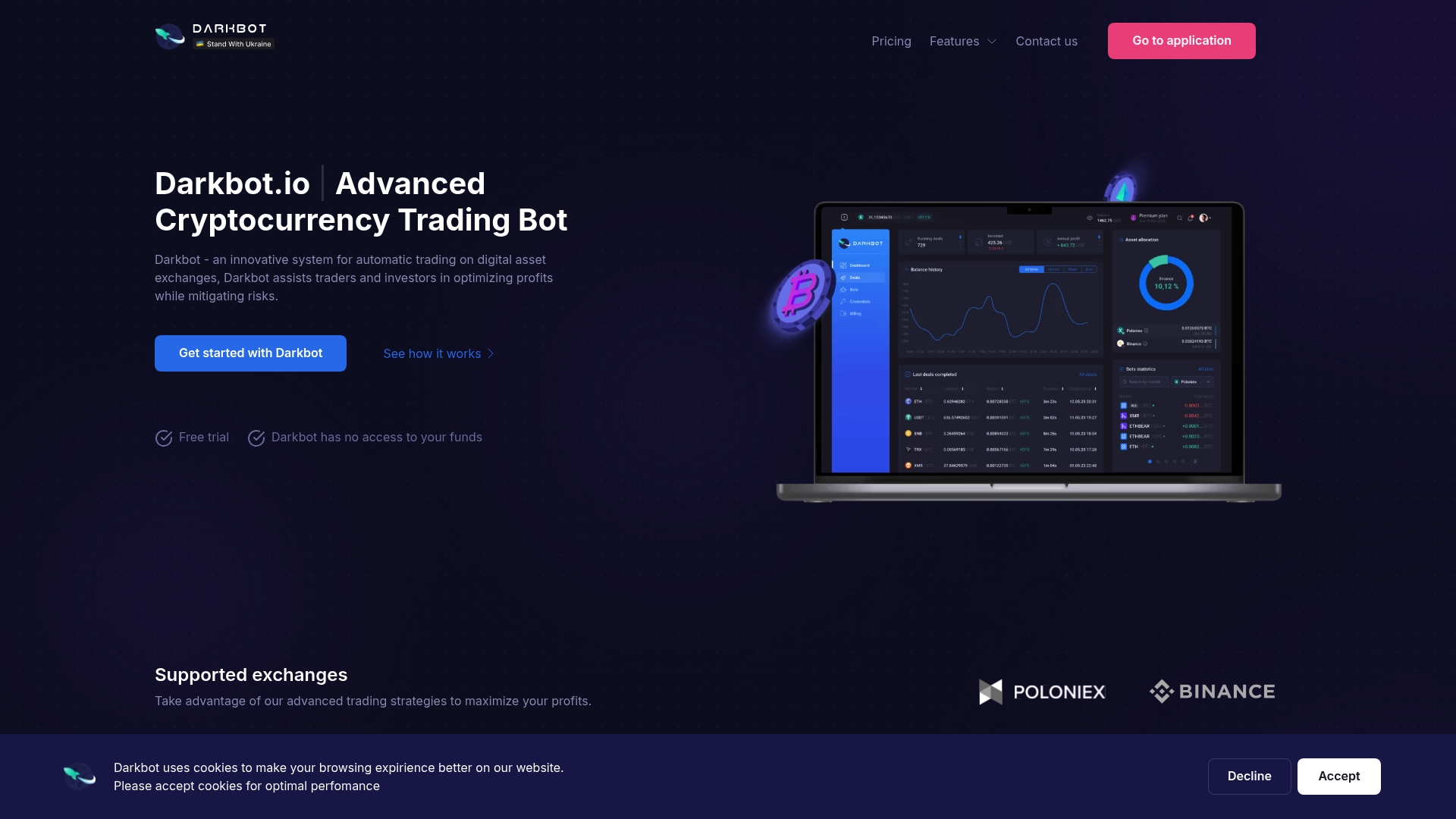
Stop letting manual effort and emotional bias hold you back. Experience the confidence of deploying multiple simultaneously running bots fine-tuned with proven machine learning models, all within a secure and dependable environment. Whether you are a novice seeking simplicity or an experienced trader demanding precise control, visit Darkbot.io now to start automating smarter crypto trading decisions. Enhance your portfolio management and risk mitigation today by exploring our advanced trading bot solutions and see how algorithmic automation delivers consistent, data-driven performance.
Frequently Asked Questions
What is machine learning in crypto trading?
Machine learning in crypto trading refers to the use of advanced algorithms to analyze complex financial data, identify patterns, and adapt trading strategies to dynamic market conditions, enabling more optimized decision-making.
How do different machine learning strategies apply in cryptocurrency trading?
In cryptocurrency trading, there are three main strategies: supervised learning uses labeled data for price predictions; unsupervised learning discovers hidden market patterns; and reinforcement learning develops adaptive trading strategies by learning from market feedback.
What are the popular machine learning models used in crypto trading today?
Some popular machine learning models in crypto trading include Gradient Boosting, XGBoost, Support Vector Regression, and Long Short-Term Memory (LSTM) networks, each offering unique advantages in addressing market prediction and risk management.
What risks are associated with using machine learning in trading?
Risks associated with using machine learning in trading include model overfitting, data integrity challenges, algorithmic bias, and vulnerabilities to cybersecurity threats, which require robust risk management and continuous model validation.
Recommended

Start trading on Darkbot with ease
Come and explore our crypto trading platform by connecting your free account!
Free plan available • No credit card required