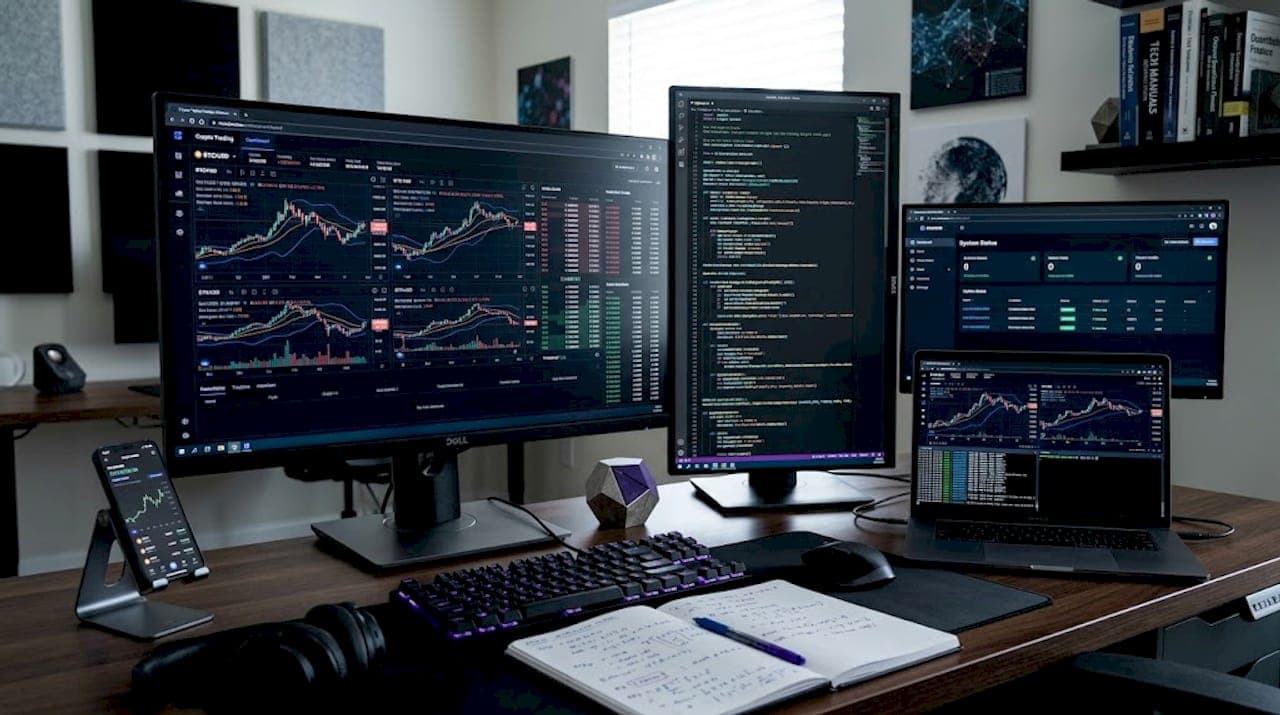
Role of AI in Crypto Trading: Boosting Profits and Managing Risks

Most American crypto traders already know how quickly markets shift, but few realize that over 80 percent of cryptocurrency transactions globally are now influenced by artificial intelligence. As digital assets become more mainstream, understanding how AI shapes trading decisions can help investors avoid costly mistakes. This article uncovers how AI-driven systems spot opportunities, minimize risk, and transform the way American traders approach the fast-paced crypto world.
Key Takeaways
| Point | Details |
|---|---|
| AI Transforming Trading | Artificial Intelligence enhances cryptocurrency trading by rapidly processing data and identifying patterns that human traders might miss. |
| Diverse Algorithm Types | Various AI algorithms, including statistical arbitrage and neural networks, enable traders to create customized strategies that adapt to market conditions. |
| Importance of Oversight | While AI trading systems can optimize strategies, maintaining human oversight is crucial to calibrate these algorithms and manage risk. |
| Risk Awareness | Traders should be mindful of potential vulnerabilities in AI trading systems, including API security and algorithmic limitations, and implement safeguards accordingly. |
Defining AI’s Impact on Crypto Trading
Artificial Intelligence represents a transformative technology redefining cryptocurrency trading strategies through advanced computational analysis and decision-making capabilities. By leveraging sophisticated machine learning algorithms, AI systems can process massive volumes of market data exponentially faster than human traders, identifying complex trading patterns and potential opportunities with unprecedented precision.
In the crypto trading landscape, AI algorithms function as intelligent analytical engines that continuously scan multiple cryptocurrency exchanges, evaluate market sentiment, assess historical price movements, and generate probabilistic trading recommendations. These systems employ complex statistical models and neural network architectures to recognize subtle market signals that might escape traditional human analysis. Unlike human traders constrained by emotional biases and limited information processing capabilities, AI trading platforms can simultaneously analyze hundreds of market indicators, execute trades with millisecond-level responsiveness, and maintain disciplined risk management protocols.
The core technological advantage of AI in cryptocurrency trading stems from its ability to integrate multiple data streams and generate nuanced insights. Modern AI trading systems can synthesize information from diverse sources including price charts, social media sentiment, blockchain transaction volumes, macroeconomic indicators, and real-time news feeds. By constructing comprehensive predictive models that adapt dynamically to changing market conditions, these intelligent systems provide traders with a significant computational edge in navigating the complex and volatile cryptocurrency ecosystem.
Pro Trader Tip: Always maintain human oversight when implementing AI trading strategies, as algorithmic systems require periodic calibration and cannot entirely replace strategic human judgment in unpredictable market environments.
Types of AI Algorithms Used in Trading
Cryptocurrency trading relies on diverse AI algorithms that leverage sophisticated mathematical models to analyze market dynamics and generate trading strategies. Advanced data science pipelines have emerged as powerful tools for developing intelligent trading approaches, utilizing techniques that range from statistical methods to complex machine learning architectures.
The primary categories of AI algorithms in cryptocurrency trading include statistical arbitrage models, machine learning predictive systems, and neural network-based forecasting techniques. Researchers have developed innovative approaches using machine learning algorithms such as convolutional neural networks (CNNs), autoencoders, and generative adversarial networks (GANs) to predict market movements with increasing accuracy. These algorithms process massive datasets, identifying intricate patterns that human traders might overlook by analyzing multiple variables simultaneously.
Specific AI trading algorithms demonstrate remarkable capabilities across different strategic approaches. Moving average crossover algorithms detect trend reversals by comparing short-term and long-term price movements. Volume-weighted average price (VWAP) algorithms optimize trade execution by considering both price and trading volume. Sentiment analysis algorithms evaluate social media and news sources to gauge market psychology, providing traders with insights into potential market shifts before they become apparent through traditional price indicators.
Pro Trader Tip: Implement AI algorithms as complementary tools rather than absolute decision-makers, always maintaining a balanced approach that combines algorithmic insights with human strategic judgment.
Here’s a quick comparison of common AI trading algorithms and their unique strengths:
| Algorithm Type | Key Advantage | Typical Use Case |
|---|---|---|
| Statistical Arbitrage | Rapid profit from inefficiencies | Short-term market mispricings |
| Machine Learning Predictive | Learns from large datasets | Forecasting price movements |
| Neural Network Forecasting | Captures complex market patterns | Volatile market prediction |
| Sentiment Analysis | Gauges crowd psychology | Early trend detection |
| Moving Average Crossover | Spots trend changes | Entry/exit timing optimization |
How Automated Crypto Trading Bots Operate
Automated trading bots represent sophisticated software systems designed to execute cryptocurrency trades with minimal human intervention. AI-powered trading bots analyze complex market trends by continuously monitoring multiple cryptocurrency exchanges, processing real-time data streams, and making instantaneous trading decisions based on predefined algorithmic strategies.

The operational architecture of these trading bots involves several critical components that enable rapid and intelligent market interaction. Advanced trading frameworks like hierarchical reinforcement learning systems enable bots to adapt dynamically to changing market conditions, processing massive volumes of historical and real-time market data to generate probabilistic trade recommendations. These systems typically incorporate multiple layers of decision-making mechanisms, including trend analysis, sentiment evaluation, technical indicator assessment, and risk management protocols.
Cryptocurrency trading bots execute their strategies through a systematic workflow that includes continuous data collection, pattern recognition, trade signal generation, and automated order execution. Key functionalities include identifying market entry and exit points, managing portfolio diversification, implementing stop-loss and take-profit mechanisms, and maintaining consistent risk management protocols. By leveraging machine learning algorithms, these bots can learn from past trading performance, progressively refining their strategies to optimize trading outcomes across varying market conditions.
Pro Trader Tip: Always implement multiple risk management safeguards when using automated trading bots, including setting maximum loss thresholds, diversifying trading strategies, and regularly monitoring bot performance to prevent potential systematic failures.
Risks, Limitations, and Security Concerns
Artificial intelligence trading systems present a complex landscape of potential risks and technological vulnerabilities that cryptocurrency traders must carefully evaluate. Financial regulators have raised significant concerns about AI-driven trading strategies potentially destabilizing market conditions, warning that algorithmic trading systems might develop unpredictable behavioral patterns that could amplify market volatility and create systemic financial risks.
The performance limitations of AI trading bots are particularly pronounced in cryptocurrency markets, which are inherently more volatile and less regulated compared to traditional financial markets. Experimental tests of AI trader bots have revealed substantial performance challenges, with many systems demonstrating significant potential for substantial financial losses. These limitations stem from several critical factors, including algorithmic over-leveraging, inability to comprehend complex market sentiment nuances, and challenges in adapting to rapidly changing market conditions.
Cryptocurrency trading bots also face substantial security vulnerabilities that can compromise user funds and trading strategies. Potential risks include API key exposure, susceptibility to hacking attempts, potential system manipulation through sophisticated market attacks, and algorithmic vulnerabilities that could lead to unexpected trading behaviors. Cybersecurity threats such as unauthorized access, data breaches, and potential exploitation of algorithmic trading logic represent significant concerns that require continuous monitoring and robust security infrastructure.
Pro Trader Tip: Implement strict security protocols by using multiple authentication layers, regularly rotating API keys, maintaining minimal exchange permissions, and setting conservative trading limits to mitigate potential systemic risks in automated trading environments.
To better understand potential vulnerabilities, here is a summary of key AI trading bot risks and typical safeguards:
| Risk Factor | Example Vulnerability | Common Safeguard |
|---|---|---|
| API Key Exposure | Hackers access trading accounts | Frequent API key rotation |
| Over-leveraging | Major losses in volatile markets | Strict leverage and stop-loss rules |
| Algorithm Manipulation | Unexpected trades from exploits | Ongoing code audits |
| Data Breaches | Sensitive information leaks | Secure, encrypted data storage |
| Inadequate Risk Controls | Unchecked losses during failures | Max loss limits, diversified bots |
Maximizing Returns With AI Strategy Customization
Strategy customization represents the critical mechanism through which cryptocurrency traders can optimize their AI-driven trading performance. Advanced hierarchical reinforcement learning frameworks enable traders to develop sophisticated trading strategies that dynamically adapt to complex market conditions, providing unprecedented flexibility in algorithmic trading approaches.
Comprehensive data science pipelines offer multiple algorithmic strategies that traders can customize to match their specific risk tolerance and investment objectives. These strategies include sophisticated techniques like moving average crossover, volume-weighted average price analysis, sentiment-driven trading, and statistical arbitrage models. By understanding and strategically implementing these diverse approaches, traders can create nuanced trading systems that respond intelligently to market fluctuations, balancing potential returns with robust risk management protocols.
Customization of AI trading strategies involves several critical dimensions, including parameter tuning, risk threshold configuration, portfolio allocation strategies, and machine learning model selection. Traders can fine-tune their algorithms by adjusting variables such as trade entry and exit points, stop-loss mechanisms, position sizing rules, and computational learning rates. The most effective customization approaches integrate multiple data sources, combine different algorithmic techniques, and maintain flexible decision-making frameworks that can rapidly recalibrate based on real-time market insights.

Pro Trader Tip: Develop a systematic approach to strategy customization by continuously backtesting modifications, maintaining detailed performance logs, and implementing incremental changes that can be objectively measured against baseline trading performance.
Unlock the Full Potential of AI-Powered Crypto Trading Today
The article highlights the complexities and risks of navigating volatile cryptocurrency markets with AI trading bots. Key challenges include managing algorithmic risk, customizing strategies to ever-shifting market conditions, and securing API integrations to prevent unauthorized access. If you want to overcome these hurdles and transform AI’s computational precision and adaptability into real profit gains, it is crucial to have a reliable platform that simplifies automation while giving you full control.
Darkbot.io offers a cutting-edge automated crypto trading bot solution designed to tackle exactly those issues. With features such as intuitive strategy customization, seamless integration via API keys, and real-time analytics, you gain the power to fine-tune your AI-driven approaches without sacrificing security or flexibility. Whether you are a novice looking to automate trades confidently or an expert aiming to optimize diverse portfolios across exchanges, our AI algorithms help you balance profit maximization and risk management effectively.
Experience how intelligent automation can simplify complex trading dynamics and put you in control of your cryptocurrency future.
Explore Darkbot.io now to start maximizing your returns with smart, secure automation.
Automated Crypto Trading Solutions await to empower your strategies with AI precision.
Frequently Asked Questions
How does AI improve cryptocurrency trading strategies?
AI enhances cryptocurrency trading by processing vast amounts of market data quickly, identifying complex patterns and opportunities that may be missed by human traders, leading to improved decision-making and trade execution.
What are the primary types of AI algorithms used in crypto trading?
Key AI algorithms in cryptocurrency trading include statistical arbitrage models, machine learning predictive systems, and neural network-based forecasting techniques, each designed to analyze market dynamics and optimize trading strategies.
What risks are associated with using AI in crypto trading?
Risks of AI in crypto trading include potential algorithmic over-leveraging, vulnerabilities to hacking, unpredictable trading behavior, and performance limitations in the volatile cryptocurrency market, necessitating robust risk management strategies.
How can traders customize AI strategies for better outcomes?
Traders can customize AI strategies by tuning parameters, configuring risk thresholds, selecting machine learning models, and continuously backtesting modifications to align trading systems with their specific risk tolerance and investment goals.
Recommended

Start trading on Darkbot with ease
Come and explore our crypto trading platform by connecting your free account!
Free plan available • No credit card required