Role of AI in Cryptocurrency Trading Success

Sharp price swings can wipe out entire profits in minutes, especially for traders in high-inflation economies where managing volatility becomes a daily challenge. With over $1 trillion in digital assets traded globally each day, tech-savvy investors know that traditional approaches often fall short. Whether you are a seasoned American or navigating markets abroad, this guide explores how artificial intelligence offers adaptive, automated solutions to help you trade smarter, minimize risk, and efficiently protect gains even when you cannot watch the charts nonstop.
Key Takeaways
| Point | Details |
|---|---|
| AI Transforms Trading | AI enhances cryptocurrency trading through advanced algorithms that analyze complex market data to improve decision-making. |
| Diverse AI Strategies | Key AI strategies include Supervised, Reinforcement, and Unsupervised Learning, each offering unique advantages in market analysis and prediction. |
| Risk Management Optimization | AI tools provide real-time risk assessment and adaptive strategies, helping traders navigate high market volatility effectively. |
| Challenges in Implementation | AI traders face significant challenges such as data quality issues, regulatory uncertainty, and lack of transparency, which require careful mitigation approaches. |
Defining AI in Cryptocurrency Trading
Artificial Intelligence (AI) in cryptocurrency trading represents a sophisticated technological approach that transforms traditional market analysis and decision-making processes. By leveraging advanced machine learning algorithms and predictive models, AI enables traders to process massive amounts of complex market data with unprecedented speed and accuracy. The core objective is to develop intelligent systems that can analyze historical price movements, market sentiment, and trading patterns to generate strategic insights.
AI trading systems utilize multiple computational techniques to enhance cryptocurrency investment strategies. Systematic reviews have demonstrated that machine learning models like Long Short-Term Memory networks (LSTMs), Convolutional Neural Networks (CNNs), and Transformer architectures can effectively predict market trends and automate trading decisions. These models can simultaneously process diverse data inputs including historical price charts, social media sentiment, trading volume, and macroeconomic indicators to generate nuanced trading recommendations.
The primary mechanisms of AI in cryptocurrency trading involve sophisticated pattern recognition, risk management, and adaptive strategy development. Machine learning algorithms continuously learn from market data, identifying complex relationships that human traders might overlook. This enables the creation of dynamic trading strategies that can adjust in real-time to changing market conditions. Unlike traditional rule-based systems, AI-driven approaches can develop increasingly refined decision-making processes that evolve with market complexity.
Pro Tip: When exploring AI trading solutions, prioritize platforms that offer transparent algorithm performance metrics and allow customizable risk management parameters to align with your personal investment strategy.
Types of AI Strategies in Crypto Markets
Artificial Intelligence strategies in cryptocurrency markets represent a sophisticated array of computational approaches designed to analyze, predict, and execute trading decisions. Advanced research surveys have identified multiple AI methodologies that transform traditional trading paradigms, enabling more dynamic and intelligent market interactions. These strategies leverage complex machine learning algorithms to process vast amounts of financial data and generate nuanced trading recommendations.
The primary AI strategies in cryptocurrency markets can be categorized into several distinct approaches. Supervised Learning models utilize historical price data to train predictive algorithms, enabling traders to forecast potential market movements based on established patterns. Reinforcement Learning strategies create adaptive trading systems that continuously optimize decision-making processes by learning from previous market interactions and adjusting strategies in real-time. Unsupervised Learning techniques focus on discovering hidden market patterns and clustering trading behaviors without predefined outcomes, offering unique insights into market dynamics.
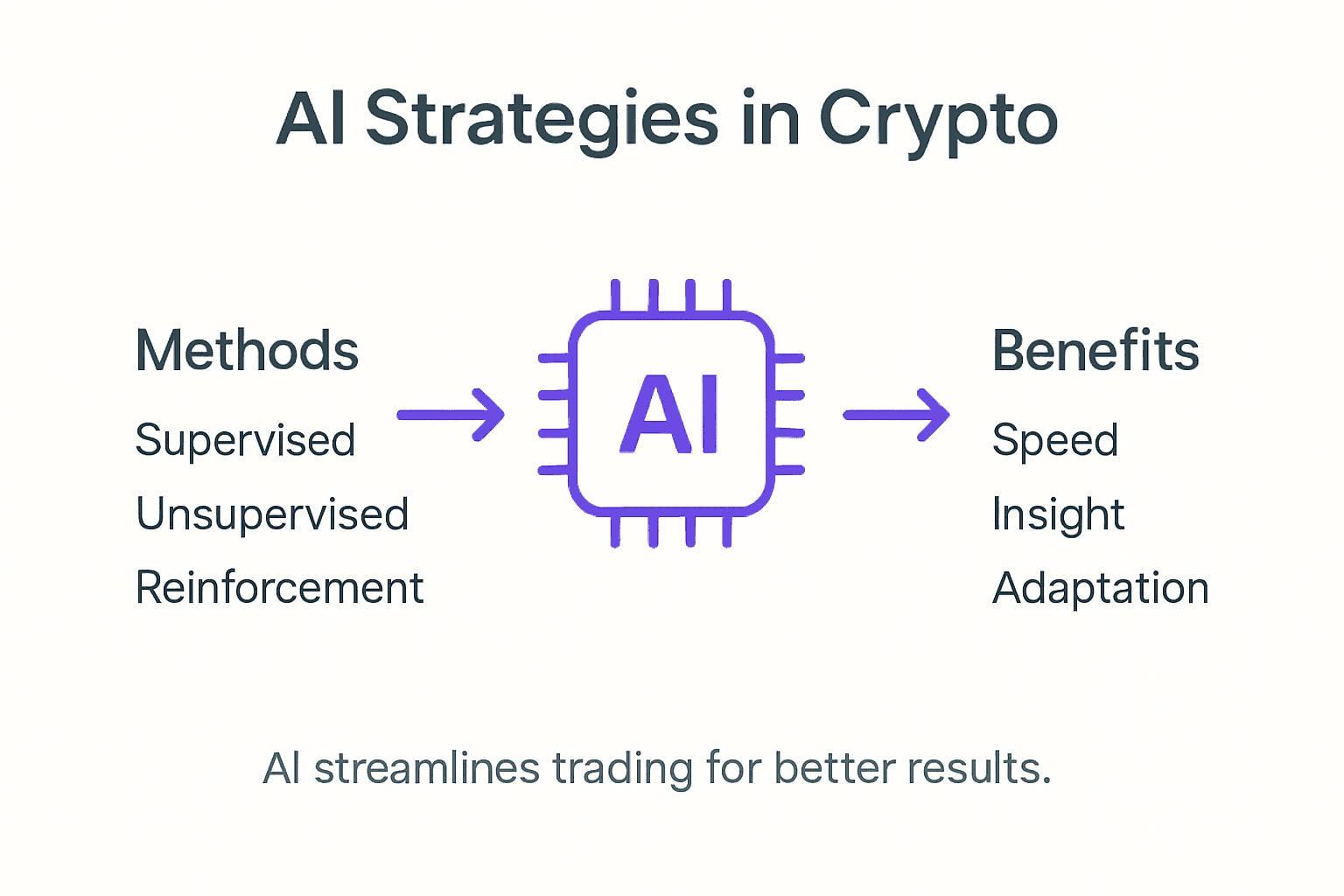
Moreover, AI strategies in crypto markets extend beyond simple price prediction. Advanced approaches integrate multiple data sources including social media sentiment, blockchain transaction records, macroeconomic indicators, and real-time market news to develop comprehensive trading frameworks. These sophisticated models can simultaneously analyze complex, multidimensional datasets, identifying subtle correlations and potential market opportunities that traditional analytical methods might overlook. By combining computational power with adaptive learning algorithms, AI strategies provide traders with increasingly refined tools for navigating the volatile cryptocurrency ecosystem.
Here’s how common AI strategies in crypto compare:
| Strategy Type | Core Method | Main Advantage |
|---|---|---|
| Supervised Learning | Historical data training | Accurate trend forecasting |
| Reinforcement Learning | Trial and feedback | Adapts to new market events |
| Unsupervised Learning | Pattern discovery | Reveals hidden market insights |
Pro Tip: When exploring AI trading strategies, prioritize platforms that offer transparent performance metrics and allow granular customization of risk management parameters to align with your specific investment goals.
How AI Enhances Automated Trading Systems
Artificial Intelligence has fundamentally transformed automated trading systems by introducing unprecedented levels of computational sophistication and adaptive decision-making capabilities. Advanced research demonstrates that AI algorithms can autonomously analyze real-time data streams, execute complex trading strategies, and optimize portfolio management with remarkable precision. These intelligent systems go beyond traditional rule-based approaches, dynamically adjusting to market fluctuations and identifying opportunities that human traders might overlook.

The core enhancement AI brings to automated trading systems involves multiple sophisticated mechanisms. Neural Architecture Search enables trading algorithms to continuously refine their own computational structures, allowing for more intelligent and adaptive decision-making processes. Ensemble Methods combine multiple machine learning models to create more robust predictive frameworks, reducing individual model biases and improving overall trading performance. These techniques allow automated systems to process complex multidimensional datasets, integrating diverse information sources like market sentiment, blockchain transaction records, and macroeconomic indicators to generate nuanced trading insights.
Moreover, AI-enhanced automated trading systems excel in risk management and strategy optimization. By employing advanced machine learning techniques, these systems can develop probabilistic models that assess potential market scenarios, calculate potential risks, and dynamically adjust trading parameters in milliseconds. This level of computational intelligence enables traders to implement more sophisticated hedging strategies, manage portfolio volatility, and execute trades with significantly reduced human error. The result is a more systematic, disciplined approach to cryptocurrency trading that leverages computational power to make more informed and timely investment decisions.
Pro Tip: When implementing AI-driven automated trading systems, prioritize platforms offering transparent algorithmic performance metrics and comprehensive risk management customization options.
Managing Volatility and Risk With AI Tools
Cryptocurrency markets are characterized by extreme volatility, presenting unique challenges for traders seeking consistent investment strategies. Advanced machine learning models now offer sophisticated risk analysis tools that transform how investors approach market unpredictability, enabling more intelligent and adaptive investment decision-making. These AI-powered systems analyze complex, multidimensional datasets to provide nuanced insights into potential market fluctuations and risk factors, significantly enhancing portfolio management capabilities.
The primary mechanisms of AI risk management involve developing Predictive Volatility Models that continuously assess market conditions through real-time data processing. These intelligent systems integrate diverse data sources including blockchain transaction records, social media sentiment, trading volume patterns, and macroeconomic indicators to create comprehensive risk assessments. By employing advanced machine learning techniques like ensemble methods and neural networks, AI tools can forecast potential short-term volatility spikes with unprecedented accuracy, allowing traders to dynamically adjust their investment exposure and implement proactive risk mitigation strategies.
Moreover, AI-driven risk management transcends traditional static analytical approaches by introducing adaptive learning capabilities. The algorithms continuously refine their predictive models based on new market data, learning from historical trading patterns and emerging market dynamics. This means that risk assessment becomes a dynamic, evolving process rather than a fixed calculation. Traders can leverage these intelligent systems to implement sophisticated hedging techniques, automatically rebalance portfolios, and execute trades that minimize potential losses while optimizing potential returns in the inherently unpredictable cryptocurrency ecosystem.
Pro Tip: Implement AI risk management tools that offer granular customization options and provide transparent performance tracking to effectively navigate cryptocurrency market volatility.
Challenges and Limitations for AI Traders
Cryptocurrency trading powered by artificial intelligence, while promising significant technological advantages, confronts numerous complex challenges that limit its comprehensive implementation. Comprehensive surveys of AI integration reveal critical barriers including scalability constraints, regulatory compliance difficulties, and significant technological interoperability issues. These limitations underscore the critical need for nuanced understanding and strategic approach when deploying AI trading systems in the volatile cryptocurrency ecosystem.
The primary technical challenges for AI traders emerge from fundamental data and algorithmic constraints. Data Quality Dependency represents a significant obstacle, where AI systems are inherently limited by the accuracy, completeness, and timeliness of their input data sources. Machine learning models can become susceptible to Overfitting, where algorithms develop strategies that perform exceptionally well on historical data but fail to generalize effectively in dynamic, unpredictable market conditions. Additionally, cryptocurrency markets present unique vulnerabilities, including potential manipulation through coordinated trading activities or deliberate misinformation campaigns that can mislead AI decision-making processes.
Furthermore, ethical and governance challenges pose substantial risks to widespread AI trader adoption. Regulatory frameworks surrounding cryptocurrency and algorithmic trading remain fragmented and rapidly evolving, creating substantial compliance uncertainties. Transparency becomes a critical concern, as complex machine learning models often operate as complex “black boxes” where decision-making processes are not easily interpretable by human traders. This lack of explainability can create significant trust barriers and potential legal complications, especially when automated systems execute high-stakes trading decisions without clear, auditable reasoning mechanisms.
Key challenges faced by AI-powered crypto trading systems:
| Challenge | Business Impact | Mitigation Approach |
|---|---|---|
| Data Quality Issues | Unreliable predictions, increased losses | Use trusted data sources |
| Overfitting Risks | Poor generalization in live trading | Regular backtesting |
| Regulatory Uncertainty | Potential non-compliance and legal challenges | Monitor legal changes |
| Lack of Transparency | Hinders trust and accountability | Enhance model explainability |
Pro Tip: Implement rigorous backtesting protocols and maintain human oversight to effectively mitigate potential AI trading system limitations and unexpected behavioral patterns.
Harness AI for Smarter Cryptocurrency Trading Success
The article highlights how AI transforms cryptocurrency trading with sophisticated strategies like supervised and reinforcement learning, dynamic risk management, and automated decision-making. If you are facing challenges such as market volatility, data complexity, or the need for adaptive trading systems, these insights reveal how AI can help you gain a competitive edge while managing risks efficiently. Darkbot.io is your gateway to deploying these cutting-edge AI strategies through an advanced automated trading bot designed for both novices and experts.
Take control of your crypto portfolio today by leveraging AI-driven automation that fine-tunes strategies in real time, integrates seamlessly with multiple exchanges, and offers customizable risk parameters. Visit Darkbot.io now to experience an intuitive platform built for maximizing profits and minimizing losses amidst crypto market fluctuations. Discover flexible plans and personalized support to simplify your trading and move confidently toward success at Darkbot.io. Begin automating your investment strategy with reliable AI tools designed to keep you ahead of the market volatility.
Frequently Asked Questions
What is the role of AI in cryptocurrency trading?
AI enhances cryptocurrency trading by analyzing vast amounts of market data quickly and accurately, enabling traders to derive strategic insights, optimize trading strategies, and manage risk more effectively.
How do AI strategies improve trading predictions in cryptocurrency markets?
AI strategies, such as supervised learning and reinforcement learning, utilize historical data and adaptive learning techniques to improve the accuracy of market predictions and adjust to real-time market conditions.
What challenges do AI traders face in cryptocurrency trading?
AI traders encounter challenges such as data quality issues, the risk of overfitting models, regulatory uncertainties, and a lack of transparency in AI decision-making processes, which can affect trading outcomes.
How can AI tools aid in managing volatility in cryptocurrency markets?
AI tools can provide predictive volatility models that assess market conditions, allowing traders to dynamically adjust their investment exposure, implement strategic hedging, and minimize potential losses during market fluctuations.
Recommended

Start trading on Darkbot with ease
Come and explore our crypto trading platform by connecting your free account!
Free plan available • No credit card required