Why Use Trading Bots for Hedge Funds’ Growth
Every crypto hedge fund faces the pressure of millisecond decisions as markets swing across global exchanges. In this environment, automated trading bots have proven indispensable for executing complex strategies and maintaining discipline amid volatility. Unlike manual trading, these systems harness AI-powered algorithms to process massive datasets, react to market shifts in real time, and enforce strict risk controls beyond the limits of human performance. Explore how these tools anchor modern fund operations by delivering unmatched consistency and scalability.
Key Takeaways
| Point | Details |
|---|---|
| Automation Enhances Efficiency | Trading bots execute strategies without emotional biases, resulting in faster and more precise trading decisions. This can lead to significant gains in performance for hedge funds. |
| Integrated Approach is Optimal | A hybrid model combining automation and human oversight maximizes strengths from both, enabling nuanced decision-making alongside consistency in execution. |
| Rigorous Risk Management is Crucial | Automated systems must be paired with strong risk management frameworks to mitigate the potential operational risks introduced by automation. |
| Careful Bot Selection Matters | Different trading bots serve specific functions; understanding their strengths allows funds to allocate capital effectively and minimize concentration risks. |
Automated Trading Bots In Hedge Funds Explained
Automated trading bots have become core infrastructure for hedge funds managing complex portfolios across volatile crypto markets. These systems function as disciplined execution engines that operate independently of emotional decision-making, processing massive data streams and executing trades at speeds impossible for human traders. Unlike traditional retail trading tools, hedge fund implementations rely on AI-powered algorithms that analyze complex datasets to optimize strategy execution, adapt to market conditions in real-time, and maintain consistent position management across multiple exchanges simultaneously. Leading quantitative funds like Renaissance Technologies and Two Sigma have demonstrated the effectiveness of this approach, leveraging systematic trading models to achieve superior risk-adjusted returns.
At their core, these bots execute repeatable trading logic without intervention. They monitor market conditions continuously, identify opportunities aligned with predetermined parameters, and execute positions at optimal prices. The practical advantage extends beyond speed alone. Hedge funds operate in environments where millisecond delays compound into missed opportunities, regulatory compliance requires perfect audit trails, and portfolio drift from target allocations costs basis points daily. Bots handle high-frequency trading, statistical arbitrage, market making, and trend following with mechanical consistency that human operators cannot maintain across global markets operating across multiple time zones. They eliminate behavioral bias by following pre-established rules rather than reacting to price action or market noise.
The technical implementation layer matters significantly for hedge funds specifically. These organizations require granular control over execution logic, strict position limits, comprehensive risk guardrails, and complete transparency into bot decision-making. Bots must integrate seamlessly with existing portfolio management systems, maintain strict API security protocols, and produce detailed logs for regulatory review. They operate as systematic extensions of the fund’s investment thesis rather than autonomous agents making independent decisions. This distinction is crucial. The bot implements what the fund’s analysts and portfolio managers determine should be traded, when, and under what conditions. Machine learning components optimize execution efficiency and identify statistical patterns, but human oversight remains embedded in strategy design, parameter selection, and risk management frameworks. Understanding how to structure automated strategies with appropriate guardrails, monitoring systems, and human decision points separates effective implementations from systems that create liability through uncontrolled automation.
Pro tip: Start automation pilots with a single strategy on a subset of capital, maintaining parallel manual execution to validate bot performance against your benchmark before scaling to full portfolio automation.
Key Variants Of Crypto Trading Bots For Funds
Crypto trading bots come in distinct variants, each optimized for different market conditions, asset classes, and execution strategies. Hedge funds typically deploy bots across multiple categories simultaneously, matching bot type to specific trading objectives and market opportunities. Understanding these variants helps funds allocate capital efficiently and avoid concentration risk in any single automation approach.
Centralized exchange bots form the backbone of most hedge fund operations. These systems connect directly to major exchanges through API integration and execute dollar-cost averaging, grid trading, and signal-based strategies with mechanical precision. Grid trading divides a price range into segments and automatically buys at support levels while selling at resistance, capturing volatility without directional prediction. Dollar-cost averaging spreads purchases across time intervals, reducing exposure to single price points and smoothing entry costs. Signal-based trading executes predefined rules triggered by technical indicators, on-chain metrics, or external data feeds. These bots provide structured position building and scaling that maintains discipline during volatile swings. Funds leverage backtesting capabilities to validate each strategy against historical data before deploying live capital, measuring win rates, drawdowns, and risk-adjusted returns under different market regimes.
Decentralized exchange bots operate differently, executing trades on chains and pools where speed and arbitrage opportunities matter most. Telegram DEX bots enable rapid execution for token launches and memecoins, capitalizing on opportunities that exist for seconds before prices adjust. These require strict risk controls since transaction costs, slippage, and failed transactions compound quickly in high-speed environments. AI agent bots represent experimental automation that adapts strategies based on market feedback, learning patterns from price action and adjusting parameters without human intervention. While promising for hands-off management, these require rigorous oversight and clear fallback procedures.
Funds also deploy specialized bots for specific functions: arbitrage bots identify price discrepancies across exchanges and execute simultaneous trades to capture the spread; portfolio rebalancing bots maintain target allocations by automatically buying underweight positions and selling overweight ones; and risk management bots enforce position limits, stop losses, and correlation thresholds. The selection depends entirely on fund strategy, market conditions, and risk tolerance.
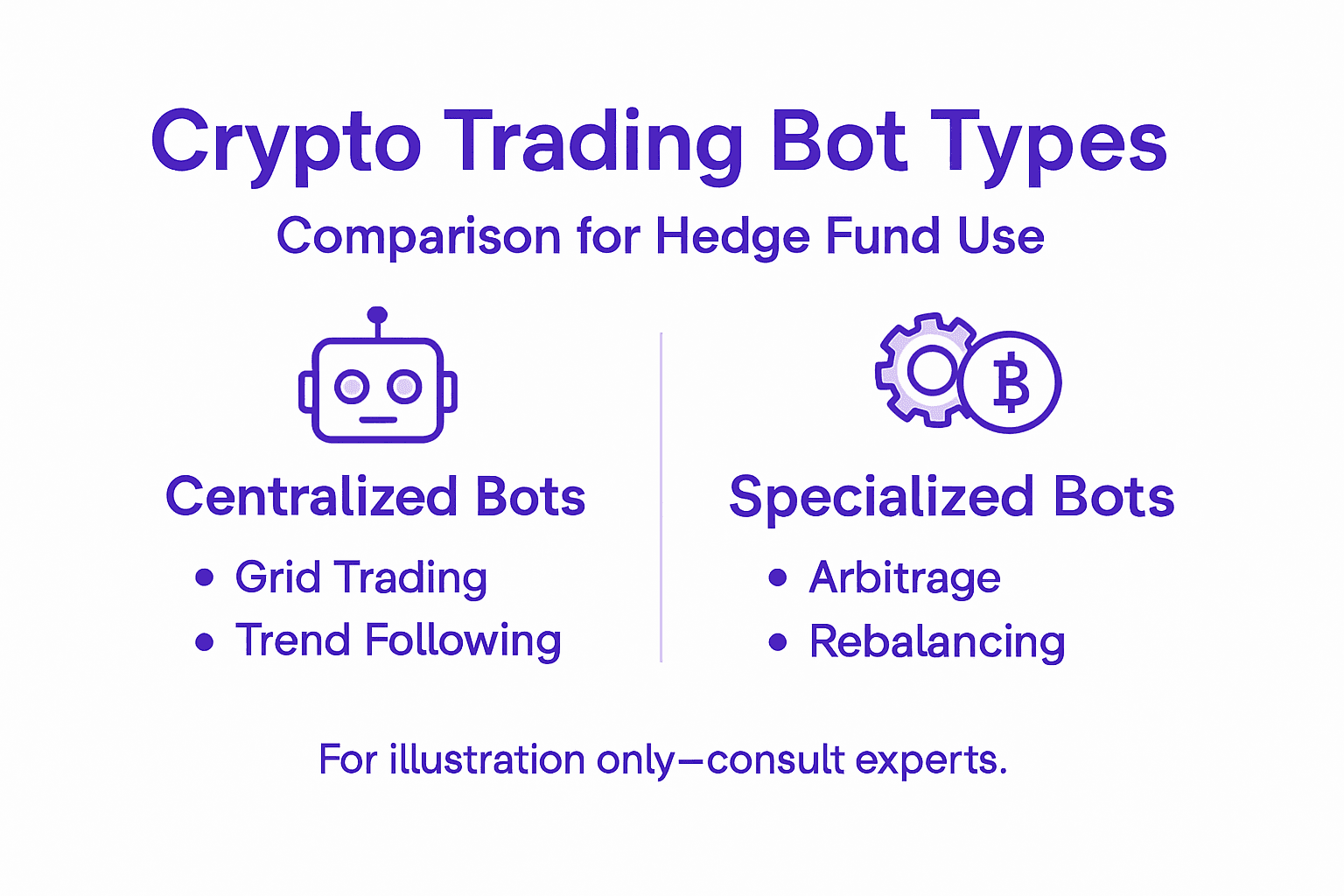
Here’s a summary of major crypto trading bot types and their typical hedge fund applications:
| Bot Type | Main Purpose | Strength in Fund Context |
|---|---|---|
| Centralized Exchange | Grid, DCA, signal-based trading | Reliable, high liquidity pairs |
| Decentralized Exchange | Arbitrage, token launch sniping | Rapid trade execution, new assets |
| AI Agent | Adaptive strategy optimization | Learns market patterns, hands-off |
| Specialty (Arbitrage, Rebalancing, Risk) | Spread capture, allocation maintenance, automated controls | Boosts efficiency, enforces discipline |
Pro tip: Start with centralized exchange grid trading bots on liquid pairs where you have deep market knowledge, then expand to arbitrage and signal-based variants only after validating backtests across multiple market cycles.
How Bots Enhance Efficiency And Returns
Trading bots deliver efficiency gains that compound into measurable performance advantages for hedge funds. The core mechanism is straightforward: bots execute trading logic without fatigue, emotion, or delay. They monitor markets continuously across multiple exchanges and asset pairs simultaneously, identifying opportunities that align with predetermined parameters and executing at optimal prices. A human trader managing five positions might monitor them inconsistently, miss price movements during sleep or meetings, and execute sub-optimal entries driven by fear or greed. A bot executes the same strategy on fifty positions with perfect consistency, capturing every qualified opportunity within its defined parameters. This mechanical discipline eliminates the behavioral gaps that cost basis points daily in traditional operations.

Speed matters enormously in competitive markets. Bots process market data and execute trades in milliseconds, while human decision-making takes seconds at minimum. In liquid markets, this difference determines whether a fund captures an arbitrage spread before it vanishes or enters a position at peak prices. Beyond speed, bots handle complexity that exceeds human cognitive limits. AI systems analyze large datasets at scale and automate portfolio rebalancing while managing dozens of correlated positions and risk constraints simultaneously. They calculate optimal position sizing across multiple assets considering liquidity, volatility, correlation, and drawdown limits without introducing calculation errors. Funds gain operational leverage by automating routine execution tasks, freeing analysts to focus on strategy research, risk management oversight, and market condition analysis rather than manually executing trades or monitoring positions.
Consider the operational reality. Manual portfolio rebalancing requires traders to calculate target allocations, identify drift across dozens or hundreds of positions, execute trades across multiple exchanges, and verify fills. This takes hours weekly and introduces errors. A rebalancing bot completes this task in minutes, measuring actual allocations against targets, executing buys and sells simultaneously across exchanges, and verifying completion automatically. The time savings multiply across strategies. Over a year, this automation translates into hours recovered for high-value analysis work. More importantly, rebalancing happens consistently on schedule rather than whenever someone remembers to execute it, preventing allocation drift that costs returns. AI-driven automation minimizes human errors while enabling 24/7 market monitoring that captures opportunities across global time zones without staffing night shifts.
Returns improvements come from three sources: capturing opportunities faster than manual execution allows, maintaining discipline during volatile swings that trigger emotional trading, and optimizing execution across many positions simultaneously. A fund running identical strategies manually versus automated might see the bot version outperform by 50 to 150 basis points annually after accounting for transaction costs. This performance gap widens in volatile markets where opportunities appear and disappear rapidly and where emotional discipline becomes critical.
Pro tip: Measure bot efficiency gains by comparing identical strategies run manually versus automated over complete market cycles, tracking execution speed, slippage, position accuracy, and rebalancing frequency to quantify the performance edge before scaling capital.
Managing Risks And Security With Automation
Automation introduces both risk mitigation opportunities and new threat vectors that hedge funds must manage deliberately. The paradox is real: while bots eliminate behavioral trading errors and execute risk controls with perfect consistency, they also concentrate operational risk into software systems that can malfunction, experience security breaches, or execute flawed logic at scale. Managing this duality requires structured frameworks that treat automation as a controlled tool rather than a black box.
Risk management automation enforces discipline that human traders cannot maintain under stress. Position limits embedded in bot logic execute automatically regardless of market euphoria or panic. Stop losses trigger mechanically when prices reach predetermined thresholds, preventing catastrophic losses that might occur if a trader hesitated during volatile swings. Correlation monitoring prevents concentration in correlated assets that appear diversified but move together during market stress. Portfolio rebalancing maintains target allocations instead of drifting toward winners that become overweights. Effective risk management frameworks handle AI-induced uncertainty and model bias by implementing data quality checks, validating model outputs against reality, and maintaining human oversight of critical decisions. Funds prevent bot runaway scenarios through hard limits on order size, mandatory position reviews before scaling, and circuit breakers that halt trading if market conditions diverge dramatically from historical patterns.
Security becomes the critical constraint. Trading bots require API keys that grant access to exchange accounts and the ability to move funds. Compromised keys expose the entire portfolio to theft in seconds. Phishing attacks targeting fund staff can steal credentials that unlock bot systems. Ransomware infections can encrypt bot logic and demand payment for decryption. Funds must implement robust encryption, data security protocols, and compliance with regulations like the Digital Operational Resilience Act. This means isolating bot infrastructure on dedicated hardware, storing API keys in encrypted vaults with multi-factor authentication, implementing network segmentation that prevents lateral movement if one system is compromised, and maintaining detailed audit logs of every bot action for forensic review. Exchange connections use read-only monitoring channels for non-critical data and restricted API keys with tight permission scopes that allow only specific operations rather than full account access.
Monitoring separates controlled automation from rogue automation. Funds establish real-time dashboards that track bot performance, comparing actual positions to expected positions, monitoring execution slippage against benchmarks, and flagging any trading activity that deviates from defined strategies. Alert thresholds trigger human review when bots approach position limits, execute unusual trade sequences, or experience connection failures. Regular backtesting validates bot logic against historical scenarios and stress tests confirm performance during market extremes. Quarterly reviews compare bot-generated returns to manual strategies, ensuring performance advantages justify the operational complexity and security risks.
Pro tip: Implement a separation-of-duties model where bot configuration requires approval from at least two team members and where API keys are stored in different locations, preventing any single compromised system from enabling unauthorized trading.
Comparing Manual Trading To Automated Systems
The choice between manual trading and automated systems is not binary. Most successful hedge funds operate hybrid models that leverage strengths of each approach. Understanding the tradeoffs clarifies when automation adds value and when human judgment remains essential.
Manual trading excels in interpreting market nuance and responding to unprecedented conditions. A seasoned trader recognizes when traditional correlations have broken, when liquidity is disappearing before prices show it, or when regulatory announcements will trigger specific market reactions. Human intuition captures context that quantitative models miss. However, manual trading is constrained by human cognitive limits and emotional biases such as fear or greed that impair decision-making during high-stakes moments. A trader managing five positions mentally might execute them inconsistently. During market stress, fear can override predetermined risk rules, leading to delayed stop losses or panic selling at peaks. The cognitive load of tracking dozens of correlated positions, calculating optimal position sizing, and monitoring global markets across time zones exceeds what humans can do consistently. Trading during market recoveries, when sentiment shifts rapidly and new opportunities emerge, favors human adaptability and qualitative judgment. Trading during market stress, when quantitative discipline matters most, exposes human weakness.
Automated systems eliminate emotional interference and execute with mechanical consistency. They process vast datasets in milliseconds, identifying patterns across thousands of price points and correlations that human analysis cannot match. AI-driven funds outperform during market downturns by effectively mitigating downside risk while maintaining predetermined risk limits that emotional traders might abandon. Bots execute identical strategies on hundreds of positions without fatigue or hesitation. They maintain position discipline during volatile swings when human traders feel panic. They execute rebalancing on schedule rather than whenever someone remembers. However, automation struggles with unprecedented events. When markets behave outside historical patterns, bots either execute logic that no longer applies or halt entirely, waiting for human direction. Bots cannot interpret qualitative information like management changes at portfolio companies or macroeconomic policy shifts that suggest regime changes.
The optimal approach combines both. Integration of automation and manual oversight provides superior performance across market cycles, leveraging complementary strengths. Bots execute routine position management, rebalancing, and risk controls with perfect consistency. Humans oversee strategy selection, monitor bot performance, interpret market regime changes, and adjust parameters when conditions shift. During recoveries, human managers might increase automation thresholds to capture opportunities faster. During downturns, human monitoring intensifies to validate that risk controls are working as intended. This division of labor lets analysts focus on high-value decisions while automation handles execution precision and 24/7 monitoring that humans cannot sustain.
Compare the strengths and limits of manual vs. automated trading in hedge funds:
| Aspect | Manual Trading Advantage | Automation Advantage |
|---|---|---|
| Human Judgment | Contextual, nuanced decisions | Consistent execution, no emotions |
| Speed & Scale | Slow, limited by attention | Millisecond trades, 24/7 coverage |
| Risk Management | Intuitive for unprecedented events | Rigorous, pre-defined rules |
| Adaptability | Responds to market news and anomalies | Fast parameter adjustments through logic |
Pro tip: Implement a staged automation rollout starting with position rebalancing bots on core holdings, then adding signal-based trading on secondary positions only after validating bot performance matches your manual benchmarks over complete market cycles.
Unlock Hedge Fund Growth With Advanced Crypto Trading Bots
The article highlights the critical challenge hedge funds face in implementing disciplined, emotion-free trading across multiple volatile crypto markets. Managing complex strategies like grid trading, arbitrage, and AI-driven optimization requires seamless automation that maintains rigorous risk controls and real-time execution. At the core is the need for a reliable, secure platform that supports sophisticated bot customization, continuous monitoring, and portfolio rebalancing to capture every opportunity without manual error or delay.
Darkbot.io answers these challenges by delivering an intuitive SaaS solution designed precisely for hedge funds and serious crypto investors. With multi-exchange API integration, AI-powered strategy tuning, and automated risk management features, it frees you from the limits of manual trading and emotional bias. Use Darkbot.io to implement scalable, tested bot strategies that align perfectly with insights from the article, empowering your team to focus on high-value decisions instead of operational overhead.
Take control of your automated crypto trading journey now
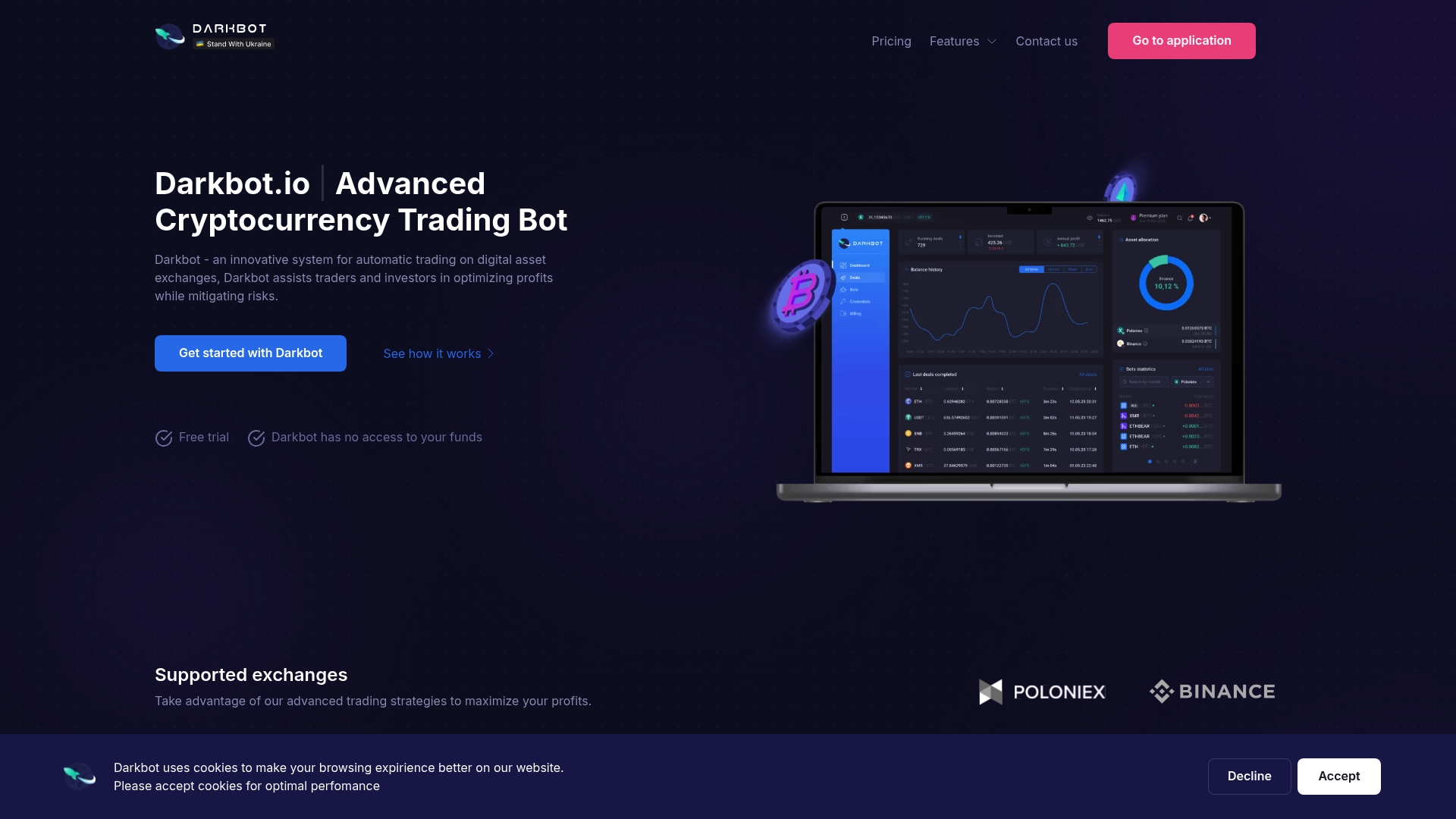
Experience how AI-driven automation accelerates execution speed and consistency while enhancing risk discipline. Start with flexible plans that fit your fund’s scale and see measurable improvements in trading efficiency and returns. Visit Darkbot.io today to build and deploy your next-generation automated trading bots.
Frequently Asked Questions
What are trading bots, and how do they work for hedge funds?
Trading bots are automated systems that execute trading strategies based on predefined rules without human intervention. They analyze market data, identify trading opportunities, and execute trades rapidly across multiple exchanges, helping hedge funds manage portfolios more effectively in volatile markets.
How do automated trading bots improve efficiency in hedge funds?
Automated trading bots enhance efficiency by executing trades with speed and precision, eliminating emotional decision-making. They monitor market conditions 24/7 and manage complex datasets simultaneously, allowing analysts to focus on strategic research while routine tasks are automated.
What types of trading strategies can hedge funds implement using bots?
Hedge funds can use trading bots to implement various strategies, including high-frequency trading, statistical arbitrage, market making, and trend following. Each bot type is tailored to specific market conditions and trading objectives, such as grid trading and dollar-cost averaging.
What are the risk management features of trading bots in hedge funds?
Trading bots include risk management features like position limits, stop losses, and correlation monitoring to mitigate risks. They enforce discipline in trading decisions by executing predefined rules automatically, minimizing the potential for human error during market volatility.
Recommended

Start trading on Darkbot with ease
Come and explore our crypto trading platform by connecting your free account!
Free plan available • No credit card required