7 Examples of Trading Strategies for Beginner Crypto Traders

Over 60 percent of American crypto traders admit to feeling overwhelmed by constant market swings, especially when juggling busy careers and family commitments. For beginners with limited time, managing cryptocurrency risk can feel impossible without automated help. Discover how practical automated strategies take the pressure off novice traders worldwide, offering simple solutions that fit into a tight schedule while safeguarding your investments in unpredictable markets.
Quick Summary
| Takeaway | Explanation |
|---|---|
| 1. Utilize Dollar Cost Averaging | Invest fixed dollar amounts regularly to mitigate market volatility and emotional stress. |
| 2. Implement Grid Trading in Sideways Markets | Set up buy/sell orders at incrementally spaced price points to capitalize on minor price fluctuations. |
| 3. Apply Trend Following Strategies | Align your trades with market momentum using technical indicators to capitalize on upward or downward trends. |
| 4. Explore Arbitrage Opportunities | Quickly exploit price differences across exchanges for consistent, small profits with minimal risk. |
| 5. Use Stop-Loss and Take-Profit Orders | Predetermine your acceptable loss and profit levels to automate risk management and reduce emotional trading. |
1. Dollar Cost Averaging for Easy Automated Investing
Dollar Cost Averaging (DCA) offers beginner crypto traders a straightforward approach to investing without the stress of timing market movements. This strategy involves purchasing a fixed dollar amount of cryptocurrency at regular intervals, regardless of current market prices.
With DCA, you eliminate the emotional rollercoaster of trying to predict market bottoms or peaks. Instead, you consistently invest small amounts over time, which helps smooth out the impact of market volatility. By spreading your investments across multiple entry points, you reduce the risk associated with making a single large purchase at an unfavorable moment.
Implementing DCA is particularly powerful in cryptocurrency markets, which are known for dramatic price swings. Automated crypto trading strategies can help you execute this approach seamlessly, ensuring you invest consistently without emotional interference.
For example, if you decide to invest $200 monthly in Bitcoin, you would purchase that fixed amount regardless of whether Bitcoin is trading at $30,000 or $40,000. This method means you buy more units when prices are low and fewer when prices are high, effectively averaging out your purchase price.
Many cryptocurrency exchanges and trading platforms now offer built-in DCA tools that can automatically execute these purchases for you. These tools remove the need for manual intervention, making consistent investing effortless.
Pro tip: Start with a small, manageable investment amount that you can consistently commit to without financial strain, and gradually increase your allocation as you become more comfortable with the strategy.
2. Grid Trading for Profiting in Sideways Markets
Grid trading offers cryptocurrency traders a strategic approach to generating profits during market periods with minimal directional movement. This sophisticated trading method allows investors to capitalize on price fluctuations by creating a mathematical grid of buy and sell orders at predetermined price levels.
The core principle of grid trading revolves around setting up multiple buy and sell orders at incrementally spaced price points within a specific trading range. When the market price moves between these predefined levels, traders can automatically execute trades that generate small but consistent profits. Unlike strategies that rely on strong market trends, grid trading thrives in sideways or range-bound markets where prices oscillate within a relatively stable corridor.
Dynamic Grid Trading strategies have revolutionized this approach by introducing adaptive algorithms that adjust grid positions based on real-time market conditions. These advanced techniques can help traders maximize potential returns while managing downside risk more effectively.
To implement a basic grid trading strategy, you would first determine a price range for your chosen cryptocurrency. Then, you would place buy orders below the current market price and sell orders above it at equal intervals. As the price moves up and down within this range, your orders will be executed automatically, allowing you to profit from small price variations.
Modern cryptocurrency trading platforms and bots offer built-in grid trading functionality, making it easier for beginners to implement this strategy without complex manual calculations. These tools can help you set up your grid parameters, manage order execution, and track performance with minimal intervention.
Pro tip: Start with a small allocation and narrow grid spacing to minimize risk while you learn the nuanced dynamics of grid trading in volatile cryptocurrency markets.
3. Trend Following to Capture Upward and Downward Moves
Trend following represents a powerful trading strategy that allows cryptocurrency investors to ride market momentum in both bullish and bearish conditions. By systematically identifying and tracking established price movements, traders can potentially capture significant gains across different market phases.
The fundamental principle of trend following involves recognizing and aligning your trading position with the prevailing market direction. Instead of trying to predict exact market tops or bottoms, this approach focuses on joining and maintaining positions that move in a consistent trajectory. When prices demonstrate a clear upward or downward trend, traders can use various technical indicators to confirm and participate in these movements.
Trend-following strategies have shown remarkable adaptability in cryptocurrency markets, where high volatility creates numerous opportunities for momentum-based trading. Technical indicators like moving averages, relative strength index, and trend lines can help traders identify and validate emerging market trends.
To implement a trend following strategy, you would typically use moving average crossovers or momentum oscillators to signal potential entry and exit points. For instance, when a short-term moving average crosses above a long-term moving average, it might indicate a bullish trend. Conversely, a downward crossover could suggest a bearish market condition.
Successful trend following requires discipline and a robust risk management approach. This means setting clear stop-loss levels, avoiding emotional trading, and being prepared to exit positions when trend indicators suggest a potential reversal. Modern trading platforms and algorithmic tools can help automate these decisions, reducing the impact of human emotional biases.
Pro tip: Start by backtesting your trend following strategy using historical cryptocurrency price data to understand its potential performance before committing real capital.
4. Arbitrage Opportunities Across Multiple Exchanges
Arbitrage trading represents a sophisticated strategy for cryptocurrency investors to profit from price discrepancies across different trading platforms. By identifying and quickly executing trades between exchanges with varying asset prices, traders can potentially capture small but consistent returns.
In the world of cryptocurrency, prices for the same digital asset can vary significantly across different exchanges due to factors like liquidity, regional market dynamics, and trading volume. These price differences create arbitrage opportunities that astute traders can exploit through rapid buying and selling strategies.
Spatial arbitrage techniques leverage advanced machine learning algorithms to identify and execute trades across multiple platforms within milliseconds. The key challenge lies in recognizing these price differences quickly and executing trades before the market adjusts.
To implement an arbitrage strategy, you would simultaneously purchase a cryptocurrency at a lower price on one exchange and immediately sell it at a higher price on another. For example, if Bitcoin is trading at $50,000 on Binance and $50,200 on Kraken, a successful arbitrage trade could yield a quick profit minus transaction fees.
However, successful arbitrage requires sophisticated tools and considerations. Transaction fees, transfer times, and potential price movements during transfer can quickly erode potential profits. Modern trading platforms and automated bots can help traders identify and execute these opportunities more efficiently by monitoring multiple exchanges in real time.
Pro tip: Start with small trade sizes and carefully calculate all potential transaction costs to ensure your arbitrage strategy remains profitable.
5. Automated Portfolio Rebalancing for Steady Growth
Automated portfolio rebalancing is a strategic approach that helps cryptocurrency investors maintain their desired asset allocation while managing risk and potential returns. This method systematically adjusts your investment portfolio to ensure your original investment strategy remains consistent despite market fluctuations.
At its core, portfolio rebalancing involves periodically buying or selling assets to maintain a predetermined percentage of different cryptocurrencies in your portfolio. For example, if you initially decide to hold 50% Bitcoin, 30% Ethereum, and 20% alternative coins, market movements will naturally shift these percentages over time.
Threshold-based rebalancing strategies offer an advanced approach to managing these allocations by triggering portfolio adjustments when asset percentages deviate beyond a specific range. This method helps investors systematically lock in gains and redistribute investments more effectively than fixed interval approaches.
Modern cryptocurrency trading platforms and automated bots can execute these rebalancing strategies with precision, removing emotional decision-making and ensuring your portfolio stays aligned with your original investment goals. These tools can monitor your portfolio in real time and make automatic adjustments based on predefined rules.
Implementing an automated rebalancing strategy requires setting clear allocation targets, determining rebalancing triggers (such as percentage deviations or specific time intervals), and selecting the cryptocurrencies that fit your risk tolerance and investment objectives. Machine learning techniques are increasingly being used to optimize these rebalancing decisions, providing more sophisticated and adaptive portfolio management.
Pro tip: Start with a conservative rebalancing approach by setting moderate deviation thresholds and gradually refine your strategy as you gain more experience with cryptocurrency markets.
6. Using Stop-Loss and Take-Profit for Risk Management
Stop-loss and take-profit orders represent essential risk management tools for cryptocurrency traders seeking to protect their investments and secure potential gains. These automated trading mechanisms allow investors to predetermine their maximum acceptable loss and target profit levels before executing a trade.
A stop-loss order automatically sells a cryptocurrency when its price drops to a specific predetermined level, preventing potentially catastrophic losses during sudden market downturns. Conversely, a take-profit order automatically closes a position when the asset reaches a target price, ensuring you lock in gains without constant market monitoring.
Advanced risk management strategies emphasize the importance of setting these orders as part of a comprehensive trading approach. By implementing these tools, you transform emotional trading into a disciplined, systematic process.
For example, if you purchase Bitcoin at $40,000, you might set a stop-loss order at $38,000 to limit potential losses to 5% and a take-profit order at $45,000 to secure a 12.5% gain. These orders execute automatically, removing emotional decision-making and protecting your investment from unexpected market volatility.
Modern cryptocurrency trading platforms and automated bots offer sophisticated stop-loss and take-profit functionalities. These tools can help you establish complex risk management strategies, including trailing stop-loss orders that adjust dynamically as the market price moves in your favor.
Pro tip: Calculate your stop-loss and take-profit levels using a percentage of your entry price rather than fixed dollar amounts to maintain consistent risk management across different trades.
7. Machine Learning Strategies for Smarter Decisions
Machine learning strategies represent a cutting-edge approach to cryptocurrency trading that leverages advanced algorithms to analyze complex market patterns and make data-driven investment decisions. These intelligent systems can process vast amounts of market data far beyond human capabilities, identifying subtle trading opportunities that traditional methods might miss.
At its core, machine learning in cryptocurrency trading involves training sophisticated algorithms to recognize patterns, predict price movements, and execute trades with remarkable precision. Unlike traditional trading approaches that rely on human intuition, these strategies use historical data, technical indicators, and real-time market signals to generate trading recommendations.
Machine learning trading frameworks combine multiple advanced techniques including unsupervised clustering, deep reinforcement learning, and predictive modeling. These approaches help manage the inherent volatility of cryptocurrency markets by generating high-quality trading signals and reducing uncertainty.
Implementing machine learning strategies typically involves using specialized trading platforms and AI-powered bots that can analyze market conditions continuously. These systems can adapt their strategies in real time, learning from previous trades and adjusting their approach based on changing market dynamics.
Modern machine learning models can integrate various data sources including price history, trading volume, social media sentiment, and macroeconomic indicators to generate comprehensive trading insights. By processing these diverse inputs simultaneously, these intelligent systems can develop nuanced trading strategies that go far beyond simple trend following.
Pro tip: Start by experimenting with pre-built machine learning trading models and gradually customize them to match your specific risk tolerance and investment goals.
Below is a comprehensive table summarizing the strategies and methodologies discussed throughout the article regarding cryptocurrency trading approaches and mechanisms.
| Strategy | Description | Benefits and Key Takeaways |
|---|---|---|
| Dollar Cost Averaging (DCA) | Regular investments of a fixed amount, irrespective of market price. | Reduces the impact of market volatility and minimizes timing risk. |
| Grid Trading | Placing buy and sell orders at predefined levels within a price range. | Profits from price oscillations in sideways markets. |
| Trend Following | Aligning trades with the market’s directional trend. | Maximizes gains during sustained upward or downward market movements. |
| Arbitrage Trading | Exploiting price differences for the same asset across exchanges. | Captures consistent profits from market inefficiencies. |
| Automated Portfolio Rebalancing | Adjusting asset allocations to maintain desired investment proportions. | Manages risk and aligns portfolio composition with investment goals. |
| Using Stop-Loss and Take-Profit Orders | Setting predefined levels for automatic trade execution. | Limits losses and secures profits without constant market monitoring. |
| Machine Learning Strategies | Employing AI to analyze data and optimize trades. | Enhances decision-making and identifies complex pattern-based opportunities. |
Automate Your Crypto Trading Strategies with Darkbot.io
Navigating beginner crypto trading strategies like Dollar Cost Averaging, Grid Trading, and Trend Following can feel overwhelming. With fluctuating markets and the need for precise timing, many traders face challenges such as emotional decision-making, complex strategy management, and risk control. Darkbot.io understands these pain points and offers a powerful solution to automate and optimize your approach. Whether you want to execute consistent automated trading strategies, manage your portfolio with automated rebalancing, or deploy sophisticated algorithms built on AI and machine learning, Darkbot.io makes professional crypto trading accessible and straightforward.
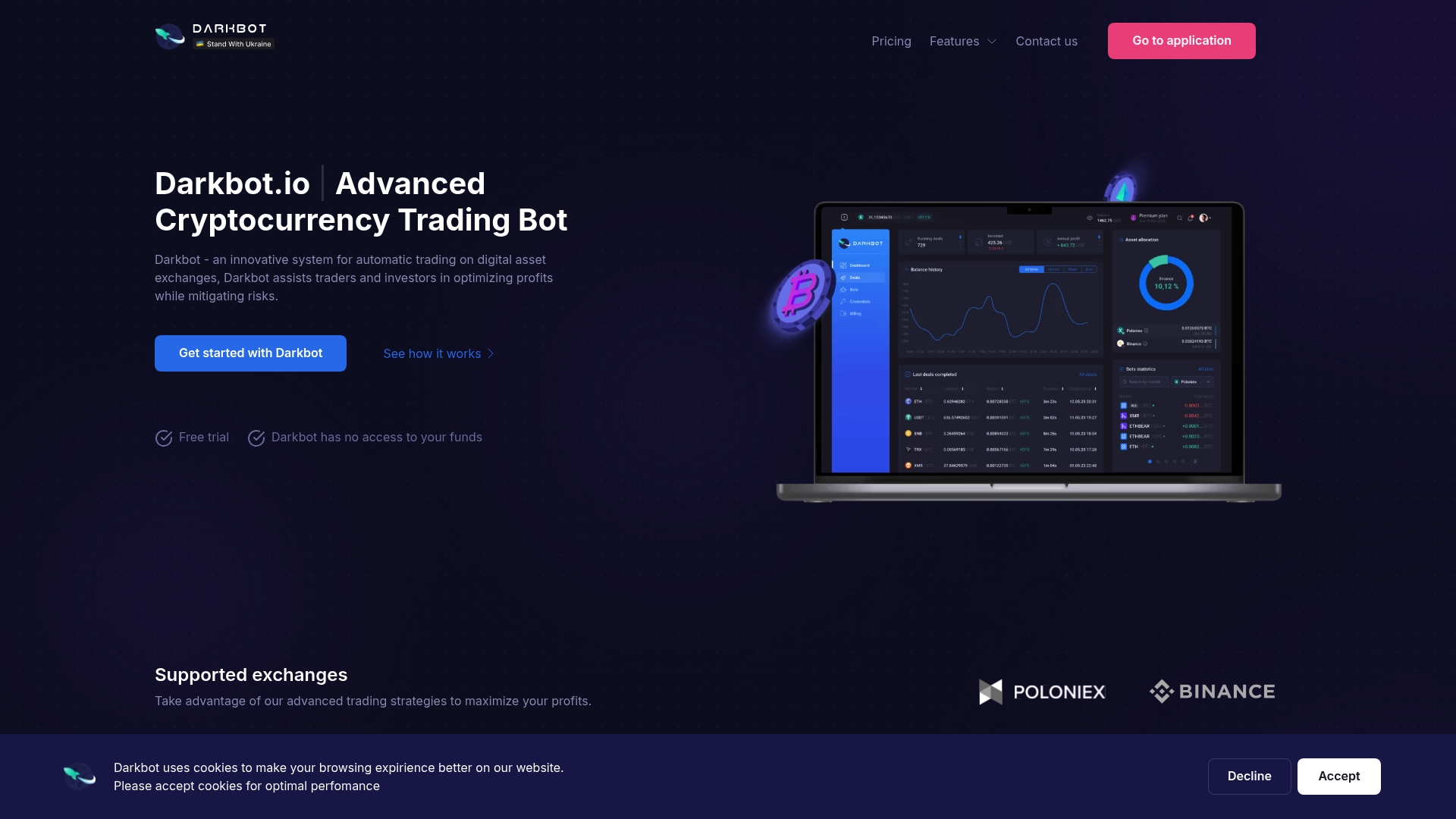
Take control of your crypto investments now and remove the guesswork through automation. Visit Darkbot.io to start customizing your trading bots with secure exchange integration and real-time analytics. Don’t wait for the market to decide your fate. Start automating smarter trades today and gain the confidence to succeed in volatile crypto markets.
Frequently Asked Questions
What is Dollar Cost Averaging and how can I use it in crypto trading?
Dollar Cost Averaging (DCA) is an investing strategy where you buy a fixed dollar amount of cryptocurrency at regular intervals, regardless of its price. To implement DCA, set a monthly budget, such as $200, and purchase the same amount of cryptocurrency each month, minimizing the emotional effects of market fluctuations.
How does Grid Trading work and when should I use it?
Grid Trading involves placing multiple buy and sell orders at predetermined price levels to capitalize on price fluctuations in a sideways market. Start by identifying a price range for your chosen cryptocurrency, then set up buy orders below and sell orders above the current price to automate trades as prices move within that range.
What are the benefits of Trend Following in cryptocurrency trading?
Trend Following allows you to align your trades with the prevailing market direction, maximizing potential gains during upward and downward price movements. Implement this strategy by using moving averages to signal when to enter or exit a position, ensuring that you stay with the trend as long as it lasts.
How can I identify Arbitrage Opportunities in cryptocurrency exchanges?
Arbitrage Opportunities arise when the same cryptocurrency is priced differently across various exchanges. To take advantage, monitor the prices on multiple exchanges and look for significant discrepancies—when one exchange has a cryptocurrency at a lower price, purchase it there and sell it on another exchange where the price is higher.
What is Automated Portfolio Rebalancing and why is it useful?
Automated Portfolio Rebalancing helps you maintain your desired asset allocation by adjusting your portfolio based on market changes, ensuring consistent risk management. To start, set your target percentages for each cryptocurrency in your portfolio, and automate trades to buy or sell when those percentages deviate from your targets.
How do Stop-Loss and Take-Profit orders help with risk management?
Stop-Loss and Take-Profit orders allow you to set predetermined price levels for selling your cryptocurrency to minimize losses or lock in profits. Define your stop-loss level a few percentage points below your entry price and set a take-profit level a certain percentage above your entry price to automate the process and reduce emotional trading.
Recommended

Start trading on Darkbot with ease
Come and explore our crypto trading platform by connecting your free account!
Free plan available • No credit card required