API Key Integration: Simplifying Crypto Bot Automation

Manual crypto trading can drain your energy and still leave you second-guessing every move. For many novice and micro-cap traders juggling limited time, staying ahead of volatile markets feels nearly impossible. API key integration acts as a bridge that automates trading and connects your tools directly to exchange services, creating a seamless, emotion-free workflow that works around the clock. Learn how these digital keys lay the groundwork for safer, more efficient portfolio management no matter where you trade.
Key Takeaways
| Point | Details |
|---|---|
| Understanding API Keys | API keys are essential for connecting your trading bot to cryptocurrency exchanges securely, enabling automated trading operations without manual intervention. |
| Permission Management | It’s crucial to grant only the minimum necessary permissions to your API key to reduce exposure to risks. |
| Continuous Monitoring | Regularly check your API usage and activity logs to detect any unauthorized actions or security breaches. |
| Testing and Error Handling | Thoroughly test your trading bot in a controlled environment and implement error handling to ensure stability under changing market conditions. |
Defining API Key Integration in Crypto Trading
An API key is a unique identifier that grants your trading bot permission to access your exchange account. Think of it as a digital key that unlocks specific actions without sharing your full password.
API integration connects your bot to cryptocurrency exchanges through secure, programmatic channels. Instead of manually placing orders through a website, your bot communicates directly with the exchange’s systems to execute trades, check balances, and retrieve market data.
When you integrate an API key with your trading bot, you’re establishing a bridge between two systems. Your bot sends requests to the exchange, and the exchange responds with data or executes the requested action. This happens in milliseconds.
API key integration enables emotion-free trading by removing manual decision-making from order execution. Your bot follows its rules consistently, regardless of market volatility or psychological pressure.
The core purpose of API integration in crypto trading is to automate the entire trading workflow. Without it, you’d manually check prices, analyze conditions, and click buy or sell buttons—a process too slow for most market opportunities.
How API Keys Work in Practice
When you generate an API key on an exchange, you receive two components:
- Public key: Allows reading data like market prices and your account balance
- Private key: Grants permission to execute trades and transfer funds
Your trading bot uses these keys to authenticate requests. The exchange verifies the keys match your account, then processes the bot’s instructions.

Different exchanges provide different capabilities through their APIs. Some allow advanced features like conditional orders or stop losses. Others offer basic trade execution only. Understanding your exchange’s API limitations directly affects what your bot can accomplish.
Why This Matters for Novice Traders
Manual trading consumes time and mental energy. With API integration, your bot operates 24/7 without fatigue. It executes strategies consistently, follows risk rules automatically, and responds to market conditions faster than any human could.
This is especially valuable for traders managing multiple positions or monitoring markets across time zones. Your bot doesn’t sleep.
Pro tip: Start by integrating with one exchange and testing your bot on small position sizes before expanding to multiple exchanges or increasing capital allocation.
Types of API Keys and Exchange Permissions
Not all API keys are created equal. Exchanges implement permission levels that control what your bot can actually do with your account. Granting excessive permissions increases risk; limiting permissions reduces functionality.
Think of API key permissions like access cards in a building. A visitor badge lets you enter the lobby. An employee card opens offices. A manager’s key unlocks the vault. Your bot needs the right “card” for its specific job.
Understanding Permission Levels
Most exchanges offer granular permission controls that limit what actions your API key can perform. These permission types typically include:
- Read-Only access: View account balances, order history, and market data without executing trades
- Trading permissions: Place, modify, and cancel orders on your behalf
- Withdrawal permissions: Transfer funds or cryptocurrencies from your account
Each permission grants specific capabilities. You don’t need to enable all of them for basic bot automation.
Here’s a summary of common API key permission levels and their uses:
| Permission Level | Main Capabilities | Recommended For |
|---|---|---|
| Read-Only | View balances and market data | Strategy analysis, monitoring |
| Trading | Place, modify, or cancel orders | Active trading bots |
| Withdrawal | Transfer funds externally | Automated fund management |
The least privilege principle states you should grant only the minimum permissions required for your bot to function. This is your first defense against unauthorized access.
Choosing the Right Permission Set
For a trading bot, you typically need read and trade permissions. Read-only access lets the bot monitor prices and your positions. Trade permissions let it execute orders according to your strategy.
Do not enable withdrawal permissions unless your bot specifically needs them. Most trading bots never require this access. Limiting withdrawals prevents a compromised key from draining your account.
Additional Security Controls
Beyond basic permissions, exchanges implement additional safeguards:
- IP whitelisting: Only requests from specific IP addresses can use the key
- Key rotation: Regularly regenerate keys to expire old ones
- Rate limiting: Restrict how many requests the key can make per second
IP whitelisting is particularly valuable for traders. If your bot operates from a fixed server location, whitelist that IP. This prevents attackers from using stolen keys elsewhere.
Permission Mismatches and Bot Failures
If your bot attempts an action without proper permissions, the exchange rejects the request. Your bot may appear frozen or display errors. Always verify your key has the permissions your strategy requires before deploying the bot.
Different exchanges name their permissions differently. Binance uses “spot trading,” Coinbase uses “trade,” Kraken uses “query open orders and trades.” Check your exchange’s documentation to map permissions to your bot’s needs.
Pro tip: Create separate API keys for each exchange and each bot instance, limiting each key to only the permissions that specific bot actually needs.
How API Key Integration Works for Bots
When you connect your API key to a trading bot, you’re creating a live communication channel between two systems. Your bot becomes an extension of your exchange account, able to monitor markets and execute trades around the clock.
Here’s the practical flow: you generate an API key on your exchange, provide it to your bot, and the bot authenticates itself with that key. From that moment forward, every action the bot takes is linked to your account and follows the permissions you assigned.
The Authentication Process
Your bot starts by sending your API key to the exchange’s servers. The exchange validates the key matches a real account and hasn’t been revoked or compromised. Only after verification does the exchange allow your bot to proceed.
This authentication happens automatically before every request. Your bot doesn’t need to log in once—it authenticates with every single action it takes.
Real-Time Data and Order Execution
Once authenticated, crypto API bots continuously pull market data and monitor your positions. Your bot queries the exchange for current prices, your account balances, and the status of open orders.
Based on this data, your bot evaluates its trading rules. If conditions match your strategy, it sends an order request to the exchange. The exchange processes the request and confirms the trade.
All of this happens with minimal latency—often measured in milliseconds. Your bot reacts to opportunities faster than you could manually.
A properly integrated bot operates 24/7 without fatigue, executing trades at optimal prices determined by your strategy, not by emotions or time constraints.
Continuous Monitoring and Adjustment
Your bot doesn’t execute a trade and then disappear. It continuously monitors filled orders, checks if conditions change, and manages risk automatically according to your rules.
If you set a stop loss at 5% below entry, your bot watches the position. The moment the price drops to that threshold, it executes the sell order without hesitation or second-guessing.
Similarly, if you program profit-taking rules, your bot exits winning positions at predetermined targets.
Why This Matters for You
Manual trading locks you into a single device during market hours. API integration eliminates that constraint. Your bot works regardless of whether you’re sleeping, working another job, or managing other tasks.
You also remove emotion from execution. Your bot follows rules with mechanical precision. It doesn’t panic-sell in downturns or hold losers hoping for recovery.
The bot’s connection through your API key means all actions reflect your account and your strategy—nothing is left to chance or third-party interpretation.
Latency and Speed Advantages
Different exchange APIs have different speed characteristics. Some exchanges prioritize speed for high-frequency traders. Others focus on stability over raw speed.
For most crypto traders automating position management, latency measured in hundreds of milliseconds is more than sufficient. Your bot doesn’t need to operate at microsecond speeds—it needs reliability and consistent rule execution.
Pro tip: Test your bot with small position sizes first to verify the API connection is stable and your orders execute as expected before scaling capital.
Security Risks and Safety Best Practices
Your API key is a master password to your exchange account. If compromised, an attacker can drain your funds, manipulate your positions, or steal your data. The risk is real and demands serious protection.
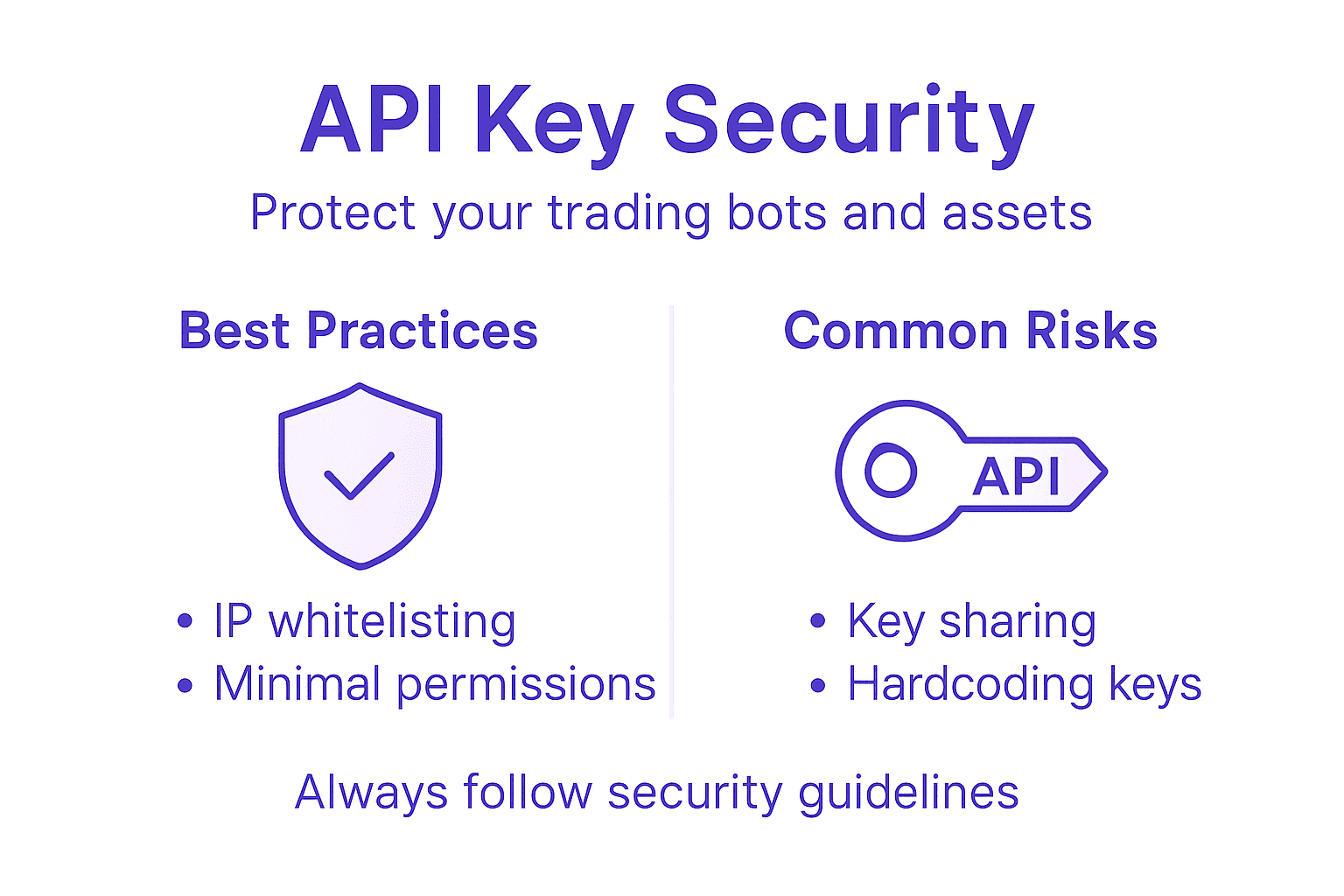
Understanding these risks isn’t about creating paranoia—it’s about establishing disciplined practices that keep your assets safe while your bot operates.
Common Security Mistakes
The most dangerous error is storing API keys insecurely. Never paste your key into emails, messaging apps, or public documents. Never commit keys to GitHub or version control systems where they remain visible forever.
Other frequent mistakes include:
- Sharing a single key across multiple bots or services
- Enabling unnecessary permissions on your key
- Failing to monitor key activity for suspicious behavior
- Reusing the same key across different exchanges
Each mistake compounds your vulnerability. Combined, they create catastrophic risk.
Structural Security Controls
API key mismanagement causes severe security breaches that lead to unauthorized transactions and data theft. Protect yourself with proven controls:
- IP whitelisting: Restrict your key to work only from specific IP addresses
- Key rotation: Regenerate keys periodically, retiring old ones
- Least privilege: Grant only the minimum permissions your bot requires
- Audit logging: Enable activity logs and review them regularly
IP whitelisting is your strongest single defense. If your bot runs on a fixed server, whitelist only that server’s IP. An attacker with your key cannot use it from elsewhere.
See how security controls layer together for stronger API key protection:
| Security Control | Purpose | Added Benefit |
|---|---|---|
| IP Whitelisting | Restricts access by location | Blocks remote unauthorized use |
| Key Rotation | Regularly replaces keys | Limits usefulness of stolen keys |
| Audit Logging | Tracks all API actions | Enables quick breach detection |
| Least Privilege | Grants minimal necessary access | Minimizes damage from compromises |
A compromised API key with no IP whitelist can drain your account in seconds. Whitelisting at least forces attackers to breach your server infrastructure first.
Monitoring and Detection
Your exchange often provides activity logs showing every action your API key takes. Review these logs weekly or set up alerts for unusual activity.
Look for:
- Orders your bot didn’t execute
- Withdrawals to unfamiliar addresses
- Login attempts from new locations
- API access from unexpected IP addresses
Early detection stops attackers before massive damage occurs. Most breaches go unnoticed for days or weeks—don’t be that trader.
Key Management for Multiple Bots
If you run multiple bots, create a separate API key for each one. A compromised key then only affects that specific bot, not your entire account.
Assign each key the minimum permissions it needs. Your momentum bot doesn’t need withdrawal permissions. Your rebalancing bot doesn’t need leverage trading access.
This compartmentalization limits damage if any single key is exposed.
Recovery and Incident Response
If you suspect a key is compromised, revoke it immediately. Most exchanges allow instant key deletion through their settings.
Revocation stops the key from working anywhere. Your bot will stop functioning until you provide a new key, but that’s far better than allowing further damage.
After revocation, change your exchange password and enable two-factor authentication if you haven’t already.
Pro tip: Create a checklist of security actions: IP whitelist your bot, enable audit logging, set calendar reminders to rotate keys quarterly, and review activity logs monthly.
Common Pitfalls and How to Avoid Them
Most traders who struggle with API integration fail for predictable reasons. Understanding these mistakes helps you avoid costly errors that could compromise your funds or crash your bot.
The difference between a stable bot and a disaster often comes down to how carefully you handle setup and ongoing monitoring.
Hardcoding Keys and Endpoints
The most dangerous mistake is hardcoding your API key directly into your bot’s code. This means your key is baked into every file, visible to anyone with access to your source code.
If you ever push code to GitHub or share files with developers, that key is exposed permanently. Even if you delete the repository, the key remains visible in Git history forever.
Store credentials in environment variables instead. Your bot reads the key from a protected system file, not from code. If the key changes, you update one file, not your entire codebase.
Ignoring Error Handling and Rate Limits
Common API integration mistakes include insufficient testing and overlooking rate limits. Exchanges limit how many requests you can make per second. If your bot exceeds this limit, the exchange rejects requests and your bot fails.
Implement retry logic that pauses briefly before resending failed requests. Add exponential backoff—wait longer with each retry attempt. This prevents overwhelming the exchange.
Test your bot against edge cases:
- Network outages that disconnect your bot
- Sudden price spikes that fill orders instantly
- Rate limit rejections that require retries
- Missing or delayed market data
Test these scenarios before deploying real capital. Surprises in production are expensive.
A bot without proper error handling crashes when market conditions shift unexpectedly. Comprehensive testing prevents catastrophic failures when they matter most.
Failing to Monitor API Usage
Your bot consumes API quota with every action. Check your exchange’s usage dashboard regularly to spot unusual activity.
If your bot suddenly makes 10x more requests than normal, something is wrong. Either your strategy changed, you have a bug, or someone compromised your key. Catch this early.
Neglecting Documentation
Exchanges update their API specifications regularly. An endpoint that works today might change tomorrow. Read your exchange’s changelog monthly and test changes before they break your bot.
If your exchange releases a new API version, don’t ignore it hoping your old version still works. Plan migration to the new version before the old one is discontinued.
Insufficient Testing Before Deployment
Deploy your bot on a small account first with minimal capital. Verify the API connection works, orders execute correctly, and data flows properly.
Only after weeks of stable operation should you increase position sizes. Slow scaling catches problems before they become expensive.
Pro tip: Document every API setting you configure: which permissions are enabled, which IPs are whitelisted, and which rate limits apply—create a checklist to review before going live.
Unlock Seamless Crypto Bot Automation with Darkbot.io
API key integration is the backbone of successful crypto bot automation. The challenges of securely managing API permissions, monitoring real-time data, and ensuring uninterrupted, emotion-free trading can overwhelm even the most dedicated traders. Darkbot.io expertly simplifies these complexities by offering a unified platform that supports secure API key integration, advanced strategy customization, and continuous portfolio monitoring.
Take control of your automated crypto trading today. With Darkbot.io you gain dependable security features like IP whitelisting and permission management combined with sophisticated AI-driven trading algorithms designed to optimize your profits while managing risks effectively. Whether you are a novice looking for ease of use or an experienced trader seeking multi-exchange automation, start your journey now at Darkbot.io and discover how effortless managing your trading bots can be. Learn more about our automated trading solutions and experience reliable API key integration built for real-world crypto markets.
Frequently Asked Questions
What is an API key in crypto trading?
An API key is a unique identifier that allows your trading bot to access your exchange account securely, enabling it to perform actions like executing trades and retrieving market data without needing to share your full password.
How does API key integration simplify trading?
API key integration allows trading bots to operate 24/7, executing strategies consistently and without emotional interference. This automates the trading workflow, enabling faster responses to market conditions compared to manual trading.
What permissions should I grant to my API key?
For most trading bots, it is advisable to grant read and trade permissions to allow the bot to view market data and execute trades. Avoid granting withdrawal permissions unless absolutely necessary to minimize security risks.
What are the common security practices for managing API keys?
To protect your API keys, employ practices like IP whitelisting, periodic key rotation, and granting the least privileges necessary. Monitor usage logs regularly to detect any unusual activity, and never hardcode keys directly in your code.
Recommended
- Cryptocurrency API Integration: Maximizing Automated Trading
- Crypto Trading Bot Security: Protecting Profits and Data
- Darkbot API and Market Data Integration for Advanced Trading
- Master the Trading Bot Setup Workflow for Automated Profits
- f01i.ai – AI Crypto Trading Bot Builder | No Commissions | Automated Trading

Start trading on Darkbot with ease
Come and explore our crypto trading platform by connecting your free account!
Free plan available • No credit card required