Beginner's workflow for crypto automation with AI in 2026

Automating cryptocurrency trading intimidates many beginners who lack coding skills or technical knowledge. The volatile crypto markets demand quick decisions, but manual trading consumes time and often leads to emotional mistakes. AI and machine learning tools now simplify automation, enabling novice traders to build profitable strategies without advanced programming expertise. This guide walks you through a practical workflow using accessible platforms like Freqtrade, covering environment setup, strategy execution, risk management, and AI integration to help you confidently automate your first crypto trading bot in 2026.
Key takeaways
| Point | Details |
|---|---|
| Preparation is essential | Define your trading strategy, risk tolerance, and goals before automating to avoid costly errors. |
| Freqtrade simplifies automation | This open-source Python bot integrates AI/ML frameworks and supports over 100 exchanges for flexible trading. |
| Testing prevents losses | Backtesting with historical data and dry-run modes validate strategies safely before deploying real capital. |
| Risk management is critical | Implement stop-loss rules, position sizing, and monitoring to protect your portfolio from market volatility. |
| AI enhances performance | Machine learning models improve signal quality and strategy optimization when combined with sound fundamentals. |
Preparing your environment and tools for crypto automation
Before automating crypto trades, you need the right software, hardware, and foundational knowledge. Basic Python skills help you customize trading scripts, though many platforms offer user-friendly interfaces that reduce coding requirements. Freqtrade supports local execution, running fully on your machine, and is open-source with Python-based customizable scripts. This makes it ideal for beginners who want control without relying on cloud services.

Installing Freqtrade locally requires a stable internet connection and a modest computer or server capable of running 24/7. You’ll also need API keys from your chosen exchanges like Binance, Kraken, or OKX to enable automated trading. Python’s ccxt library offers unified API access to over 100 crypto exchanges, simplifying multi-exchange bots. This unified approach lets you switch between platforms without rewriting code.
Your hardware doesn’t need to be expensive. A standard desktop or cloud server with 4GB RAM handles most basic strategies. However, if you plan to run multiple bots simultaneously or train complex machine learning models, consider upgrading to 8GB or more. Reliable uptime matters because crypto markets operate around the clock, and downtime means missed opportunities.
| Tool/Requirement | Purpose | Notes |
|---|---|---|
| Python 3.8+ | Programming language for bot scripts | Free and widely supported |
| Freqtrade | Open-source trading bot platform | Supports AI/ML integration |
| API Keys | Connect bot to exchanges | Generate from exchange settings |
| ccxt Library | Unified exchange connectivity | Simplifies multi-exchange setups |
| 24/7 Server | Run bot continuously | Desktop PC or cloud instance |
Pro Tip: Start with a single exchange and one simple strategy to minimize complexity while learning the platform’s features and quirks.
Once your environment is ready, explore the trading bot guide for additional setup insights. Freqtrade supports integration with AI/ML models such as TensorFlow and PyTorch, allowing you to enhance strategies with predictive analytics as you gain experience. This flexibility makes Freqtrade a powerful choice for beginners aiming to grow their automation skills over time.
Step-by-step setup and execution of your first automated trading strategy
With your environment configured, you’re ready to build and test your first automated strategy. This process involves connecting your bot to exchanges, defining trading logic, integrating AI models, and validating performance through backtesting and dry-run modes. Each step ensures your bot operates safely and effectively before risking real capital.
- Configure API keys and exchange connections securely by storing credentials in environment variables or encrypted files, never hardcoding them into scripts.
- Define your trading strategy using Python scripts that specify entry signals, exit conditions, stop-loss thresholds, and position sizing rules tailored to your risk tolerance.
- Integrate AI/ML models via Freqtrade’s freqai module to generate predictive signals based on historical patterns and market indicators.
- Use the backtesting engine with historical price data to evaluate strategy performance across different market conditions and timeframes.
- Run your bot in dry-run mode to monitor simulated trades in real-time without deploying actual funds, allowing you to identify bugs and refine logic.
- Adjust parameters with hyperparameter optimization tools to fine-tune settings like moving average periods or RSI thresholds for better results.
Freqtrade’s architecture includes Strategy Engine, Risk & Money Management, Backtesting & Optimization, and AI/ML integration modules. These components work together to execute trades based on your defined rules while managing risk and adapting to market changes. The Strategy Engine processes signals from technical indicators or machine learning models, while the Risk & Money Management module enforces stop-loss limits and position sizing to protect your portfolio.
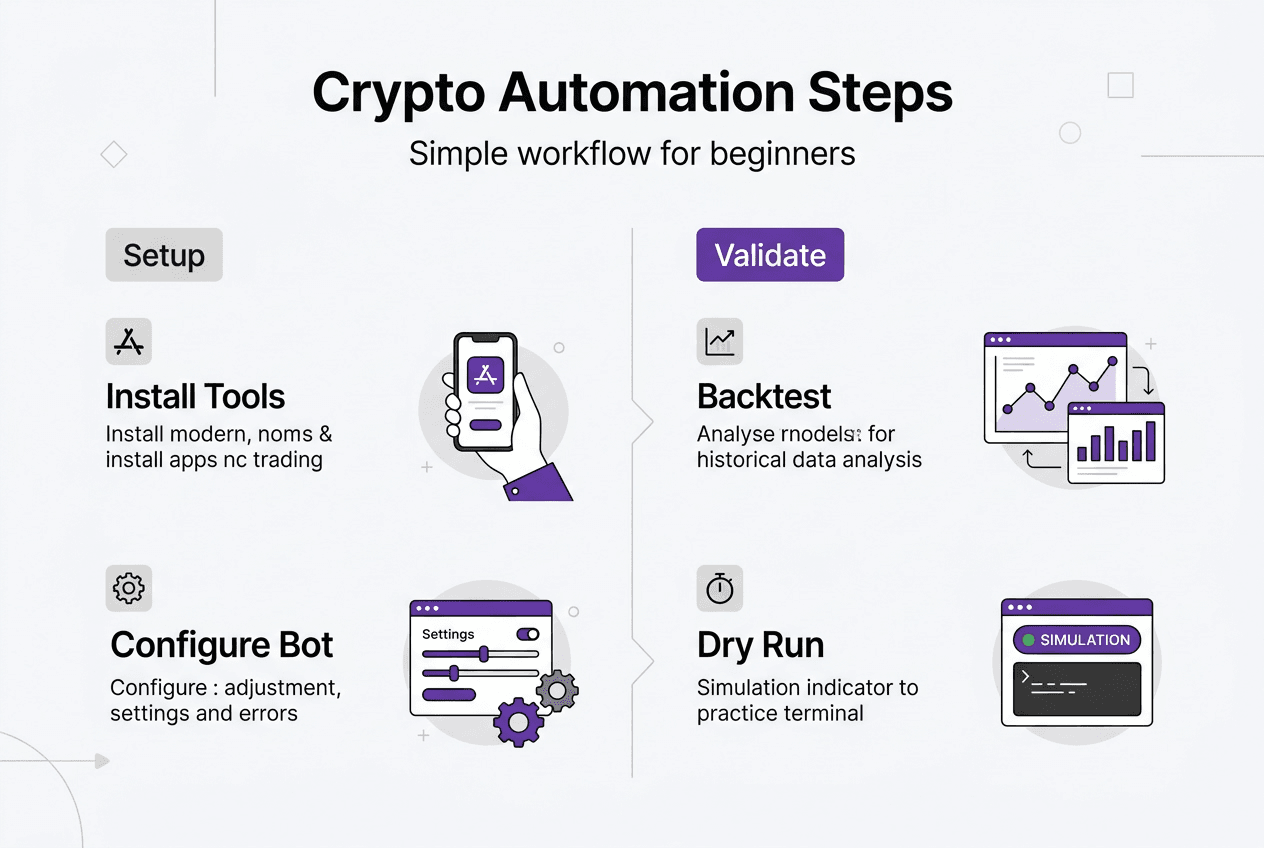
Backtesting against historical data and using dry-run mode help validate strategies before live deployment. Backtesting reveals how your strategy would have performed in past markets, highlighting strengths and weaknesses. Dry-run mode simulates live trading without financial risk, letting you observe how the bot responds to real-time price movements and order execution delays. Starting in dry-run mode avoids real money loss while learning how the bot works.
Pro Tip: Run backtests across multiple market conditions, including bull runs, bear markets, and sideways trends, to ensure your strategy adapts well to volatility.
Once backtesting and dry-run results meet your expectations, you can transition to live trading with a small capital allocation. Monitor the bot closely during the first few days to catch any unexpected behavior. The automated crypto success workflow provides additional guidance on transitioning from testing to live execution while maintaining disciplined risk controls.
Monitoring, risk management, and optimizing your crypto trading bot
Deploying your bot is just the beginning. Continuous monitoring and robust risk management ensure your automation remains profitable and secure. Crypto markets shift rapidly, and even well-tested strategies can underperform if you neglect oversight or fail to adapt to new conditions.
Freqtrade allows users to control and monitor the bot via Telegram or WebUI, providing start/stop commands and profit/loss insights. Telegram integration sends real-time notifications about trades, errors, and performance metrics directly to your phone, enabling quick responses when issues arise. The WebUI offers a dashboard with charts, open positions, and historical trade logs for deeper analysis.
Implement risk controls to protect your capital. Stop-loss orders automatically close losing positions before they erode your portfolio. Position sizing limits the percentage of your capital allocated to any single trade, preventing catastrophic losses from one bad decision. Maximum drawdown limits pause trading if losses exceed a predefined threshold, giving you time to reassess your strategy. These safeguards are essential for surviving volatile market swings.
- Store API keys securely in encrypted files or environment variables, never in plain text or version control systems.
- Handle exchange rate limits gracefully by implementing retry logic and respecting API call quotas to avoid account suspensions.
- Schedule regular performance reviews to identify trends, adjust parameters, and ensure your strategy remains aligned with market conditions.
Proper error handling, rate limit management, and secure API key storage are essential for reliable 24/7 bot operation. Bots can crash due to network issues, exchange downtime, or unexpected data formats. Robust error handling logs issues without halting execution, while rate limit management prevents your bot from exceeding API quotas that could trigger temporary bans.
Common mistakes plague novice traders. Skipping backtests leads to deploying untested strategies that fail in live markets. Ignoring error handling causes bots to crash silently, missing profitable opportunities. Over-optimizing strategies to fit historical data perfectly creates models that perform poorly on new data. Bots reward preparation, testing, and oversight, not optimism; avoid common mistakes like skipping backtests or ignoring risk controls.
| Risk Strategy | Pros | Cons |
|---|---|---|
| Fixed stop-loss | Simple to implement, limits losses | May exit prematurely during volatility |
| Trailing stop-loss | Locks in profits as price rises | Can trigger during normal pullbacks |
| Position sizing | Controls exposure per trade | Reduces potential gains on winners |
| Maximum drawdown | Prevents catastrophic losses | May pause bot during recovery phases |
Pro Tip: Review your bot’s performance weekly, comparing actual results to backtested expectations, and adjust risk parameters based on real-world outcomes.
“Successful automation isn’t about finding a perfect strategy but about managing risk consistently and adapting to market changes.”
Explore risk management in crypto trading for deeper insights into protecting your portfolio. Additional resources on risk management for trading bots and step by step trading automation provide actionable frameworks for refining your approach.
Leveraging AI and machine learning for smarter crypto trading strategies
AI and machine learning elevate basic trading strategies by predicting market movements, optimizing parameters, and analyzing sentiment from news and social media. These technologies process vast datasets faster than humans, identifying patterns that manual analysis might miss. Integrating ML models into your bot enhances signal quality and adaptability.
Common ML model types include CNN-LSTM networks that combine convolutional layers for pattern recognition with long short-term memory units for time series forecasting. Ensemble models aggregate predictions from multiple algorithms to reduce error rates. Sentiment analysis with large language models evaluates news headlines, tweets, and forum posts to gauge market mood and predict price reactions.
Bots like Freqtrade integrate ML frameworks such as TensorFlow, PyTorch, and Scikit-learn for predictive modeling. Training models on historical price data, volume, and technical indicators improves buy, sell, and hold signal accuracy. For example, a trained LSTM model might predict short-term price movements based on recent candlestick patterns, while a sentiment model flags bullish or bearish news events.
Multi-LLM veto systems use several large language models to validate sentiment signals before executing trades. If one model detects bullish sentiment but others disagree, the bot refrains from trading, reducing false positives. A case study bot combining CNN-LSTM and multi-LLM veto systems achieved returns over 1800% with controlled risk. This demonstrates how combining multiple AI approaches creates robust strategies that adapt to diverse market conditions.
| Platform | AI/ML Features | Suitability |
|---|---|---|
| Freqtrade | TensorFlow, PyTorch, freqai module | Beginners to advanced users |
| Jesse | Machine learning backtesting tools | Intermediate Python developers |
| OctoBot | Strategy marketplace, cloud AI | Novices seeking simplicity |
| Custom Python | Full flexibility with libraries | Experienced coders |
Robust backtesting and optimization features across AI-integrated platforms help traders design strategies aiming for consistent returns. Platforms vary in ease of use, customization depth, and community support, so choose one that matches your technical skills and learning goals.
Pro Tip: Begin with simple moving average crossovers or RSI-based strategies, then gradually incorporate ML models to avoid overwhelming complexity and ensure you understand each component’s impact.
Explore machine learning impact in crypto trading to understand how predictive models improve decision-making. Additional insights on machine learning in fintech 2026 and smarter automated trading with ML offer practical examples and case studies demonstrating real-world applications.
Boost your crypto automation journey with Darkbot solutions
Having learned the essential workflow for crypto automation, you can enhance your journey further with professional AI-powered tools. Darkbot offers an AI-powered crypto trading bot that automates sophisticated strategies easily, eliminating the need for extensive coding or manual monitoring. Our platform supports integration with major exchanges and AI/ML models, streamlining setup and ongoing strategy refinement.
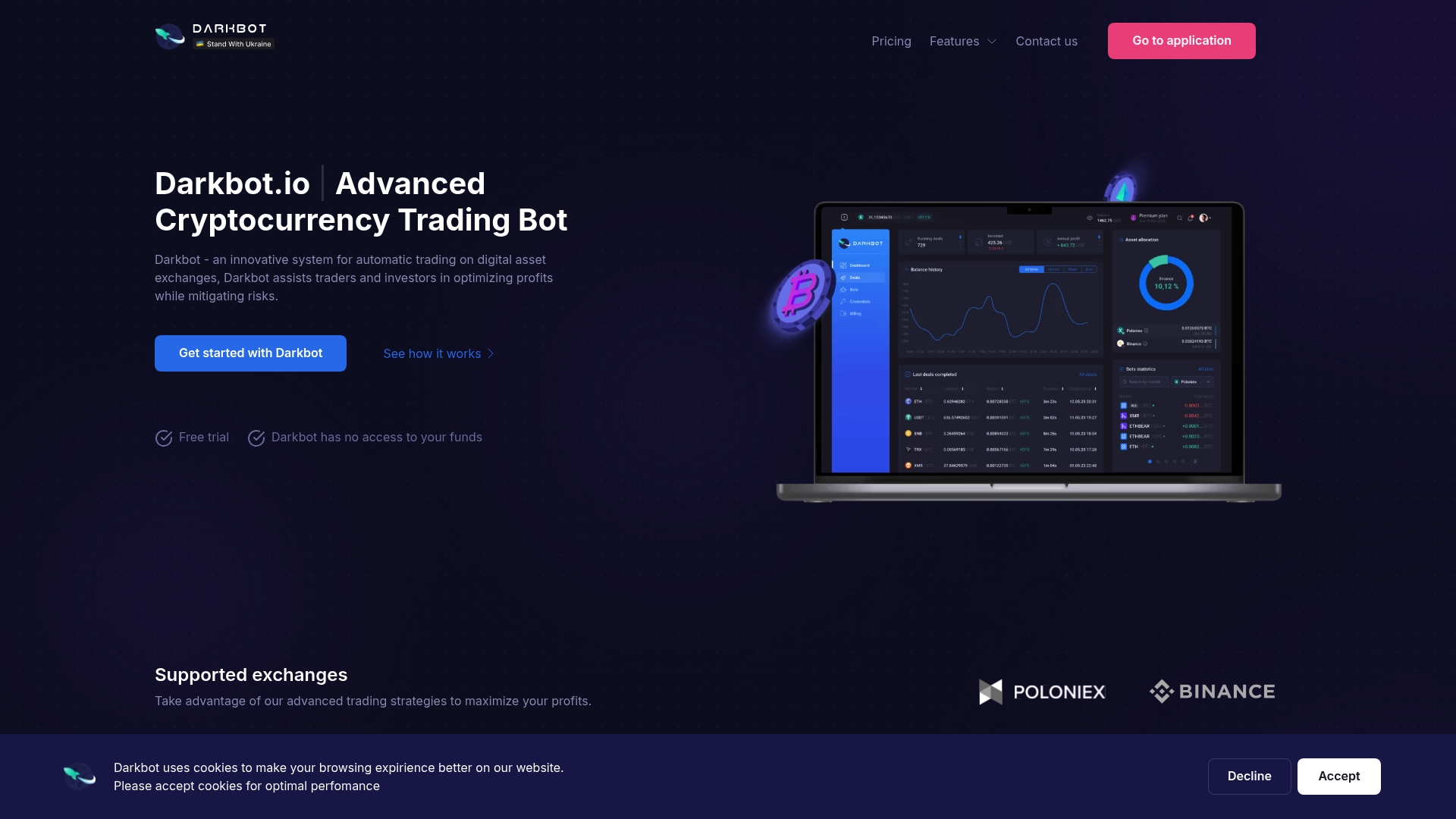
The cryptocurrency portfolio management tool optimizes asset allocation for performance and risk, automatically rebalancing your holdings based on market conditions and predefined rules. Whether you’re running multiple bots or managing a diversified portfolio, Darkbot provides real-time analytics, personalized support, and flexible pricing plans tailored to novice and experienced traders alike. Start with Darkbot to accelerate your automation success.
Frequently asked questions
What is the best beginner-friendly crypto trading bot with AI?
Freqtrade is highly recommended for beginners due to its open-source nature and AI integration. It supports major exchanges, offers extensive documentation, and allows customization without requiring advanced programming skills. The platform’s active community provides tutorials, strategy templates, and troubleshooting help, making it easier for novices to learn automation fundamentals and gradually incorporate machine learning models.
How do I safely test my crypto trading bot before live use?
Use your bot’s built-in backtesting engine on historical market data to evaluate strategy performance across different conditions. Testing with historical data backtesting and dry-run simulates real trades without risking capital. Run trades in dry-run mode to monitor live simulated performance and identify bugs or logic errors. Avoid deploying without thorough testing to prevent losses caused by untested strategies or configuration mistakes.
Can AI guarantee profits in automated crypto trading?
AI can improve decision-making and signal quality by analyzing patterns humans might miss, but it cannot guarantee profits. Profitability depends on user strategies and market conditions; AI assists strategy optimization but does not guarantee gains. Market volatility and strategy design heavily influence outcomes. Continuous monitoring and adjustment remain crucial to adapt to changing market dynamics and maintain performance.
What exchanges are supported for AI-based crypto bots like Freqtrade?
Freqtrade supports major exchanges such as Binance, OKX, Kraken, and over 100 others via unified APIs. Ensure your chosen exchange supports API keys for trading bots and review documentation for specific integration requirements. Python’s ccxt library provides unified access to more than 100 cryptocurrency exchanges. Major global exchanges are commonly supported and well documented, simplifying cross-exchange bot development and deployment.
Recommended

Start trading on Darkbot with ease
Come and explore our crypto trading platform by connecting your free account!
Free plan available • No credit card required