Crypto Trading Bots Explained: Complete Expert Guide

Every american investor faces a flood of choices when it comes to digital currencies, but over 70 percent of crypto trades worldwide now use automated systems. This rapid shift to trading bots can mean greater profits and less emotional stress, yet understanding how these automated tools actually work is crucial for anyone looking to stay competitive. In this guide, you will discover the key principles behind crypto trading bots and what sets them apart from traditional investing.
Table of Contents
- Crypto Trading Bots: Core Concepts Explained
- Major Types of Crypto Trading Bots
- How Automated Trading Bots Operate
- Use Cases and Strategy Integrations
- Risks, Security, and Best Practices
Key Takeaways
| Point | Details |
|---|---|
| Automated Trading Efficiency | Crypto trading bots automate trades using algorithms, allowing for faster, emotion-free decision-making and improved market interactions. |
| Types of Trading Bots | Various bot types exist to cater to different trading strategies, including arbitrage, market making, and trend following. |
| Risks and Security | While powerful, trading bots pose security risks requiring robust management and practices to safeguard against vulnerabilities. |
| Future of Trading Bots | The integration of advanced technologies like machine learning and blockchain will enhance the capabilities and intelligence of trading bots. |
Crypto Trading Bots: Core Concepts Explained
Crypto trading bots represent sophisticated software programs designed to automate cryptocurrency trading strategies across digital asset exchanges. Algorithmic trading leverages computational technology to execute trades based on predefined parameters, removing human emotional interference and enabling faster, more precise market interactions. According to Wikipedia, these programs can perform trades more efficiently than human traders by utilizing advanced computational power and speed.
At their core, trading bots function through a series of strategic components: market data analysis, signal generation, and automated execution. These systems continuously monitor cryptocurrency market conditions, analyzing price movements, trading volumes, and technical indicators in real time. The bot evaluates potential trading opportunities against preset rules and automatically initiates buy or sell orders without requiring constant human supervision. This approach allows traders to implement complex strategies 24/7 across multiple exchanges simultaneously.
The primary advantages of crypto trading bots include:
- Elimination of emotional decision making
- Ability to process massive amounts of market data instantly
- Consistent strategy implementation
- Reduced human error
- Potential for executing trades faster than manual methods
Traders utilizing these automated systems range from individual investors managing small portfolios to professional traders running sophisticated algorithmic trading platforms. By leveraging technology, these bots transform cryptocurrency trading from a manually intensive process into a streamlined, data-driven investment approach.
Major Types of Crypto Trading Bots
Cryptocurrency trading bots come in diverse configurations, each engineered to address specific market strategies and trader objectives. According to Medium, these automated systems can be categorized into several specialized types designed to optimize trading performance across different market conditions.
Arbitrage Bots represent one of the most sophisticated trading bot categories, focusing on exploiting price discrepancies across multiple cryptocurrency exchanges. These intelligent systems rapidly identify and execute trades where an asset is priced differently on various platforms, generating profit from minimal market inefficiencies. Unlike manual traders who might spend hours scanning markets, arbitrage bots can detect and capitalize on these opportunities within milliseconds.
The primary types of crypto trading bots include:
- Arbitrage Bots: Exploit price differences across exchanges
- Market Making Bots: Provide liquidity by placing simultaneous buy and sell orders
- Trend Following Bots: Trade based on prevailing market momentum
- Dollar Cost Averaging Bots: Automate recurring purchases to average investment costs
- Grid Trading Bots: Execute trades within predefined price ranges
Each bot type serves a unique purpose, enabling traders to implement sophisticated strategies with minimal manual intervention.
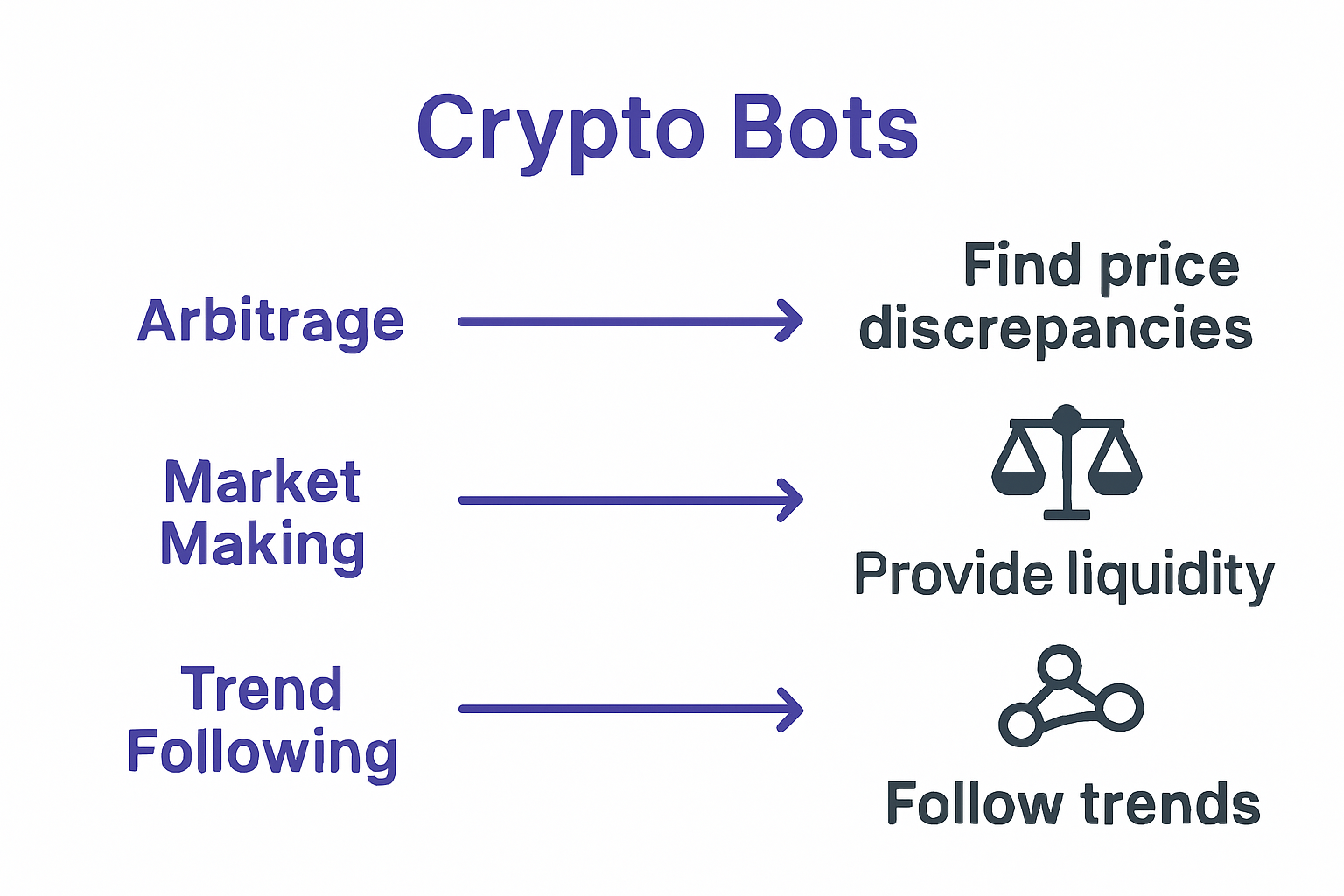 Whether you’re a risk-averse investor seeking consistent returns or an aggressive trader chasing market opportunities, there’s a specialized trading bot designed to match your specific investment approach. The key is understanding each bot’s strengths and aligning it with your personal trading objectives and risk tolerance.
How Automated Trading Bots Operate
Automated trading bots are intricate software systems that transform complex trading strategies into executable computer algorithms. Wikipedia explains that these systems execute orders using pre-programmed instructions that account for critical market variables such as time, price, and trading volume. By leveraging advanced computational capabilities, trading bots can analyze market data and identify potential trading opportunities with unprecedented speed and precision.
The operational mechanism of trading bots involves several interconnected stages. Data Collection represents the initial phase, where bots continuously aggregate real-time market information from multiple cryptocurrency exchanges. This includes tracking price movements, order book depths, trading volumes, and relevant technical indicators. Once data is collected, the Signal Generation component analyzes this information against predefined trading rules and strategies, determining potential entry and exit points for trades.
Key operational components of trading bots include:
- Market Data Aggregation: Collecting real-time price and volume information
- Technical Analysis Algorithms: Applying mathematical models to predict market movements
- Risk Management Protocols: Implementing stop-loss and take-profit parameters
- Trade Execution Engine: Automatically placing orders across connected exchanges
- Performance Tracking: Monitoring and logging trading activities and outcomes
The sophistication of these automated systems allows traders to implement complex strategies that would be nearly impossible to execute manually. By removing human emotional interference and leveraging computational power, trading bots can process massive amounts of market data, make split-second decisions, and maintain consistent trading discipline across volatile cryptocurrency markets.

Use Cases and Strategy Integrations
Cryptocurrency trading bots have evolved far beyond simple automated execution, now incorporating advanced machine learning techniques to create increasingly sophisticated investment strategies. ArXiv research demonstrates how Long Short-Term Memory (LSTM) neural networks and reinforcement learning can be utilized to develop trading agents capable of dynamically adapting to complex market conditions and learning from their own trading experiences.
One groundbreaking approach in bot development involves integrating blockchain technology directly into trading mechanisms. According to research from ArXiv, innovative projects like ChainBot are exploring ways to create algorithmic trading bots using smart contracts. These advanced systems preserve the confidentiality of trading strategies through sophisticated techniques like zero-knowledge proofs, allowing traders to maintain strategic privacy while executing automated trades across decentralized platforms.
Key use cases and strategy integrations for crypto trading bots include:
- Trend Following Strategies: Automatically identifying and trading along market momentum
- Arbitrage Optimization: Detecting and exploiting price differences across exchanges
- Mean Reversion Trading: Capitalizing on statistical price corrections
- Portfolio Rebalancing: Maintaining optimal asset allocation automatically
- Risk Management: Implementing dynamic stop-loss and take-profit mechanisms
The future of trading bots lies in their ability to combine multiple advanced technologies. By integrating machine learning, blockchain innovations, and complex algorithmic strategies, these systems are transforming from simple automated tools into intelligent trading partners capable of making nuanced, data-driven investment decisions across volatile cryptocurrency markets.
Risks, Security, and Best Practices
Cryptocurrency trading bots introduce complex security challenges that demand rigorous risk management strategies. ArXiv research reveals significant vulnerabilities, particularly in decentralized exchanges, where trading bots can potentially exploit transaction reordering and create consensus instability. These sophisticated algorithmic systems, while powerful, can inadvertently generate significant financial risks if not carefully designed and monitored.
The fundamental security risks associated with crypto trading bots stem from multiple potential failure points. According to Wikipedia, decentralized finance platforms utilizing these bots face substantial threats from coding errors and potential hacks, especially when smart contracts lack comprehensive auditing. The absence of traditional financial intermediaries amplifies these risks, making thorough security protocols absolutely critical for protecting investor assets.
Key security best practices for crypto trading bots include:
- Comprehensive API Key Restrictions: Limit exchange permissions to trading only
- Two-Factor Authentication: Enable additional login security layers
- Regular Security Audits: Continuously validate bot code and strategies
- Encrypted Connection Protocols: Use secure, authenticated communication channels
- Gradual Strategy Implementation: Start with small capital allocations
Successful bot deployment requires a proactive approach to risk management. Traders must remain vigilant, continuously educating themselves about emerging security threats, maintaining updated software, and implementing robust safeguards to protect their automated trading infrastructure from potential vulnerabilities and financial losses.
Take Control of Your Crypto Trading with Darkbot.io
Navigating the complexities of crypto trading bots can feel overwhelming when trying to build strategies that balance speed, accuracy, and risk. This expert guide highlights the challenge of managing multiple exchanges, eliminating emotional trading, and automating sophisticated approaches like arbitrage and trend following. If you want to harness automated trading while avoiding common pitfalls like inconsistent execution or security vulnerabilities, it is crucial to choose a dependable, secure solution designed with both beginners and professionals in mind.
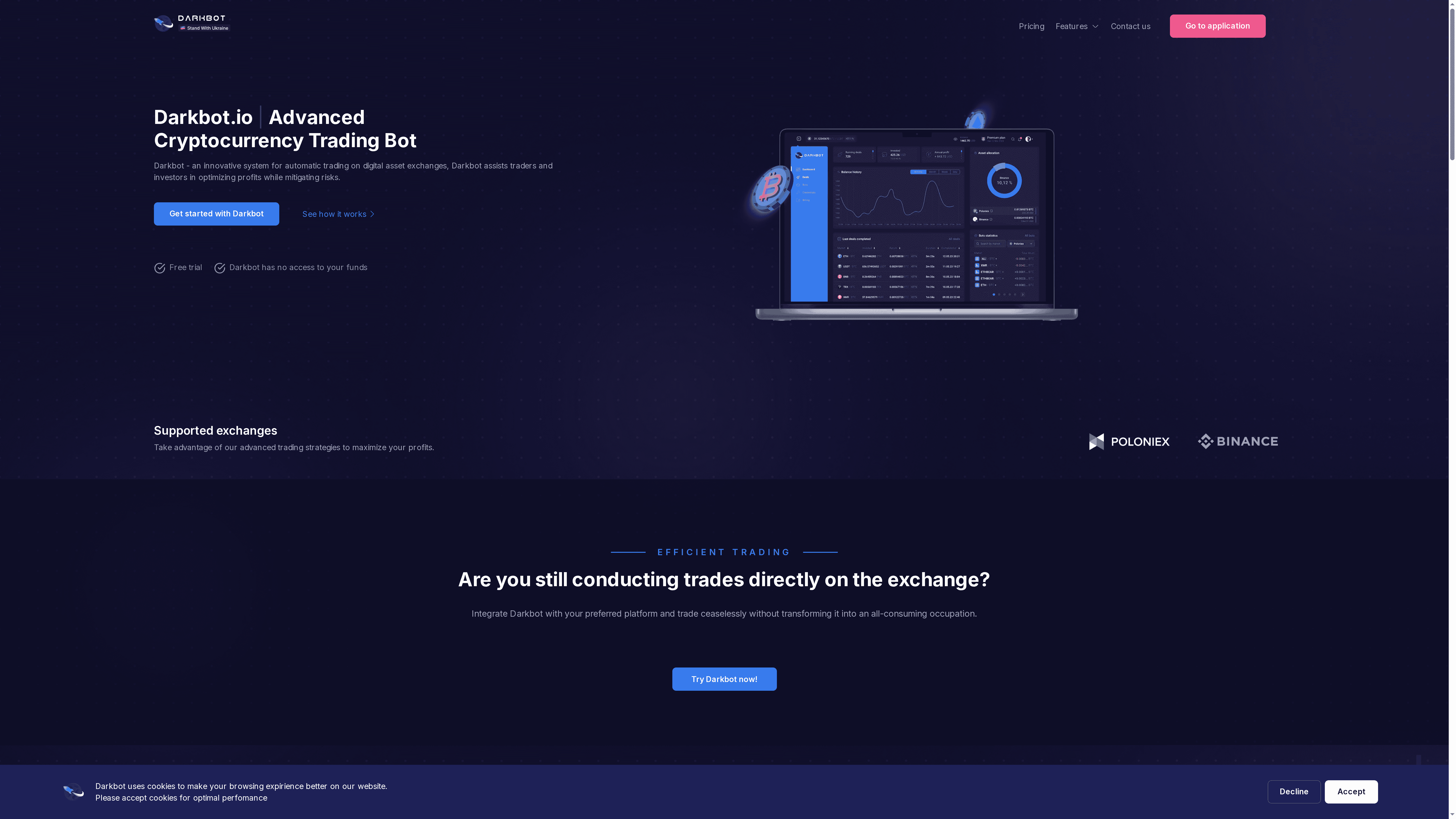
Discover how Darkbot.io empowers you to overcome these challenges with advanced AI-driven crypto trading bots. Our platform offers seamless exchange integration via API keys, customizable strategies, and automated portfolio rebalancing so you can confidently automate your trades. Whether you want to deploy multiple simultaneous bots or fine-tune your tactics using real-time analytics, Darkbot.io provides the tools and support to simplify your trading journey. Start automating smarter today by visiting our landing page and unlock your potential in volatile crypto markets.
Frequently Asked Questions
What are crypto trading bots?
Crypto trading bots are automated software programs that execute trading strategies for cryptocurrencies on digital asset exchanges. They leverage computational technology to make trades based on predefined parameters, minimizing emotional interference and enabling 24/7 trading.
How do crypto trading bots work?
Crypto trading bots operate by analyzing market data in real-time, generating trading signals based on predefined rules, and executing buy or sell orders automatically. They collect data on price movements, trading volumes, and other technical indicators, acting quickly to capitalize on market opportunities.
What types of trading strategies can crypto bots implement?
Crypto trading bots can implement various trading strategies, including arbitrage (exploiting price differences across exchanges), market making (providing liquidity), trend following (trading based on market momentum), dollar cost averaging (automating recurring purchases), and grid trading (executing trades within specific price ranges).
What are the risks associated with using crypto trading bots?
While crypto trading bots can improve trading efficiency, they also come with security risks. Potential vulnerabilities include coding errors, hacks, and exploitation of transaction reordering in decentralized exchanges. Best practices include comprehensive API key restrictions, two-factor authentication, and regular security audits to safeguard investments.

Start trading on Darkbot with ease
Come and explore our crypto trading platform by connecting your free account!
Free plan available • No credit card required