Crypto Trading Strategy Optimization Steps for Profits

Stepping into the world of cryptocurrency can feel unpredictable with markets that never sleep and price swings every hour. For traders and gig workers balancing busy schedules, the constant need to watch the screen rarely fits real life. Learning how to build and automate a strategic trading framework allows you to set clear goals and transform your approach, so your strategy works for you around the clock. Discover how practical tools and careful planning can help you reduce manual effort while aiming for more consistent results.
Quick Summary
| Key Takeaway | Explanation |
|---|---|
| 1. Conduct thorough market analysis | Evaluate price behavior, trading volume, and trends for informed decision-making. |
| 2. Set clear trading goals | Define investment horizon, risk levels, and profit targets to guide your strategy. |
| 3. Configure automated trading parameters | Establish entry and exit conditions, along with risk management guidelines for consistency. |
| 4. Integrate APIs securely | Use secure authentication and data synchronization during exchange integration for safe trading. |
| 5. Continuously optimize strategies | Analyze performance metrics and adjust parameters to enhance trading effectiveness over time. |
Step 1: Assess Market Conditions and Define Goals
Successful cryptocurrency trading begins with a strategic approach to understanding market dynamics and setting clear, achievable goals. In this crucial first step, you’ll develop a comprehensive framework for evaluating current market conditions and establishing realistic trading objectives.
To start, you’ll need to conduct a thorough cryptocurrency market analysis that goes beyond surface-level observations. This involves examining several key factors:
- Price behavior across different timeframes
- Trading volume and market liquidity
- Historical volatility patterns
- Macroeconomic indicators affecting digital assets
- Emerging trends in blockchain technology
Defining your trading goals requires a strategic approach that aligns with your risk tolerance and financial objectives. Consider creating a structured goal framework that includes:
- Determine your investment horizon
- Calculate acceptable risk levels
- Set specific profit targets
- Establish portfolio diversification strategy
- Define exit and entry criteria
Market success comes from understanding the landscape, not predicting its every move.
Your goals should be specific, measurable, and adaptable. Remember that cryptocurrency markets operate 24/7, which means continuous monitoring and strategy refinement are essential for long-term success.
Pro tip: Develop a trading journal to track your market observations, helping you refine your strategy and learn from both successful and unsuccessful trades.
Step 2: Configure Automated Strategy Parameters
Configuring automated trading strategy parameters is the critical bridge between your market analysis and actual trading execution. This step transforms your initial market insights into a precise, actionable trading framework that can operate consistently across volatile cryptocurrency markets.
To effectively configure trading bot settings, you’ll need to establish a comprehensive set of parameters that define your trading logic. These parameters act as the strategic blueprint for your automated trading system:
- Entry conditions specifying when to initiate trades
- Exit strategies determining profit-taking and loss mitigation
- Risk management thresholds
- Position sizing rules
- Timeframe selection for trading signals
Implementing these parameters requires careful consideration of multiple factors:
- Analyze historical market performance
- Define precise buying and selling criteria
- Set stop-loss and take-profit levels
- Configure portfolio allocation percentages
- Establish risk tolerance boundaries
Successful automated trading relies on disciplined parameter configuration, not magical predictions.
Different trading strategies demand unique parameter approaches. For instance, Grid Trading requires defining specific price ranges, while Dollar-Cost Averaging focuses on systematic investment scheduling. Your configuration should remain flexible, allowing periodic refinement based on ongoing market performance.
Here’s a quick comparison of automated trading strategies for cryptocurrencies:
| Strategy Type | Key Function | Ideal Use Case | Business Impact |
|---|---|---|---|
| Grid Trading | Buys/sells in price bands | Sideways or volatile markets | Generates consistent small profits |
| Dollar-Cost Averaging | Invests fixed amounts regularly | Long-term portfolio building | Reduces timing risk, builds position |
| Momentum Trading | Follows price trends | Trending markets | Captures rapid gains, higher risk |
| Arbitrage Bots | Exploits price differences | Multi-exchange setups | Seeks low-risk profits, needs fast execution |
Pro tip: Implement a systematic backtesting process to validate your strategy parameters before deploying real capital, allowing you to simulate and optimize performance without financial risk.
Step 3: Integrate Exchange APIs and Secure Data
Successful cryptocurrency trading automation hinges on seamlessly connecting your trading platform with exchange APIs while maintaining robust security protocols. This critical step transforms your strategy from theoretical concept to live trading capability.
When integrating cryptocurrency exchange APIs, you’ll need to navigate a complex landscape of authentication, permissions, and data synchronization. The integration process involves several strategic components:
- Generate API keys with restricted trading permissions
- Implement secure authentication protocols
- Configure IP whitelisting
- Enable two-factor authentication
- Test API connections in sandbox environments
Your API integration workflow should follow these systematic steps:
- Select compatible cryptocurrency exchanges
- Create exchange account with API access
- Generate restricted API keys
- Configure security settings
- Validate API connection stability
Security is not a feature. It’s the foundation of successful automated trading.
Different exchanges offer varying API capabilities, so understanding the specific endpoints and protocols for platforms like Binance, Coinbase, and Kraken is crucial. Each platform has unique requirements for REST and WebSocket connections, rate limits, and data retrieval mechanisms.
Pro tip: Always use API keys with minimal necessary permissions and regularly rotate your credentials to maintain optimal security for your automated trading infrastructure.
Step 4: Fine-Tune Bot Settings Using Analytics
Optimizing your cryptocurrency trading bot requires a methodical approach to analyzing performance and dynamically adjusting strategy parameters. This critical phase transforms raw trading data into actionable insights that continuously improve your automated trading system.
When configuring AI-powered trading bots, you’ll need to leverage comprehensive analytics to refine your trading strategy. The fine-tuning process involves several key analytical components:
- Performance metrics tracking
- Risk management evaluation
- Indicator sensitivity adjustment
- Position sizing optimization
- Market condition correlation analysis
Your bot fine-tuning workflow should incorporate these systematic steps:
- Collect comprehensive trading performance data
- Analyze historical trade execution patterns
- Identify strategy strengths and weaknesses
- Adjust parameters incrementally
- Validate changes through backtesting
Machine learning transforms data into intelligent trading decisions.
Successful bot optimization requires continuous monitoring and willingness to adapt. Machine learning algorithms can help dynamically adjust strategies in real-time, responding to subtle market shifts and emerging trading opportunities.

Pro tip: Implement a staged optimization approach by testing parameter changes on small trading positions before full-scale deployment to minimize potential risks.
Step 5: Validate Performance and Adjust Strategies
Validating and refining your cryptocurrency trading strategy is a continuous process that transforms raw performance data into actionable insights. This critical stage ensures your automated trading system remains adaptive and responsive to changing market conditions.
Through advanced machine learning frameworks, you can systematically evaluate your trading strategy’s effectiveness across multiple performance metrics. The validation process involves comprehensive analysis of key indicators:
- Mean absolute error calculation
- R-squared value assessment
- Risk-adjusted return analysis
- Drawdown percentage measurement
- Comparative benchmark evaluation
Your performance validation workflow should include these essential steps:
- Collect comprehensive trading data
- Calculate multi-dimensional performance metrics
- Compare against historical market benchmarks
- Identify strategy improvement opportunities
- Implement incremental strategic adjustments
True trading mastery lies in continuous learning and adaptation.
Successful strategy validation requires a disciplined approach that balances quantitative analysis with nuanced market understanding. Machine learning algorithms can help detect subtle patterns and recommend strategic refinements that might escape manual review.
The following table summarizes key performance metrics commonly used in trading strategy validation:
| Metric | Purpose | Typical Outcome | Optimization Potential |
|---|---|---|---|
| Mean Absolute Error | Measures prediction accuracy | Lower is better | Tweak models for improvement |
| R-squared Value | Assesses fit to data | Higher is better | Refine input variables |
| Risk-Adjusted Return | Evaluates risk vs reward | Balance sought | Adjust allocation, risk limits |
| Drawdown Percentage | Tracks maximum loss | Minimize value | Tighten stop-loss, diversify more |
| Benchmark Comparison | Checks against market returns | Beats baseline | Learn from successful strategies |
Pro tip: Create a structured performance log documenting each strategy adjustment, enabling you to track the impact of changes and build a systematic approach to trading optimization.
Take Your Crypto Trading Strategy to the Next Level with Automation
Understanding and optimizing crypto trading strategies can be overwhelming with ever-changing market conditions and complex parameters for entry, exit, and risk management. This article highlights the critical pain points like configuring automated strategy parameters, integrating exchange APIs securely, and fine-tuning bots using analytics to boost profitability while managing risk. Don’t let manual trading challenges slow you down or leave profits on the table.
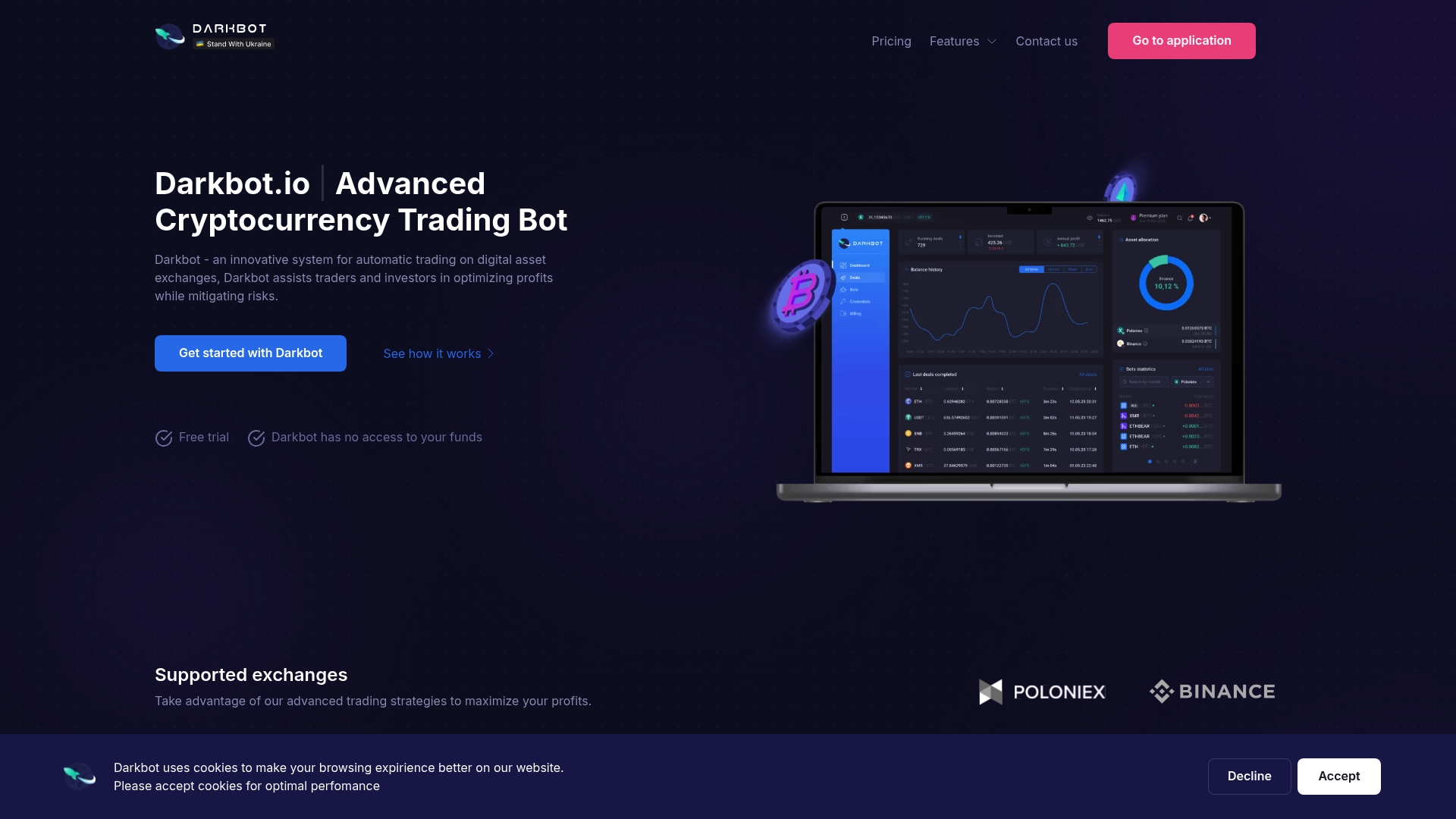
Unlock smarter trading with Darkbot.io, an advanced SaaS platform designed to automate your cryptocurrency strategies efficiently across multiple exchanges. Benefit from seamless API integration, AI-driven strategy optimization, real-time analytics, and secure portfolio management all in one intuitive interface. Whether you are just starting or an experienced trader, now is the moment to transform your trading approach. Get started at Darkbot.io and see how automation can simplify your crypto journey while maximizing profits with less guesswork.
Frequently Asked Questions
What are the key steps to optimize a cryptocurrency trading strategy for profits?
To optimize a cryptocurrency trading strategy for profits, you should assess market conditions, configure automated strategy parameters, integrate exchange APIs with strong security, fine-tune bot settings using analytics, and validate performance to make ongoing adjustments. Start by defining your trading goals and establishing market insights to guide your strategy.
How can I define specific goals for my cryptocurrency trading strategy?
You can define specific goals by determining your investment horizon, calculating acceptable risk levels, setting profit targets, and establishing a diversification strategy. Write down your goals to keep them measurable and adaptable, helping you stay focused on achieving them.
What parameters should I configure for my automated trading bot?
You should configure parameters that include entry conditions, exit strategies, risk management thresholds, position sizing rules, and the timeframe for trading signals. Set these parameters based on historical market performance to ensure your bot operates efficiently in the current market conditions.
How can I use analytics to fine-tune my trading bot settings?
Utilize performance metrics tracking and analyze historical trade execution patterns to fine-tune your trading bot settings. Adjust parameters incrementally based on established performance metrics, and validate these changes by backtesting to ensure optimal execution in real-time trading scenarios.
What performance metrics should I focus on when validating my trading strategy?
Focus on metrics such as mean absolute error, risk-adjusted return, and drawdown percentage to validate your trading strategy. Collect data on these metrics regularly and compare them against benchmarks to identify areas for improvement and make necessary adjustments to your strategy.
Recommended
- Cryptocurrency Trading Strategy Guide 2025: Automate Success
- Crypto Bot Strategy Optimization Guide for Maximizing Profits
- Crypto Trading Strategy Optimization for Profitable Automation
- 7 Examples of Trading Strategies for Beginner Crypto Traders
- Top 5 Investiciono-zlato.com Alternativa 2026 za Individualne Investitore i Kolekcionare Zlata

Start trading on Darkbot with ease
Come and explore our crypto trading platform by connecting your free account!
Free plan available • No credit card required