How to Automate Crypto Trading for Maximum Efficiency

Trading bots are powering a quiet revolution in the american crypto market, with over 80 percent of crypto trades now executed by algorithms. For any trader looking to stay competitive, understanding how to build and manage these automated systems has become essential. This guide lays out clear steps for selecting platforms, customizing strategies, managing risk, and keeping your trading operation both secure and effective from start to finish.
Table of Contents
- Step 1: Assess Platform And Connect Exchanges
- Step 2: Customize Trading Strategies And Bots
- Step 3: Configure Risk Controls And Automation Settings
- Step 4: Test Bots With Paper Trading Or Backtesting
- Step 5: Activate Automation And Monitor Performance
Quick Summary
| Important Insight | Detailed Explanation |
|---|---|
| 1. Choose reliable exchanges | Select cryptocurrency exchanges based on reliability, trading volume, and strong API documentation to ensure successful integrations. |
| 2. Implement secure API practices | Use read-only API keys initially and store keys securely to protect your trading bot from unauthorized access. |
| 3. Set comprehensive risk controls | Establish risk management features like stop-loss orders tailored to your trading strategies, adjusting ranges based on market conditions. |
| 4. Conduct thorough testing | Test your trading bot using backtesting and paper trading to validate strategies without risking actual capital in real markets. |
| 5. Monitor and adjust regularly | Activate your bot with live monitoring tools and maintain a consistent review schedule for performance analysis and strategy optimization. |
Step 1: Assess Platform and Connect Exchanges
Connecting cryptocurrency exchanges is your gateway to automated trading success. In this critical setup phase, you will strategically select trading platforms and establish secure API connections that enable your trading bot to execute strategies automatically.
Carefully choose cryptocurrency exchanges based on their reliability, trading volume, and API robustness. According to tas.co.in, selecting a reputable exchange with substantial trading volume and robust API documentation is crucial. Popular platforms like Binance, Coinbase Pro, and Kraken offer excellent trading infrastructure. When generating API keys, implement strict security practices. Store your keys in secure environment variables and limit API permissions to only the functions your trading bot requires.
Pro Tip: Always use read-only API keys initially. This prevents unauthorized withdrawals and adds an extra layer of security to your trading setup.
Before connecting multiple exchanges, verify each platform supports your preferred trading strategies. Some exchanges have different fee structures, trading pairs, and API limitations that could impact your bot’s performance. Take time to understand each platform’s specific requirements and integration processes. Your careful preparation now will streamline your automated trading journey and help minimize potential complications down the road.
Step 2: Customize Trading Strategies and Bots
Customizing your cryptocurrency trading bot requires strategic planning and advanced algorithmic techniques. This critical phase transforms a basic trading script into a sophisticated automated system capable of executing complex market strategies with precision.
Recent research from arxiv.org highlights the potential of advanced frameworks like FinRL, which facilitate the development of customized trading strategies using deep reinforcement learning. These modular structures allow you to implement sophisticated algorithms that adapt to specific market conditions. When designing your trading bot, focus on key parameters such as entry and exit points, risk management settings, and performance indicators. Consider creating multiple strategy profiles that can dynamically switch based on market volatility or specific cryptocurrency pair behaviors.
Pro Tip: Start with conservative risk settings and gradually optimize your bot’s parameters as you gain more trading data and understand its performance.
Advanced traders can leverage hierarchical reinforcement learning techniques, similar to the EarnHFT framework, which enables creating diverse agent pools trained with different return rate preferences. This approach allows your trading bot to adapt more flexibly to changing market trends. Remember that successful bot customization is an iterative process requiring continuous monitoring, data analysis, and strategic refinement. Your goal is to create a resilient trading system that can navigate the complex and unpredictable cryptocurrency markets with intelligent, data driven decision making.
Step 3: Configure Risk Controls and Automation Settings
Configuring risk controls and automation settings is your critical safeguard against potential trading losses. This essential step transforms your trading bot from a simple execution tool into a sophisticated risk management system that protects your investment capital.
According to tas.co.in, implementing strategic risk management features like stop-loss and take-profit orders is crucial. Different trading strategies require varied stop-loss ranges. For instance, scalping strategies typically need tight stop-losses between 0.2% and 0.5%, while swing trading might employ wider ranges around 5% to 10%. The key is to create a flexible risk management framework that adapts to your specific trading approach and market conditions.
Pro Tip: Always set your stop-loss levels based on your total portfolio risk tolerance, not just individual trade potential.
As recommended by minddeft.com, integrating automated risk management tools allows your bot to close positions automatically at predefined profit or loss levels. Consider implementing advanced features like trailing stop-loss, which can help secure profits during strong market trends. These intelligent automation settings create a dynamic defense mechanism that protects your investments while allowing potential gains to run. The goal is to design a system that makes calculated decisions faster and more objectively than manual trading ever could.

Step 4: Test Bots With Paper Trading or Backtesting
Testing your cryptocurrency trading bot is a critical step that determines its potential real world performance without risking actual capital. This phase allows you to validate your bot’s strategy and identify potential weaknesses before deploying live trading configurations.
Research from arxiv.org highlights the importance of comprehensive testing through platforms like FinRL, which provide a robust pipeline for developing and evaluating trading strategies. These advanced testing frameworks enable you to simulate various market environments using historical data, giving you a detailed preview of how your bot might perform under different market conditions. When conducting backtests, focus on key performance metrics such as total returns, maximum drawdown, win rate, and risk adjusted return.
Pro Tip: Always use multiple years of historical data and test your bot across different market cycles to ensure true performance validation.
Paper trading offers an additional layer of validation by simulating real time trading with current market conditions using virtual money. This approach allows you to observe your bot’s decision making processes in near live environments without financial risk. Pay close attention to how your bot adapts to market volatility, executes trades, and manages unexpected price movements. Remember that successful testing is an iterative process. Be prepared to refine your strategy based on insights gained during backtesting and paper trading sessions.
Step 5: Activate Automation and Monitor Performance
Activating your cryptocurrency trading bot marks the transition from preparation to live market engagement. This critical phase transforms your carefully developed strategy from theoretical potential into real world trading performance.
According to tas.co.in, deploying your bot requires robust monitoring tools including live alerts for unusual market conditions and comprehensive performance dashboards. Implement automated circuit breakers that can halt trading if losses exceed predefined limits or if unexpected technical issues arise. These safeguards protect your investment from potential catastrophic losses during sudden market shifts.
Pro Tip: Set up real time notifications on your mobile device to track critical bot performance metrics even when you are away from your computer.
As recommended by azcryptoexchanges.com, establish a consistent review schedule tailored to your trading strategy. High frequency strategies demand daily performance checks, while longer term approaches might require weekly comprehensive analyses. Focus on key performance indicators such as win rate, average profit per trade, and overall portfolio performance. Be prepared to make incremental adjustments based on emerging performance data. Remember that successful automated trading is an ongoing process of observation, analysis, and strategic refinement.
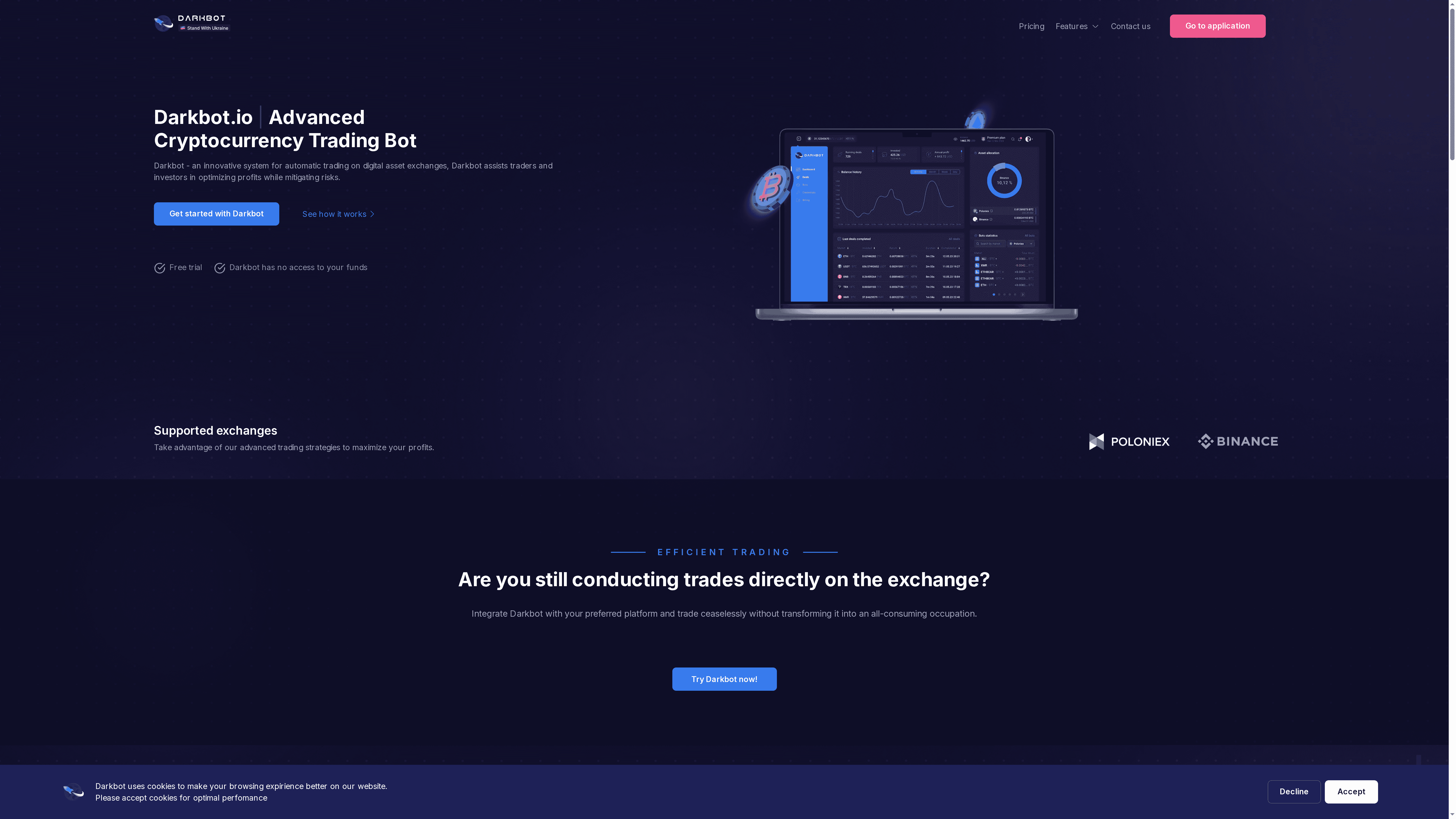
Unlock the Full Potential of Automated Crypto Trading with Darkbot.io
The article highlights key challenges like securely connecting exchanges, customizing strategies, managing risk, and continuously monitoring bot performance. These pain points are common hurdles that can slow down or complicate your goal to automate crypto trading efficiently. You need a solution that simplifies API integration, offers flexible strategy customization, and provides powerful risk controls with real-time analytics. Darkbot.io addresses these exact needs by delivering an intuitive platform designed for traders who want to maximize profits while minimizing manual effort and risk.
Experience seamless exchange integration with secure API key management, multiple simultaneous bots setup to test custom strategies, and automated portfolio rebalancing that adapts to market volatility. Darkbot.io empowers both novice and expert traders with AI-driven algorithms and easy-to-use automation controls so you can protect your capital and optimize returns. Whether you are looking to automate scalping or swing trading, the platform’s sophisticated yet approachable tools make it possible.
Start transforming your crypto trading journey today with [Darkbot.io
 ](
](
Ready to reduce risk and improve trading efficiency? Visit Darkbot.io now to explore plans that fit your trading style and experience hands-on control over your automated strategies. Make the smart choice to automate with confidence and never miss out on crypto opportunities again.
Frequently Asked Questions
What platforms should I consider for automating crypto trading?
Choose cryptocurrency exchanges based on their reliability, trading volume, and strong API documentation. Start by selecting exchanges like Binance, Coinbase Pro, or Kraken, which provide robust trading infrastructure.
How do I implement risk controls in my automated trading bot?
To implement risk controls, set stop-loss and take-profit orders tailored to your trading strategy. For example, scalping strategies might use tight stop-losses of 0.2% to 0.5%, while swing trading may require wider ranges of 5% to 10%.
What is the best way to test my crypto trading bot before going live?
Conduct backtesting using historical data to evaluate your bot’s performance across various market conditions. Aim to use multiple years of historical data and simulate different market cycles to ensure your strategy is sound.
How can I effectively monitor my trading bot’s performance?
Implement robust monitoring tools that provide live alerts for unusual market conditions and performance metrics. Set up a review schedule that fits your strategy type; high-frequency strategies may require daily checks, while longer-term methods could be reviewed weekly.
How do I set up API connections securely for my trading bot?
When setting up API connections, generate keys while adhering to strict security practices by using read-only API keys initially. Store your keys in secure variables and limit permissions to only what your bot needs for trading tasks.
What are the key components to customize in my trading bot?
Focus on customizing parameters such as entry and exit points, risk management settings, and performance indicators. Consider designing multiple strategy profiles that can easily adapt to changes in market conditions or cryptocurrency pair behaviors.
Recommended

Start trading on Darkbot with ease
Come and explore our crypto trading platform by connecting your free account!
Free plan available • No credit card required