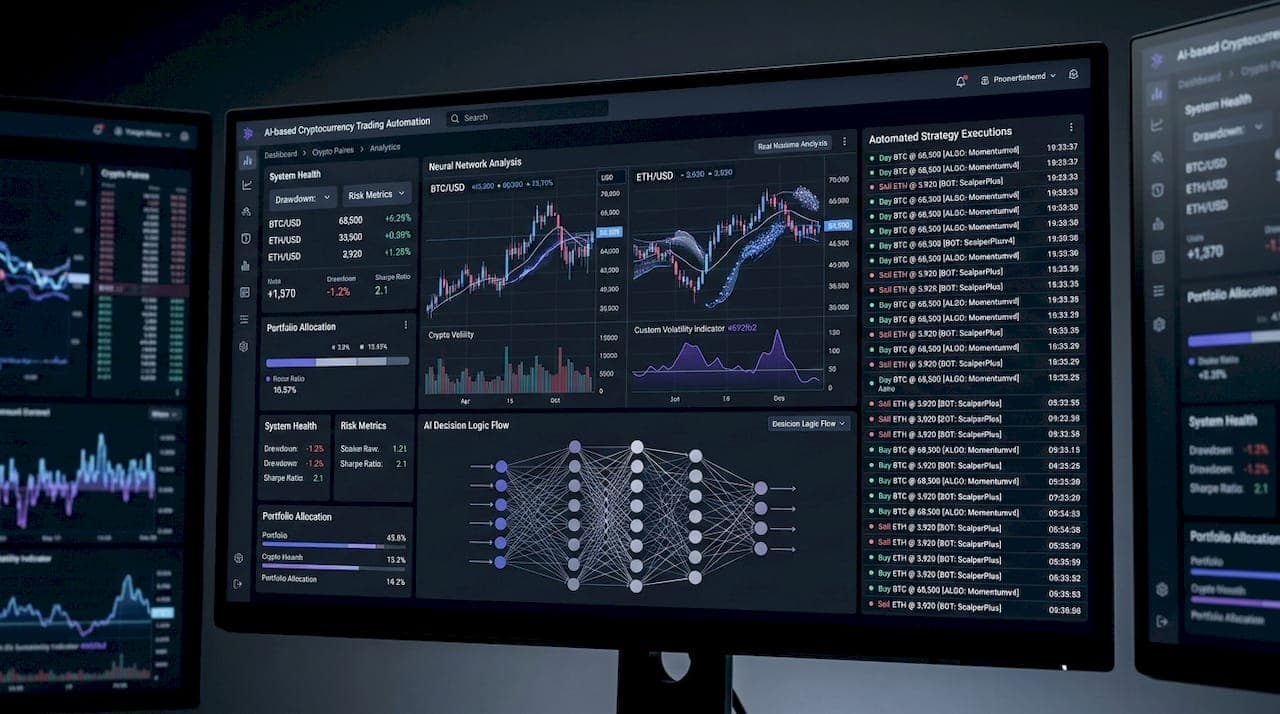
Machine Learning in Finance – Maximizing Trading Efficiency

Trading in volatile cryptocurrency markets often means juggling rapid price shifts, tough risk decisions, and massive streams of real-time data. For busy professionals and algorithmic trading enthusiasts, finding smarter ways to analyze trends and automate strategies is essential. Machine learning offers powerful, data-driven tools that help uncover hidden patterns, enhance risk assessment, and adapt trading systems faster. Explore how these advanced technologies drive smarter trading outcomes and continuous strategy improvement for global investors.
Key Takeaways
| Point | Details |
|---|---|
| Machine Learning Transforms Finance | Machine learning revolutionizes financial analysis by extracting insights from complex datasets that traditional methods cannot manage. |
| Key Applications | Techniques like predictive analytics and algorithmic trading enhance decision-making and risk assessment in finance. |
| Risks and Misconceptions | Understanding the limitations and risks, such as model interpretability and data quality, is essential for effective use of machine learning. |
| Ongoing Optimization | Successful implementation requires continuous model validation and optimization, alongside robust security protocols. |
Machine Learning in Finance Explained
Machine learning represents a revolutionary approach to financial analysis, transforming how investment strategies are developed and executed. By leveraging advanced algorithms and statistical models, machine learning enables financial professionals to extract meaningful insights from complex datasets that traditional methods cannot effectively process.
The core of machine learning in finance revolves around several key techniques and applications:
- Predictive Analytics: Forecasting market trends and asset prices
- Risk Assessment: Identifying potential financial risks with greater accuracy
- Algorithmic Trading: Developing sophisticated trading strategies
- Fraud Detection: Recognizing unusual transaction patterns
Advanced computational techniques have dramatically expanded the capabilities of financial machine learning models. These models can now process massive amounts of historical and real-time data, uncovering patterns that human analysts might miss.
Modern machine learning approaches in finance go beyond simple statistical regression. Deep learning neural networks can now analyze complex, non-linear relationships within financial markets, providing more nuanced and adaptive predictive models. These models can incorporate multiple data sources, from traditional financial statements to social media sentiment and macroeconomic indicators.
Key Benefits of Machine Learning in Finance:
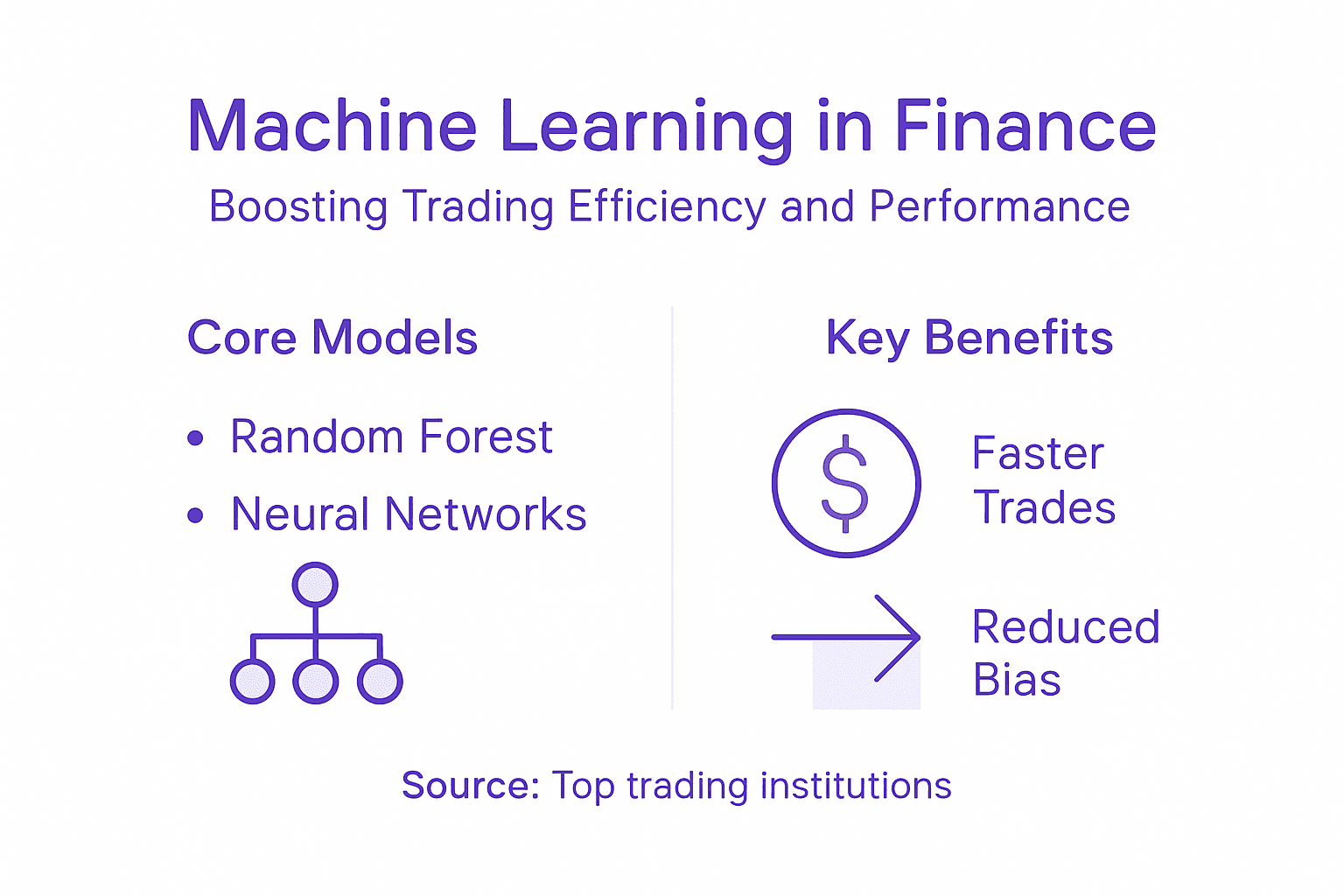
- Enhanced decision-making speed
- More comprehensive data analysis
- Reduced human cognitive bias
- Improved risk management
- Dynamic strategy adaptation
By integrating machine learning techniques, financial institutions can develop more robust, data-driven strategies that respond quickly to market changes. The technology allows for continuous learning and model refinement, creating increasingly sophisticated analytical tools.
Pro tip: Always validate machine learning models using multiple testing scenarios and maintain human oversight to ensure algorithmic trading strategies remain aligned with broader financial objectives.
Major Types and Technologies Used
Financial machine learning encompasses a diverse array of sophisticated technologies designed to extract meaningful insights and drive intelligent decision-making in complex market environments. Advanced machine learning models have revolutionized financial analysis by providing powerful computational techniques that can process massive datasets and uncover intricate patterns.
Key machine learning technologies utilized in financial domains include:
- Random Forest: Ensemble learning method for complex prediction tasks
- Support Vector Machines (SVM): Powerful classification and regression algorithms
- Long Short-Term Memory (LSTM): Neural network architecture for time series analysis
- XGBoost: Gradient boosting framework for high-performance predictions
- Convolutional Neural Networks (CNN): Advanced pattern recognition in financial data
These technologies offer unique capabilities for addressing different financial challenges. Random Forest algorithms, for instance, excel at handling non-linear relationships and managing multiple variable interactions, making them particularly effective for risk assessment and portfolio optimization.

Here’s how popular machine learning models differ in finance:
| Model Type | Best Application | Key Strength |
|---|---|---|
| Random Forest | Risk assessment | Handles many variables |
| LSTM | Time-series forecasting | Learns temporal trends |
| SVM | Credit scoring | Strong for boundaries |
| CNN | Pattern recognition | Detects data anomalies |
| XGBoost | Portfolio optimization | Fast with big datasets |
Deep Learning Approaches:
- Advanced neural network architectures
- Ability to process complex, multidimensional financial data
- Adaptive learning mechanisms
- Enhanced predictive accuracy
- Reduced human intervention
Large language models in finance have emerged as transformative tools for natural language processing tasks, enabling more sophisticated analysis of financial texts, reports, and market sentiments. These models can be fine-tuned to specific financial domains, providing nuanced insights that traditional analytical methods cannot achieve.
Hybrid approaches combining multiple machine learning techniques are becoming increasingly prevalent, allowing financial institutions to develop more robust and adaptable predictive models that can quickly respond to dynamic market conditions.
Pro tip: Regularly update and retrain machine learning models to ensure they remain accurate and relevant in rapidly changing financial landscapes.
Top Real-World Applications in Trading
Machine learning applications in financial markets have dramatically transformed trading strategies across multiple domains, offering unprecedented capabilities for data analysis and decision-making. These advanced technologies enable traders to process complex market information with remarkable precision and speed.
Key real-world applications of machine learning in trading include:
- Algorithmic Trading: Automated execution of trading strategies
- Market Prediction: Forecasting price movements and trends
- Portfolio Optimization: Intelligent asset allocation and risk management
- Sentiment Analysis: Evaluating market emotions and investor behavior
- High-Frequency Trading: Rapid decision-making in microsecond timeframes
In algorithmic trading, machine learning models can analyze historical price data, market indicators, and external factors to develop sophisticated trading strategies. These models continuously learn and adapt, improving their predictive capabilities by identifying subtle patterns that human traders might overlook.
Performance Advantages:
- Faster decision processing
- Reduced emotional bias
- Consistent strategy execution
- Multi-dimensional data analysis
- Adaptive learning mechanisms
Advanced AI models in financial forecasting have demonstrated exceptional performance across various markets, including equities, cryptocurrencies, commodities, and forex. By capturing nonlinear market dynamics, these models provide traders with more nuanced and contextually aware trading insights.
Hybrid machine learning approaches are increasingly becoming standard, combining multiple algorithmic techniques to create more robust and resilient trading systems that can navigate complex and volatile market conditions.
Pro tip: Develop a systematic approach to testing and validating machine learning trading models, ensuring consistent performance across different market scenarios.
Risks, Challenges, and Common Misconceptions
Machine learning challenges in finance reveal complex limitations that traders and investors must carefully understand. Despite technological advancements, machine learning is not a guaranteed solution but a sophisticated tool requiring nuanced implementation.
Key risks and challenges in financial machine learning include:
- Model Interpretability: Difficulty understanding complex algorithmic decisions
- Overfitting: Creating models too closely aligned with historical data
- Data Quality: Dependency on accurate, comprehensive information
- Algorithmic Bias: Potential for unintended discriminatory patterns
- Computational Complexity: High resource requirements for advanced models
One significant misconception is that machine learning algorithms can consistently predict market movements with absolute precision. In reality, these models provide probabilistic insights, not guaranteed outcomes. They analyze patterns and probabilities but cannot eliminate inherent market uncertainties.
Common Misconceptions:
- Machine learning guarantees profit
- Algorithms can perfectly predict market trends
- More complex models always perform better
- Human oversight is unnecessary
- All data inputs are equally valuable
Financial machine learning risks extend beyond technical challenges, encompassing ethical and social dimensions. Successful implementation requires robust data governance, continuous model validation, and a deep understanding of underlying economic principles.
Traders must recognize that machine learning models are tools for augmenting human decision-making, not replacing critical thinking. They provide insights and probabilities but should not be blindly trusted without rigorous testing and domain expertise.
This table summarizes common challenges vs. solutions in financial machine learning:
| Challenge | Practical Solution |
|---|---|
| Overfitting | Use cross-validation |
| Data Quality Issues | Implement robust preprocessing |
| Model Complexity | Prioritize interpretability |
| Algorithmic Bias | Regular fairness assessments |
| High Cost | Optimize computational resources |
Pro tip: Implement a systematic model validation process that includes backtesting, cross-validation, and regular performance assessments to mitigate potential machine learning risks.
Optimizing Strategies and Ensuring Security
Financial machine learning optimization requires a comprehensive approach that balances technological sophistication with robust security protocols. Successful implementation demands more than advanced algorithms; it necessitates a holistic strategy addressing performance, risk management, and data integrity.
Key strategies for optimizing machine learning trading models include:
- Feature Engineering: Developing sophisticated input selection techniques
- Data Preprocessing: Cleaning and normalizing complex financial datasets
- Model Validation: Implementing rigorous testing across multiple market scenarios
- Adaptive Learning: Creating flexible algorithms that evolve with market conditions
- Performance Monitoring: Continuous assessment of model effectiveness
Effective optimization requires understanding the intricate balance between model complexity and practical usability. Traders must develop models that can adapt to changing market dynamics while maintaining predictable and controllable behavior.
Security Optimization Principles:
- Implement multi-layer authentication
- Use encrypted data transmission
- Develop comprehensive access control mechanisms
- Create detailed audit trails
- Regularly update security protocols
Advanced trading model validation emphasizes the importance of temporal stability and interpretability. This approach ensures that machine learning models remain reliable across different market conditions, reducing potential operational risks and unexpected performance variations.
Successful strategy optimization is not about creating the most complex model, but developing a robust, transparent, and adaptable system that can provide consistent, reliable insights while maintaining the highest standards of data protection and ethical trading practices.
Pro tip: Implement a comprehensive model governance framework that includes regular security audits, performance reviews, and adaptive refinement processes to maintain optimal trading strategy effectiveness.
Unlock Trading Efficiency with Machine Learning-Powered Automation
The article highlights key challenges like optimizing trading strategies, managing risks, and adapting to dynamic markets through sophisticated machine learning models. If you are seeking to overcome overfitting issues, enhance predictive accuracy, and automate complex decision processes while maintaining full control and security, Darkbot.io offers a perfect solution. By leveraging advanced AI and machine learning algorithms, Darkbot.io empowers traders to automate and refine strategies seamlessly across multiple cryptocurrency exchanges, helping you stay ahead in volatile financial environments.

Experience the future of crypto trading through a platform designed for both novices and experts. Benefit from real-time analytics, customizable strategies, and secure API integrations that translate the article’s concepts into actionable profits. Ready to reduce manual effort and maximize your trading efficiency today Visit Darkbot.io and start your journey with an AI-powered trading bot designed to adapt, optimize, and secure your digital assets. Explore features tailored for algorithmic trading, risk management, and portfolio optimization at Darkbot.io to transform insights into results.
Frequently Asked Questions
What is machine learning in finance?
Machine learning in finance refers to the application of advanced algorithms and statistical models to analyze complex financial datasets, enabling financial professionals to develop investment strategies and insights that traditional methods may not uncover.
How does machine learning improve trading efficiency?
Machine learning enhances trading efficiency by automating data analysis, providing faster decision-making, reducing human bias, and enabling continuous learning and adaptation to changing market conditions.
What are some common machine learning models used in trading?
Common machine learning models in trading include Random Forest, Support Vector Machines (SVM), Long Short-Term Memory (LSTM) networks, and XGBoost, each offering unique advantages for tasks like risk assessment and portfolio optimization.
What are the risks associated with machine learning in finance?
The risks include model interpretability challenges, overfitting, data quality issues, algorithmic bias, and high computational complexity, all of which require careful management to ensure effective implementation.
Recommended
- Machine Learning in Trading 2025: Smarter Crypto Strategies
- Machine Learning in Trading Strategies: Crypto Automation Explained
- Machine Learning in Crypto Trading: Impact and Advantages
- Machine Learning in Cryptocurrency: Smarter Automated Trading
- The Future of FinTech: How AI is Reshaping Financial Services - BankStatementFlow Blog

Start trading on Darkbot with ease
Come and explore our crypto trading platform by connecting your free account!
Free plan available • No credit card required