Cryptocurrency Trading Algorithms: Smarter Profits, Fewer Risks

Most American crypto traders have seen how volatile digital assets can feel in high-inflation environments. When every market spike carries both risk and opportunity, advanced trading bots offer a clear advantage. By using sophisticated algorithms and smart automation, traders can react in milliseconds and minimize costly errors. Recent studies show that algorithmic trading accounts for over 80% of volume on leading digital exchanges. This guide spotlights the latest tools and techniques to help you automate strategies while managing risks efficiently.
Key Takeaways
| Point | Details |
|---|---|
| Understanding Algorithms | Familiarize yourself with various cryptocurrency trading algorithms and their strategies. |
| Risk Management | Implement strict risk management protocols to limit potential losses in trading. |
| AI and Machine Learning | Leverage AI and machine learning for data analysis to enhance trading decision-making. |
| Security and Compliance | Prioritize robust security measures and stay updated on compliance requirements across jurisdictions. |
What Are Cryptocurrency Trading Algorithms
Cryptocurrency trading algorithms represent sophisticated computational systems designed to execute trading strategies automatically across digital asset markets. These advanced programs leverage mathematical models, statistical analysis, and artificial intelligence to make trading decisions without direct human intervention. By analyzing massive datasets and market signals in microseconds, these algorithms can identify potential trading opportunities far more quickly than manual traders.

The core principle behind cryptocurrency trading algorithms involves systematically processing multiple data inputs to generate probabilistic trading signals. Advanced machine learning models can now assess price movements, market sentiment, trading volume, and external economic indicators simultaneously. These computational approaches transform raw market data into actionable trading instructions, enabling traders to implement complex strategies with precision and speed.
Modern cryptocurrency trading algorithms typically fall into several strategic categories: trend-following algorithms that identify and capitalize on market momentum, mean-reversion algorithms that trade based on price deviation from historical averages, and arbitrage algorithms that exploit price differences across multiple exchanges. Each algorithm type employs unique mathematical frameworks to evaluate market conditions, assess risk, and execute trades according to predefined rules. Some sophisticated systems even incorporate machine learning techniques that allow the algorithm to adapt and improve its decision-making process based on ongoing performance analysis.
Pro tip: When exploring cryptocurrency trading algorithms, start by thoroughly understanding the specific mathematical logic and risk management parameters built into each strategy before deploying real capital.
Types of Crypto Trading Algorithms Explained
Cryptocurrency trading algorithms represent sophisticated computational strategies designed to navigate the complex and volatile digital asset markets. These algorithms can be categorized into several distinct types, each employing unique mathematical models and computational approaches to generate trading signals and optimize investment performance. Multi-objective optimization techniques have become increasingly important in developing robust trading strategies that balance multiple performance criteria.
The primary categories of cryptocurrency trading algorithms include trend-following algorithms, mean-reversion algorithms, and arbitrage algorithms. Trend-following algorithms aim to capitalize on existing market momentum by identifying and trading in the direction of current price movements. These systems analyze historical price data, moving averages, and momentum indicators to detect potential sustained price trends. Mean-reversion algorithms, conversely, operate on the principle that asset prices tend to fluctuate around a long-term average, seeking to profit from price corrections when an asset deviates significantly from its historical baseline.
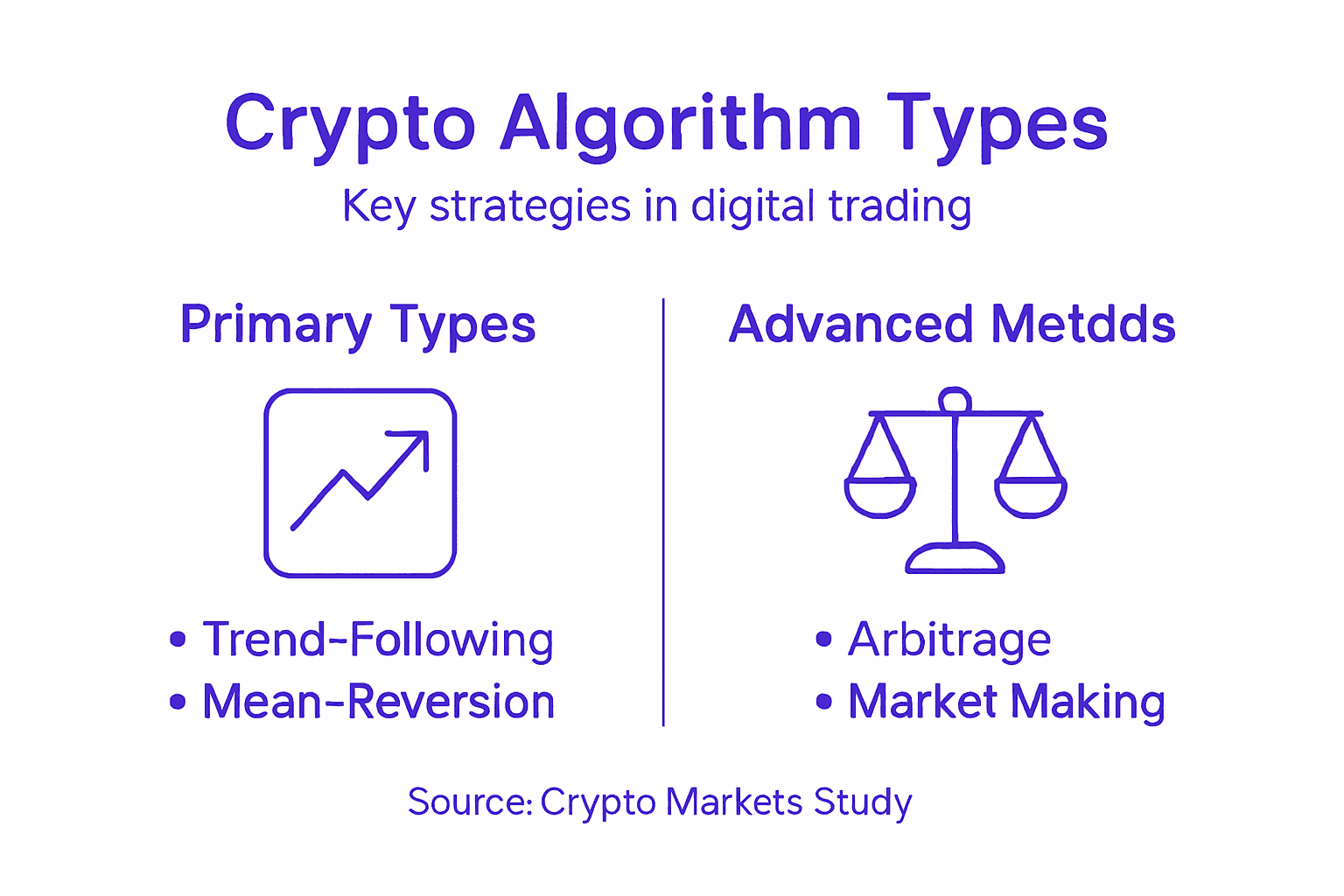
Arbitrage algorithms represent another sophisticated approach, focusing on exploiting price discrepancies across different cryptocurrency exchanges. These algorithms continuously monitor multiple markets simultaneously, identifying and executing trades that capitalize on momentary price differences. Advanced machine learning techniques have significantly enhanced the capabilities of these algorithms, enabling them to process vast amounts of market data and execute trades with unprecedented speed and precision. Some cutting-edge systems even incorporate sentiment analysis from social media and news sources to refine their trading decisions, adding an additional layer of sophisticated market intelligence.
Here’s how major types of crypto trading algorithms compare:
| Algorithm Type | Main Objective | Data Analyzed | Key Advantage |
|---|---|---|---|
| Trend-Following | Ride market momentum | Historical prices, averages | Profits from sustained trends |
| Mean-Reversion | Trade price corrections | Price deviations, historical avg | Identifies temporary mispricings |
| Arbitrage | Exploit exchange price gaps | Multi-exchange pricing data | Captures risk-free profit windows |
Pro tip: Always thoroughly backtest and simulate different algorithm types using historical market data before committing real capital to ensure the strategy’s reliability and potential performance.
How Trading Bots Operate Across Exchanges
Trading bots are sophisticated automated systems that navigate multiple cryptocurrency exchanges with precision and speed, executing complex trading strategies across diverse digital asset markets. These advanced computational tools leverage intricate technological infrastructures to continuously monitor market conditions, analyze price movements, and execute trades with minimal human intervention. Advanced trading bot architectures now integrate deep learning models that dynamically adapt to changing market environments.
The core operational mechanism of trading bots involves establishing secure API connections with various cryptocurrency exchanges, which enable real-time data retrieval and trade execution. These connections allow bots to simultaneously access multiple market platforms, comparing prices, assessing liquidity, and identifying potential arbitrage opportunities across different exchanges. Sophisticated bots can process massive volumes of market data in milliseconds, analyzing price trends, trading volumes, order book depths, and historical performance metrics to make instantaneous trading decisions.
Multi-exchange trading bots employ complex risk management protocols to protect investments and optimize trading performance. These systems continuously assess market volatility, implement predefined stop-loss and take-profit parameters, and dynamically adjust trading strategies based on real-time market feedback. Advanced algorithms can simultaneously manage positions across different cryptocurrency pairs and exchanges, balancing risk exposure and potential returns through intelligent portfolio diversification and automated rebalancing techniques.
Pro tip: Always verify the API permissions and security settings when connecting trading bots to exchanges, ensuring limited access that prevents unauthorized withdrawals while maintaining trading capabilities.
AI and Machine Learning in Crypto Trading
Artificial Intelligence and machine learning have revolutionized cryptocurrency trading by introducing sophisticated computational methods that transform raw market data into intelligent trading strategies. These advanced technologies enable traders to process vast amounts of information far beyond human cognitive capabilities, identifying complex patterns and generating probabilistic trading signals with remarkable precision. Machine learning frameworks now employ sophisticated models like Gradient Boosting, XGBoost, and neural networks to analyze historical cryptocurrency market dynamics with unprecedented accuracy.
The core strength of AI in cryptocurrency trading lies in its ability to continuously learn and adapt to changing market conditions. Machine learning algorithms can simultaneously analyze multiple data streams, including price movements, trading volumes, social media sentiment, blockchain transaction patterns, and macroeconomic indicators. These computational models develop increasingly nuanced understanding of market behaviors, allowing them to generate more refined predictions and execute trades with minimal human intervention. Unlike traditional trading approaches, AI-driven systems can dynamically adjust their strategies in real-time, responding to market volatility with instantaneous precision.
Advanced machine learning techniques in cryptocurrency trading encompass various sophisticated approaches, including supervised learning for price prediction, unsupervised learning for pattern recognition, and reinforcement learning for strategy optimization. These models can process thousands of input features, creating complex decision-making frameworks that assess risk, potential returns, and market sentiment simultaneously. By integrating multiple algorithmic techniques, AI trading systems can develop robust, adaptive strategies that systematically manage investment risks while identifying potentially profitable trading opportunities across diverse cryptocurrency markets.
Pro tip: Regularly validate and retrain your machine learning trading models using recent market data to ensure continued performance and adaptability in rapidly changing cryptocurrency markets.
Risk Management and Common Pitfalls
Cryptocurrency trading inherently involves complex risk landscapes that demand sophisticated management strategies to protect investment capital. The unique volatility and decentralized nature of digital assets create multiple potential points of financial vulnerability that require systematic and proactive risk mitigation approaches. Risk management techniques play a critical role in navigating the unpredictable cryptocurrency market, emphasizing the need for comprehensive and adaptive strategies.
Common pitfalls in cryptocurrency trading often stem from psychological biases, inadequate risk control, and insufficient understanding of market dynamics. Traders frequently make critical mistakes such as over-leveraging positions, failing to implement stop-loss orders, neglecting portfolio diversification, and allowing emotional reactions to drive trading decisions. Technical risks like poor exchange security, vulnerable API integrations, and incomplete understanding of trading bot configurations can also lead to significant financial losses. Advanced traders recognize that risk management is not about eliminating risk entirely but about systematically measuring, monitoring, and controlling potential downside exposure.
Effective risk management in cryptocurrency trading requires a multifaceted approach combining quantitative analysis, psychological discipline, and strategic planning. Key strategies include implementing strict position sizing rules, maintaining diversified portfolios across different cryptocurrencies and asset classes, using advanced hedging techniques, and continuously monitoring market conditions. Traders must develop robust risk assessment frameworks that incorporate technical indicators, fundamental analysis, market sentiment evaluation, and adaptive algorithmic responses. By treating risk management as a dynamic, ongoing process rather than a static set of rules, cryptocurrency traders can build more resilient and sustainable investment strategies.
Below is a summary of essential risk management strategies in crypto trading:
| Strategy | Purpose | Potential Pitfall Avoided |
|---|---|---|
| Position Sizing Rules | Limit exposure per trade | Prevents over-leveraging |
| Portfolio Diversification | Reduce asset-specific risk | Avoids concentration losses |
| Advanced Hedging Techniques | Offset possible losses | Mitigates extreme volatility |
| Continuous Market Monitoring | Adjust strategies as conditions shift | Reduces missed market signals |
Pro tip: Never invest more than 2-3% of your total portfolio value in any single cryptocurrency trade to maintain effective risk distribution and protect against potential market volatility.
Costs, Security, and Compliance Considerations
Cryptocurrency trading algorithms operate within a complex landscape of financial, technological, and regulatory challenges that demand sophisticated approaches to cost management, security, and legal compliance. Traders must navigate an intricate ecosystem where technological capabilities intersect with evolving regulatory frameworks, requiring a comprehensive understanding of potential risks and mitigation strategies. Global regulatory frameworks continue to develop sophisticated approaches to cryptocurrency trading, emphasizing the critical importance of understanding compliance requirements across different jurisdictions.
Security represents a fundamental concern in cryptocurrency trading algorithms, with potential vulnerabilities existing at multiple technological and operational levels. Trading platforms must implement robust cybersecurity measures, including advanced encryption protocols, multi-factor authentication, cold storage solutions for digital assets, and continuous monitoring systems to prevent unauthorized access and potential financial breaches. The costs associated with maintaining high-security infrastructure can be significant, often requiring substantial investment in technological infrastructure, regular security audits, and ongoing threat detection mechanisms.
Compliance considerations extend beyond technical security measures, encompassing complex legal and regulatory requirements that vary dramatically across different international jurisdictions. Cryptocurrency traders must develop comprehensive compliance strategies that address anti-money laundering (AML) regulations, know-your-customer (KYC) protocols, tax reporting requirements, and potential cross-border trading restrictions. Advanced trading algorithms must be designed with built-in compliance mechanisms that can automatically adapt to changing regulatory landscapes, ensuring that trading activities remain within legal boundaries while maintaining operational flexibility and efficiency.
Pro tip: Always allocate a dedicated budget for ongoing security infrastructure and regulatory compliance to protect your trading activities and maintain long-term operational sustainability.
Enhance Your Crypto Trading with Smarter Algorithms and Reduced Risks
Navigating the rapid shifts and complexity of cryptocurrency markets demands more than intuition. The article highlights the challenges of managing volatility, securing robust risk management, and applying advanced algorithmic strategies like trend-following, arbitrage, and AI-driven machine learning. If you’ve ever felt overwhelmed by market noise or worried about risks like over-leveraging and security vulnerabilities, it is clear that optimizing your trading requires sophisticated automation that learns and adapts in real time.
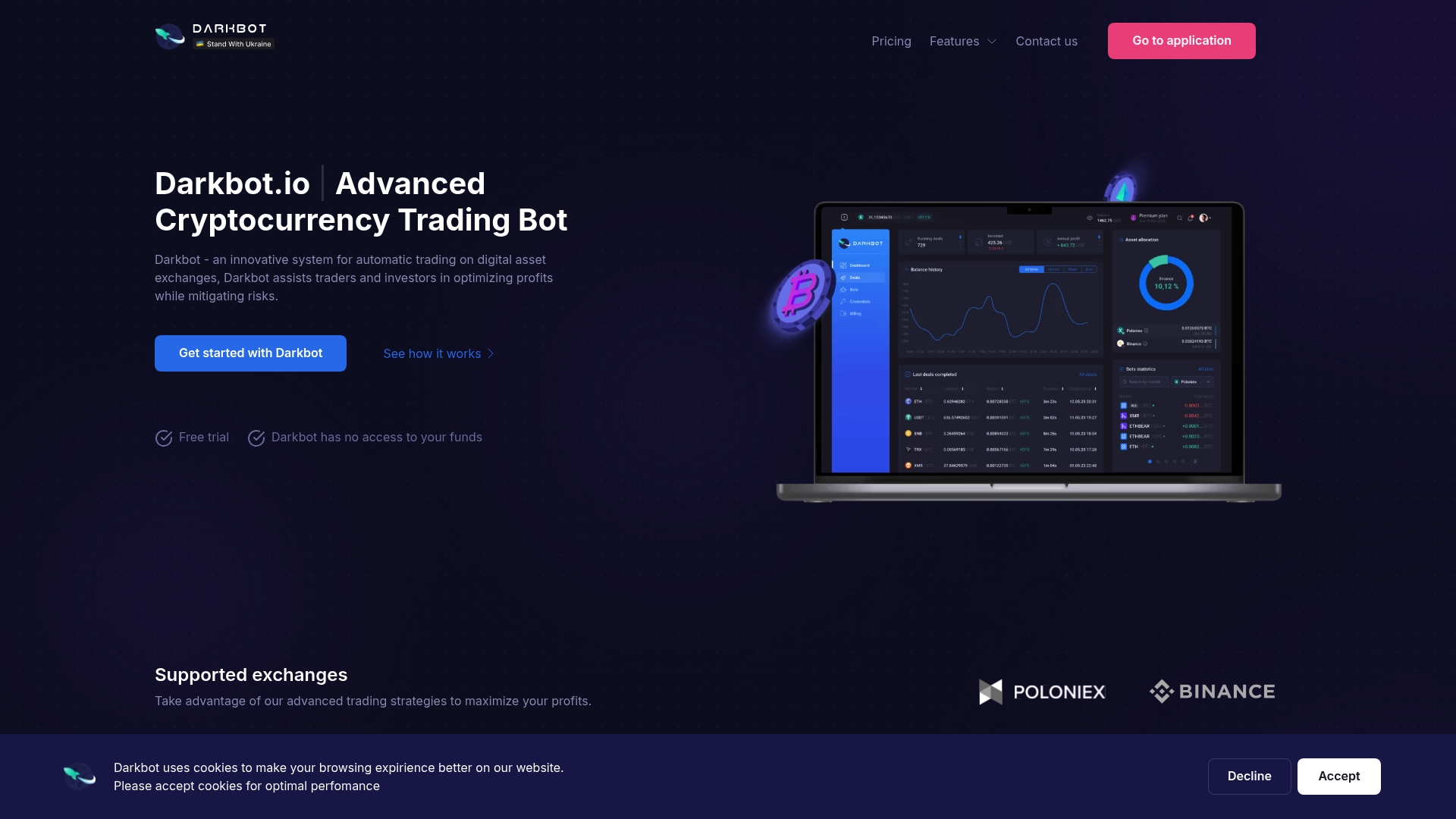
Take control of your trading journey today with Darkbot.io—an innovative platform designed to automate and enhance your cryptocurrency strategies seamlessly across multiple exchanges. Experience powerful features such as customizable AI-driven bots, secure API integration, automated portfolio rebalancing, and real-time analytics all in one intuitive tool. There is no better time to transform complex trading algorithms into dependable profit opportunities and effective risk management. Visit Darkbot.io now to start your free trial and make smarter, safer crypto trades with confidence.
Frequently Asked Questions
What are cryptocurrency trading algorithms?
Cryptocurrency trading algorithms are automated systems that execute trading strategies in digital asset markets using mathematical models and AI. They analyze large datasets quickly to identify trading opportunities without human intervention.
How do trading bots operate across multiple exchanges?
Trading bots connect securely to various cryptocurrency exchanges via APIs, allowing them to monitor market conditions, execute trades, and manage portfolios across different platforms simultaneously, all while minimizing human input.
What are the main types of cryptocurrency trading algorithms?
The primary types include trend-following algorithms, which capitalize on market momentum, mean-reversion algorithms, which profit from price corrections, and arbitrage algorithms that exploit price discrepancies across exchanges.
How can AI and machine learning improve cryptocurrency trading?
AI and machine learning enhance trading strategies by analyzing vast amounts of market data to identify patterns, making real-time adjustments to trading strategies, and predicting future price movements with greater accuracy.
Recommended

Start trading on Darkbot with ease
Come and explore our crypto trading platform by connecting your free account!
Free plan available • No credit card required