Cryptocurrency Trading Bot Terminology Explained: Key Insights

Trading cryptocurrency often feels overwhelming when every second counts and price swings seem unpredictable. For many North American traders, the appeal of automated trading bots lies in their ability to remove emotional decision making and execute strategies with precision and speed. Learning the most important terms like Application Programming Interfaces (APIs) and machine learning can help you use these bots to strengthen risk management and make your trading more efficient.
Key Takeaways
| Point | Details |
|---|---|
| Understanding Trading Bots | Cryptocurrency trading bots automate trading strategies by analyzing market data and executing trades without human intervention. |
| Key Functionalities | Modern bots utilize features such as technical analysis, risk management, and machine learning to adapt to market changes effectively. |
| API Security | Secure API integration is essential for bot functionality, requiring careful permission settings to protect against unauthorized access. |
| Legal Compliance | Traders must navigate varying legal frameworks related to cryptocurrency trading automation, making regular compliance audits crucial. |
Core Concepts in Cryptocurrency Trading Bots
Cryptocurrency trading bots represent sophisticated software programs designed to automate trading strategies across digital asset exchanges. These automated systems analyze market data systematically using advanced algorithms and machine learning techniques, executing trades without requiring constant human intervention. By removing emotional decision making and leveraging computational speed, trading bots aim to optimize investment performance in volatile cryptocurrency markets.

The core technological infrastructure of cryptocurrency trading bots relies on multiple interconnected components. Application Programming Interfaces (APIs) serve as critical communication channels, enabling bots to interact directly with exchange platforms, retrieve real time market data, execute buy and sell orders, and monitor portfolio performance. These bots utilize complex mathematical models and statistical analysis to identify potential trading opportunities, applying predefined strategies with precision and consistency that human traders cannot match.
Modern cryptocurrency trading bots typically incorporate several key functionalities. These include technical indicator analysis, risk management protocols, portfolio rebalancing mechanisms, and adaptive learning algorithms that can adjust strategies based on changing market conditions. Some advanced bots integrate machine learning models that continuously refine trading approaches by analyzing historical price movements, market sentiment data, and macroeconomic indicators. The goal is creating an autonomous system capable of making data driven decisions faster and more objectively than manual trading approaches.
Pro tip: Always thoroughly test and validate your trading bot’s performance using historical market data and simulated trading environments before committing real financial resources.
Types of Bots and Trading Strategies Defined
Cryptocurrency trading bots are specialized software programs categorized by their strategic approaches and functional design. Automated trading strategies encompass a diverse range of methodologies, each targeting specific market conditions and investment objectives. The primary categories include trend-following bots, arbitrage bots, market-making bots, and portfolio rebalancing bots, each employing unique algorithmic techniques to optimize trading performance.
Trend-following bots represent one of the most common strategies, utilizing technical indicators like Moving Averages (MA), Relative Strength Index (RSI), and Exponential Moving Average (EMA) to identify potential market movements. These bots analyze historical price data and statistical patterns to execute trades based on emerging market trends. Arbitrage bots exploit price discrepancies across different exchanges, rapidly executing buy and sell orders to capture minimal but consistent profit margins. By leveraging computational speed and real-time market monitoring, these bots can identify and capitalize on pricing inefficiencies faster than human traders.
More advanced cryptocurrency trading bots incorporate sophisticated machine learning algorithms that continuously adapt to changing market dynamics. These intelligent systems can integrate multiple strategies, such as dollar-cost averaging (DCA) and grid trading, which help manage risk and optimize investment returns. Some specialized bots focus on specific niches like scalping, which involves making numerous small trades to accumulate profits, while others concentrate on long-term portfolio management and automated rebalancing techniques.
Here’s a summary of common cryptocurrency trading bot strategies and their primary use cases:
| Bot Type | Core Strategy | Main Advantage | Typical Use Case |
|---|---|---|---|
| Trend-Following | Follows market trends via indicators | Captures momentum in price swings | Bull or bear market movements |
| Arbitrage | Exploits price gaps across exchanges | Gains from fast price discrepancies | Multi-exchange trading |
| Market-Making | Provides liquidity by placing orders | Profits from bid-ask spreads | Low-volatility markets |
| Portfolio Rebalancing | Adjusts holdings to preset allocations | Maintains desired asset splits | Long-term portfolio management |
| Scalping | Makes numerous small, quick trades | Accumulates slight gains rapidly | Highly liquid trading pairs |
Pro tip: Always validate a trading bot’s performance through extensive backtesting and start with minimal capital to understand its actual market behavior before full deployment.
Essential Bot Features and Common Jargon
Cryptocurrency trading bots require a sophisticated set of features to effectively navigate the complex digital asset marketplace. Algorithmic trade execution involves multiple critical components that enable automated trading strategies. These include real-time market data analysis, advanced technical indicator integration, risk management protocols, and customizable trading parameters that allow investors to define specific investment strategies and constraints.
Key technical terminology defines the core functionality of cryptocurrency trading bots. Technical indicators like Relative Strength Index (RSI), Moving Average Convergence Divergence (MACD), and Exponential Moving Averages (EMA) serve as fundamental decision-making tools. These mathematical calculations help bots identify potential market trends, momentum shifts, and trading opportunities by analyzing historical price movements, trading volumes, and statistical patterns. Traders must understand terms like “backtesting” (simulating strategies using historical data), “stop-loss” (automatic selling to limit potential losses), and “take-profit” (automatic selling at predetermined profit levels) to effectively configure and manage their trading bots.
Advanced cryptocurrency trading bots incorporate machine learning algorithms that continuously adapt to changing market conditions. These intelligent systems can process complex datasets, recognize emerging patterns, and adjust trading strategies in real time. Sophisticated features like multi-exchange support, portfolio rebalancing, and risk diversification enable traders to create nuanced, adaptive trading approaches. Additional critical features include API key integration, secure data encryption, detailed performance reporting, and customizable alert systems that provide traders with comprehensive insights into their automated trading activities.
The following table compares essential bot features and their impact on crypto trading success:
| Feature | Functionality Description | Benefit to Trader |
|---|---|---|
| Real-Time Data Analysis | Processes latest market information | Enables timely, informed decisions |
| Risk Management | Sets stop-loss and order controls | Reduces potential losses |
| Backtesting Tools | Simulates strategies using old data | Validates effectiveness pre-launch |
| Machine Learning | Adapts tactics with market changes | Enhances long-term performance |
| Multi-Exchange Support | Connects to several trading platforms | Diversifies and spreads risk |
Pro tip: Select a trading bot with transparent performance metrics and start with conservative settings to understand its behavior before scaling your investment strategy.
API Keys, Exchanges, and Integration Explained
API keys represent the critical authentication mechanism enabling cryptocurrency trading bots to interact securely with digital asset exchanges. Secure API integration involves complex encryption protocols and carefully configured permission settings that allow bots to execute trades, retrieve market data, and manage portfolio positions without compromising account security. These unique cryptographic credentials establish a controlled communication channel between trading platforms and automated trading systems.
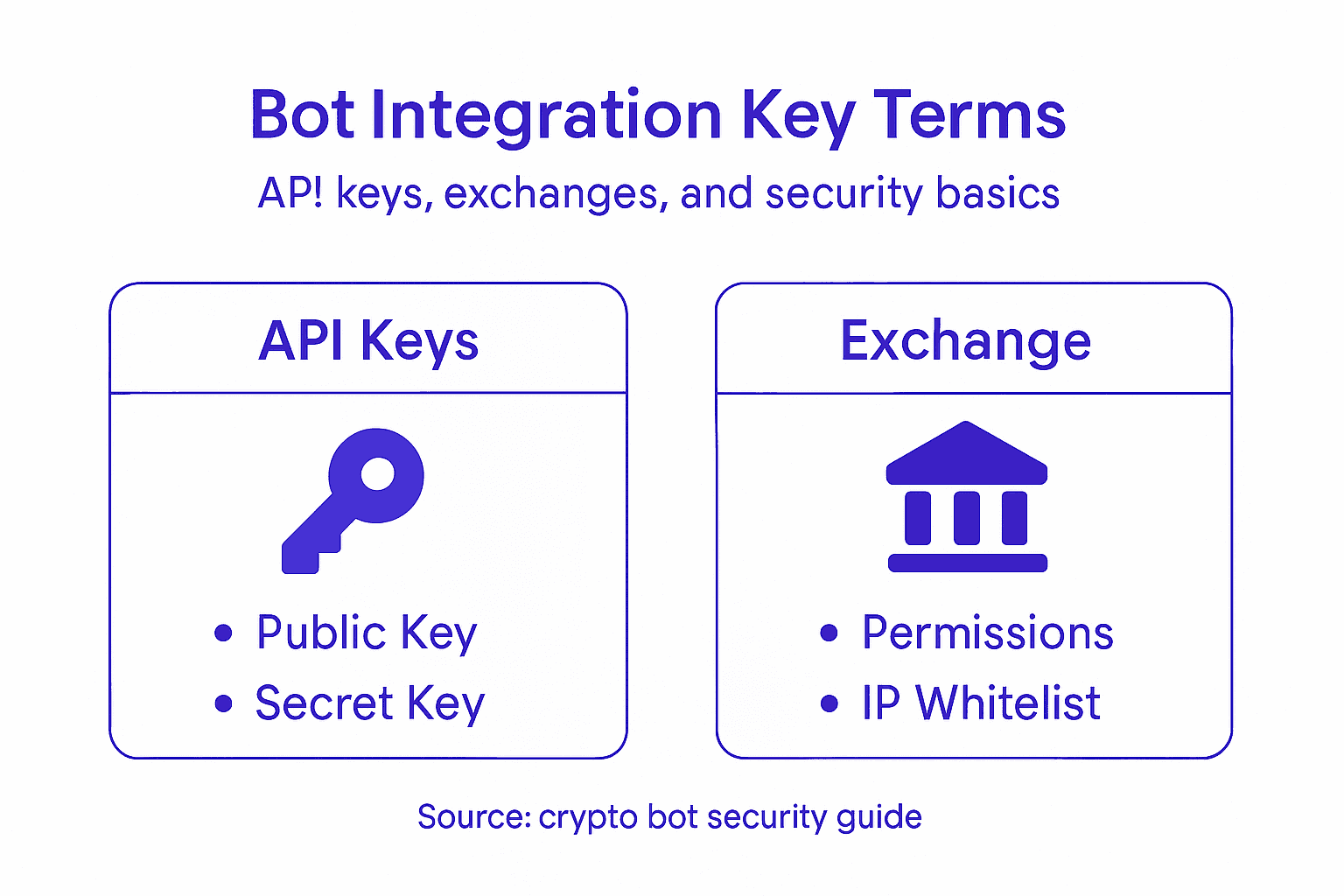
Exchange permissions define the specific capabilities granted through API keys, typically categorized into three primary access levels: read-only, trading, and withdrawal. Read-only keys allow bots to access market data and account information without executing trades, providing a safe starting point for new users. Trading-enabled keys permit automated order placement and strategy execution, while withdrawal-enabled keys represent the highest risk level, granting potential fund transfer capabilities. Traders must meticulously configure these permissions, understanding that each expanded privilege increases potential security vulnerabilities.
Modern cryptocurrency exchanges support API integrations through sophisticated authentication mechanisms including IP whitelisting, two-factor authentication (2FA), and encrypted communication protocols. Advanced trading platforms provide granular control over API key management, enabling users to generate multiple keys with distinct permission levels, set strict trading limits, and rapidly revoke access if potential security threats emerge. These robust integration frameworks allow traders to maintain precise control over their automated trading infrastructure while minimizing potential risks associated with third-party access.
Pro tip: Always generate unique API keys with minimal required permissions and enable IP address restrictions to significantly enhance your trading bot’s security profile.
Risks, Security, and Legal Considerations
Cryptocurrency trading bots introduce complex legal and security challenges that demand sophisticated risk management strategies. Market manipulation risks remain a critical concern, with automated trading systems potentially creating unintended market distortions through high-frequency transactions or algorithmic vulnerabilities. Traders must understand that regulatory environments vary significantly across jurisdictions, creating a complex landscape of legal compliance requirements that can impact bot deployment and operational strategies.
Security vulnerabilities represent another significant dimension of cryptocurrency trading bot risks. These automated systems are potential targets for sophisticated cyber attacks, with API key theft, unauthorized access, and system exploitation representing major threats. Sophisticated traders implement multi-layered security protocols including encrypted key storage, restricted API permissions, IP address whitelisting, and continuous monitoring systems to mitigate potential breaches. Advanced authentication mechanisms like two-factor authentication and hardware security keys provide additional layers of protection against unauthorized access attempts.
Legal considerations surrounding cryptocurrency trading bots are increasingly complex and rapidly evolving. Different countries maintain varying regulatory frameworks governing automated trading, with specific requirements related to anti-money laundering (AML) protocols, know your customer (KYC) regulations, and financial reporting standards. Traders must remain vigilant about jurisdictional compliance, understanding that legal interpretations can change quickly in the dynamic cryptocurrency ecosystem. Professional traders often consult legal experts to ensure their automated trading strategies remain compliant with local and international financial regulations.
Pro tip: Regularly audit your trading bot’s security settings, maintain updated compliance documentation, and consult legal professionals to navigate the complex regulatory landscape of cryptocurrency trading automation.
Master Cryptocurrency Trading Bot Terminology with Confidence
Understanding key terms like API keys, backtesting, and risk management is essential to navigating the complex world of automated cryptocurrency trading. If you have ever felt overwhelmed by the jargon while trying to build your own strategy or worried about securing your accounts properly, you are not alone. This article breaks down those terms and concepts that form the foundation for successful trading bot operation.
Darkbot.io offers an advanced yet user-friendly platform designed to solve these challenges by providing seamless exchange integration, customizable strategy settings, and real-time analytics to keep you in control of your investments. Whether you are a novice eager to learn or an experienced trader seeking sophisticated automation, our platform helps you apply these concepts in a secure environment. Explore Darkbot.io and discover how AI-powered trading can reduce your manual effort and maximize your trading efficiency.
Unlock the power of clear terminology and dependable automation today.
Ready to simplify your cryptocurrency trading journey?
Start automating your strategies now with Darkbot.io and experience secure API key management, personalized bot setups, and responsive support tailored to your goals.
Learn more about our advanced trading bot features and begin transforming your trading experience immediately.
Frequently Asked Questions
What is a cryptocurrency trading bot?
Cryptocurrency trading bots are automated software programs that execute trading strategies on digital asset exchanges. They analyze market data using algorithms and make trades without requiring constant human input.
How do trading bots interact with cryptocurrency exchanges?
Trading bots use Application Programming Interfaces (APIs) to communicate with exchanges. This allows them to retrieve real-time market data, execute buy and sell orders, and manage portfolio performance securely.
What are the main types of cryptocurrency trading bots?
The main types of cryptocurrency trading bots include trend-following bots, arbitrage bots, market-making bots, and portfolio rebalancing bots, each utilizing different strategies to optimize trading performance and manage risk.
What features should I look for in a trading bot?
Key features to look for in a trading bot include real-time data analysis, risk management protocols, backtesting tools, machine learning capabilities, and multi-exchange support to ensure flexibility and comprehensive trading strategies.
Recommended

Start trading on Darkbot with ease
Come and explore our crypto trading platform by connecting your free account!
Free plan available • No credit card required