Cryptocurrency Trading Strategies: Maximizing Profits Safely

More than fifty million American investors have jumped into digital currency markets, yet only a small percentage consistently achieve long-term gains. The fast-paced world of cryptocurrency trading is packed with potential, but without a foundation in proven principles, even experienced traders face unpredictable setbacks. Whether you are just starting or fine-tuning your approach, knowing which strategies and risk management techniques separate successful American traders from the rest could make all the difference for your financial future.
Key Takeaways
| Point | Details |
|---|---|
| Risk Management is Essential | Allocate no more than 1-2% of your portfolio to a single trade and maintain diversified digital assets to minimize losses. |
| Understanding Market Dynamics | Familiarize yourself with cryptoeconomic principles and market sentiment analysis to formulate trading strategies effectively. |
| Strategy Diversification | Develop multiple, uncorrelated trading strategies to spread risk and enhance potential returns, combining both automated and manual approaches. |
| Avoid Emotional Trading | Establish clear exit strategies prior to trading to mitigate the impact of emotions on decision-making and prevent significant financial losses. |
Core Principles of Cryptocurrency Trading
Cryptocurrency trading demands a systematic approach built on fundamental principles that protect capital and optimize potential returns. Understanding these core principles is critical for navigating the complex and volatile digital asset markets. Successful traders recognize that strategy, risk management, and disciplined execution are more important than chasing quick profits.
At the foundation of effective cryptocurrency trading lies a comprehensive understanding of market dynamics. Cryptoeconomic principles integrate economics, cryptography, and game theory to help traders analyze digital economies and decentralized finance applications. This multidisciplinary approach enables traders to develop robust strategies that account for technological and economic factors unique to cryptocurrency markets.
Risk management represents the most crucial principle in cryptocurrency trading. Professional traders allocate their capital strategically, never risking more than 1-2% of their total portfolio on a single trade. Diversification across different digital assets, implementing stop-loss orders, and maintaining disciplined position sizing are essential techniques for minimizing potential losses. Understanding market volatility and developing a clear exit strategy before entering any trade helps protect traders from emotional decision making.
Technical analysis and fundamental research form another critical pillar of successful cryptocurrency trading. This involves studying price charts, understanding market sentiment, tracking blockchain developments, and analyzing project fundamentals. Trust mechanisms play a significant role in cryptocurrency adoption, influencing trader perceptions and market behaviors.

Pro Tip: Risk Management Strategy: Always calculate and preset your maximum acceptable loss per trade before executing any cryptocurrency transaction, ensuring you have a predetermined exit point that protects your overall portfolio value.
Major Types of Trading Strategies Explained
Cryptocurrency trading encompasses a diverse range of strategies designed to capitalize on market opportunities while managing risk. Traders must understand these different approaches to develop a comprehensive and adaptable trading methodology that aligns with their individual goals, risk tolerance, and market understanding.
One sophisticated trading strategy gaining traction is the statistical arbitrage approach. Pairs trading techniques offer a market-neutral strategy involving simultaneous buying and selling of correlated securities to profit from relative price movements. Modern traders are increasingly leveraging advanced computational methods, with reinforcement learning algorithms enhancing decision-making processes in cryptocurrency pair trading strategies.
Trading strategies can be broadly categorized into several primary types. Day trading involves executing multiple trades within a single day, capitalizing on short-term price fluctuations. Swing trading focuses on capturing gains from price movements over several days or weeks, requiring less frequent monitoring compared to day trading. Long-term investing, or hodling, represents a passive strategy where traders purchase and hold cryptocurrencies for extended periods, betting on long-term value appreciation. Scalping represents an ultra-short-term strategy involving multiple rapid trades to capture minimal price changes, demanding exceptional market timing and low transaction fees.
Here’s a summary of primary cryptocurrency trading strategies and their key features:
| Strategy Type | Typical Time Frame | Main Advantage | Potential Drawback |
|---|---|---|---|
| Day Trading | Intraday (minutes-hours) | Quick profit from volatility | Requires constant monitoring |
| Swing Trading | Days to weeks | Less time-intensive, larger moves | May miss intraday opportunities |
| Scalping | Seconds to minutes | Frequent small profits | High transaction fees impact |
| Long-Term Holding | Months to years | Lower time commitment | High exposure to market downturns |
| Statistical Arbitrage | Varies (hours-days) | Market-neutral risk management | Complexity in execution |
Advanced traders often employ hybrid strategies that combine multiple approaches. Algorithmic trading and automated bot strategies enable precise execution of complex trading rules across different market conditions. These strategies leverage technical analysis, machine learning, and predefined parameters to make trading decisions with minimal human intervention.
Pro Tip: Strategy Diversification: Never commit your entire portfolio to a single trading strategy, instead develop multiple uncorrelated approaches to spread risk and increase potential consistent returns.
Automated Versus Manual Trading Approaches
The ongoing debate between automated and manual cryptocurrency trading approaches highlights the evolving landscape of digital asset investment strategies. Traders must carefully evaluate the strengths and limitations of each method to develop a robust trading framework that maximizes potential returns while minimizing risk.
Machine learning models for cryptocurrency trading have demonstrated significant advantages over traditional manual trading methods. Automated trading systems leverage advanced algorithms to execute trades with precision, eliminating emotional decision-making and enabling rapid response to market changes. Unlike human traders, these systems can simultaneously analyze multiple market indicators, process vast amounts of data, and execute trades at speeds impossible for manual traders.
Manual trading offers unique advantages that automated systems cannot fully replicate. Experienced traders bring nuanced market understanding, intuition, and the ability to interpret complex geopolitical and economic factors that machine algorithms might miss. Advanced predictive models have shown promising results, but they cannot completely replace human judgment in navigating intricate market dynamics. Successful traders often blend automated tools with personal expertise, using algorithmic systems to handle repetitive tasks while maintaining strategic oversight.
Compare the core differences between automated and manual trading approaches:
| Aspect | Automated Trading | Manual Trading |
|---|---|---|
| Decision Speed | Instant, algorithm-driven | Human-paced, subjective |
| Data Processing | Analyzes vast, real-time datasets | Limited to individual analysis |
| Emotion Involvement | Emotionless execution | Prone to emotional bias |
| Adaptability | Follows preset rules | Reacts to new and nuanced information |
The most effective approach typically involves a hybrid trading strategy. Automated trading bots can manage routine trades, execute predefined strategies, and monitor markets continuously, while human traders provide strategic direction, adjust parameters, and make critical decisions during unusual market conditions. This combination leverages the computational power of automated systems with the adaptive intelligence of human traders.
Pro Tip: Hybrid Strategy Integration: Develop a balanced approach by using automated trading tools for consistent execution while reserving critical market entry and exit decisions for manual intervention based on comprehensive market analysis.
Risk Management in Crypto Markets
Risk management represents the most critical aspect of successful cryptocurrency trading, serving as the primary defense against potentially devastating financial losses. The extreme volatility inherent in digital asset markets demands a sophisticated, disciplined approach to protecting investment capital and maintaining consistent performance.
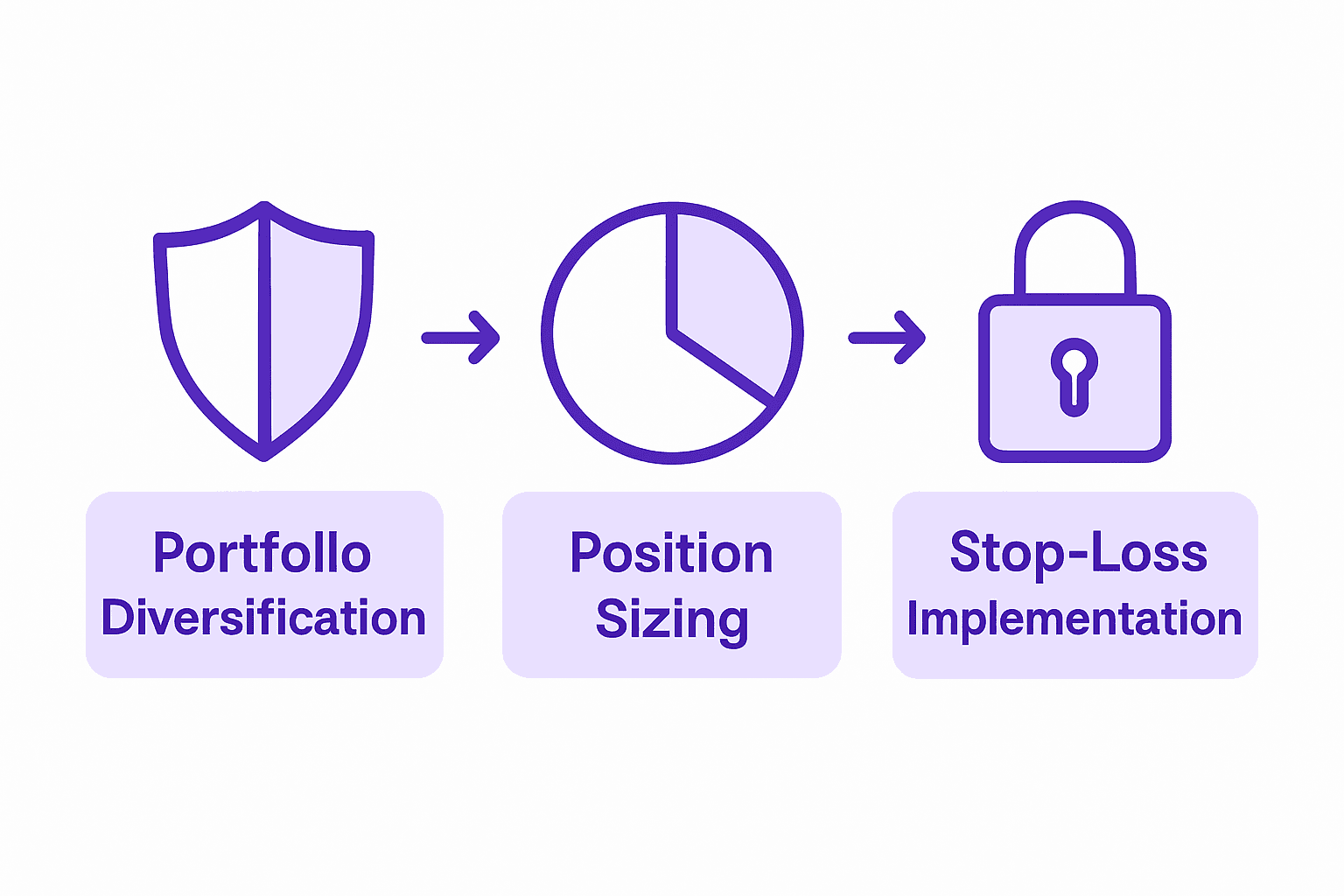
Multi-objective optimization algorithms have emerged as powerful tools for balancing return on investment, risk exposure, and trading frequency. These advanced strategies enable traders to develop more nuanced risk management frameworks that go beyond traditional stop-loss and position sizing techniques. Successful risk management involves creating a comprehensive strategy that addresses multiple dimensions of potential market uncertainty.
Key risk management principles include strategic portfolio diversification, disciplined position sizing, and implementing adaptive trading mechanisms. Dynamic grid trading strategies demonstrate how traders can develop flexible approaches that adjust to changing market conditions. Traders should typically limit individual trade risks to 1-2% of total portfolio value, use stop-loss orders consistently, and maintain sufficient cash reserves to weather market volatility. Implementing automated risk control mechanisms can help remove emotional decision-making and enforce predefined risk parameters.
Technological advancements have significantly enhanced risk management capabilities. Machine learning algorithms and AI-powered trading systems can now analyze complex market patterns, identify potential risk scenarios, and automatically execute protective measures. These tools enable traders to develop more sophisticated risk mitigation strategies that adapt in real-time to market dynamics, providing a level of protection and insight impossible through manual trading approaches.
Pro Tip: Risk Allocation Strategy: Never allocate more than 5% of your total investment capital to any single cryptocurrency, and maintain a diversified portfolio across multiple uncorrelated digital assets to minimize potential systemic risks.
Common Errors to Avoid in Strategy Execution
Cryptocurrency trading strategies require precision, discipline, and a comprehensive understanding of potential pitfalls that can derail even the most well-designed investment approach. Successful traders distinguish themselves by recognizing and proactively mitigating common execution errors that can rapidly erode trading capital and undermine long-term performance.
Arbitrage approaches in pair trading highlight the critical importance of balancing profitability with robust risk management. One of the most prevalent errors traders commit is failing to establish clear, predefined exit strategies before entering a position. Emotional decision-making often leads traders to hold losing positions far beyond rational thresholds, transforming what could have been a manageable loss into a catastrophic portfolio decline.
Pairs trading risks demonstrate the complex dynamics traders must navigate. Common strategic execution errors include over-leveraging positions, neglecting correlation analysis, and ignoring market volatility indicators. Traders frequently make the mistake of applying identical strategies across different market conditions without adaptive mechanisms. Successful traders recognize that each cryptocurrency asset has unique characteristics requiring nuanced, context-specific approaches. Blindly replicating strategies without continuous performance evaluation can lead to significant financial losses.
Technological tools and automated trading systems offer powerful mechanisms for minimizing human error. However, traders must avoid the counterintuitive mistake of completely removing human oversight. Algorithmic systems require consistent monitoring, parameter adjustment, and strategic intervention. Successful traders develop a symbiotic relationship with their trading tools, using automation to execute predefined strategies while maintaining critical decision-making capabilities.
Pro Tip: Strategy Validation: Rigorously backtest and paper trade any new strategy for at least three months before committing real capital, analyzing performance across multiple market conditions and systematically documenting all execution parameters.
Automate Your Cryptocurrency Trading Strategy with Confidence
Navigating the complexities of cryptocurrency trading strategies requires more than knowledge. The real challenge lies in consistently executing risk management, integrating multiple strategies, and responding swiftly to volatile market conditions without emotional bias. If you are seeking to protect your portfolio while maximizing profit potential with advanced, AI-powered tools tailored for diverse trading styles such as statistical arbitrage, swing trading, or long-term holding, automation is the key solution.

Unlock the power of automation with Darkbot.io where you can seamlessly integrate your exchange accounts and customize trading bots to execute your strategies precisely. Benefit from sophisticated risk controls, real-time analytics, and the ability to run multiple simultaneous bots designed to minimize manual errors and manage volatility effectively. Start now to transform your trading approach into a disciplined and scalable system by visiting Darkbot.io. Experience how automated trading can elevate your crypto portfolio management and bring consistent results today.
Frequently Asked Questions
What are the core principles of cryptocurrency trading?
The core principles of cryptocurrency trading include understanding market dynamics, effective risk management, technical analysis, and fundamental research. These principles help traders optimize returns while minimizing potential losses.
How can I effectively manage risk in cryptocurrency trading?
To manage risk effectively, traders should allocate no more than 1-2% of their total portfolio on a single trade, diversify their investments, implement stop-loss orders, and maintain a clear exit strategy to protect against emotional decision-making.
What are some common trading strategies for cryptocurrencies?
Common trading strategies include day trading, swing trading, scalping, long-term holding (hodling), and statistical arbitrage. Each strategy varies in time frame, advantages, and drawbacks, depending on the trader’s goals and risk tolerance.
Should I choose automated or manual trading approaches?
A hybrid approach that combines both automated and manual trading is often effective. Automated systems handle routine tasks and execute trades rapidly, while manual trading allows for strategic oversight and adaptability to unique market conditions.
Recommended

Start trading on Darkbot with ease
Come and explore our crypto trading platform by connecting your free account!
Free plan available • No credit card required