Hedging Strategies in Crypto: Minimizing Volatility Risks

Worrying about sudden price swings in your crypto portfolio can be stressful, especially when your schedule does not leave time for constant monitoring. The digital asset market, known for its rapid spikes and dives, pushes many traders to search for smarter ways to manage risk. With the rise of automated hedging tools, even novice investors can now tap into dynamic risk mitigation strategies that once seemed out of reach, making portfolio protection more accessible than ever.
Key Takeaways
| Point | Details |
|---|---|
| Understanding Crypto Hedging | Crypto hedging aims to manage and mitigate potential losses in volatile markets rather than eliminate risks entirely. Investors should recognize the varying hedge effectiveness of different cryptocurrencies influenced by multiple factors. |
| Types of Hedging Strategies | Key strategies include Futures Contracts, Options Trading, and Spot Hedging, each with unique characteristics. The choice of strategy should align with risk tolerance and specific investment goals. |
| Automated Hedging Benefits | Automated trading bots enhance risk management by providing real-time monitoring and portfolio adjustments, allowing for precise hedging strategies without human errors. |
| Risks and Best Practices | Investors must navigate market volatility and regulatory challenges in crypto hedging. Employing strong risk controls and comprehensive compliance tracking is essential to mitigate potential pitfalls. |
Defining Crypto Hedging and Key Misconceptions
Crypto hedging represents a strategic approach investors use to minimize potential losses in volatile digital asset markets. At its core, hedging involves creating financial positions that offset potential negative price movements, essentially acting as a protective mechanism for cryptocurrency portfolios.
Understanding the fundamental mechanics requires debunking several prevalent misconceptions. Contrary to popular belief, crypto hedging is not about eliminating all risks but rather about managing and mitigating potential downside exposure. Systematic research on portfolio diversification highlights that cryptocurrencies can serve complex roles beyond simple trading instruments:
- Act as potential diversification tools against traditional financial assets
- Provide alternative protection during economic uncertainties
- Offer potential hedge properties against geopolitical risks
- Demonstrate variable performance across different market conditions
Cryptocurrencies like Bitcoin have emerged as particularly interesting hedging instruments. Academic research investigating cryptocurrency hedging reveals that many digital assets demonstrate unique risk characteristics, with some showing negative or zero correlation to traditional market indices. This means they can potentially serve as natural hedges during periods of market stress.
Risk Mitigation Strategies require investors to recognize that hedging is not a guaranteed protection mechanism but a nuanced approach to risk management. Different cryptocurrencies offer varying levels of hedge effectiveness, influenced by factors like market capitalization, liquidity, and broader economic contexts.
Pro tip: Always conduct thorough research and understand the specific risk profile of each cryptocurrency before implementing any hedging strategy.
Types of Hedging Strategies in Crypto Markets
Cryptocurrency markets offer sophisticated investors multiple approaches to manage potential risks through strategic hedging techniques. Comprehensive analysis of hedging strategies reveals a range of sophisticated instruments designed to protect digital asset portfolios from extreme price volatility.
Key hedging strategies in cryptocurrency markets include:
- Futures Contracts: Agreements to buy or sell assets at predetermined prices
- Options Trading: Providing right, but not obligation, to execute trades
- Portfolio Insurance: Dynamic risk management technique
- Delta Hedging: Reducing directional risk through offsetting positions
- Spot Hedging: Direct trading to counterbalance potential losses
Traditional derivatives like futures and options represent fundamental risk mitigation tools for crypto investors. Academic research on cryptocurrency hedging highlights that these instruments allow traders to create protective positions that can minimize downside exposure during market turbulence.

Each hedging strategy carries unique characteristics and complexity levels. Futures contracts, for instance, enable investors to lock in prices and protect against potential downward movements, while options provide more flexible risk management by offering conditional trading rights. The selection of an appropriate hedging approach depends on multiple factors, including risk tolerance, market conditions, and specific investment objectives.
Pro tip: Always analyze your specific risk profile and market conditions before implementing any cryptocurrency hedging strategy, as each approach requires careful understanding and precise execution.
How Automated Bots Enable Crypto Hedging
Automated trading bots have revolutionized cryptocurrency hedging by introducing sophisticated, data-driven risk management capabilities. Automated hedging strategies using machine learning demonstrate how technology can dynamically adjust portfolio protection in real-time, addressing the inherent volatility of digital asset markets.
Key capabilities of automated crypto hedging bots include:
- Real-time Risk Assessment: Continuous monitoring of market conditions
- Dynamic Hedge Ratio Adjustment: Instantaneous portfolio rebalancing
- Algorithmic Collateral Management: Optimizing leverage and risk exposure
- Multi-exchange Execution: Simultaneous hedging across different platforms
- Machine Learning Adaptation: Evolving strategies based on market patterns
These bots leverage advanced algorithms to execute complex hedging techniques with unprecedented speed and precision. Crypto risk management methodologies reveal how automation enables traders to implement sophisticated hedging strategies that would be impossible through manual trading, such as rapid position switching, granular risk metric calculations, and automated portfolio rebalancing.
The technological sophistication of automated bots allows for nuanced risk management that goes beyond traditional hedging approaches. By continuously analyzing market data, these systems can detect potential risks, execute protective trades, and maintain optimal portfolio balance with minimal human intervention, effectively transforming how investors protect their cryptocurrency investments.
Here is a comparison of automation versus manual approaches in crypto hedging:
| Aspect | Automated Bots | Manual Hedging |
|---|---|---|
| Speed | Instantly reacts to market changes | Slower trade execution |
| Precision | Consistently applies strategies | Human error risk |
| Monitoring | 24/7 market analysis | Limited to user availability |
| Adaptability | Learns from new data via algorithms | Strategy updates require manual input |
Pro tip: Configure your automated trading bot with multiple hedging strategies and regularly review its performance to ensure alignment with your risk tolerance and investment objectives.
Portfolio Diversification Versus Derivatives Hedging
Cryptocurrency portfolio strategies reveal two primary approaches for managing investment risks: passive portfolio diversification and active derivatives hedging. These methods offer distinct mechanisms for protecting digital asset investments, each with unique strengths and strategic applications in volatile crypto markets.
Key differences between portfolio diversification and derivatives hedging include:
-
Portfolio Diversification:
- Broad risk distribution across multiple assets
- Lower transaction costs
- Passive investment strategy
- Moderate risk reduction
-
Derivatives Hedging:
- Targeted volatility control
- Precise risk management
- Active trading approach
- Customizable protection mechanisms
Research in European equity markets demonstrates that while diversification provides moderate protection during market downturns, derivatives offer more sophisticated and adaptable risk mitigation. Derivatives hedging allows investors to implement more precise strategies, such as creating specific price protection levels or managing directional market risks with greater accuracy.
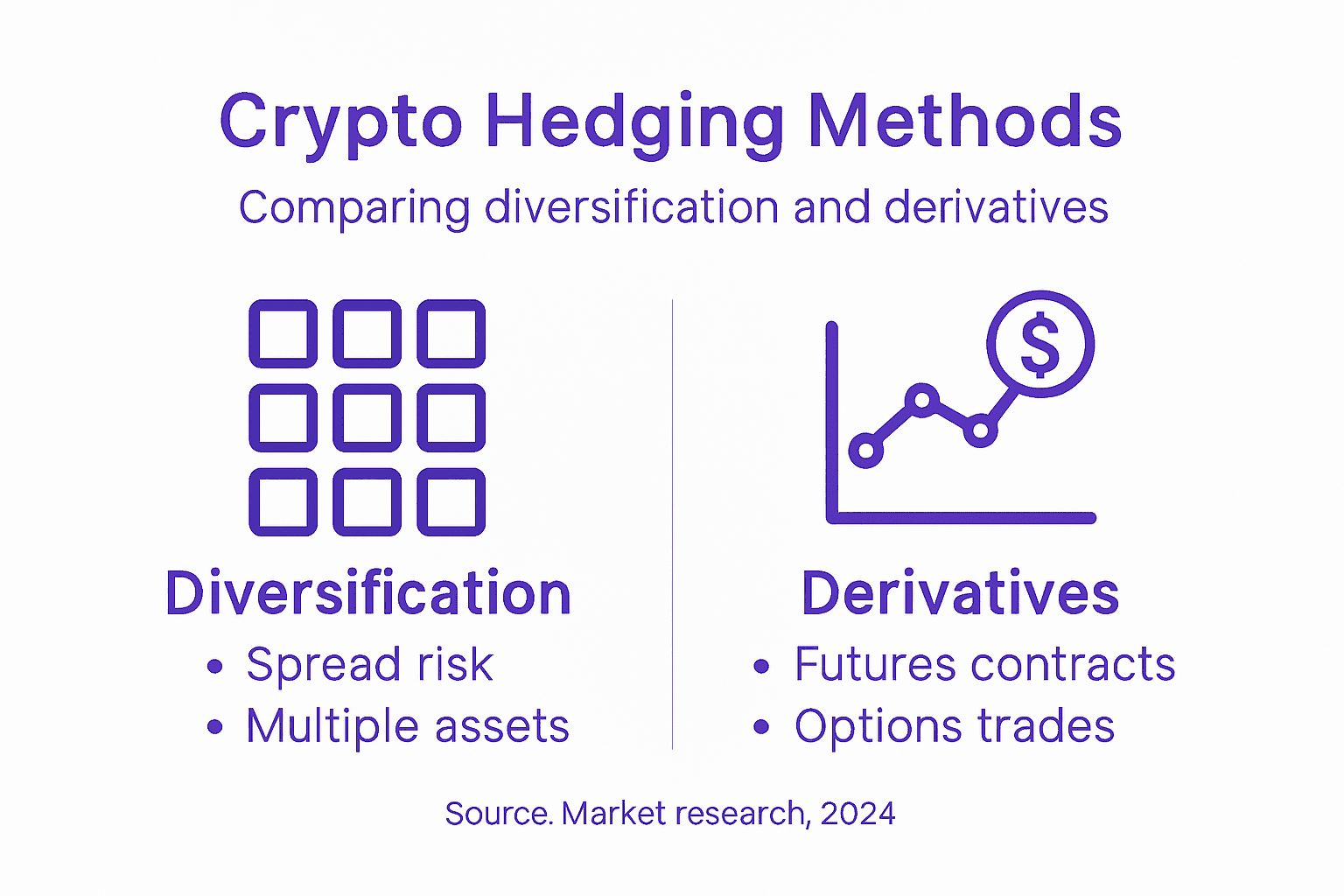
Ultimately, sophisticated investors often combine both approaches, recognizing that portfolio diversification and derivatives hedging are complementary rather than mutually exclusive strategies. The optimal risk management technique depends on individual investment goals, risk tolerance, and specific market conditions.
Pro tip: Develop a hybrid approach that integrates both portfolio diversification and derivatives hedging to create a more robust and flexible risk management strategy.
Common Pitfalls and Regulatory Risks in Crypto Hedging
Crypto hedging challenges reveal a complex landscape of operational and regulatory risks that investors must carefully navigate. The cryptocurrency market presents unique vulnerabilities that extend beyond traditional financial environments, requiring sophisticated risk management approaches and deep understanding of potential pitfalls.
Key risks in cryptocurrency hedging include:
-
Market Volatility Risks:
- Extreme price fluctuations
- Rapid value erosion
- High liquidation probabilities
- Unpredictable market movements
-
Regulatory Challenges:
- Inconsistent global legal frameworks
- Sudden policy changes
- Potential trading restrictions
- Complex compliance requirements
Operational pitfalls in cryptocurrency hedging demonstrate significant risks around stablecoin peg instability, market manipulation, and liquidity constraints. Regulatory uncertainty represents a critical challenge, with governments worldwide adopting divergent approaches to cryptocurrency regulation, creating potential legal and financial risks for investors.
Sophisticated investors must remain vigilant, continuously monitoring regulatory updates and developing adaptive strategies that can withstand sudden market and legal shifts. Understanding these risks requires comprehensive research, ongoing education, and a flexible approach to investment management.
This summary outlines common pitfalls and best practices for crypto hedging:
| Challenge Area | Frequent Pitfall | Best Practice |
|---|---|---|
| Regulatory | Ignoring evolving laws | Regular compliance reviews |
| Volatility | Overleveraged positions | Strong risk controls |
| Technology | Bot misconfiguration | Routine performance checks |
| Liquidity | Inadequate exit options | Use high-volume exchanges |
Pro tip: Develop a comprehensive compliance tracking system and maintain diversified hedging strategies to mitigate potential regulatory and market risks.
Master Crypto Hedging with Advanced Automated Solutions
Navigating the complexities of crypto hedging requires precision, agility, and sophisticated risk management techniques. The article “Hedging Strategies in Crypto: Minimizing Volatility Risks” highlights challenges such as market volatility, strategy customization, and real-time portfolio adjustments. Traders and investors seeking to effectively manage these risks need a reliable tool that combines speed, accuracy, and dynamic strategy execution.

Experience how Darkbot.io transforms crypto hedging by offering an AI-powered automated trading bot designed to execute multiple strategies simultaneously across top exchanges. With seamless API integration, real-time analytics, and portfolio rebalancing features, you gain the confidence to control volatile markets with ease. Start optimizing your crypto risk management today by visiting Darkbot.io and explore how you can automate personalized hedging techniques to safeguard your investments. Take charge now and turn volatility into opportunity.
Frequently Asked Questions
What is crypto hedging?
Crypto hedging is a strategy used by investors to minimize potential losses in the volatile digital asset markets by creating financial positions that counteract negative price movements.
What are some common hedging strategies in cryptocurrency markets?
Common hedging strategies include futures contracts, options trading, portfolio insurance, delta hedging, and spot hedging, each offering different mechanisms for protecting digital asset investments from volatility.
How do automated trading bots enhance crypto hedging?
Automated trading bots enhance crypto hedging by using advanced algorithms to perform real-time risk assessments, dynamically adjust hedge ratios, and execute trades across multiple exchanges, ensuring precise and timely risk management.
What are the differences between portfolio diversification and derivatives hedging?
Portfolio diversification involves broad risk distribution across multiple assets and is a passive investment strategy, whereas derivatives hedging provides targeted volatility control through active trading and customizable protection mechanisms.
Recommended

Start trading on Darkbot with ease
Come and explore our crypto trading platform by connecting your free account!
Free plan available • No credit card required