Machine learning for smarter option trading in 2026
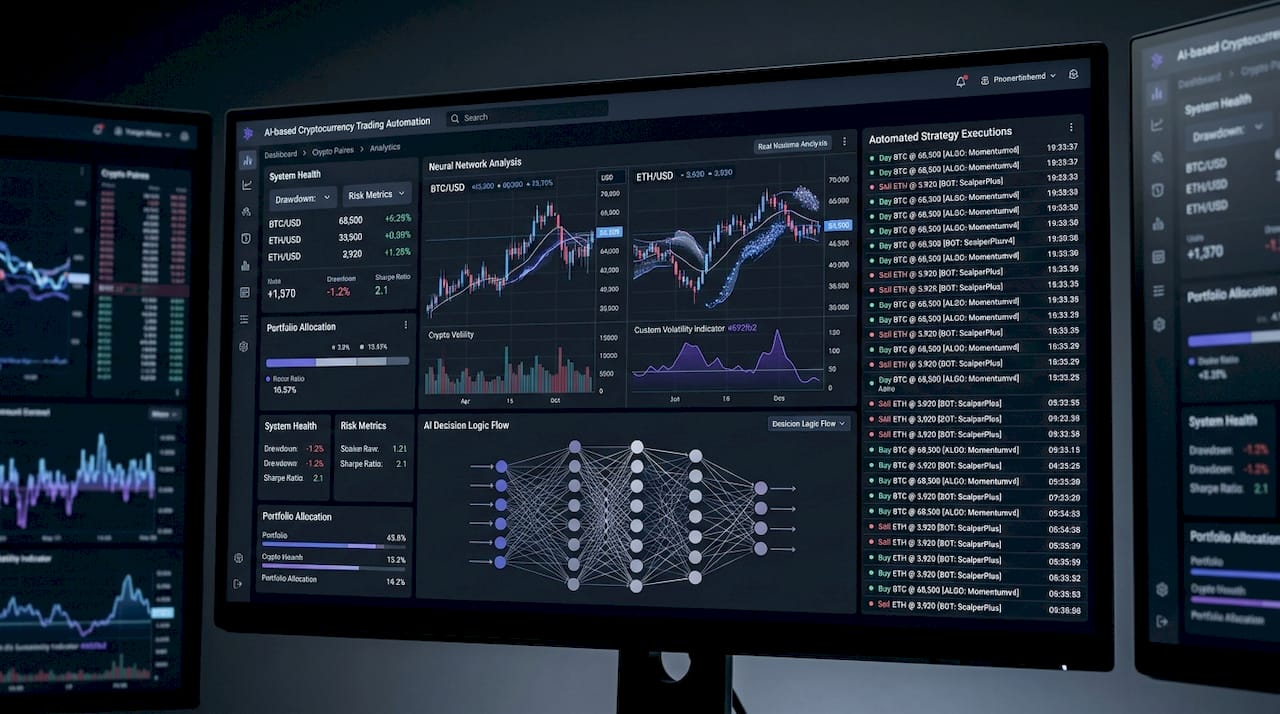
TL;DR:
- Machine learning models like LSTM outperform traditional options pricing models by adapting to market data.
- Features such as strike price, underlying price, and time to maturity are most predictive for ML-driven options strategies.
- In crypto markets, ML reduces hedging errors and models market microstructure risks better than static formulas.
Most traders still price options like it’s 2005. Black-Scholes remains the default, even though its core assumption of constant volatility was disproven decades ago. Meanwhile, LSTM neural networks outperform Black-Scholes, Heston, and standard MLP models in pricing European call options, and reinforcement learning is quietly rewriting how professionals hedge risk in crypto markets. This article walks you through the machine learning models that actually work, the features that drive real returns, and the practical frameworks you need to build smarter, automated option strategies without falling into the most common traps.
Key Takeaways
| Point | Details |
|---|---|
| ML outperforms classic models | Long short-term memory networks and ensembles beat Black-Scholes and Heston for pricing and hedging complex options. |
| Feature engineering is key | Success with ML comes from selecting and combining vital inputs like strike, underlying price, and time to maturity. |
| Ensembles and RL boost performance | Using ensemble models and reinforcement learning especially in crypto options can yield stronger returns and lower risk. |
| Monitoring and explainability matter | Traders must monitor for data drift and use explainable AI tools to trust and manage risk in live ML trading systems. |
Why machine learning is changing option trading
Classic option pricing models carry assumptions baked in from a different era. Black-Scholes assumes log-normal returns and constant volatility. Heston relaxes that slightly, allowing stochastic volatility, but still imposes a rigid parametric structure. When crypto entered the picture, with its fat tails, liquidity gaps, and overnight regime shifts, these models started breaking down in ways that cost traders real money.
Machine learning takes a different approach. Instead of forcing the market to fit a formula, it learns the pricing surface directly from data. That distinction matters enormously when you’re trading path-dependent options, navigating a volatility smile, or reacting to discrete events like protocol upgrades or regulatory announcements.
Here’s where ML adds the most value in options:
- Flexibility: Non-parametric models adapt to any distribution without assuming normality
- Exotic payoffs: ML handles barrier, Asian, and lookback options where closed-form solutions don’t exist
- Regime changes: Models retrain continuously, catching structural breaks that static formulas miss
- Volatility smile: ML fits the full implied volatility surface, not just the at-the-money point
- Path dependency: Recurrent architectures like LSTMs naturally model sequential price dynamics
“The ability of ML models to incorporate the full volatility surface and market microstructure data represents a fundamental shift in how derivatives risk is measured and managed.” This is especially relevant for deep hedging frameworks that use neural networks to replace traditional delta-hedging entirely.
That said, human judgment still matters. ML trading strategies work best when a trader understands the model’s assumptions and monitors its outputs actively. Automation without oversight is just a faster way to lose money.
Pro Tip: For short-maturity vanilla options with liquid underlyings, Black-Scholes still provides a useful benchmark. Don’t replace it entirely. Use it as a sanity check against your ML output.
Core ML models for option pricing and risk management
Not every ML model is suited for every option problem. Choosing the wrong architecture is one of the most common mistakes in automated trading. Here’s how the major model families compare:

| Model | Speed | Flexibility | Interpretability | Best for |
|---|---|---|---|---|
| LSTM | Medium | High | Low | Long-maturity, path-dependent |
| Random Forest | Fast | Medium | High | Feature selection, regime detection |
| R-FFNN / R-RNN | Fast | High | Medium | American and exotic options |
| Reinforcement Learning | Slow to train | Very High | Very Low | Dynamic hedging, execution |
| Black-Scholes / Heston | Very Fast | Low | Very High | Short-maturity vanilla options |
Randomized neural networks (R-FFNN, R-RNN) match or exceed traditional basis function methods for American-style and exotic options, with significantly lower computational overhead. That’s a major practical advantage when you’re running hundreds of positions simultaneously.
LSTM with rolling window training captures short-term volatility dynamics and outperforms competing models for long-maturity options, where path dependency is most pronounced. In hedging tests, LSTM-based approaches reduce error by a factor of 6 compared to Black-Scholes delta-hedging.
Strengths and weaknesses by model family:
- LSTM: Excellent for sequential data; computationally expensive; needs large datasets
- Random Forest: Interpretable and fast; struggles with time-series structure; great for feature importance
- RL: Adapts to transaction costs and discrete hedging; requires careful reward design and extensive simulation
- R-FFNN/R-RNN: Fast training, strong generalization; less studied in live crypto environments
Explainability is becoming a non-negotiable factor. Regulators and risk managers increasingly require you to justify automated decisions. Tools like SHAP (SHapley Additive exPlanations) let you audit which inputs are driving your model’s output, which is critical for optimizing crypto trading in a compliant, sustainable way. If your model is a complete black box, you’re flying blind when it drifts. Pairing ML with explainability tools is now considered a best practice in ML for crypto automation.
From features to signals: Building ML-driven option strategies
A model is only as good as its inputs. Feature engineering is where most option trading strategies succeed or fail, and it’s often underestimated by traders who focus too much on model architecture.
The most important features for ML in options:
| Feature | Why it matters |
|---|---|
| Strike price | Defines moneyness and payoff structure |
| Underlying price | Core driver of intrinsic value |
| Time to maturity (TTM) | Controls time decay and optionality |
| Implied volatility (IV) | Reflects market’s forward-looking risk |
| Open interest (OI) | Signals positioning and liquidity |
| IV skew | Captures asymmetric demand for puts vs. calls |
LSTM captures short-term vol dynamics well, but SHAP analysis reveals that strike price, underlying price, and time to maturity are the most predictive features. Volatility, counterintuitively, ranks lower in importance than most traders expect.
Here’s a practical four-step process for building ML-driven option signals:
- Feature engineering: Construct Greeks, IV surface metrics, OI changes, and rolling vol ratios from raw data
- Model selection: Start with Random Forest for interpretability, then layer in LSTM or ensemble methods for live trading
- Backtesting: Test across multiple volatility regimes, not just trending markets. AI trading examples show that regime-specific backtests reveal failure modes that flat backtests miss entirely
- Live deployment: Start with conservative position sizes, monitor SHAP values weekly, and retrain on a rolling basis
Ensemble ML models using Greeks, IV skew, and OI changes outperform pure momentum strategies in Nifty 50 options, particularly during high-volatility periods. This pattern holds across markets and is directly applicable to crypto trading automation.
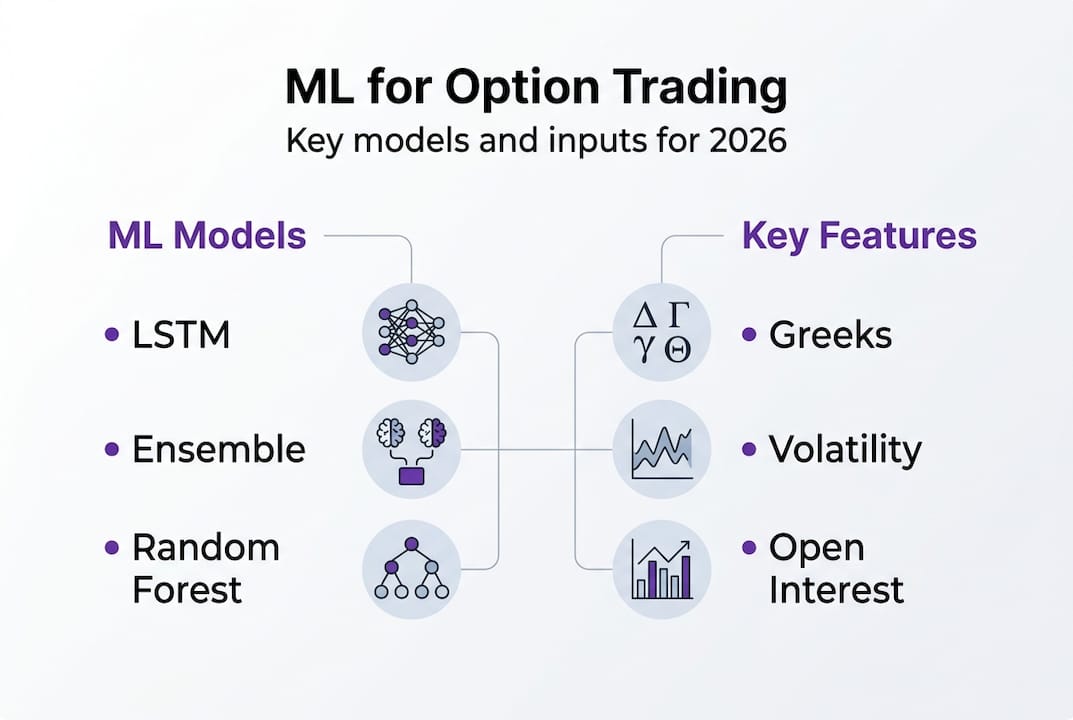
Pro Tip: Always regime-test your signals. A strategy that works beautifully in trending markets may collapse in mean-reverting conditions. Ensemble models that blend trend and mean-reversion signals tend to be more robust across market cycles.
The most common pitfall is overfitting to historical volatility patterns. If your model was trained entirely on 2021 crypto bull-market data, it will likely fail in a low-volatility or bearish environment.
Machine learning for crypto option trading and volatility arbitrage
Crypto options operate in a fundamentally different environment than equity options. Liquidity is thinner, transaction costs are higher, and the market structure changes faster. These differences make ML not just useful but necessary for serious crypto option traders.
Key ways crypto options differ from traditional markets:
- Liquidity gaps: Bid-ask spreads on BTC options can be 5 to 10 times wider than equivalent equity options
- Discrete hedging: Rebalancing every minute is impractical; models must account for hedging frequency constraints
- Transaction costs: Fees erode theoretical edge quickly; any strategy must be cost-aware by design
- Regime volatility: Crypto can shift from 30% to 120% annualized volatility within days
- 24/7 markets: No overnight gap risk in the traditional sense, but weekend liquidity crises are common
RL multi-agent framework approaches outperform baseline strategies in BTC and ETH options volatility trading, specifically by capturing the spread between implied and realized volatility. The multi-agent structure separates the timing decision from the hedging decision, which allows each component to specialize.
“Deep hedging using the full implied volatility surface and underlying dynamics reduces hedging error by a factor of 6 compared to standard delta-hedging approaches.” Deep hedging RL using full IV surface is robust to transaction costs in ways that classic approaches simply are not.
For live strategies, the biggest failure mode is model drift. A model trained on Q1 2025 data may be dangerously miscalibrated by Q3 2025 if BTC volatility has shifted structurally. Backtesting crypto strategies across multiple market regimes before deployment is non-negotiable. Pair that with ongoing monitoring and conservative parameter settings to manage the ML impact in crypto trading responsibly.
Our take: What most option trading guides get wrong about machine learning
Most guides treat ML as a plug-and-play upgrade. Drop in an LSTM, watch it outperform Black-Scholes, deploy, profit. That framing is dangerously incomplete.
The real challenge isn’t building a model that backtests well. It’s building one that stays calibrated in live markets. Data drift is silent and fast in crypto. A model that looked perfect six months ago may now be pricing options based on a volatility regime that no longer exists. Without continuous recalibration and explainability checks, you won’t know until you’ve already taken the loss.
We also think the industry underestimates crypto-specific microstructure risks. Slippage, fee structures, and liquidity fragmentation across exchanges can erase theoretical edge entirely. Any ML strategy that doesn’t model these frictions explicitly is incomplete.
The traders who consistently profit from ML-driven options aren’t the ones who automate everything. They’re the ones who treat ML as a co-pilot, using trading efficiency with ML to handle scale and speed while keeping human judgment in the loop for regime detection and risk overrides. Handing the wheel over entirely is how you get caught flat in a flash crash.
Automate and optimize your crypto option strategies with Darkbot
The frameworks in this article are powerful, but they require the right infrastructure to execute. You need reliable backtesting, real-time signal monitoring, and seamless exchange connectivity to turn ML insights into live trades.
Darkbot is built exactly for this. As an AI crypto trading solution, it gives you the tools to automate ML-driven strategies across multiple exchanges without writing infrastructure from scratch. Use portfolio optimization to manage risk across positions dynamically, and validate every strategy with robust backtesting tools before going live. Whether you’re running volatility arbitrage or delta-neutral option strategies, Darkbot handles the execution layer so you can focus on the edge.
Frequently asked questions
Which machine learning model is best for option trading?
For most use cases, LSTM neural networks outperform traditional models, especially for long-dated or exotic options. Ensemble ML models using Greeks and IV skew also consistently beat momentum-only strategies.
How does machine learning help in risk management for options?
ML reduces hedging error and adapts automatically to changing volatility or liquidity regimes. Deep hedging RL using full IV surface methods cut hedging error by a factor of 6 compared to standard delta-hedging.
Are ML-driven strategies effective in crypto options trading?
Yes, particularly RL and ensemble methods. RL multi-agent framework approaches have shown strong outperformance in BTC and ETH options volatility arbitrage in both backtested and live settings.
What features are most important when building ML models for options?
Strike price, underlying price, and time to maturity are the most predictive inputs. LSTM captures short-term vol well, but SHAP analysis confirms that volatility itself ranks lower in feature importance than most traders assume.
Recommended
- Machine Learning in Trading 2025: Smarter Crypto Strategies
- Machine learning in fintech 2026: optimizing crypto trading
- Machine Learning in Cryptocurrency: Smarter Automated Trading
- Machine Learning in Trading Strategies: Crypto Automation Explained
- Predictive analytics in fantasy sports: smarter strategies

Start trading on Darkbot with ease
Come and explore our crypto trading platform by connecting your free account!
Free plan available • No credit card required