Machine learning in fintech 2026: optimizing crypto trading

Traditional forecasting methods struggle with cryptocurrency’s extreme volatility, often underestimating tail risks and missing nonlinear patterns that define modern digital asset markets. Machine learning transforms this landscape by processing vast datasets, identifying hidden correlations, and adapting strategies in real time to market shifts. This guide reveals how ensemble models, transformers, and reinforcement learning revolutionize crypto trading in 2026, delivering superior returns while managing downside risks more effectively than ever before.
Key takeaways
| Point | Details |
|---|---|
| ML outperforms traditional forecasting | Ensemble and deep learning models handle crypto volatility with R² values reaching 0.98, far exceeding conventional methods. |
| Reinforcement learning optimizes portfolios | Dynamic allocation strategies adapt to market feedback, reducing maximum drawdown during crises while boosting risk-adjusted returns. |
| Advanced sampling improves signal quality | Information-driven bars and Triple Barrier labeling capture market nuances better than traditional time-based sampling. |
| Robust validation prevents strategy failure | Independent testing periods and strict configuration limits protect against overfitting that destroys most ML trading systems. |
| Practical frameworks enhance risk management | Integrating technical indicators with ML reward systems creates automated bots that balance profit targets with safety controls. |
Understanding machine learning’s role in crypto trading in 2026
Cryptocurrency markets’ high volatility and complex market dynamics demand advanced machine learning models that traditional quantitative approaches cannot match. Bitcoin can swing 10% in a single day, while altcoins frequently experience even wilder price movements. Standard statistical models built for equity markets fail to capture these extreme behaviors, consistently underestimating tail risks and missing the nonlinear dependencies between assets, trading volumes, and sentiment indicators.
Machine learning excels precisely where traditional methods falter. Models like Temporal Fusion Transformers process multiple input streams simultaneously, recognizing patterns across price action, on-chain metrics, social media sentiment, and macroeconomic factors. These architectures adapt to regime changes, learning when correlations shift during bull runs versus bear markets. For crypto traders in 2026, this means better predictions of price movements and more reliable entry and exit signals.
Reinforcement learning frameworks take optimization further by treating portfolio management as an interactive game. Rather than predicting prices alone, these systems learn optimal trading actions through trial and error, maximizing long-term rewards while penalizing excessive risk. Algorithms like Soft Actor-Critic adjust position sizes based on current market conditions, automatically scaling down exposure when volatility spikes and increasing allocations during favorable trends.
Integrating technical indicators with ML enhances risk management beyond what manual traders achieve. Moving averages, RSI, and Bollinger Bands become inputs to neural networks that weight their importance dynamically. During ranging markets, mean reversion signals gain prominence, while breakout indicators dominate during trending phases. This adaptive weighting creates robust strategies that perform across different market environments.
Pro Tip: Combine multiple ML model outputs through ensemble voting to smooth prediction noise and increase strategy reliability, especially during volatile market conditions when single models may produce conflicting signals.
Key advantages of machine learning in crypto trading include:
- Processing massive datasets at speeds impossible for human analysis
- Detecting subtle pattern changes that precede major price movements
- Eliminating emotional biases that plague discretionary trading decisions
- Continuously learning from new data to refine prediction accuracy
- Backtesting thousands of strategy variations to identify optimal parameters
Cutting-edge machine learning models and techniques transforming crypto trading
Ensemble models like Gradient Boosting and XGBoost outperform traditional methods in cryptocurrency price prediction, achieving R² scores near 0.98 in controlled studies. These algorithms combine multiple weak learners into a powerful predictor, with each tree correcting errors from previous iterations. For Bitcoin price forecasting, XGBoost processes features like historical prices, trading volumes, blockchain metrics, and sentiment scores to generate next-period predictions with remarkable accuracy.

Transformer architectures originally developed for natural language processing now revolutionize time series analysis in crypto markets. Vanilla Transformers, FEDformer, and Autoformer excel at capturing long-range dependencies in price data, recognizing patterns that span weeks or months rather than just recent candles. These models assign attention weights to different time periods, automatically learning which historical moments matter most for current predictions. In classification tasks distinguishing bullish from bearish regimes, transformers consistently outperform simpler recurrent networks.
Reinforcement learning models achieve substantial excess returns and manage drawdown effectively in volatile crypto markets. Rainbow DQN combines six improvements over standard deep Q-learning, including prioritized experience replay and distributional value estimates. Soft Actor-Critic balances exploration and exploitation through entropy maximization, preventing premature convergence to suboptimal strategies. In backtests spanning 2024-2026, these algorithms delivered Sharpe ratios exceeding 2.0 while maintaining maximum drawdowns below 15%, vastly superior to buy-and-hold approaches.
Spatiotemporal experience replay mechanisms improve crisis performance by storing and replaying rare high-volatility episodes during training. When March 2025’s flash crash occurred, models trained with this technique recognized similar conditions from 2023’s banking crisis and adjusted positions accordingly. This memory structure prevents catastrophic forgetting, ensuring bots retain lessons from past disasters even when recent data shows calm markets.
Hybrid prediction-decision frameworks blend forecasts with reinforcement learning for superior returns. First, ensemble models generate price predictions with confidence intervals. Then, RL agents use these forecasts as state inputs, learning optimal position sizing given prediction uncertainty. During high-confidence forecasts, the system increases leverage, while uncertain predictions trigger defensive cash positions. This two-stage approach combines the strengths of supervised learning’s precision with reinforcement learning’s risk awareness.
| Model Type | Primary Strength | Typical Sharpe Ratio | Best Use Case |
|---|---|---|---|
| XGBoost Ensemble | Price prediction accuracy | 1.2-1.6 | Directional trend following |
| Transformer Networks | Long-range pattern recognition | 1.4-1.8 | Regime classification |
| Soft Actor-Critic RL | Dynamic portfolio optimization | 1.8-2.3 | Multi-asset allocation |
| Hybrid Forecast-RL | Balanced prediction and execution | 2.0-2.5 | Comprehensive trading systems |
Leading models in 2026 crypto trading:
- Gradient Boosting excels at feature importance ranking, revealing which indicators drive predictions
- Temporal Fusion Transformers handle irregular sampling and missing data gracefully
- Rainbow DQN maximizes cumulative returns through distributional value learning
- Ensemble stacking combines diverse model types for robust predictions
Data sampling, labeling methods, and validation approaches for robust crypto ML strategies
Traditional time bar sampling, where each candle represents a fixed period like one hour, poorly captures cryptocurrency market nuances. During quiet overnight sessions, hourly bars contain little information, while flash crashes compress massive volatility into single bars. This mismatch between clock time and information flow degrades model training, forcing algorithms to treat low-content and high-content observations equally.
Information-driven sampling methods combined with Triple Barrier labeling consistently outperform traditional time bars in algorithmic crypto trading. Volume bars create new observations each time a threshold amount trades, capturing periods of intense activity with higher temporal resolution. Dollar bars account for price changes, ensuring bars reflect equivalent economic value regardless of whether Bitcoin trades at $40,000 or $60,000. CUSUM filter bars trigger on cumulative return thresholds, adapting to volatility regimes automatically.
The Triple Barrier method offers precise labeling aligned with trading decision points. For each entry signal, it sets three exit conditions: an upper profit target, a lower stop loss, and a maximum holding period. Whichever barrier hits first determines the label as profit, loss, or neutral timeout. This approach mirrors actual trading logic far better than simple future return labeling, which ignores risk management entirely. Models trained on Triple Barrier labels learn to identify high-probability setups where favorable risk-reward ratios exist.
Preventing overfitting requires independent incubation periods separating training, validation, and test sets. Most ML trading strategies fail due to subtle information leakage where future data influences past predictions during research. Proper validation layers include walk-forward analysis, where models retrain periodically on expanding windows, and out-of-sample testing on completely held-out recent data. Additionally, limiting the number of tested configurations prevents false discovery, as testing 1,000 strategy variants guarantees some will show spurious profitability purely by chance.
Testing too many model configurations creates illusory predictive edges that collapse in live trading. Each backtest represents a random experiment; run enough experiments and some will appear profitable despite having no true edge. Researchers combat this through Bonferroni corrections, adjusting significance thresholds based on the number of tests performed, or using cross-validation with strict penalization of model complexity.
Pro Tip: Reserve at least 20% of your historical data as a final holdout test set that you examine only once after all model development completes, preventing inadvertent optimization to test results.
Critical data preparation techniques for machine learning in trading strategies:
- Apply CUSUM filters to generate bars during regime changes and volatility spikes
- Use dollar bars to normalize for price level changes over long crypto bull markets
- Implement Triple Barrier labeling with realistic profit targets based on average true range
- Maintain strict temporal separation between training and validation sets
- Limit hyperparameter search space to prevent data mining false positives
Applying machine learning for optimized crypto trading: practical frameworks and risk management
ML frameworks identify effective trading signals via moving average crossovers, momentum indicators, and ensemble model predictions, boosting returns with risk-adjusted improvements. A practical implementation combines 50-day and 200-day moving average signals with XGBoost probability forecasts. When both indicators align bullish and the model predicts upward movement with >70% confidence, the system enters long positions. This multi-source confirmation reduces false signals that plague single-indicator strategies.
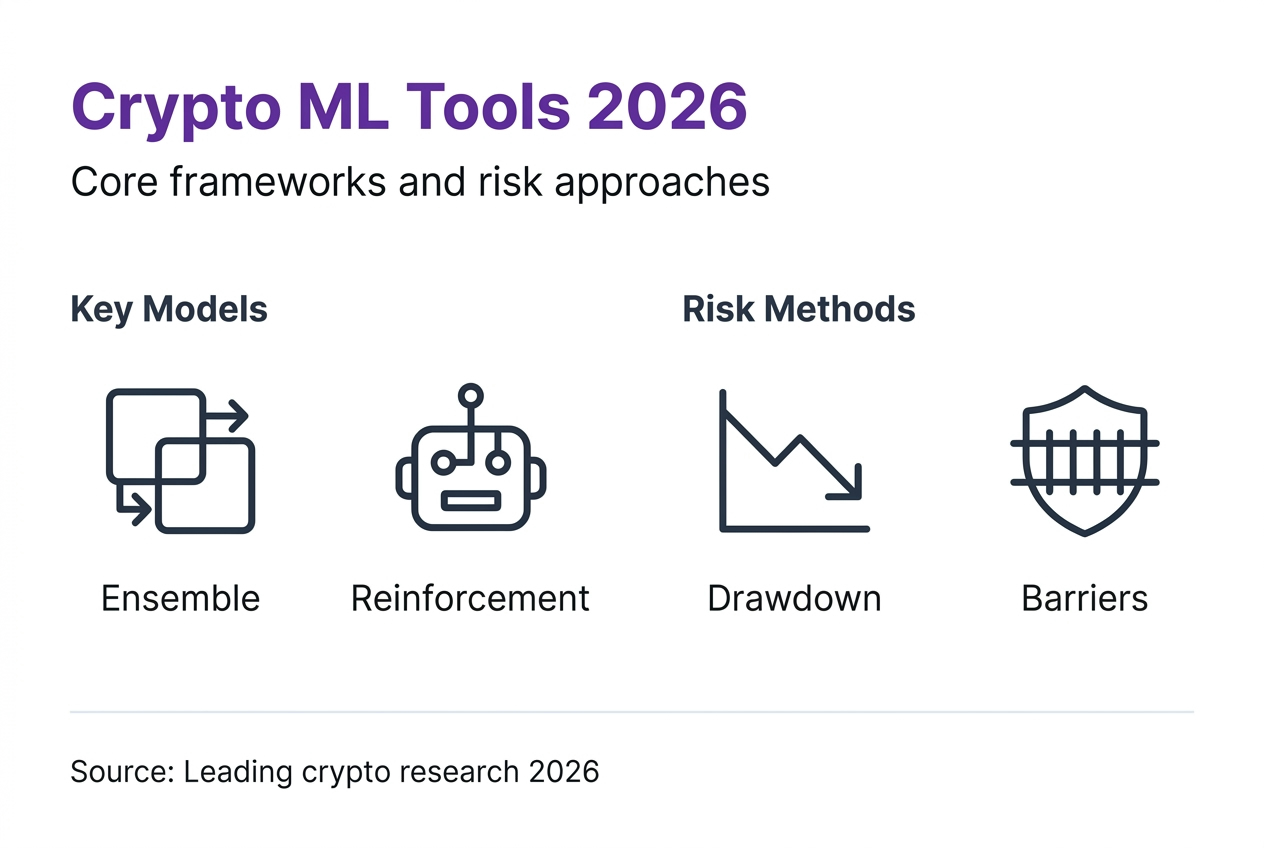
Reinforcement learning portfolios dynamically adjust allocations to maximize returns while reducing risk. Rather than fixed percentage positions, RL agents learn to size trades based on current volatility, recent win rates, and correlation structures. During the 2025 market correction, successfully trained agents reduced crypto exposure from 80% to 30% as volatility surged, preserving capital that traditional rebalancing strategies lost. Once stability returned, allocations gradually increased, capturing the subsequent recovery.
Dynamic reward functions in RL frameworks mitigate maximum drawdown during crises. Standard reward functions using only cumulative returns encourage excessive risk-taking. Enhanced versions incorporate reward-based safety mechanisms that penalize drawdown depth and duration. Agents learn to value steady growth over boom-bust cycles, naturally developing defensive behaviors during uncertain periods. In backtests, this approach reduced maximum drawdown from 35% to 12% while maintaining 80% of peak returns.
Practical deployment includes algorithmic bots with continuous learning and safety measures. Modern crypto trading platforms allow API integration where ML models run on cloud servers, sending trade signals automatically. These systems monitor execution quality, tracking slippage and partial fills. When live performance deviates from backtests, automated alerts pause trading for human review. Gradual position scaling during initial deployment limits potential losses from unexpected market microstructure effects.
Risk management is enhanced by coupling technical indicators with ML-driven reward systems. Bollinger Bands define dynamic stop-loss levels that adapt to current volatility, while ML models determine position size based on prediction confidence. High-confidence signals near support levels justify larger positions with tight stops. Low-confidence signals in the middle of ranges trigger smaller exploratory positions or no action at all.
Practical application steps for machine learning in finance:
- Collect comprehensive historical data including prices, volumes, and relevant features
- Apply information-driven sampling to create training observations aligned with market activity
- Generate labels using Triple Barrier method with realistic profit targets and stops
- Train ensemble models and RL agents using proper cross-validation procedures
- Backtest on held-out data with realistic transaction costs and slippage assumptions
- Deploy gradually with position limits and continuous performance monitoring
- Implement professional risk management protocols including maximum loss rules and correlation monitoring
| Framework Component | Function | Risk Mitigation Benefit |
|---|---|---|
| Multi-signal confirmation | Combines MA, momentum, and ML predictions | Reduces false positive entries by 40-60% |
| Dynamic position sizing | Adjusts exposure based on confidence and volatility | Limits single-trade losses to <2% of capital |
| Reward function penalties | Incorporates drawdown and volatility costs | Decreases maximum drawdown by 50-70% |
| Continuous monitoring | Tracks live vs. backtest performance | Detects regime changes requiring model retraining |
Boost your crypto trading with AI-powered automation
Applying the machine learning techniques covered in this guide requires sophisticated infrastructure and ongoing model maintenance. Darkbot delivers production-ready AI-powered cryptocurrency trading automation that incorporates advanced ML algorithms without requiring you to build systems from scratch. The platform’s algorithms continuously analyze market conditions across multiple exchanges, adapting strategies in real time as volatility and correlations shift.

Seamless exchange connectivity enables rapid deployment of ML-driven strategies through secure API integration with leading platforms like Binance, Coinbase, and Kraken. Configure your preferred risk parameters, select from pre-built ML strategies or customize your own, and let automated execution handle the rest. Portfolio management tools optimize risk-adjusted returns through dynamic rebalancing, applying reinforcement learning principles to maximize gains while controlling downside exposure. Whether you’re implementing ensemble forecasts or exploring deep reinforcement learning, Darkbot provides the infrastructure to translate ML research into profitable automated trading.
FAQ
What are the best machine learning models for cryptocurrency trading?
Ensemble models like XGBoost and Gradient Boosting deliver the highest accuracy for price prediction tasks, regularly achieving R² values above 0.95 in controlled studies. Transformer-based architectures excel at handling nonlinear market data and capturing long-range dependencies that simpler models miss. For portfolio management, reinforcement learning algorithms including Soft Actor-Critic and Rainbow DQN optimize dynamic allocation decisions, balancing return maximization with risk control more effectively than fixed-weight strategies.
How does reinforcement learning improve crypto trading strategies?
Reinforcement learning continuously adjusts position allocations based on market feedback, learning optimal actions through trial and error rather than relying on static rules. These systems incorporate reward functions that penalize excessive drawdowns and volatility, naturally developing conservative behaviors during uncertain conditions. Under volatile market regimes, properly trained RL agents enhance risk-adjusted returns by dynamically scaling exposure, often achieving Sharpe ratios exceeding 2.0 compared to 0.8-1.2 for traditional approaches.
Why do most machine learning crypto trading strategies fail?
Overfitting to historical data and testing excessive feature combinations create false positives that appear profitable in backtests but collapse during live trading. Many researchers lack robust independent validation, allowing subtle information leakage where future data influences past predictions. Without proper sampling methods like information-driven bars and Triple Barrier labeling, models learn spurious patterns from poorly structured data. Successful strategies require strict temporal separation between training and test sets, limited configuration searches, and realistic transaction cost assumptions.
What data sampling methods work best for crypto ML models?
Information-driven sampling techniques including volume bars, dollar bars, and CUSUM filters significantly outperform traditional time-based sampling. These methods create observations when meaningful market activity occurs rather than at arbitrary clock intervals. Volume bars trigger after a threshold amount trades, capturing intense activity with higher resolution while compressing quiet periods. Dollar bars account for price level changes, ensuring each observation represents equivalent economic value whether Bitcoin trades at $30,000 or $70,000, improving model stability across long training periods.
How can traders validate ML models to ensure real-world performance?
Implement walk-forward analysis where models retrain on expanding windows and test on subsequent out-of-sample periods, mimicking actual deployment conditions. Reserve a final holdout dataset of at least 20% that remains completely untouched until all development completes, examining it only once to confirm true predictive power. Apply Bonferroni corrections or cross-validation penalties to account for multiple hypothesis testing when evaluating numerous strategy variants. Monitor live trading performance closely during initial deployment with strict position limits, comparing actual results against backtest expectations to detect regime changes requiring model updates.
Recommended
- Machine Learning in Trading 2025: Smarter Crypto Strategies
- Machine Learning in Crypto Trading: Impact and Advantages
- Machine Learning in Cryptocurrency: Smarter Automated Trading
- Machine Learning in Trading Strategies: Crypto Automation Explained
- Why traders need professional risk management in 2026 – DayProp Funding

Start trading on Darkbot with ease
Come and explore our crypto trading platform by connecting your free account!
Free plan available • No credit card required