Multi-exchange integration in crypto trading 2026

Cryptocurrency markets scatter liquidity across over a thousand active exchanges worldwide, each operating with unique protocols, fee structures, and asset listings. This fragmentation creates inefficiencies that cost traders real money through missed arbitrage opportunities, delayed executions, and suboptimal pricing. Multi-exchange integration solves this problem by connecting multiple trading venues into one unified system, enabling automated strategies to capture opportunities across platforms simultaneously. For traders seeking to optimize performance in 2026’s volatile crypto markets, understanding how integration works and why it matters can transform your trading results and risk management approach.
Key takeaways
| Point | Details |
|---|---|
| Unified system access | Multi-exchange integration connects multiple crypto exchanges into one automated trading system |
| Speed advantage | Low-latency WebSocket feeds enable sub-10ms data processing for faster execution |
| Technical foundation | Symbol normalization and API abstraction manage differences across exchange protocols |
| Reliability boost | Robust order lifecycle tracking and connection management prevent costly downtime |
| Strategic benefits | Automation across venues optimizes arbitrage, risk diversification, and portfolio performance |
Understanding cryptocurrency market fragmentation and its challenges
Crypto markets operate fundamentally differently from traditional finance. Rather than consolidating around a few dominant exchanges, cryptocurrency markets are naturally fragmented across centralized and decentralized venues, each implementing distinct protocols and operational frameworks. This structural reality creates both opportunities and obstacles for traders.
The scale of fragmentation is staggering. Over a thousand active cryptocurrency exchanges exist worldwide, ranging from major platforms like Binance and Coinbase to regional exchanges serving specific markets. Each venue attracts different customer bases, supports various fiat currency pairs, and implements unique regulatory compliance measures. This diversity means identical assets can trade at meaningfully different prices across platforms.
Price dispersion across exchanges creates arbitrage opportunities but also introduces complexity. When Bitcoin trades at $68,500 on one exchange and $68,650 on another, savvy traders can profit from the spread. However, capturing these opportunities requires monitoring multiple platforms simultaneously, managing separate accounts, and executing trades fast enough that the price gap doesn’t close before completion.
For traders operating manually, the challenges multiply quickly:
- Juggling multiple exchange interfaces wastes time and increases error risk
- Each platform requires separate API integration with unique documentation
- Inconsistent data formats make cross-platform analysis difficult
- Manual monitoring cannot match the speed needed for time-sensitive opportunities
- Security concerns grow with each additional platform connection
“The fragmented nature of crypto markets means traders who limit themselves to single exchanges are essentially trading with one hand tied behind their back, missing opportunities that exist just one platform away.”
These fragmentation challenges explain why sophisticated traders increasingly turn to crypto exchange fragmentation solutions. Without integrated systems that unify access across venues, capturing the full potential of crypto trading becomes nearly impossible for anyone beyond full-time professionals with significant technical resources.
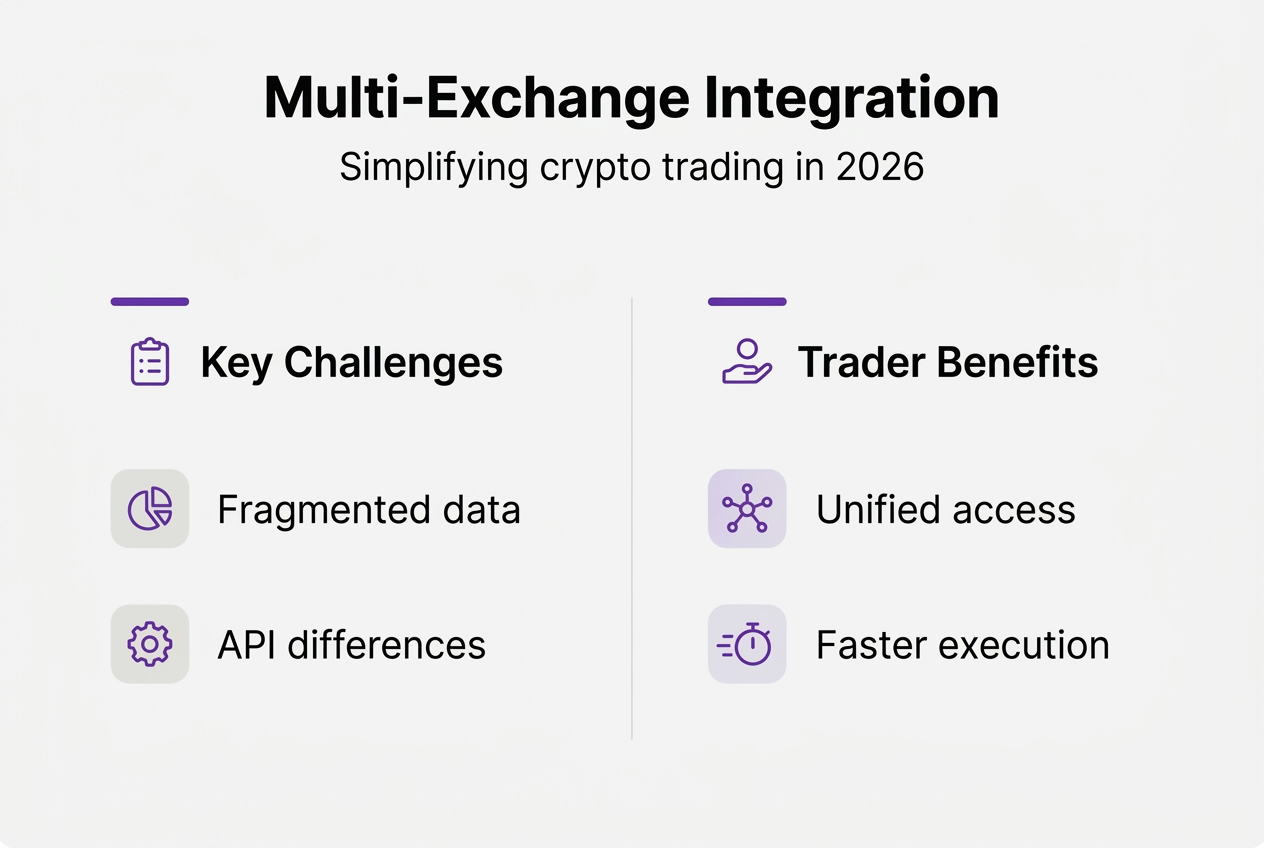
Core components of multi-exchange integration: data, APIs, and order management
Building reliable multi-exchange integration requires solving several technical challenges that arise from each platform’s unique implementation. The foundation starts with abstracting away exchange-specific details through smart architectural patterns.
The venue adapter pattern serves as the critical first layer. Each exchange has its own API quirks requiring abstraction for maintainable integration. Rather than writing custom code for every exchange, adapters translate between a standardized internal interface and each platform’s specific API requirements. This approach keeps your core trading logic clean while handling the messy reality of diverse exchange implementations.
Symbol normalization solves another fundamental problem. Exchanges have different symbol conventions that require normalization. One platform might list Bitcoin as “BTC/USDT” while another uses “BTCUSDT” and a third prefers “XBT-USD”. Your integration layer must map these variations to a single internal representation, ensuring your trading strategies work consistently regardless of venue.

Real-time data handling separates professional systems from amateur attempts. WebSocket feeds provide continuous streaming updates with minimal latency, essential for capturing fast-moving opportunities. Your integration must handle connection lifecycle events gracefully, automatically reconnecting when networks hiccup and buffering data during brief interruptions to prevent gaps in your market view.
Order lifecycle management tracks every state change from submission through completion:
- Order created and validated locally
- Submission sent to exchange API
- Exchange acknowledgment received
- Partial fills reported and logged
- Final completion or cancellation confirmed
- Post-trade reconciliation and position updates
Pro Tip: Log every order state transition with timestamps and exchange responses. When investigating execution quality or debugging issues, this audit trail becomes invaluable for understanding exactly what happened and when.
| Data Method | Latency | Reliability | Best Use Case |
|---|---|---|---|
| REST Polling | 500-2000ms | Moderate | Account balances, historical data |
| WebSocket Streams | 5-50ms | High with reconnect logic | Real-time prices, order updates |
| FIX Protocol | 10-100ms | Very high | Institutional trading, large orders |
The right API integration approach depends on your trading style and volume requirements. High-frequency strategies demand WebSocket feeds and aggressive latency optimization. Slower rebalancing strategies can tolerate REST polling for some data types. Understanding these tradeoffs helps you build systems matched to your actual needs rather than over-engineering solutions.
Latency and execution: why speed and resilience matter in automated multi-exchange trading
Execution quality in automated trading comes down to two factors: how fast your system responds to opportunities and how reliably it performs under real-world conditions. Both dimensions require careful engineering when integrating multiple exchanges.
Latency accumulates through several phases in your trading pipeline. Data ingestion captures market updates from exchange feeds. Signal computation analyzes this data to identify trading opportunities. Risk checks verify position limits and exposure constraints. Order submission packages and transmits instructions to the exchange. Each phase adds milliseconds that compound into your total response time.
Asynchronous parallelism dramatically improves multi-exchange performance. Rather than processing exchanges sequentially, modern systems handle each venue concurrently. When your strategy needs to check prices across five exchanges, parallel processing queries all five simultaneously instead of waiting for each response before starting the next request. Multi-exchange integrated trading pipelines achieve round-trip latencies as low as 87ms using async parallel execution.
WebSocket streams provide the speed advantage that separates competitive systems from also-rans. While REST polling might check prices every 500 milliseconds, WebSocket connections push updates within 5 to 10 milliseconds of exchange events. For strategies exploiting short-lived arbitrage opportunities, this 50x speed improvement often determines whether you capture profit or arrive too late.
Connection resilience matters as much as raw speed. Networks experience routine disruptions, exchanges restart services during maintenance, and API rate limits occasionally trigger temporary blocks. Fast, deterministic recovery from normal WebSocket disconnections is critical for reliable trading. Your integration must detect disconnections within seconds, attempt reconnection with exponential backoff, and resume normal operation without manual intervention.
Pro Tip: Implement connection health monitoring that tracks not just whether you’re connected, but whether you’re receiving expected update frequencies. A “connected” WebSocket that stopped sending data is worse than a known disconnection because it creates false confidence.
“In crypto trading, the difference between profit and loss often comes down to milliseconds. Systems that can identify and act on arbitrage opportunities 100 milliseconds faster than competitors consistently capture spreads that slower systems never see.”
Every millisecond impacts fill quality, especially when trading volatile assets or pursuing arbitrage strategies. A 50-millisecond delay might seem trivial, but in fast-moving markets, prices can shift meaningfully in that window. Traders using automate crypto trading efficiently approaches understand that infrastructure quality directly translates to bottom-line results.
Practical benefits and strategies for traders using multi-exchange integration
The technical foundation of multi-exchange integration enables concrete trading strategies that generate alpha and manage risk more effectively than single-venue approaches. Understanding how to apply these capabilities separates theoretical knowledge from practical profit.
Arbitrage represents the most obvious application. When the same asset trades at different prices across venues, integrated systems can simultaneously buy on the cheaper exchange and sell on the more expensive one, pocketing the spread. Arbitrageurs link exchanges influencing price dispersion and trade volumes across small and large venues. This activity not only generates profit but also improves overall market efficiency by narrowing price gaps.
Risk management improves dramatically with multi-exchange access. Rather than concentrating your entire portfolio on one platform, you can distribute holdings across several exchanges. This diversification protects against exchange-specific risks like technical outages, regulatory actions, or security breaches. If one exchange experiences problems, your other positions remain accessible and tradable.
| Approach | Execution Speed | Error Rate | Opportunity Capture | Setup Complexity |
|---|---|---|---|---|
| Manual Multi-Exchange | Slow (minutes) | High (human error) | Low (miss fast moves) | Low (just accounts) |
| Automated Integration | Fast (milliseconds) | Very Low (systematic) | High (catch all signals) | Moderate (technical setup) |
Practical tips for implementing multi-exchange strategies:
- Start with two or three exchanges rather than trying to integrate everything at once
- Choose venues with good API documentation and active developer communities
- Monitor API rate limits carefully and implement request throttling to avoid bans
- Test connection handling by deliberately disconnecting during development
- Track execution quality metrics to identify which exchanges provide best fills
Strategy examples that leverage integration include statistical arbitrage across correlated pairs on different exchanges, liquidity aggregation that routes orders to venues with best pricing, and dynamic rebalancing that maintains target allocations as prices shift. Each approach becomes practical only when you can monitor and execute across multiple platforms simultaneously.
Pro Tip: Focus on exchange pairs with meaningful trading volume and liquidity. Theoretical arbitrage opportunities on low-volume venues often prove impossible to execute at scale because order books lack depth to absorb your trades without significant slippage.
The automated trading strategies guide framework shows how combining technical analysis signals with multi-exchange execution creates robust strategies. Your analysis identifies opportunities, while integration ensures you can act on signals regardless of which venue offers the best execution path.
Explore Darkbot’s multi-exchange trading solutions
Implementing sophisticated multi-exchange integration from scratch requires significant technical expertise and ongoing maintenance as exchange APIs evolve. Darkbot trading bot provides a turnkey solution that handles the complexity while giving you full control over your trading strategies.
Our platform abstracts away the technical challenges of exchange integration, symbol normalization, and connection management. You focus on defining your trading logic while Darkbot handles real-time data processing with low-latency execution across your connected exchanges. The system processes market updates within milliseconds and routes orders to optimal venues automatically.
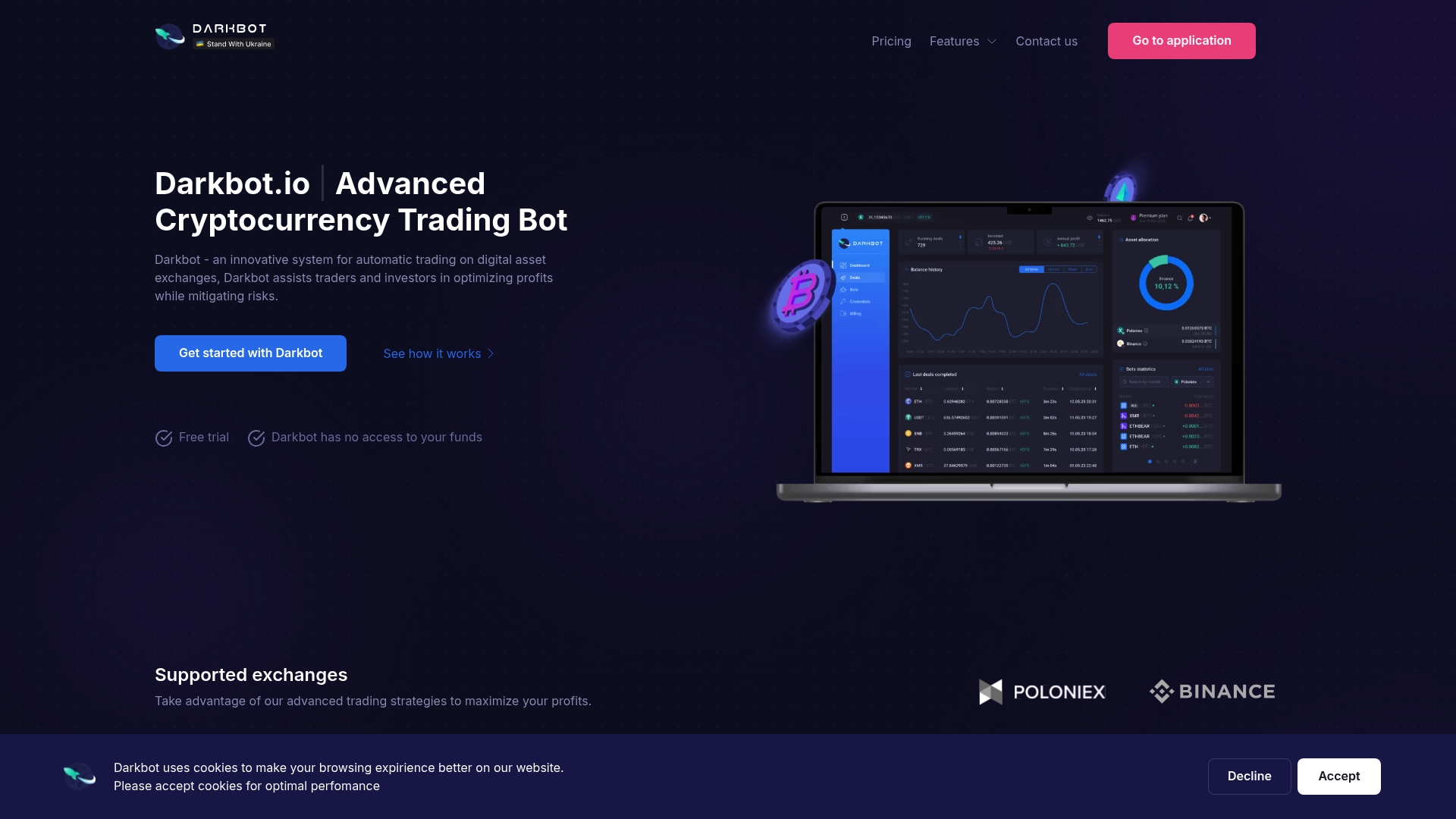
Darkbot’s tools for cryptocurrency portfolio management enable sophisticated risk optimization across multiple exchanges. Set allocation targets, define rebalancing triggers, and let automation maintain your desired exposure as markets move. The platform supports both novice traders getting started with automation and experienced professionals running complex multi-strategy portfolios.
Connecting your crypto exchange takes minutes with our streamlined API key setup process. We provide detailed guides for each supported platform and offer expert support when you need assistance. Our 2026 platform updates include enhanced machine learning models, expanded exchange coverage, and improved execution algorithms that adapt to changing market conditions.
Frequently asked questions
What is multi-exchange integration in cryptocurrency trading?
Multi-exchange integration connects multiple crypto trading venues into one unified system that monitors markets and executes trades across platforms simultaneously. This integration uses APIs to communicate with each exchange, normalizes data formats for consistent analysis, and manages order lifecycles from submission through completion. The result is automated trading that captures opportunities wherever they appear, rather than limiting you to a single platform’s liquidity and pricing.
How does symbol normalization work across different exchanges?
Symbol normalization maps each exchange’s unique asset naming conventions to a standardized internal format your system uses consistently. For example, Bitcoin might appear as “BTCUSDT” on Binance, “BTC-USD” on Coinbase, and “XBT/USD” on Kraken. Your normalization layer creates a canonical symbol like “BTC/USD” internally, then translates to each exchange’s specific format when placing orders. This ensures your trading strategies work identically across venues without custom code for each platform.
Why does latency matter so much in multi-exchange trading?
Latency determines whether you capture profitable opportunities before they disappear. Arbitrage spreads between exchanges often last only seconds, and the trader who acts fastest captures the profit. Lower latency also improves fill quality by reducing the chance that prices move between when you identify an opportunity and when your order executes. Systems achieving sub-100ms round-trip latency consistently outperform slower alternatives in competitive crypto markets.
What are the main benefits of trading across multiple exchanges?
Multi-exchange trading enables arbitrage by exploiting price differences across venues, improves execution quality through access to deeper liquidity, and reduces risk by diversifying holdings across platforms. You gain flexibility to route orders to exchanges with best pricing for each trade, avoid concentration risk from keeping all assets on one platform, and access unique trading pairs or features available only on specific exchanges. This comprehensive market access translates directly to better performance.
How do I troubleshoot connection issues with exchange APIs?
Start by verifying your API keys have correct permissions and haven’t expired. Check that your IP address is whitelisted if the exchange requires it. Monitor rate limits to ensure you’re not exceeding allowed request frequencies. Implement exponential backoff for reconnection attempts rather than hammering the API repeatedly. Log all API responses including error messages for debugging. Most connection issues stem from authentication problems, rate limiting, or network instability, all of which systematic monitoring and retry logic can handle automatically.
Recommended

Start trading on Darkbot with ease
Come and explore our crypto trading platform by connecting your free account!
Free plan available • No credit card required