Risk Management in Crypto Trading: Smart Automation

Extreme price swings and sudden market disruptions can catch even the most experienced trader off guard. For algorithmic trading enthusiasts navigating unpredictable crypto markets, mastering risk management in crypto trading becomes more than a smart move—it is a necessity. With volatility, limited oversight, and evolving digital threats shaping every trade, this guide breaks down proven frameworks and flexible tools to protect your crypto positions, harnessing the power of automation so you stay ahead no matter where or when opportunity strikes.
Key Takeaways
| Point | Details |
|---|---|
| Importance of Risk Management | Comprehensive strategies are crucial for navigating the volatile cryptocurrency market and protecting investments. |
| Types of Risks | Market, operational, liquidity, and systemic risks must be understood to develop effective trading strategies. |
| Automated Strategies | Implementing automated risk management tools can enhance decision-making and mitigate potential losses effectively. |
| Portfolio Diversification | Strategic diversification of assets reduces overall risk and increases potential returns in dynamic market conditions. |
Defining Risk Management in Crypto Trading
Risk management in cryptocurrency trading represents a systematic approach to identifying, analyzing, and mitigating potential financial losses within digital asset markets. Unlike traditional financial markets, crypto trading environments are characterized by extreme volatility and minimal regulatory oversight, making comprehensive risk strategies essential for sustainable investment practices. Comprehensive financial risk frameworks highlight the multifaceted nature of cryptocurrency risk management.
At its core, risk management involves understanding and quantifying potential threats across several critical dimensions. These dimensions include market risk (price fluctuations), operational risk (exchange vulnerabilities), liquidity risk (ability to convert assets), and systemic risk (broader market interconnectedness). Traders must develop nuanced strategies that account for these complex, interconnected risk factors, utilizing sophisticated analytical tools and probabilistic modeling techniques to protect their investment portfolios.

The cryptocurrency landscape demands a proactive, multidimensional approach to risk control. Successful risk management requires continuous monitoring, real-time adaptation, and disciplined execution of predefined risk mitigation protocols. This involves setting precise stop-loss parameters, diversifying asset allocations, maintaining robust security practices, and developing algorithmic trading strategies that can respond dynamically to market changes. Macrofinancial frameworks underscore the importance of understanding systemic vulnerabilities in crypto asset ecosystems.
Pro tip: Develop a comprehensive risk management plan that includes specific allocation percentages, maximum loss thresholds, and automated trading rules to maintain consistent, disciplined investment strategies.
Types of Risks in Digital Asset Markets
Cryptocurrency markets present a complex landscape of interconnected risks that extend far beyond traditional financial instrument vulnerabilities. Digital transformation risks highlight the unique challenges emerging from decentralized digital economies, where traditional risk management frameworks often prove inadequate. These risks manifest across multiple dimensions, requiring traders and investors to develop sophisticated, adaptive strategies.
Financial risks in digital asset markets can be categorized into several critical domains. Market Risk encompasses extreme price volatility, where cryptocurrency values can fluctuate dramatically within hours. Liquidity Risk emerges from thin trading volumes and potential market manipulation. Operational Risk involves technical vulnerabilities like exchange hacks, smart contract failures, and blockchain network disruptions. Systemic Risk represents broader interconnectedness where failures in one cryptocurrency or platform can trigger cascading market impacts. Comprehensive market risk analysis demonstrates how these risks are intricately linked and can rapidly destabilize digital asset ecosystems.
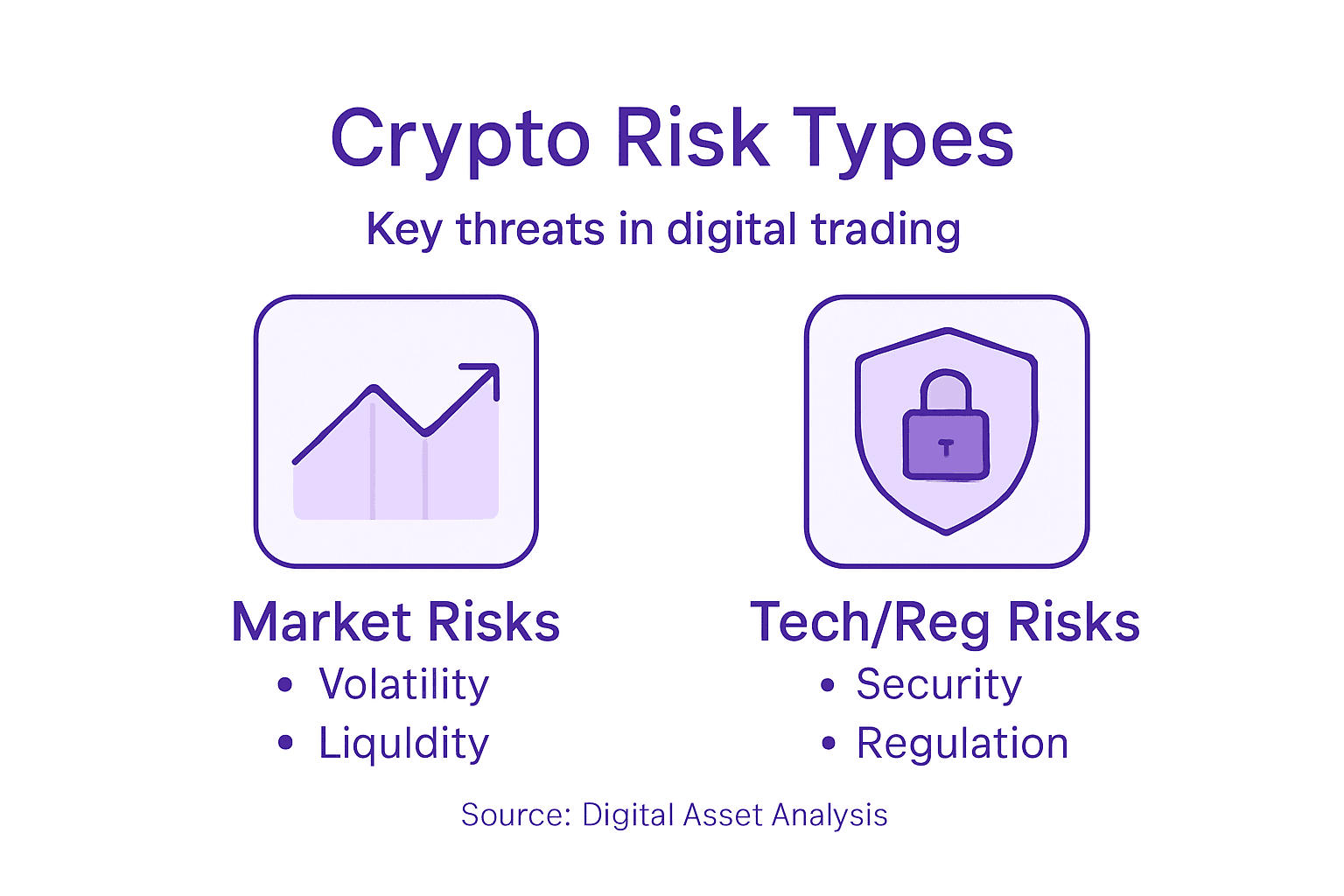
Technical and regulatory risks further complicate the digital asset landscape. Cybersecurity threats, regulatory uncertainty, potential government interventions, and technological obsolescence create additional layers of complexity. Traders must continuously monitor geopolitical developments, technological innovations, and regulatory shifts that could dramatically impact cryptocurrency valuations. Understanding these multifaceted risks requires ongoing education, robust analytical tools, and a willingness to adapt strategies in response to rapidly evolving market conditions.
Pro tip: Develop a dynamic risk assessment framework that includes regular portfolio stress testing, automated risk monitoring tools, and predefined exit strategies for different risk scenarios.
Here’s a quick comparison of key risk types in the crypto market:
| Risk Type | Description | Primary Impact |
|---|---|---|
| Market Risk | Price swings and volatility | Losses from rapid changes |
| Operational Risk | Technical or exchange failures | Asset theft or lost access |
| Liquidity Risk | Limited buying or selling | Difficulty exiting positions |
| Systemic Risk | Interconnected market issues | Broader ecosystem disruption |
Automated Strategies for Managing Risk
Automated risk management represents a sophisticated approach to navigating the volatile cryptocurrency markets, leveraging advanced technological tools to systematically mitigate potential financial vulnerabilities. Advanced trading strategies provide traders with powerful mechanisms to protect their investments through intelligent, rule-based decision-making systems. These automated approaches transform traditional risk management from reactive interventions to proactive, algorithmic defense strategies.
Key automated risk management techniques include implementing sophisticated stop-loss and take-profit mechanisms, which automatically execute predefined trading actions based on specific market conditions. Algorithmic hedging allows traders to create complex strategies that simultaneously protect against downside risks while maintaining potential upside opportunities. Ensemble machine learning approaches enable traders to develop multi-layered risk mitigation strategies that can adapt dynamically to changing market conditions, utilizing deep reinforcement learning techniques to optimize decision-making processes.
The most effective automated risk management strategies integrate multiple layers of protection. These include statistical arbitrage techniques, portfolio rebalancing algorithms, and cross-exchange risk monitoring systems. Traders can configure automated tools to implement strict risk parameters such as maximum drawdown limits, position sizing rules, and automatic portfolio diversification. By removing emotional decision-making and implementing systematic, data-driven approaches, these strategies provide a disciplined framework for managing the inherent uncertainties of cryptocurrency markets.
Pro tip: Implement a multi-tiered automated risk management system that combines algorithmic stop-loss mechanisms, dynamic position sizing, and real-time portfolio rebalancing to effectively protect your digital asset investments.
Below is a summary of automated risk management features and their benefits:
| Feature | Practical Role | Benefit to Traders |
|---|---|---|
| Stop-Loss Automation | Sets exit price automatically | Limits potential losses |
| Algorithmic Hedging | Balances risky positions | Reduces exposure, increases control |
| Portfolio Rebalancing | Adjusts asset allocation | Maintains optimal diversification |
| Transaction Cost Analysis | Evaluates trading expenses | Protects profitability |
Portfolio Protection and Diversification Tactics
Cryptocurrency portfolio management demands sophisticated strategies that extend beyond traditional asset allocation approaches. Modern Portfolio Theory analysis demonstrates that strategic diversification can significantly mitigate risk while potentially enhancing overall investment returns. By carefully selecting and balancing digital assets with distinct performance characteristics, investors can create robust portfolios that are resilient to market volatility.
Effective diversification in cryptocurrency markets requires a nuanced approach that goes beyond simple asset allocation. Strategic asset selection involves identifying cryptocurrencies with low correlation coefficients, ensuring that portfolio components respond differently to market conditions. Global market correlation models reveal that combining assets with independent price movements can substantially reduce overall portfolio risk. This might include mixing established cryptocurrencies like Bitcoin and Ethereum with emerging altcoins, blockchain infrastructure tokens, decentralized finance (DeFi) platforms, and layer-one protocol tokens.
Advanced portfolio protection techniques incorporate dynamic rebalancing, risk-weighted allocation, and systematic hedging strategies. Investors can implement sophisticated approaches such as dollar-cost averaging, setting strict maximum exposure limits for individual assets, and utilizing automated trading bots that can dynamically adjust portfolio composition based on predefined risk parameters. The goal is to create a flexible, adaptive investment strategy that can withstand market fluctuations while maintaining potential for growth.
Pro tip: Implement a structured diversification approach by allocating no more than 5-10% to high-risk cryptocurrencies, maintaining a core portfolio of established digital assets with proven market resilience.
Common Mistakes Algorithmic Traders Make
Algorithmic trading in cryptocurrency markets demands precision and systematic approach. Algorithmic trading errors can significantly undermine investment performance, transforming potentially profitable strategies into substantial financial risks. Understanding these critical mistakes is fundamental to developing robust, reliable trading systems that can navigate the complex and volatile digital asset landscape.
Overfitting historical data represents one of the most prevalent pitfalls for algorithmic traders. Traders frequently create strategies that perform exceptionally well on past data but fail catastrophically when deployed in real market conditions. Machine learning trading challenges reveal that models often lack sufficient generalizability, leading to strategies that are mathematically elegant but practically ineffective. This occurs when algorithms are excessively tailored to specific historical market conditions, neglecting the dynamic and unpredictable nature of cryptocurrency markets.
Another significant error involves inadequate risk management and failure to account for transactional costs. Many algorithmic traders neglect crucial factors such as trading fees, slippage, and market impact, which can dramatically erode potential profits. Sophisticated trading strategies must incorporate comprehensive cost analysis, dynamic position sizing, and robust stop-loss mechanisms. Successful algorithmic trading requires continuous monitoring, periodic strategy recalibration, and a willingness to adapt algorithms in response to changing market dynamics.
Pro tip: Implement a rigorous backtesting framework that includes out-of-sample validation, transaction cost modeling, and stress testing across multiple market scenarios to develop more resilient trading algorithms.
Master Risk Management in Crypto Trading with Smart Automation
Risk management in cryptocurrency trading is essential to protect your investments from volatile market swings and technical vulnerabilities. The article highlights key challenges such as market risk, operational risk, and the need for automated strategies like dynamic stop-losses and portfolio rebalancing. Many traders struggle with emotional decision-making and complex risk factors that demand continuous monitoring and adaptation.
Darkbot.io offers a powerful, AI-driven automated trading bot solution designed to tackle these exact pain points. With features like seamless exchange integration, customizable strategies, and real-time portfolio management, Darkbot helps you automate risk controls and execute disciplined trading rules across multiple digital asset exchanges. This means you can reduce manual effort while maintaining precise risk thresholds and dynamic asset allocation.
Elevate your trading performance by embracing automation that understands the complexities of cryptocurrency markets. Start managing your risks intelligently and efficiently with Darkbot.io today.
Automate your strategy and protect your portfolio now.
Ready to transform your crypto trading experience and safeguard your investments? Visit Darkbot.io to explore how our platform’s advanced algorithmic tools align with proven risk management techniques. Don’t wait for market risks to impact your gains. Take control today with automated portfolio management and tailored trading bots that work for you around the clock.
Frequently Asked Questions
What is risk management in cryptocurrency trading?
Risk management in cryptocurrency trading involves identifying, analyzing, and mitigating potential financial losses by employing techniques like stop-loss orders, diversification, and automated trading strategies.
What types of risks should I consider in crypto trading?
Key types of risks in cryptocurrency trading include market risk (price volatility), liquidity risk (difficulty in buying/selling assets), operational risk (exchange vulnerabilities), and systemic risk (interconnectedness of the market).
How can automated strategies help manage risk in crypto trading?
Automated strategies can help manage risk by executing predefined trading actions, such as stop-loss and take-profit orders, and utilizing algorithmic hedging to protect against downside risks while maintaining upside potential.
What are some common mistakes made by algorithmic traders?
Common mistakes include overfitting historical data, inadequate risk management, neglecting transaction costs, and failing to continuously monitor and adapt strategies to changing market dynamics.
Recommended

Start trading on Darkbot with ease
Come and explore our crypto trading platform by connecting your free account!
Free plan available • No credit card required