Risks of Crypto Bot Automation – What Every Trader Should Know

Trying to juggle market volatility, inflation pressures, and limited time can leave even the savviest investors feeling stuck. Automated crypto bot solutions are attracting attention for their ability to deliver consistent execution and risk management—no matter how chaotic your schedule or local economy becomes. This guide unpacks bot automation and core trading strategies, showing how algorithm-driven decisions help busy professionals maintain portfolio discipline while sidestepping emotional fatigue and manual mistakes.
Key Takeaways
| Point | Details |
|---|---|
| Understanding Crypto Bots | Crypto bots automate trading by executing predefined strategies without emotional interference, maximizing efficiency and speed. |
| Types of Bots | Different crypto bots serve distinct purposes, including arbitrage, market-making, trend-following, and portfolio management, tailored to specific trading goals. |
| Security and Compliance | Users must actively manage security risks associated with bots, including API key protection and compliance with cryptocurrency regulations to avoid financial and legal repercussions. |
| Market Volatility Awareness | The inherent volatility of cryptocurrency markets necessitates ongoing strategy evaluation to mitigate risks of significant losses during sudden price swings. |
Defining Crypto Bot Automation and Core Concepts
Crypto bot automation refers to software that executes trades on your behalf based on predefined rules, market conditions, and your configured parameters. Rather than manually checking charts and placing orders, the bot monitors market data continuously and triggers transactions when specific conditions align with your strategy. The core function is mechanical and systematic: receive market signal, evaluate against rules, execute trade, repeat. No emotion, no delays, no manual fatigue.

At its foundation, bot automation operates through Application Programming Interfaces (APIs) that connect your bot to cryptocurrency exchanges. When you authorize a bot through your exchange account, you grant it permission to read market data, check your balance, and place orders. The bot then becomes your algorithmic agent, evaluating thousands of data points per second and making split-second decisions that would be impossible to execute manually. Crypto trading bots work by combining three essential elements: data collection from exchange feeds, strategy logic that interprets this data according to your rules, and execution capability that performs actual trades within milliseconds of a signal being generated.
Understanding how automation differs from other trading approaches matters significantly. Manual trading requires you to watch charts, interpret signals, and execute orders yourself, which introduces human delays and emotional decision-making. Signal-based services send you trade recommendations, but you still must act on them. Automated bots eliminate both the delay and the emotional layer. The bot operates according to algorithm-driven trading logic within your configured parameters, making decisions based on quantified rules rather than sentiment or hunches. Your role shifts from active trader to strategy architect and overseer. You define the rules, set the risk parameters, and monitor performance. The bot executes with mechanical precision.
The practical distinction becomes clear when you consider trade frequency and consistency. A human trader might execute 5-10 trades per day across different time zones and market conditions. A crypto bot can evaluate opportunities thousands of times per day across multiple trading pairs simultaneously, applying identical logic every single time without fatigue or distraction. This consistency has value, but consistency in executing a flawed strategy is simply consistent failure. Automation amplifies whatever decision logic you program into it, whether that logic is sound or problematic.
Pro tip: Before deploying any bot, document your complete trading rules on paper and backtest them manually against historical price data for at least 2-4 weeks. This forces you to understand exactly what conditions trigger trades and reveals logical gaps before automation executes them with real capital.
Key Types of Crypto Trading Bots
Crypto trading bots fall into distinct categories based on their core strategy and operational approach. Understanding these types matters because each one operates under different market conditions, carries different risk profiles, and suits different trader objectives. A bot optimized for one market scenario can perform poorly or dangerously in another. The main categories include arbitrage bots, market-making bots, trend-following bots, and portfolio automation bots. Each addresses a specific trading opportunity or management need.
Arbitrage bots exploit price differences across exchanges or trading pairs. When Bitcoin trades at $42,500 on one exchange and $42,600 on another, an arbitrage bot buys low and sells high simultaneously, capturing the spread as profit. The bot automates what would otherwise require constant monitoring of multiple exchanges and split-second execution. Market-making bots operate differently by placing both buy and sell orders around current market prices, profiting from the bid-ask spread as trades execute on both sides. These bots add liquidity to markets and work best on trading pairs with sufficient volume. Trend-following bots analyze price momentum and directional movement, entering trades when an uptrend begins and exiting before reversal. They use moving averages, momentum indicators, and other technical signals to identify sustained directional moves. AI-powered bots analyze data and apply machine learning to recognize patterns that might signal profitable opportunities within these trend frameworks.
Portfolio automation bots take a different approach entirely. Rather than hunting for individual trade opportunities, these bots manage your overall asset allocation, automatically rebalancing when your portfolio drifts from your target weights. You might want 60% Bitcoin and 40% Ethereum, but price movements shift this to 65% and 35%. The bot automatically sells some Bitcoin and buys Ethereum to restore your targets. This removes emotional attachment to specific holdings and enforces disciplined rebalancing. Selecting the right bot type depends entirely on your objectives. Arbitrage and market-making require active market conditions and fast execution infrastructure. Trend-following demands clear directional price movement. Portfolio bots suit longer-term holders focused on maintaining allocation targets rather than profiting from short-term price swings.
The critical distinction is between bots designed for profit generation through market timing versus bots designed for disciplined asset management. Some traders need aggressive entry and exit signals. Others need systematic rebalancing to prevent emotional overweighting of specific assets. Your choice determines what risks you accept and what opportunities you pursue.
Here’s a comparison of major crypto trading bot types and their ideal use cases:
| Bot Category | Strategy Focus | Best Market Condition | Typical User Objective |
|---|---|---|---|
| Arbitrage | Price discrepancies | High liquidity, active markets | Capture short-term price spreads |
| Market-Making | Bid-ask spread | Stable, high-volume pairs | Earn from market liquidity |
| Trend-Following | Momentum/trends | Clear directional movement | Profit from sustained moves |
| Portfolio Manager | Allocation balancing | Long-term, mixed volatility | Maintain target asset allocation |
Pro tip: Start by identifying your actual trading objective (arbitrage profit, trend capture, portfolio balance) before selecting a bot type, as choosing the wrong bot category for your goals creates more risk than benefit.
How Automated Crypto Bots Operate
Automated crypto bots operate through a continuous cycle of data collection, decision evaluation, and trade execution. The process begins when the bot connects to your exchange via API, establishing a secure channel for reading market data and sending trade orders. Once connected, the bot enters an active monitoring loop where it pulls real-time price data, order book information, and your account balance at regular intervals, typically every few seconds or milliseconds depending on the bot’s design and exchange latency. This continuous data stream feeds directly into the decision-making engine.
The decision-making phase is where your configured strategy logic takes over. The bot evaluates market conditions against your predefined parameters: Are prices above or below moving averages? Has volume increased beyond thresholds? Do current spreads match arbitrage criteria? Is portfolio allocation drifting from targets? The bot performs these calculations identically every time without fatigue or distraction. When conditions match your rules, the bot automatically generates a trade signal. This is where algorithmic trading protocols execute predetermined instructions through smart contracts and automated market functions, ensuring trades occur with mechanical precision and no human intervention delays.
Execution happens in milliseconds. Once a signal triggers, the bot constructs a trade order with your specified parameters, size, and risk controls. For limit orders, it places the order and waits for matching. For market orders, it executes immediately at the best available price. The bot sends this order through the API to the exchange, which processes it and confirms execution. Throughout this entire sequence, risk management operates in parallel. Your configured stop-loss levels remain active. Position size limits prevent oversized trades. Automated strategy execution incorporates these protective mechanisms into every transaction. If market conditions shift unexpectedly and a losing position reaches your stop-loss level, the bot exits the trade automatically without waiting for permission.
The cycle then repeats. The bot returns to data collection, evaluates the new market state, and waits for the next signal. This loop continues 24 hours per day, 7 days per week without breaks or emotional second-guessing. Your bot operates during your sleep, during working hours, and during market volatility when manual trading becomes difficult. The consistency is both the bot’s greatest strength and its greatest risk. It executes your logic perfectly, but perfect execution of flawed logic produces flawed results at inhuman speed and scale.
Pro tip: Monitor your bot’s actual trade log for the first week of operation, comparing executed trades against your expected rules to catch configuration errors before they generate significant losses.
Major Security and Privacy Pitfalls
Security and privacy vulnerabilities in crypto bot automation represent real financial and personal risk. When you connect a bot to your exchange account via API key, you grant it permission to read your balance and execute trades. This access point creates multiple attack vectors. If the bot’s infrastructure is compromised, an attacker gains direct access to your funds. If the API key itself is stolen or exposed, bad actors can drain your account without touching the bot’s code. Software vulnerabilities and insufficient data breach response can expose your sensitive financial information, trading history, and account credentials to unauthorized parties. The bot becomes a potential liability rather than a tool.
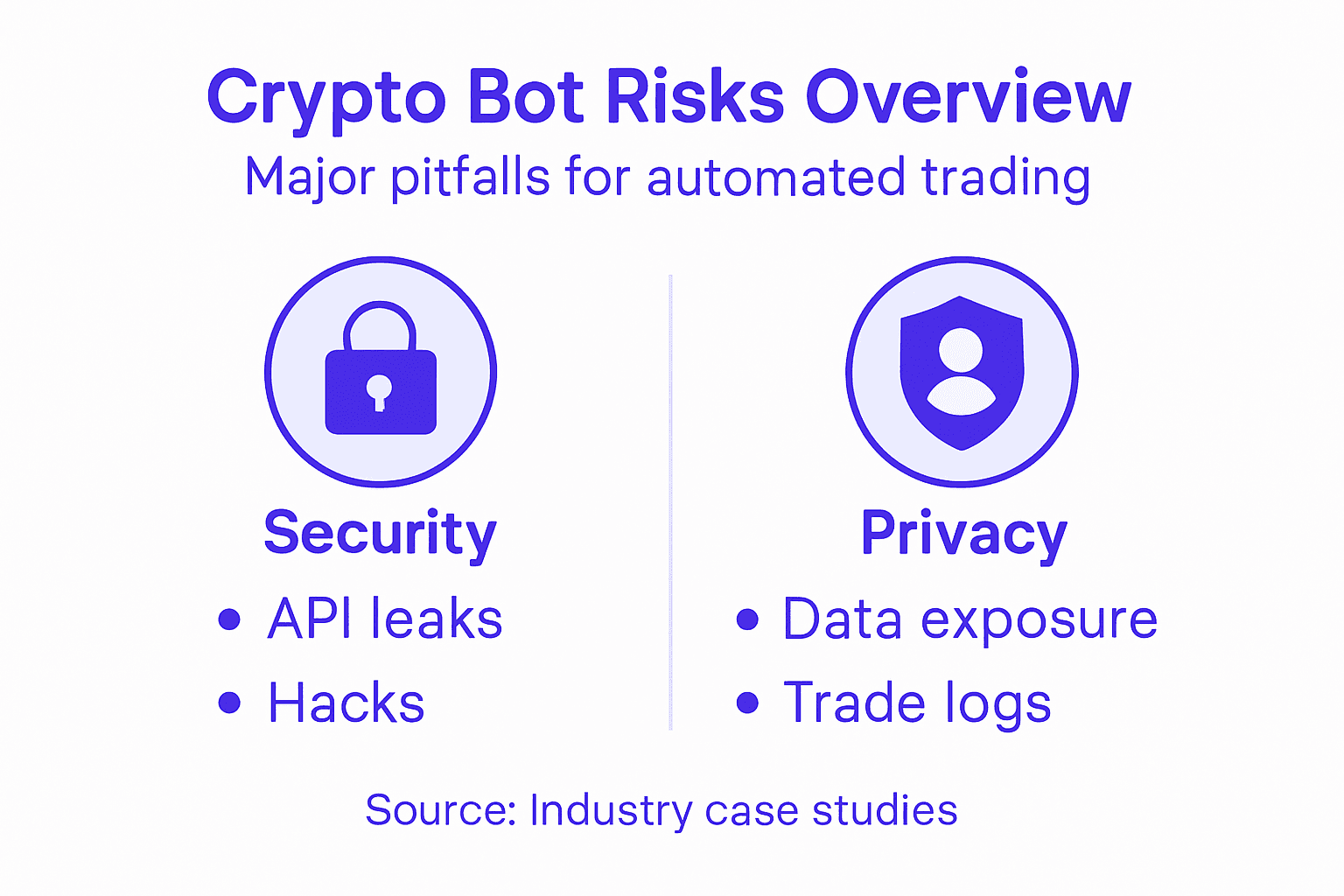
Many traders underestimate the privacy dimension. Running a bot generates detailed trading records showing your positions, entry points, exit prices, and profitability patterns. This data has value to bad actors. Competitors could learn your strategy. Hackers could identify profitable traders and target their accounts. Tax authorities might scrutinize unusual trading patterns. If your bot provider stores this data insecurely or lacks proper encryption, anyone with access to their systems sees your complete financial behavior. Security weaknesses in crypto platforms extend beyond individual bot providers to the broader exchange ecosystem. Smart contract vulnerabilities, centralized custody risks, and false claims of decentralization plague the industry. You are trusting not just the bot provider but also the exchanges where your bot trades and potentially the platforms holding your cryptocurrency.
The practical risks materialize in predictable ways. An attacker steals your API key from a compromised bot dashboard. Your account gets drained in minutes while you sleep. A bot provider goes offline suddenly, leaving you unable to manage your positions or withdraw funds. A smart contract powering automated market functions contains a bug, and liquidity providers lose capital. You authorized the bot weeks ago and never revisit security practices, leaving default passwords or sharing API keys across multiple services. Bad actors harvest these keys from public GitHub repositories where developers carelessly commit credentials. The common thread is passive trust. You set up the bot and assume security is handled for you.
Real protection requires active management on your part. Understand what data the bot collects and where it stores that data. Verify the bot provider’s security practices before connecting. Use restricted API keys that can only trade and read balances, never withdraw funds. Monitor your account for unexpected activity. Keep your API keys offline or use hardware security modules if managing significant capital. Accept that bot automation transfers some control from you to code, and that code can fail or be exploited in ways you did not anticipate.
This table summarizes key security threats and proactive defense tactics in crypto bot usage:
| Threat Example | Potential Impact | User Defense Strategy |
|---|---|---|
| API key theft | Account drained quickly | Use restricted, withdrawal-less keys |
| Bot software breaches | Data and funds exposed | Vet provider security practices |
| Public credential leaks | Total loss of funds | Never commit keys to public repos |
| Provider shutdown | Loss of control/assets | Keep critical assets separate |
| Poor record storage | Strategy disclosure risk | Encrypt trading logs, control access |
Pro tip: Create a dedicated exchange account specifically for bot trading with only the capital you can afford to lose, keeping your main holdings on a separate secure account that the bot never touches.
Market Volatility and Strategy Failure Risks
Cryptocurrency markets exhibit volatility that conventional traders rarely encounter. Bitcoin can swing 5 to 10 percent in a single day. During market stress, moves of 20 percent or more happen within hours. This volatility creates a harsh testing ground for automated strategies. A strategy that works perfectly during calm sideways markets can hemorrhage capital when volatility spikes. Substantial price fluctuations in crypto markets increase unpredictability and amplify the risk of losses, particularly during extended downturns like the 2022 crypto winter when strategies designed for gradual trends instead encountered cliff-like collapses. Your bot executes its rules faithfully, but those rules were written assuming market conditions that no longer exist.
Strategy failure manifests in specific ways when volatility breaks your assumptions. A trend-following bot enters a long position thinking a sustained uptrend is beginning, but the bounce reverses within minutes, triggering your stop-loss and locking in losses. You made the trade 47 times that week, each one losing a small amount, compounding into real money. A market-making bot places tight buy and sell orders expecting normal spreads, but during a flash crash the bid-ask spread explodes, and your bot gets left holding inventory that just declined 15 percent. An arbitrage bot identifies a price discrepancy between two exchanges but network delays and execution latency cause the spread to close before the second leg executes, trapping you in an unintended position. These failures happen not because the bot malfunctions but because market conditions violated the assumptions embedded in your strategy logic.
The deeper risk involves correlation collapse and systemic events. During normal periods, different crypto assets move somewhat independently. Your portfolio spreads risk across multiple holdings. Then a regulatory announcement hits or a major exchange announces problems. Everything sells off simultaneously. Your diversification vanishes. Your stop-losses trigger in rapid succession. Your bot executes sells into a collapsing market, realizing losses just before the recovery. Sudden price swings create liquidity risks that can overwhelm even well-designed automated strategies, calling for vigilant risk management and acceptance that no strategy survives every market condition. The bot cannot distinguish between a temporary pullback and a structural market shift until after the fact, and by then positions are already closed.
The hardest lesson is that backtested performance means almost nothing during unprecedented volatility. You tested your bot against two years of historical data where it performed beautifully. Then market conditions shift in a way that never appeared in your test data. Your bot collapses. This is not a flaw in the bot but a fundamental reality of trading: past performance never guarantees future results, and automated execution simply scales whatever happens faster.
Pro tip: Test your strategy specifically during periods of market stress from your historical data (market crashes, flash crashes, regulatory shocks) and reduce position sizes if your simulated losses during volatile periods exceed your acceptable risk tolerance.
Legal, Financial, and Compliance Impacts
Crypto bot automation operates within a regulatory environment that varies significantly by jurisdiction and continues to shift rapidly. Your bot’s activities create a detailed record of trades that tax authorities expect to see reported accurately. Every transaction has capital gains or losses implications. If your bot executes 500 trades per month, you now have 6,000 taxable events per year to document and report. Many traders underestimate this burden. You run the bot, it generates profits, and you celebrate. Then tax season arrives and you realize you have no clear record of cost basis, acquisition dates, or sale dates for thousands of individual transactions. The bot tracks this data internally, but translating bot records into tax-compliant reports requires significant effort or professional help.
Regulatory frameworks emphasize anti-money laundering compliance and consumer protection to ensure financial safety and transparency in crypto trading activities. If your bot operates across multiple jurisdictions, you may need to comply with different sets of rules. The European Union’s Markets in Crypto-Assets Regulation (MiCA) imposes specific requirements on automated trading. The United States treats crypto differently depending on whether it is being traded as a commodity, security, or currency. Your bot has no jurisdiction awareness. It executes the same strategy in every location without understanding local legal requirements. You bear responsibility for compliance. If your bot’s activities violate local regulations without your explicit knowledge, you still face the consequences.
Financial liability for bot-driven losses raises complex questions. If your bot executes a trade that violates exchange terms of service, who bears the loss? If the bot provider’s infrastructure fails and your positions liquidate, who compensates you? Risk management and custody safekeeping standards require sound operational controls, but the bot provider’s legal liability for your losses remains murky in most jurisdictions. You authorized the bot to trade on your behalf, which typically shifts liability to you as the account holder. The bot provider usually disclaims responsibility for trading outcomes, market losses, or strategy failures. You own both the profits and the losses, regardless of who wrote the bot’s code.
The practical consequence is that bot automation concentrates both financial risk and compliance responsibility on you. Your bot can generate thousands of transactions monthly, each with tax implications, regulatory considerations, and potential liability exposure. You need systems to track trades, calculate taxes, maintain records, and monitor for compliance issues. Many retail traders skip these steps entirely, assuming they will address taxes later. This creates increasing liability as trading volume grows. Running a bot without concurrent compliance infrastructure is like building a factory without safety systems. The production accelerates, but so does the risk of catastrophic failure.
Pro tip: Before deploying any bot, consult with a tax professional in your jurisdiction to understand reporting requirements and set up automated trade export systems that feed directly into tax accounting software, preventing compliance disasters later.
Gain Control Over Crypto Bot Risks With Darkbot.io
The article highlights crucial risks every crypto trader faces with automation including security vulnerabilities, strategy failures amid market volatility, and legal compliance challenges. If you worry about API key theft, unpredictable market swings, or complex tax reporting you are not alone. These pain points demand a trusted platform that not only offers advanced automation but also prioritizes robust security, intuitive strategy customization, and seamless portfolio management.
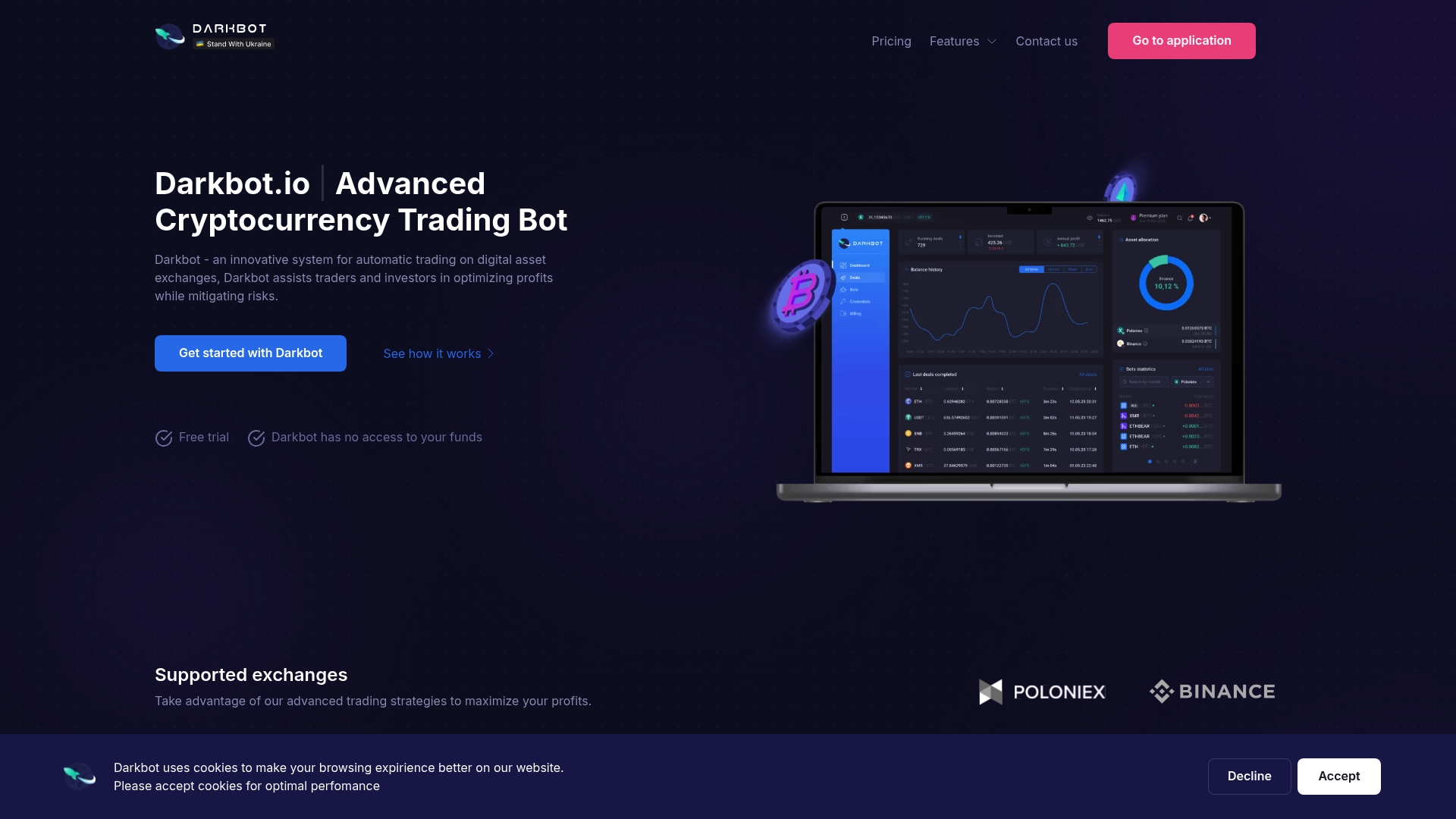
Darkbot.io is designed specifically to address these challenges by combining AI-powered trading algorithms with secure API integration and real-time analytics. Manage multiple bots simultaneously while protecting your assets with restricted API keys and encrypted data storage. Customize your strategies and backtest them to withstand volatile conditions and stay compliant with regulatory demands. Don’t let automation risks hold you back. Visit Darkbot.io today and discover how our advanced crypto trading bot can help you automate confidently. Explore our features to safeguard your portfolio and maximize profits in every market scenario.
Frequently Asked Questions
What are the main risks associated with using crypto bots?
The main risks include security vulnerabilities, strategy failure during market volatility, and regulatory compliance issues. Crypto bots can expose your accounts to unauthorized access and can also execute flawed trading strategies in unpredictable market conditions.
How can I mitigate security risks when using a crypto trading bot?
To mitigate security risks, use restricted API keys that can only access trading functions without withdrawal capabilities. Regularly monitor your trading accounts for any unauthorized activity and ensure that the bot provider has strong security practices in place.
Why do automated strategies fail during periods of high market volatility?
Automated strategies often fail during high volatility because they may be based on historical data that do not account for extreme market movements. When unexpected price swings occur, the assumptions embedded in the strategy logic may break down, leading to substantial losses.
What compliance issues should I be aware of when using crypto trading bots?
You should be aware of tax reporting requirements, regulatory compliance across different jurisdictions, and the need to maintain records of all transactions. Failure to comply can lead to legal and financial consequences, including tax liabilities and penalties.
Recommended

Start trading on Darkbot with ease
Come and explore our crypto trading platform by connecting your free account!
Free plan available • No credit card required