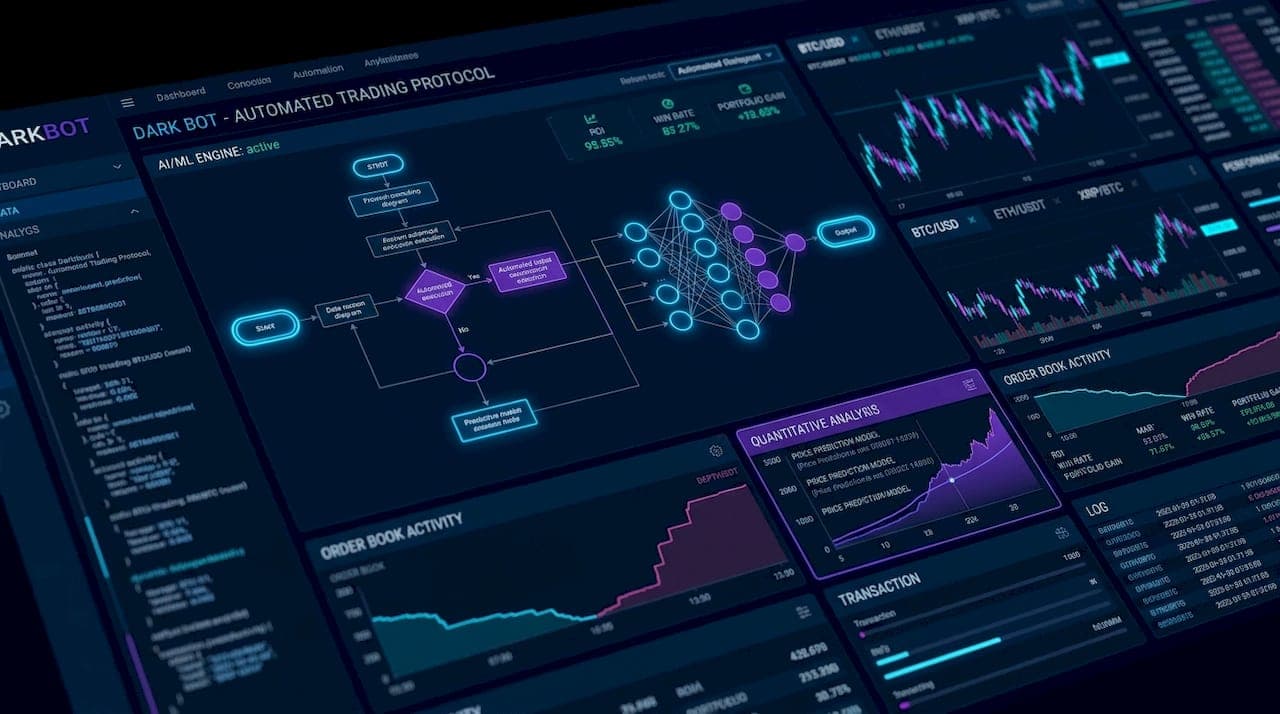
AI Trading Strategy Optimization for Profitable Results

Every Crypto hedge fund manager knows the challenge of navigating wild market swings while safeguarding assets and chasing profits. As volatility grows across exchanges from Singapore to New York, the search for more reliable performance pushes strategies toward advanced automation. Building a robust AI trading infrastructure and customizing parameters can give you powerful tools to manage risk and improve returns, setting the stage for smarter execution throughout your global portfolio.
Quick Summary
| Key Insight | Explanation |
|---|---|
| 1. Establish Core Infrastructure Layers | Create data ingestion, processing, and execution layers to support your AI trading bot. Each layer plays a critical role in effective trading. |
| 2. Customize Strategy Parameters Carefully | Tailor your trading strategy by defining precise entry, exit, and position sizing rules based on market conditions and risk tolerance. |
| 3. Conduct Thorough Automated Backtesting | Validate your strategy with quality historical data to ensure consistent performance across various market conditions before live trading. |
| 4. Validate with Paper Trading First | Test your strategy in real market conditions using paper trades to identify errors and adjust before actual capital deployment. |
| 5. Implement Stress Testing of Strategies | Stress test your strategies against market crashes and extreme volatility to ensure their robustness and ability to withstand adverse conditions. |
Step 1: Set Up AI Trading Infrastructure
Setting up AI trading infrastructure means building the technical backbone that enables your trading bot to operate consistently and effectively. This involves integrating data pipelines, connecting to exchanges, and configuring the computational resources your algorithms need to execute trades without manual intervention.
Start by selecting your core infrastructure components. You need three essential layers:
- Data ingestion layer that pulls real-time market data from your exchanges
- Processing and modeling layer where your AI algorithms analyze patterns and generate trading signals
- Execution layer that automatically places orders based on your strategy
The foundation begins with API connectivity to your exchanges. Securely connect your trading bot to the platforms where you hold assets. Your API keys grant the bot permission to read account data and execute trades, so use read-only keys for testing and restricted keys for live trading.
Next, configure your data infrastructure. Modern AI trading systems rely on machine learning models that process order book data and historical price information to identify trading opportunities. Ensure your system can handle real-time data streams without delays, as latency directly impacts execution quality.
Define your computational requirements based on your strategy complexity. Simple rule-based strategies demand minimal resources, while deep learning models analyzing multiple timeframes and indicators require more processing power. Cloud-based solutions offer flexibility, scaling resources up or down as your needs change.
Create your risk management framework before going live. This includes position size limits, maximum portfolio exposure per trade, stop-loss parameters, and daily loss thresholds. Your infrastructure must enforce these rules systematically.
Here’s a summary of how each AI trading infrastructure layer contributes to system reliability and performance:
| Layer | Main Responsibility | Failure Risk | Business Impact |
|---|---|---|---|
| Data Ingestion | Fetches real-time market data | Delayed or missing data | Missed opportunities, poor signals |
| Processing & Modeling | Analyzes data, generates signals | Calculation errors | Inaccurate trades, losses |
| Execution | Submits and manages orders | Order failures | Missed or incorrect trades |
Your infrastructure is only as reliable as its weakest component—test each layer thoroughly in paper trading mode before risking capital.
Finally, test your entire setup in a sandbox environment. Place paper trades, monitor signal generation, and verify that orders execute correctly. Run this for at least 2 weeks to catch configuration errors and ensure smooth operation.
Pro tip: Start with minimal complexity in your first deployment. A single, well-tested strategy running reliably generates better results than multiple complex strategies with execution problems or configuration gaps.
Step 2: Customize Strategy Parameters and Rules
Customizing your strategy parameters transforms a generic trading template into a system tailored to your specific market conditions, risk tolerance, and profit objectives. This step determines how your AI bot identifies opportunities and manages positions under real market pressure.
Begin by identifying the core parameters your strategy needs. These fall into three categories:
- Entry parameters that define when your bot initiates a trade
- Exit parameters that determine profit targets and loss limits
- Position sizing rules that control how much capital each trade receives
Start with entry conditions. Your strategy might use moving average crossovers, volatility thresholds, or momentum indicators. Tuning predictive features and execution rules requires testing different values against historical data to find what works best in your target markets. A 50-period moving average might work excellently in one market but fail in another with different volatility patterns.
Next, configure your exit rules precisely. Set your profit target percentage based on realistic expectations for your timeframe. If you trade 4-hour candles, a 2% profit target per trade is reasonable; intraday scalpers might target 0.5%. Your stop-loss percentage should reflect normal market noise while protecting capital from catastrophic losses.
Position sizing deserves careful attention. Parameter customization for position sizing prevents overexposure during winning streaks and preserves capital during drawdowns. Most professional traders risk 1-2% of account value per trade, meaning a single loss never exceeds that percentage.
Now set your risk management thresholds. Include daily loss limits that pause trading when losses exceed a threshold, and maximum correlation limits if you run multiple bots. These rules prevent cascade failures where losses compound across strategies.
Parameter tuning is iterative. Your initial settings rarely survive contact with live markets unchanged, so build flexibility into your system from the start.
Test your parameters against at least 6-12 months of historical data before deploying live. Your backtest should show consistent profitability across different market regimes, not just during the best market conditions.
Pro tip: Use a small position size for your first 100 trades with live parameters. Market conditions change constantly, so real-world performance often differs from backtest results. Small positions let you adjust parameters based on actual outcomes without catastrophic losses.
Step 3: Automate Backtesting with Historical Data
Automated backtesting validates your strategy against years of price history before risking real capital. This process reveals whether your logic produces consistent profits across different market conditions or just got lucky during one particular timeframe.
Begin by gathering quality historical data. Your data foundation needs to be solid, so source tick-level or minute-level price data from reliable providers. Include open, high, low, and close prices plus volume for every period your strategy will analyze. Poor data quality corrupts your entire backtest, so verify data completeness and check for gaps or anomalies.
Next, configure your backtesting environment. Load your historical dataset and define your testing window. Most professionals backtest minimum 3-5 years of data to capture bull markets, bear markets, and sideways consolidations. Your strategy must perform acceptably across all three conditions, not just in your cherry-picked timeframe.
Set up your simulation parameters carefully. Define your starting capital, commission costs per trade, slippage assumptions, and whether you’ll include withdrawal or deposit flows. Realistic simulation accounting for market conditions and data quality ensures your backtest results translate to real trading rather than remaining theoretical.
Run automated tests on your strategy variations. The system should execute trades mechanically according to your rules, calculate profit and loss for each trade, and generate performance metrics. Key metrics to monitor include:
- Win rate showing percentage of profitable trades
- Profit factor comparing gross profit to gross loss
- Maximum drawdown revealing largest peak-to-trough decline
- Sharpe ratio measuring risk-adjusted returns
Check carefully for lookahead bias and overfitting. Lookahead bias occurs when your strategy uses data it shouldn’t know yet. Overfitting happens when your parameters fit historical data perfectly but fail on new data. Both destroy real-world profitability, so test your strategy on a separate out-of-sample period to validate robustness.
A backtest showing 200% annual returns that haven’t been validated out-of-sample is worse than useless, it’s dangerous.
Analyze your backtest results beyond raw numbers. Examine equity curves to see if profits cluster in certain periods or spread consistently. Look at trade sequences to understand whether losses come in clusters that exceed your psychological tolerance.
Key backtesting metrics help you evaluate overall strategy performance before live deployment:
| Metric | What It Measures | Why It Matters |
|---|---|---|
| Win Rate | % of profitable trades | Indicates prediction accuracy |
| Maximum Drawdown | Worst capital decline | Assesses risk of large losses |
| Profit Factor | Profit/loss ratio | Gauges long-term viability |
| Sharpe Ratio | Risk-adjusted returns | Reveals reward per unit risk |
Pro tip: Use walk-forward backtesting where you train parameters on one period, test on the next period, then move forward in time. This mimics real trading conditions better than traditional backtesting and prevents overfitting to historical data.
Step 4: Validate and Deploy Optimized Strategies
Validation separates strategies that work in theory from those that generate real profits under live market conditions. This critical phase tests your strategy’s robustness before committing capital, ensuring your optimization didn’t just curve-fit to historical noise.
Start with paper trading validation. Run your strategy on live market data without risking real money for 2-4 weeks minimum. This reveals execution quality, signal generation accuracy, and whether your bot handles real market volatility as expected. Paper trading exposes configuration errors and edge cases your backtest may have missed.
Conduct comprehensive stress testing next. Your strategy must survive adverse conditions, so test performance during market crashes, gap moves, and extreme volatility spikes. Performing stress testing and risk assessment ensures your strategy doesn’t unravel when markets behave unexpectedly.
Monitor key validation metrics carefully:
- Win rate consistency showing stable profitability over time
- Drawdown experience confirming acceptable loss levels
- Execution slippage comparing intended versus actual entry prices
- Signal quality measuring false positives and entry accuracy
Implement walk-forward analysis and continuous performance monitoring before full deployment. This technique trains your model on one period, tests on the next, then rolls forward. It mimics live trading conditions better than static backtests and prevents overfitting.
Once validation confirms consistent performance, prepare for live deployment. Verify your risk management rules are enforced at the execution layer. Confirm your position sizing logic, daily loss limits, and correlation controls are hardcoded, not just suggestions. Set up monitoring dashboards tracking equity curves, trade frequency, and strategy correlation with your portfolio.
Validation isn’t a checkbox to skip quickly. The difference between a profitable strategy and an account-killer often lies in validation thoroughness.
Deploy with reduced position sizes initially. Start with 25-50% of your planned allocation and increase gradually as the strategy demonstrates real-world profitability. Real markets introduce variables that backtests cannot fully replicate.
Pro tip: Set up alerts for statistical anomalies like unusual win rate drops, extended losing streaks, or correlation increases. These signals indicate strategy drift or changed market conditions requiring parameter review before losses compound.
Unlock the Power of AI Trading Strategy Optimization Today
Building a reliable AI-driven trading infrastructure and fine-tuning strategy parameters are challenging yet essential steps to profitable cryptocurrency trading. If you have struggled with integrating data ingestion, ensuring execution reliability, or avoiding costly overfitting during backtesting, you are not alone. These pain points require sophisticated tools that simplify the complexity of deploying automated trading strategies at scale.
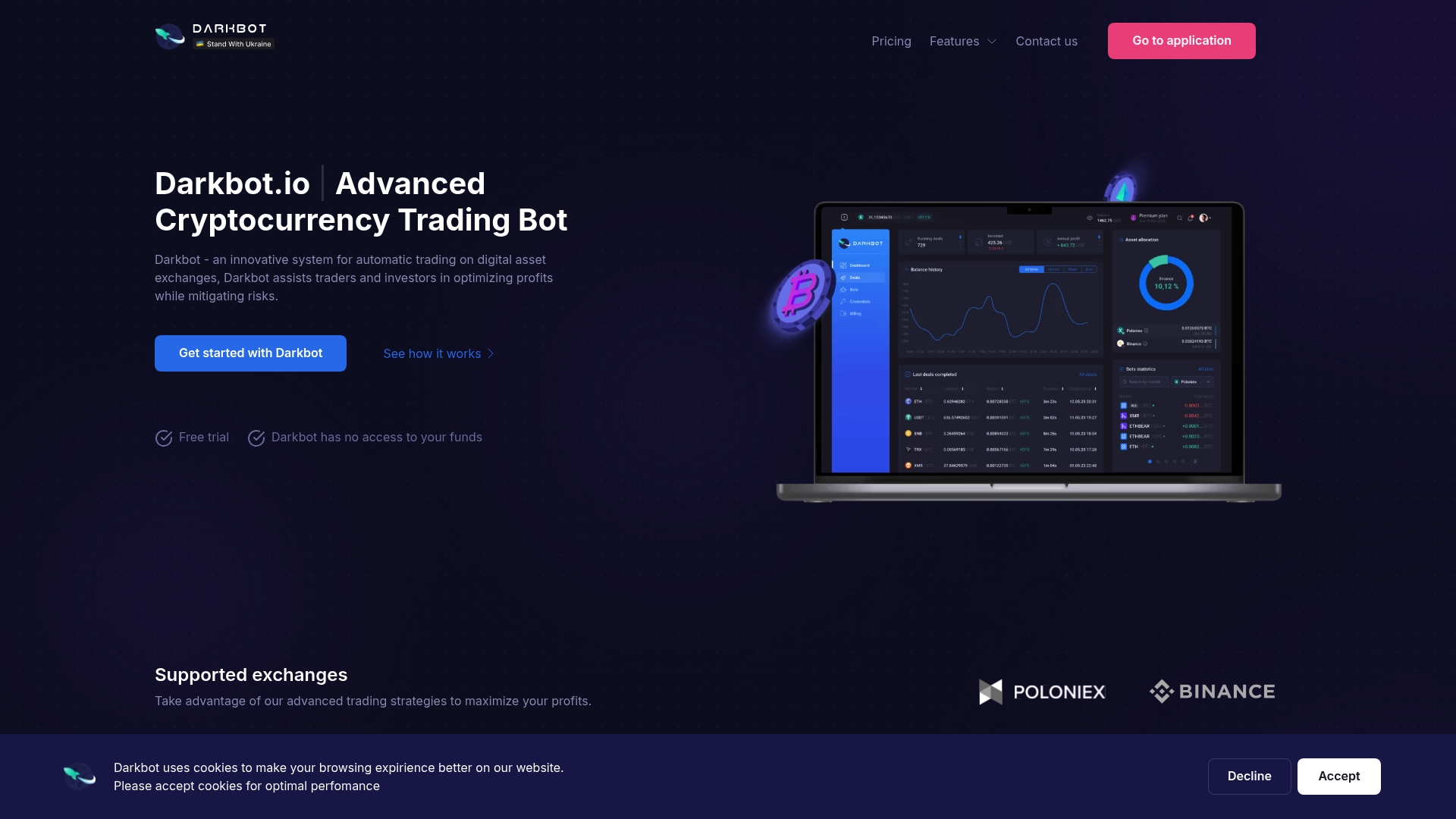
Experience how Darkbot.io helps traders overcome these hurdles by providing seamless exchange integration through secure API keys, advanced strategy customization features, and real-time analytics to monitor performance dynamically. Whether you want to test strategies in paper trading mode or implement multiple bots for diversified portfolio management, our platform empowers you to automate confidently with built-in risk controls and continuous validation. Take control over your crypto trading journey now by visiting Darkbot.io and discover personalized support and pricing that fits your needs. Start optimizing your AI trading strategies to generate consistent profits and reduce manual effort today.
Frequently Asked Questions
How do I set up my AI trading infrastructure?
To set up your AI trading infrastructure, establish three essential layers: data ingestion, processing and modeling, and execution. Begin by integrating API connectivity to your exchanges and configuring real-time data streams, ensuring your system supports your algorithm’s computational needs.
What parameters should I customize for my AI trading strategy?
Customize your AI trading strategy by defining entry parameters, exit parameters, and position sizing rules. Focus on conditions that suit your trading style and market volatility, adjusting your profit targets and stop-loss percentages to fit realistic expectations.
How can I automate backtesting for my strategy?
You can automate backtesting by gathering high-quality historical data and setting up a backtesting environment that reflects your strategy’s parameters. Configure the simulation with realistic commission costs and slippage assumptions, and run tests over at least 3-5 years of data to analyze performance metrics.
What validation steps are necessary before deploying my trading strategy?
Prior to deployment, validate your strategy through paper trading for a minimum of 2-4 weeks and conduct stress testing during adverse market conditions. Ensure consistent metrics like win rate and acceptable drawdown levels to confirm your strategy’s robustness.
How do I monitor my AI trading strategy during live deployment?
During live deployment, establish monitoring dashboards to track key metrics such as equity curves and trade frequency. Set up alerts for significant changes in performance indicators to identify potential strategy drift or market condition shifts that may require adjustments.
Recommended
- Automated Trading Strategies Tutorial for Profitable Crypto
- Crypto Bot Strategy Optimization Guide for Maximizing Profits
- Guides - Cryptocurrency Trading Blog | AI Trading Strategies & Guides | Darkbot
- Why Use AI in Trading: Maximizing Crypto Performance
- f01i.ai – AI Crypto Trading Bot Builder | No Commissions | Automated Trading
- The Future of FinTech: How AI is Reshaping Financial Services - BankStatementFlow Blog

Start trading on Darkbot with ease
Come and explore our crypto trading platform by connecting your free account!
Free plan available • No credit card required