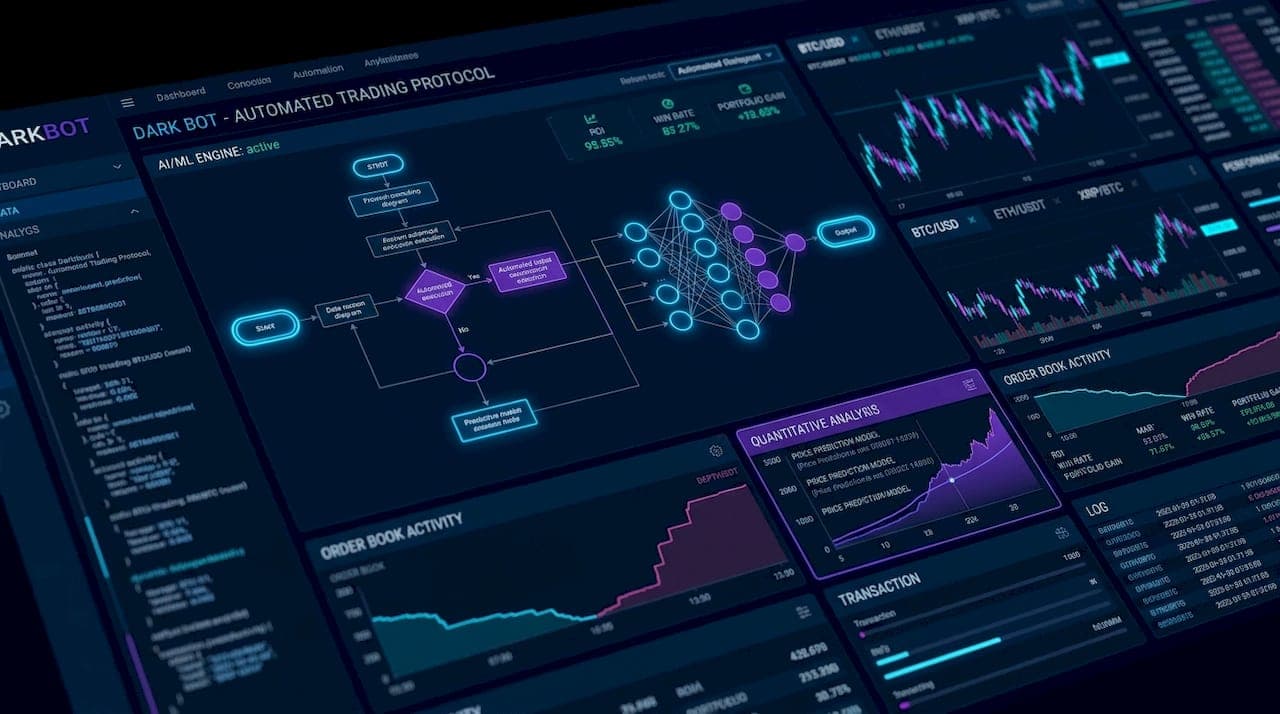
Automated Trading Strategies Tutorial for Profitable Crypto
Managing your investments often means juggling your busy schedule with the need for effective decision making. For professionals and new traders, automated crypto trading offers a smarter way to grow small to mid-sized portfolios without constant oversight. By leveraging solutions like Darkbot.io, you gain control over security and permissions while benefiting from proven strategies and robust risk management. This guide helps you connect your exchange, set up your trading bot, and confidently optimize results with less time spent watching the markets.
Quick Summary
| Essential Insight | Detailed Explanation |
|---|---|
| 1. Secure API Credentials | Generate API keys with read and trade access, avoiding withdrawal privileges for added security. |
| 2. Choose a Suitable Trading Strategy | Select strategies that align with market conditions and personal risk tolerance for effective trading. |
| 3. Monitor Performance Regularly | Establish daily checks on trade execution, win rates, and account balances to catch issues early. |
| 4. Backtest Strategies Before Live Trading | Use historical data to validate performance and identify weaknesses before deploying any strategy. |
| 5. Document and Optimize | Keep a trading journal to track changes made and their effects, fostering continuous improvement in your strategy. |
Step 1: Connect Darkbot.io to Your Exchange
Connecting your exchange account to Darkbot.io is the foundation of automated trading. This step bridges your Darkbot.io platform to your chosen exchange, enabling the bot to execute trades on your behalf while you maintain complete control over permissions and security.
Start by generating API credentials from your exchange account. Most popular exchanges like Binance, Kucoin, and Coinbase allow you to create API keys through their security settings. When you generate these credentials, the exchange will provide a public key and a secret key—treat the secret key like a password and never share it publicly.
Next, configure your API permissions carefully. You’ll need to specify which actions the API can perform. The two essential permissions are:
- Read access allows Darkbot.io to monitor your balances and portfolio
- Trade access permits the bot to execute buy and sell orders on your behalf
Most traders disable withdrawal permissions, which adds an extra security layer by preventing anyone from moving funds off the exchange even if they gain access to the API key. This is a smart precaution.
Once your API credentials are ready, connect your exchange to Darkbot.io by navigating to the exchange integration section within your account. Paste your API key and secret key into the designated fields. The platform will test the connection to confirm everything works correctly.
You should know that setting up cryptocurrency trading bot credentials requires this initial validation step to ensure secure communication between your exchange and the bot platform.
After successful connection, verify that Darkbot.io can see your balances accurately. This confirmation tells you the integration is functioning properly and ready for strategy deployment.
Restrict API permissions to only what you need—read and trade access—and consider regenerating your keys quarterly for added security.
Pro tip: Create a dedicated sub-account or API key with minimal balance exclusively for testing before running your full strategy, reducing risk if something goes wrong during initial setup.
Step 2: Select and Configure a Trading Strategy
Selecting the right trading strategy is critical to your success with Darkbot.io. This step involves choosing a strategy that matches your risk tolerance, market outlook, and trading goals, then configuring its parameters for your specific situation.
Start by understanding what types of strategies are available. Most automated traders use one of these core approaches:
Here’s a summary of common trading strategy types and the market conditions where they work best:
| Strategy Type | Core Principle | Works Best In |
|---|---|---|
| Trend-Following | Ride sustained directional trends | Volatile markets |
| Mean Reversion | Profit from price returning to average | Sideways markets |
| Momentum | Enter on price acceleration signals | Rapidly moving assets |
| Grid Trading | Execute trades across price ranges | Range-bound markets |
- Trend-following strategies capitalize on sustained price movements in one direction
- Mean reversion strategies bet that prices will return to average levels after extreme moves
- Momentum strategies enter positions when price acceleration signals strength
- Grid trading strategies execute multiple small trades across a price range
Your strategy selection depends on current market conditions and your personal preferences. In volatile markets, trend-following often performs better. In sideways markets, mean reversion tends to win. Consider what timeframe suits your schedule as well—some strategies work better on hourly charts while others thrive on daily timeframes.
Once you’ve chosen a strategy type, configure its parameters. Parameters are the specific rules that control when your bot enters and exits trades. When selecting and tuning strategy parameters, you’ll adjust values like moving average lengths, support and resistance levels, or risk percentage per trade.
Before running any strategy live, you must backtest it against historical market data. Backtesting shows you how your configured strategy would have performed in the past, revealing potential weaknesses before real money is at risk. Darkbot.io provides backtesting tools that let you see win rates, drawdowns, and profit factors.
Start conservative with your parameter settings. Many new traders configure strategies too aggressively and suffer unexpected losses. A strategy that wins 55% of trades with steady gains is more reliable than one claiming 80% win rates with massive volatility.
Backtest thoroughly with realistic settings before deploying any strategy, and expect historical performance to differ from live results.
Pro tip: Configure your strategy to risk only 1-2% of your account per trade, regardless of how good the backtest results look—this prevents a losing streak from wiping out your capital.
Step 3: Activate and Monitor Your Automated Bot
Activating your bot marks the transition from preparation to live trading. This step involves launching your strategy and establishing a monitoring routine to ensure everything performs as expected while catching any issues early.
Before you hit the activate button, run through a final checklist. Verify that your exchange connection is stable, your API permissions are correct, and your strategy parameters are saved. Check that your account has sufficient balance to cover your position sizes based on your configured risk settings.
Once everything checks out, activate your bot within Darkbot.io. The platform will begin executing trades according to your strategy rules. Start with a small test position to confirm the bot executes orders correctly on your exchange before scaling up to full size.
Monitoring is where most traders stumble. Many set a bot running and ignore it, only to discover problems weeks later. Instead, establish a daily monitoring habit by checking these key metrics:
- Trade execution confirms orders are filling at reasonable prices
- Win rate and drawdown show if performance matches your backtest expectations
- Account balance tracks whether you are gaining or losing ground
- Bot status ensures no connection errors or technical failures occurred
When monitoring automated trading bot performance, look for red flags like sudden changes in win rates, trades executing far from expected entry prices, or error messages in your bot logs. These signal something needs adjustment.
Set up alerts in Darkbot.io so you receive notifications when unusual activity occurs. Alerts should notify you of large losing trades, connection failures, or when your account balance drops below a threshold you set.
Unexpected market conditions will occasionally require strategy adjustments. If your trend-following bot performs terribly in a choppy, sideways market, you may pause it and switch to a mean reversion approach instead. This flexibility is why monitoring matters.
Live trading rarely matches backtest results perfectly. Markets change, and your bot needs oversight to adapt.
Pro tip: Review your bot’s performance every Sunday evening to plan adjustments for the week ahead, catching problems early before they compound into larger losses.
Step 4: Evaluate Results and Optimize Strategy
Evaluating your trading results reveals whether your strategy works or needs adjustment. This step involves analyzing performance metrics, identifying weaknesses, and making data-driven changes to improve consistency and profitability.
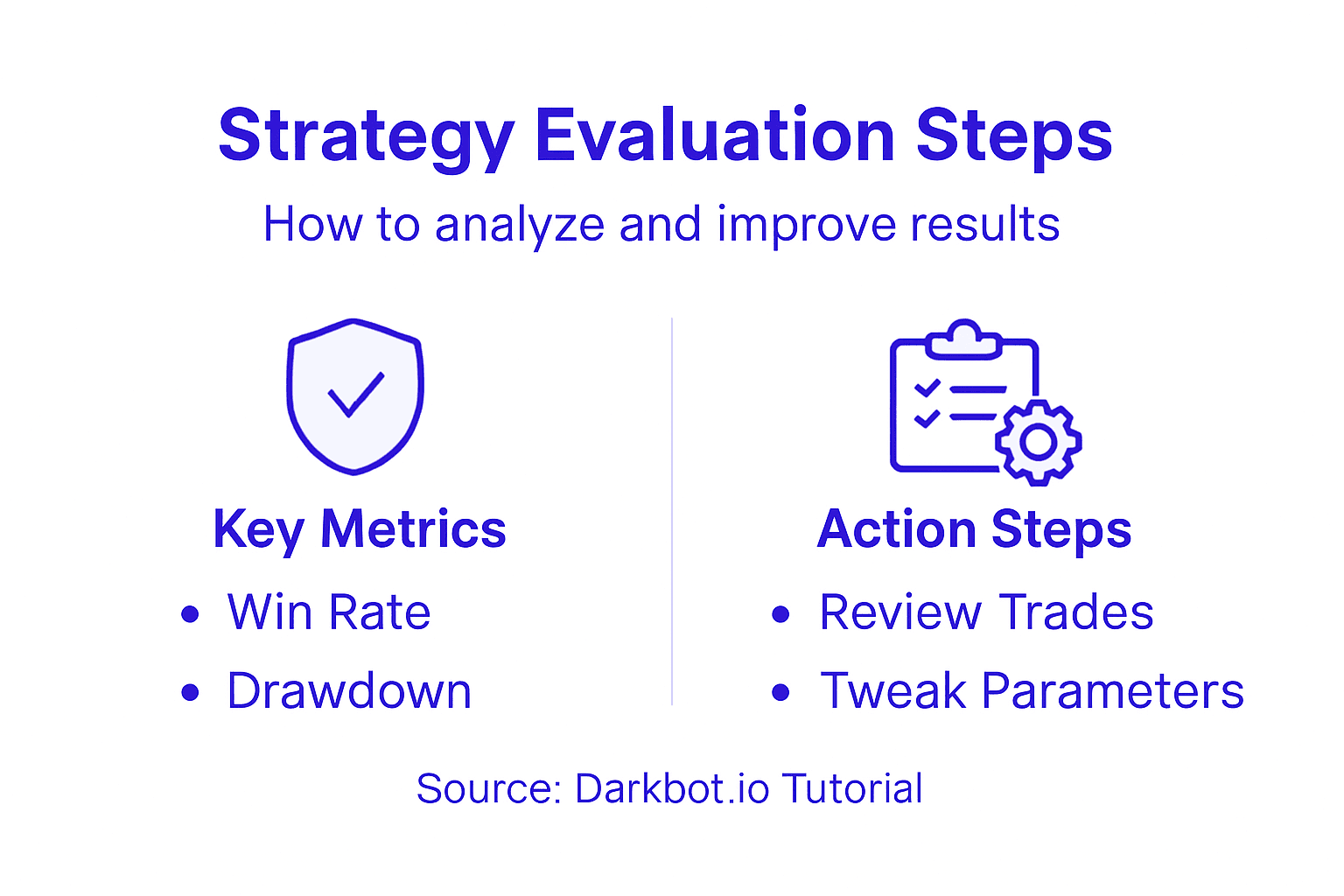
Start by gathering the right data from Darkbot.io. Pull your complete trade history for the period you want to analyze, ideally at least 30 trades or one full month of results. More data reduces the impact of lucky or unlucky streaks and shows true strategy behavior.
Next, calculate your core performance metrics. These tell you what actually happened with your money:
Use this table to quickly interpret key bot performance metrics and what they reveal:
| Metric | Indicates | Action if Unfavorable |
|---|---|---|
| Win Rate | Overall success of trades | Review strategy logic |
| Drawdown | Risk exposure from losses | Lower position size or risk |
| Sharpe Ratio | Returns relative to risk taken | Adjust strategy for consistency |
| Avg Win vs Loss | Quality of reward compared to risk | Refine exits or trade size |
- Win rate shows the percentage of winning trades versus losing trades
- Average win and loss compare your typical profit to your typical loss
- Drawdown measures your largest peak-to-trough decline in account balance
- Sharpe ratio measures returns relative to risk taken
These performance metrics guide strategy evaluation by revealing whether your strategy generates consistent returns or relies on occasional lucky trades. A 40% win rate with larger average wins than losses can outperform a 70% win rate with small wins and occasional large losses.
Compare your live results to your backtest results. Large gaps suggest your strategy performs differently in real markets than in historical data. This is normal but worth investigating. Market conditions may have changed, or slippage from real execution costs may impact results.
Identify specific problems by looking for patterns. Did losses cluster during certain market conditions? Did your strategy underperform on particular days or times? Did larger positions perform worse than smaller ones? These patterns suggest optimization opportunities.
Make one change at a time. Adjust a single parameter, run another backtest, and compare results. If the change improves your metrics, keep it. If not, revert it. This systematic approach prevents you from accidentally making your strategy worse.
Your goal is steady, consistent returns, not home run trades. A boring strategy that wins regularly beats an exciting one that crashes.
Pro tip: Keep a trading journal documenting each optimization change you make and its results, building institutional knowledge about what actually works for your style and market conditions.
Maximize Your Crypto Profits with Darkbot.io’s Automated Trading Solutions
Navigating the complexities of automated trading strategies can be overwhelming. The article highlights key challenges such as securely connecting exchange APIs, selecting and fine-tuning profitable trading strategies, and continuously monitoring performance to adapt to volatile crypto markets. If you are striving to overcome these hurdles while aiming for steady, consistent returns with minimized risk, Darkbot.io offers the perfect solution tailored to your needs.
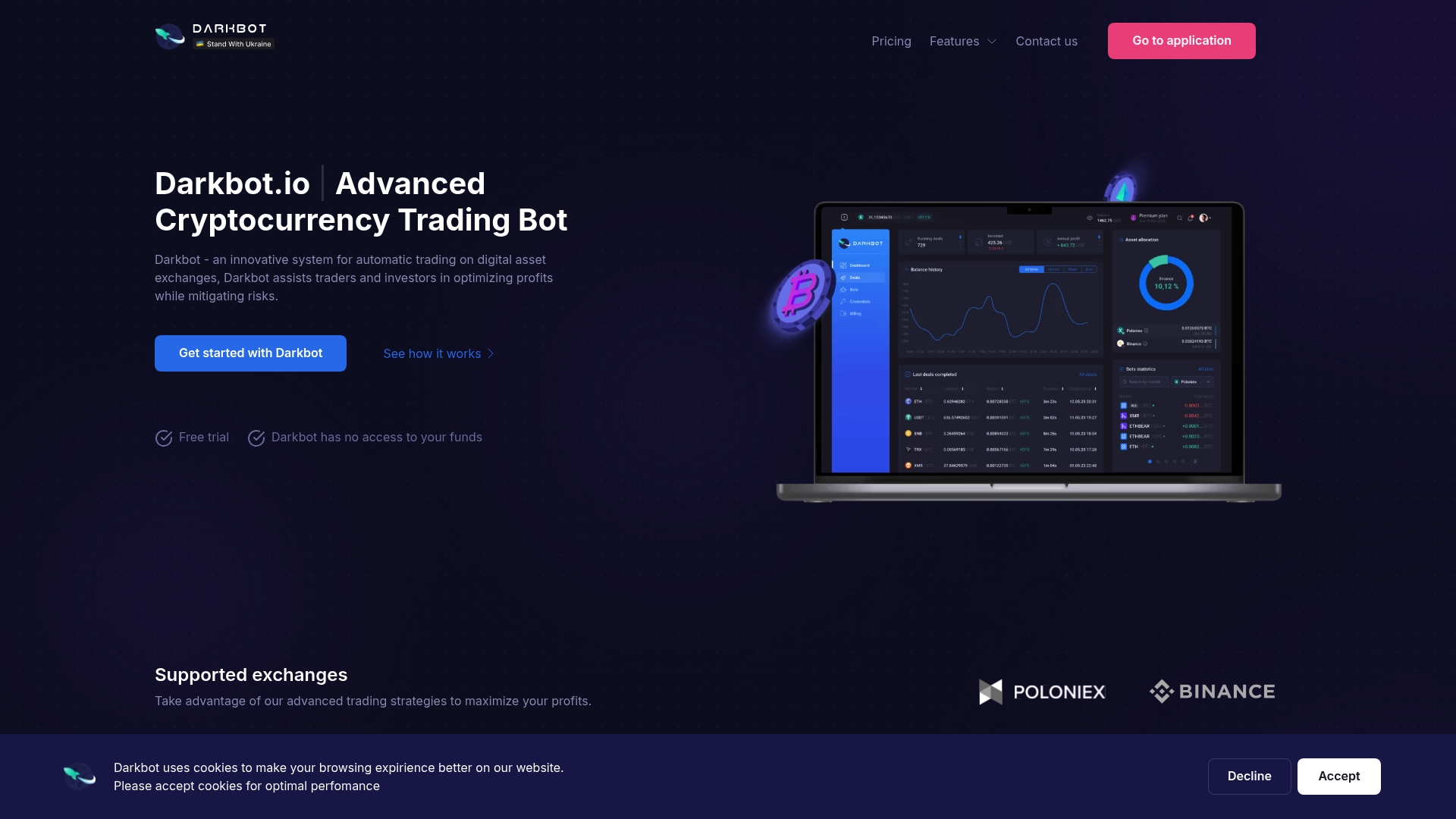
Our platform simplifies everything from seamless exchange integration via secure API keys to advanced strategy customization powered by AI and machine learning. With Darkbot.io you can confidently automate trend-following, mean reversion, momentum, or grid trading strategies while benefiting from real-time analytics and automated portfolio rebalancing. Designed for traders at every level, our intuitive interface and secure infrastructure ensure your bot performs reliably so you don’t have to watch the markets 24/7. Take control of your crypto trading journey today by exploring Darkbot.io’s powerful platform and learn how to connect your exchange effortlessly.
Start your automated trading adventure now and experience how precision automation can transform your cryptocurrency profits and reduce manual effort. Visit Darkbot.io to get started and let your strategies work smarter for you.
Frequently Asked Questions
How do I connect Darkbot.io to my exchange for automated trading?
To connect Darkbot.io to your exchange, generate API credentials from your exchange account, allowing the bot to execute trades. Once you have the API key and secret key, paste them in the specified fields in Darkbot.io to complete the integration.
What permissions should I set for my API when using Darkbot.io?
It is essential to set your API permissions carefully. Enable only ‘Read’ access to monitor balances and ‘Trade’ access to execute orders, while disabling withdrawal permissions for added security.
How can I select the best trading strategy for my crypto trading?
To select a suitable trading strategy, consider your risk tolerance and current market conditions. Once you identify a strategy type—such as trend-following or mean reversion—carefully configure its parameters according to your trading goals and backtest its performance before going live.
What steps should I take to monitor my automated trading bot effectively?
To monitor your automated trading bot, establish a daily routine to check crucial metrics like trade execution, win rates, and account balance. Set up alerts for unusual activity to catch issues quickly and adjust your strategy as necessary based on performance trends.
How can I evaluate the performance of my trading strategy?
Evaluate your trading strategy by analyzing key performance metrics, such as win rate and drawdown over a significant number of trades. Gather your complete trading history, calculate these metrics, and consider making one adjustment at a time to improve consistency and profitability.
What should I do if my trading bot’s live results differ from backtest results?
If your trading bot’s live results diverge from backtest results, investigate the potential causes, such as changes in market conditions or execution slippage. Identify specific patterns in performance and make systematic adjustments to improve your strategy based on these insights.
Recommended
- Crypto Trading Strategy Optimization for Profitable Automation
- Cryptocurrency Trading Strategy Guide 2025: Automate Success
- Why Automate Crypto Strategies for Trading Success
- Automated Crypto Trading: Streamlining Strategy Execution
- f01i.ai – AI Crypto Trading Bot Builder | No Commissions | Automated Trading

Start trading on Darkbot with ease
Come and explore our crypto trading platform by connecting your free account!
Free plan available • No credit card required