Algorithmic trading AI: boost crypto profits & manage risk

Wall Street firms once held a monopoly on algorithmic trading, running complex systems that individual traders could only dream about. That gap has closed fast. AI-powered tools now let you automate sophisticated strategies across multiple exchanges, 24 hours a day, without a team of quants behind you. This guide breaks down how AI trading bots work, which platforms deliver real results, what the evidence says about returns, and how to deploy them responsibly without blowing up your portfolio.
Key Takeaways
| Point | Details |
|---|---|
| AI unlocks advanced trading | Algorithmic trading AI empowers regular crypto investors to automate and optimize their strategies. |
| Data quality is essential | Using the right bar types and labels improves live-trading results over classic technical analysis. |
| Empirical gains possible | Well-built AI bots have posted impressive returns, but require robust risk controls. |
| Risks require vigilance | System failures, black swans, and AI hallucinations mean oversight and best practices are non-negotiable. |
| Practical deployment steps | Start with open-source platforms, test thoroughly, and adapt your bots for changing market conditions. |
What is algorithmic trading AI in crypto?
At its core, algorithmic trading AI means using artificial intelligence and machine learning to automate, optimize, and execute trades based on data rather than gut feeling. Instead of you watching charts at 3 a.m., a bot processes signals and acts in milliseconds. That matters enormously in crypto, where prices can swing 10% before you finish your coffee.
Modern crypto bots are far more capable than simple rule-based scripts. They combine multiple AI layers to make smarter decisions:
- Price forecasting using deep learning models that read historical candlestick data
- Sentiment analysis that scans news headlines and social media for market-moving events
- Risk controls that automatically limit position sizes and trigger stop-losses
- Strategy optimization that continuously refines decisions based on profit and loss feedback
The technical backbone of these systems, as explained in this overview of multi-LLM approaches, relies on hybrid deep learning models including CNN-LSTM for price patterns, large language models (LLMs) for sentiment, and reinforcement learning (RL) for strategy improvement.
“AI-powered algorithmic trading has enabled massive returns previously limited to institutional investors, now accessible to individual traders through modern bot platforms.”
Understanding how AI drives success in crypto starts with recognizing that these systems don’t just follow rules. They learn, adapt, and improve over time.
How AI models predict, analyze, and execute trades
AI trading pipelines are more structured than most traders realize. Each layer handles a specific job, and they work together to produce a trade signal. Here’s how the process flows in a modern system:
- Data ingestion: The bot collects OHLCV data (open, high, low, close, volume), technical indicators, and real-time news feeds.
- Pattern recognition: A CNN-LSTM model scans price history to identify recurring trends and likely breakout points.
- Sentiment scoring: An LLM reads news articles and social posts, flagging bullish or bearish signals before they hit the price chart.
- Decision making: A deep reinforcement learning (DRL) agent weighs all inputs and selects the best action: buy, sell, or hold.
- Execution and feedback: The bot places the trade, records the outcome, and uses profit or loss data to fine-tune future decisions.
This is exactly how hybrid AI agents operate in live crypto markets, combining CNN-LSTM forecasts, LLM sentiment, and DRL optimization into one pipeline. Understanding how ML powers automation gives you a real edge when evaluating which bots are worth your time.
Pro Tip: When evaluating any AI bot, ask whether it uses reinforcement learning. A bot that only follows static rules will break down when market conditions shift. One that learns from live feedback adapts and survives.
For a hands-on look at the technical requirements, the guide on building AI crypto bots is worth bookmarking.
Core methodologies: From information-driven bars to triple barrier labeling
The data you feed an AI model matters as much as the model itself. Most beginners assume you just plug in price data and let the bot run. The reality is more nuanced, and the difference between average and excellent performance often comes down to how that data is structured.

Standard time-based bars (one candle per minute or hour) treat all time periods equally. But markets aren’t equal. A quiet Sunday night and a volatile Fed announcement hour carry very different information. Information-driven bars fix this by sampling data based on market activity:
| Bar type | Sampling trigger | Best for |
|---|---|---|
| Time bars | Fixed time interval | Baseline comparisons |
| Volume bars | Fixed volume traded | Detecting accumulation |
| Dollar bars | Fixed dollar value traded | Cross-asset consistency |
| CUSUM bars | Statistical change detection | Regime shift detection |
Paired with smarter bars, Triple Barrier labeling transforms raw price data into meaningful trade outcomes. Instead of labeling a trade simply as “up” or “down,” it captures three possible results: hitting a profit target, triggering a stop-loss, or expiring after a set time period. This gives the AI a much richer picture of what actually happened.
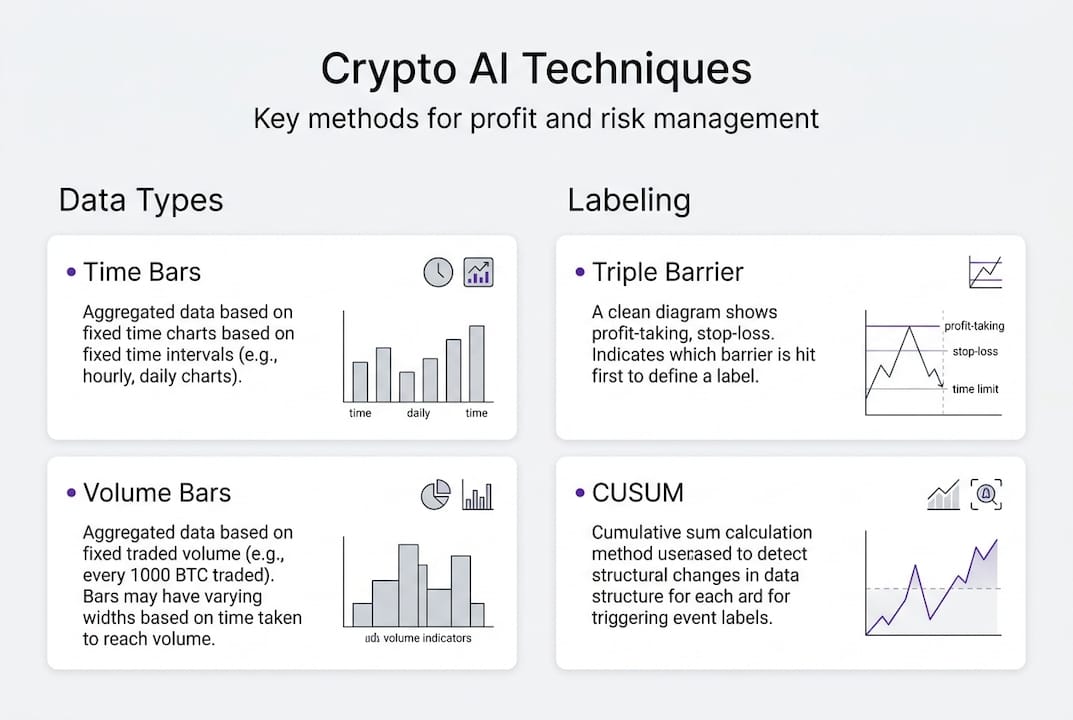
The results speak for themselves. The CUSUM plus Triple Barrier approach outperformed time-based bar strategies on BTC and ETH from 2018 to 2023, even after accounting for transaction costs. That’s a meaningful edge in a market where most strategies erode once fees are factored in.
For traders serious about smarter data-driven automation, understanding these labeling techniques separates you from traders using off-the-shelf bots with no customization. Pairing these methods with real-time market data further sharpens execution quality.
Major AI algorithmic trading platforms and bots
Choosing the right platform depends on your technical comfort level, budget, and how much control you want. Here’s a practical breakdown of the leading options:
| Platform | Type | Pricing | Key strength |
|---|---|---|---|
| Freqtrade | Open-source | Free | Full customization, ML support |
| OctoBot | Open-source | Free | Visual strategy builder |
| Pionex | Exchange-based | Free (fees apply) | Built-in plug-and-play bots |
| Superalgos | Open-source | Free | Visual backtesting, community |
| Jesse | Open-source | Free | Python-based, research-focused |
As established platforms like Freqtrade, OctoBot, Pionex, Superalgos, and Jesse demonstrate, there’s a viable option for every skill level. The CCXT library connects most of these tools to dozens of exchanges through a single unified API, making multi-exchange execution practical without custom integrations.
Key considerations when picking a platform:
- Backtesting quality: Can you test on out-of-sample data, or only in-sample?
- Exchange compatibility: Does it connect to the exchanges you actually use?
- Community and support: Active forums and documentation save hours of troubleshooting
- Transparency: Avoid platforms that hide their logic or refuse to show live trade records
For a detailed look at one popular option, the review of Pionex covers its built-in bots and fee structure clearly. If you want to understand AI bot platform returns across different setups, comparing live results across platforms is the most honest approach.
Evidence: How much can AI crypto trading really earn?
Let’s look at what the data actually shows, because the range is wide and context matters.
“A multi-LLM trading bot achieved a 1,842% BTC return using walk-forward optimization from 2023 to 2025, while grid and DCA strategies yielded 15 to 18% simulated ROI in the same period.”
Those numbers sound extraordinary, and the 1,842% figure comes from a rigorous walk-forward optimization test, not a cherry-picked backtest. Still, a few important caveats apply:
- Backtests overestimate live performance. Slippage, exchange fees, and latency eat into returns that look clean on paper.
- Market regime matters. A strategy that crushes it in a bull market may bleed in a sideways or bear market.
- Model complexity doesn’t guarantee results. A simple grid bot returning 15 to 18% consistently may outperform a complex model that overfits to historical data.
- RL agents show promise in short windows. One reinforcement learning agent returned 4.8% in two weeks of live trading, but short windows don’t confirm long-term viability.
For a balanced view of safer trading with AI, always demand live trade records alongside backtest results. The honest guide on what works and what fails is essential reading before committing capital.
Risks, edge cases, and what most traders miss
The upside is real, but so are the ways things go wrong. Most traders focus on returns and skip the risk framework entirely. That’s a costly mistake.
Here are the most common failure points, in order of how often they catch traders off guard:
- Flash crashes and herd behavior: Multiple bots running similar strategies can amplify sell-offs, creating cascading losses that no single bot anticipated.
- API vulnerabilities: A compromised API key with withdrawal permissions can drain your account in seconds.
- Regime shifts: A strategy trained on 2021 bull market data will likely fail in a 2026 sideways market without retraining.
- LLM hallucinations: Language models can misread news context and generate false signals, especially during ambiguous events.
- Backtest vs. live mismatch: Flash crashes, LLM hallucinations, and black-box risk are documented failure modes that live trading exposes quickly.
Pro Tip: Never grant withdrawal permissions to any API key used by a trading bot. Limit keys to trade execution only. This one step eliminates the most catastrophic single point of failure in automated trading.
For a frank look at strategy automation pitfalls, the lesson is consistent: AI works best as an assistive tool, not a hands-off profit machine. The real experience of AI auto-trading over two weeks illustrates both the power and the unpredictability firsthand.
Getting started: Practical steps to deploy AI algorithmic trading in 2026
Ready to move from theory to practice? Here’s a responsible, step-by-step approach that avoids the most common beginner mistakes:
- Choose your platform. Pick open-source tools like Freqtrade or OctoBot for full control, or Pionex for a simpler plug-and-play experience.
- Start with a dry run. Run your bot in simulation mode for at least two to four weeks before touching real capital. Validate results with out-of-sample data, not just the training period.
- Set hard risk limits. Apply stop-losses, define maximum position sizes, and configure alerts for unusual activity before going live.
- Diversify strategies and exchanges. Don’t run a single strategy on a single exchange. Spread exposure to reduce correlated losses.
- Monitor and retrain regularly. Markets shift. Schedule monthly reviews of bot performance and retrain models when returns start drifting.
- Keep records. Document every strategy, parameter change, and trade outcome. This matters for tax purposes and for diagnosing what went wrong.
Following best practices for open-source bots, including dry runs, ensemble methods, and regime monitoring, is the foundation of sustainable automated trading. Pairing this with a solid market volatility checklist keeps you prepared when conditions change fast.
Pro Tip: Use the smarter crypto strategies framework to evaluate whether your bot’s logic still fits current market conditions every 30 days. Stale strategies are one of the top reasons bots underperform after a strong start.
Next steps: Try AI-powered crypto trading with Darkbot
If you’ve made it this far, you understand that algorithmic trading AI isn’t magic. It’s structured, data-driven automation that rewards preparation and punishes shortcuts. The good news is that you don’t need to build everything from scratch.
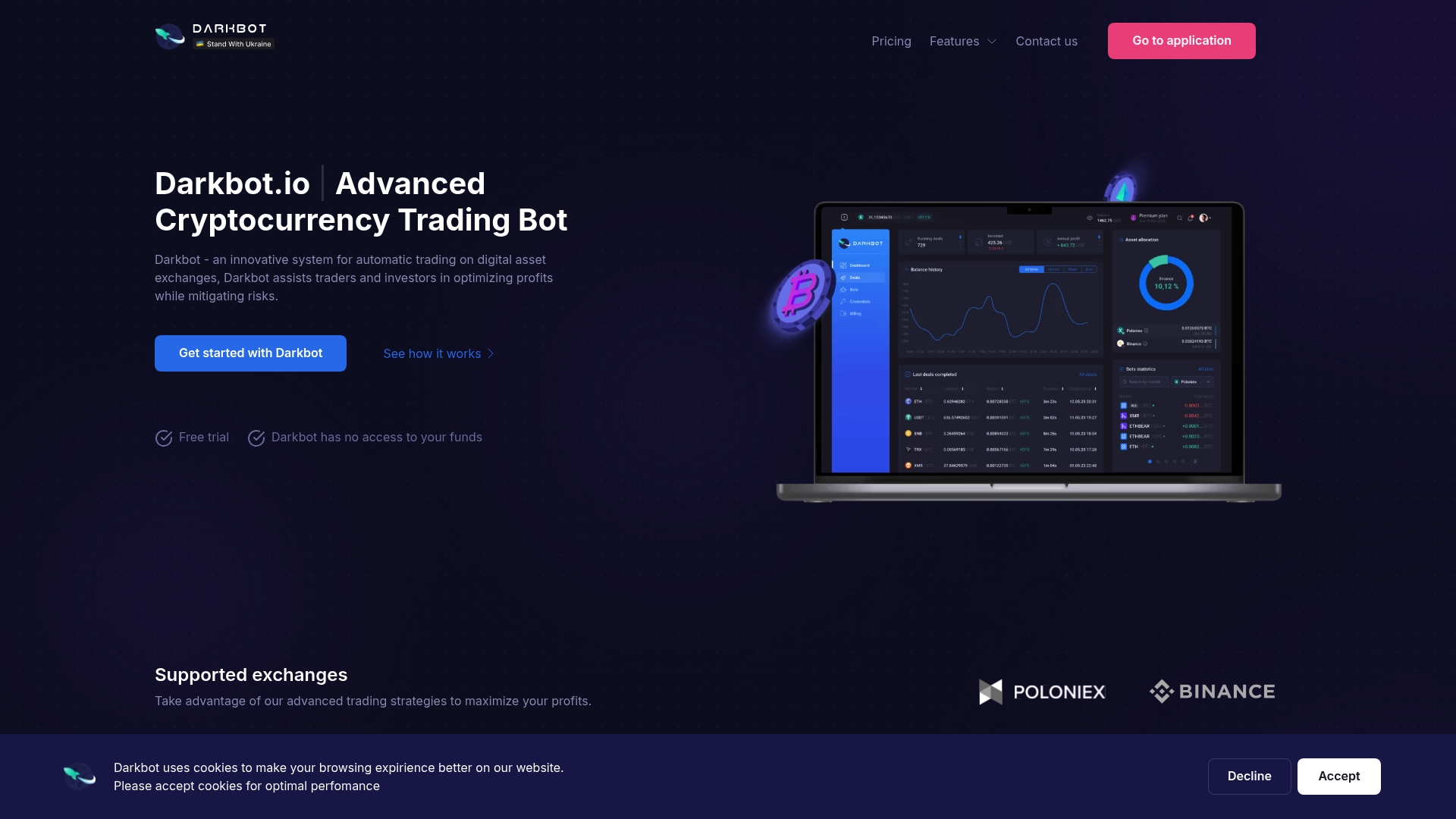
Darkbot.io gives you access to an AI-powered trading bot that connects to top exchanges via secure API keys, runs multiple strategies simultaneously, and provides real-time analytics so you always know what your bots are doing. The portfolio management features include automated rebalancing, risk controls, and transparent performance tracking, everything you need to deploy AI trading responsibly. Whether you’re starting with the free tier or scaling up with a premium plan, Darkbot is built to grow with your strategy.
Frequently asked questions
Is AI-powered algorithmic trading legal in 2026?
AI trading is legal in most countries, but regulatory scrutiny is rising and some regions now require reporting or system audits for automated trading activity. Always check local regulations before deploying live bots.
Can I use AI trading bots on multiple crypto exchanges at once?
Yes. Most advanced AI bots support multi-exchange trading through unified APIs like CCXT, and platforms support major exchanges including Binance, Kraken, and Coinbase through a single integration layer.
How do I avoid scams or poor performers when choosing an AI trading bot?
Prioritize open-source bots with transparent live trade records, require dry-run results before committing capital, and avoid any platform that promises guaranteed returns without showing verifiable data.
What is the biggest risk with AI algorithmic trading?
The most serious risks are flash crashes and API vulnerabilities, along with strategy breakdown during market regime shifts and catastrophic losses during black swan events that no model was trained to handle.
Recommended

Start trading on Darkbot with ease
Come and explore our crypto trading platform by connecting your free account!
Free plan available • No credit card required