Key Risks in Automated Trading – What Traders Miss

Market turbulence feels relentless when inflation surges in countries like Argentina or Turkey, driving traders to hunt for solutions beyond manual strategies. Automated trading promises to outpace human reaction times and minimize emotional mistakes, yet major misconceptions linger around its true capabilities and risks. This breakdown dispels common myths, clarifies how automated trading harnesses complex algorithms, and highlights what experienced day traders must watch for when putting their capital in the hands of advanced bots.
Key Takeaways
| Point | Details |
|---|---|
| Automated Trading is Not Foolproof | Traders often mistakenly believe that automated trading systems guarantee profits; however, these systems require ongoing monitoring and refinement to adapt to market changes. |
| Understanding Risks is Crucial | Automated trading introduces various risks, including technical failures and algorithmic errors; robust risk management strategies are essential for mitigation. |
| Regulatory Compliance is Evolving | Traders must stay informed about emerging regulatory frameworks targeting automated trading to ensure compliance and avoid potential penalties. |
| Continuous Backtesting is Essential | Traders should consistently backtest their algorithms using historical data and maintain flexible risk parameters to adapt to dynamic market conditions. |
Automated Trading Explained and Misconceptions
Automated trading represents a sophisticated technological approach where computer algorithms execute financial transactions without direct human intervention. Unlike traditional manual trading, these systems leverage complex mathematical models and predefined rules to make split-second investment decisions across multiple markets simultaneously.
The core mechanism of automated trading involves several critical components:
- Algorithmic execution that processes market data in milliseconds
- Pre-programmed trading strategies based on technical indicators
- Risk management protocols embedded within the trading logic
- Real-time decision-making using statistical probability models
Technological advancements in algorithmic trading have transformed financial markets, enabling traders to overcome human emotional limitations and execute strategies with unprecedented precision. However, this technological marvel comes with significant misconceptions that traders must understand.

Here’s a comparison of manual trading and automated trading to clarify their distinct operational advantages and challenges:
| Aspect | Manual Trading | Automated Trading |
|---|---|---|
| Decision Speed | Seconds to minutes | Milliseconds |
| Emotional Influence | High | Minimal |
| Scalability | Limited by trader | High across markets |
| Monitoring Need | Constant human attention | Requires periodic oversight |
| Adaptation to Market | Flexible, intuitive | Rule-based, requires updates |
Most traders incorrectly assume automated trading systems are infallible profit generators. In reality, these systems are sophisticated tools requiring continuous monitoring, periodic rebalancing, and strategic refinement. The algorithmic approach does not guarantee profits but provides a systematic framework for executing predefined trading strategies.
Key Misconceptions About Automated Trading:
- Automated trading guarantees consistent profits
- Algorithms can predict market movements with absolute certainty
- No human oversight is required once the system is operational
- All automated trading strategies perform equally well
Successful implementation demands a nuanced understanding of market dynamics, robust risk management, and continuous algorithmic optimization. Traders must recognize that these systems are tools, not magical profit machines.
Pro tip: Always backtest your automated trading strategies using historical data and maintain flexible risk parameters to adapt to changing market conditions.
Types of Risks in Crypto Trading Bots
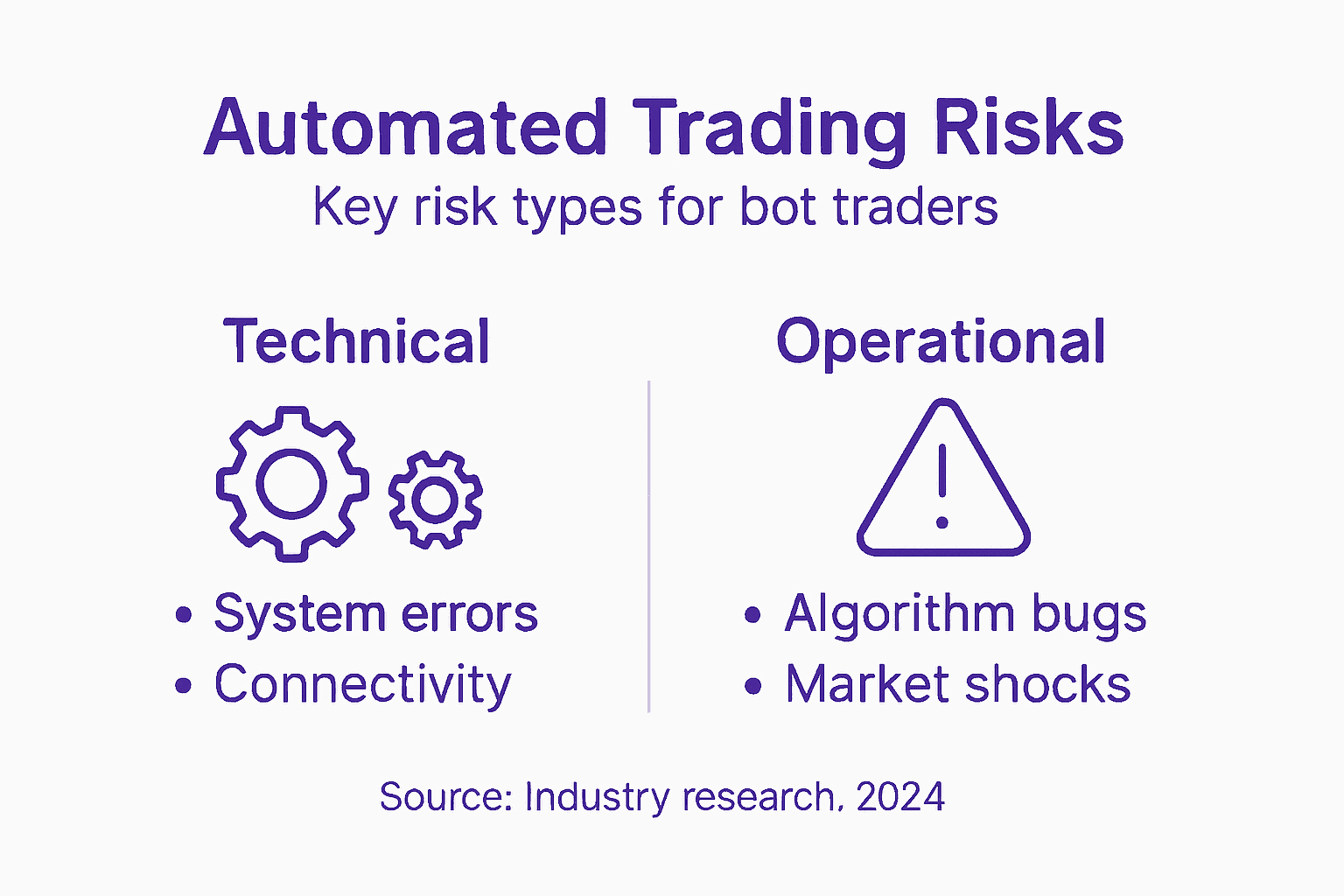
Crypto trading bots introduce complex technological risks that extend far beyond simple operational challenges. These automated systems operate in highly volatile markets, presenting multifaceted vulnerabilities that can significantly impact trader investments and overall market dynamics.
Traders must understand the primary risk categories associated with cryptocurrency trading bots:
- Technical infrastructure vulnerabilities
- Algorithmic execution errors
- Market manipulation potential
- Unexpected strategy failures
- Security and data protection risks
AI-powered trading bot market manipulation risks reveal how sophisticated bots can create artificial market conditions that distort genuine trading landscapes. These mechanisms can generate misleading price movements and artificially inflate market depth, potentially trapping unsuspecting traders.
Technical infrastructure risks represent a significant concern in automated trading. Bots rely on continuous network connectivity, real-time data feeds, and exchange API integrations. Any disruption in these interconnected systems can lead to substantial financial losses. Potential failure points include:
- API connection interruptions
- Latency in trade execution
- Unexpected exchange downtime
- Computational processing delays
Algorithmic execution risks emerge from the inherent complexity of trading strategies. Despite sophisticated mathematical models, bots can make suboptimal decisions during unprecedented market conditions. These errors often stem from insufficient backtesting, overly rigid rule sets, or failure to account for complex market interactions.
Potential Algorithmic Vulnerabilities:
- Inability to recognize black swan events
- Over-optimization of historical data
- Lack of adaptive learning mechanisms
- Blind spots in risk management protocols
Pro tip: Implement rigorous multi-scenario backtesting and maintain manual override capabilities to mitigate automated trading system vulnerabilities.
This table summarizes how various risk categories impact crypto trading bot performance:
| Risk Category | Typical Impact | Mitigation Approach |
|---|---|---|
| Technical Infrastructure | Trading disruptions | Robust network and APIs |
| Algorithmic Errors | Poor trade outcomes | Diverse backtesting methods |
| Market Manipulation | Distorted prices | Transparent bot activity logs |
| Security Vulnerabilities | Loss of funds/data | Advanced encryption protocols |
How AI and Automation Increase Risk Exposure
Artificial intelligence and automation have fundamentally transformed trading landscapes, introducing sophisticated technological capabilities that simultaneously expand and complicate risk management strategies. While these technologies promise unprecedented computational power, they also generate complex layers of potential vulnerability that traditional risk assessment frameworks struggle to comprehend.
The primary risk dimensions introduced by AI-driven trading systems include:
- Algorithmic complexity beyond human comprehension
- Unpredictable decision-making patterns
- Rapid, autonomous execution without human oversight
- Hidden systemic interconnectedness
- Potential for cascading technological failures
AI-associated risks in trading reveal how automation introduces epistemological challenges by adding layers of opacity and unpredictability to financial decision processes. These systems can generate risk through multiple interdependent mechanisms that traditional risk management approaches cannot easily anticipate or control.
Technological sophistication creates unique risk exposure scenarios. AI trading systems operate with unprecedented speed and complexity, processing massive datasets and executing trades within milliseconds. This rapid computational environment introduces several critical vulnerabilities:
- Microsecond-level decision errors
- Amplification of initial algorithmic biases
- Potential for unintended market manipulation
- Complex interdependency risks
Moreover, AI systems can generate systemic risks that emerge from their ability to simultaneously interact across multiple trading platforms and market segments. These interactions can create unforeseen feedback loops and potentially destabilizing market conditions that human traders might not recognize until significant damage occurs.
Key Risk Amplification Mechanisms:
- Exponential computational complexity
- Reduced human intervention capabilities
- Self-reinforcing algorithmic behaviors
- Potential for undetected logical errors
Pro tip: Implement comprehensive monitoring systems with explicit human intervention protocols to counterbalance AI trading system autonomy.
Regulatory and Compliance Challenges in 2026
The cryptocurrency and automated trading landscape faces unprecedented regulatory complexity in 2026, with global financial authorities increasingly scrutinizing technological innovations and their potential systemic risks. Emerging regulatory frameworks demand sophisticated compliance strategies that balance technological advancement with robust risk management protocols.
Key regulatory focus areas for automated trading platforms include:
- Cross-border transaction monitoring
- Algorithmic transparency requirements
- Real-time risk assessment capabilities
- Enhanced fraud detection mechanisms
- Data privacy and protection standards
Global compliance concerns for 2026 highlight the dual challenge of leveraging technological capabilities while managing increasingly complex regulatory environments. Financial institutions must develop adaptive compliance frameworks that can rapidly respond to evolving technological and regulatory landscapes.
Regulatory challenges in automated trading stem from multiple interconnected domains. Governments worldwide are developing sophisticated approaches to oversee AI-driven financial technologies, focusing on several critical dimensions:
- Algorithmic decision-making transparency
- Preventing market manipulation
- Protecting investor interests
- Managing systemic financial risks
Technology platforms must now demonstrate explicit compliance mechanisms that go beyond traditional reporting. This requires developing robust internal controls, maintaining comprehensive audit trails, and implementing proactive risk management strategies that can withstand intense regulatory scrutiny.
Emerging Compliance Requirements:
- Mandatory algorithmic disclosure
- Real-time risk monitoring
- Comprehensive transaction logging
- Ethical AI development standards
Pro tip: Develop a dynamic compliance framework that anticipates regulatory changes and integrates flexible technological adaptations.
Managing Bot Failures and Market Events
Automated trading bots represent sophisticated technological solutions, but they remain vulnerable to unpredictable market dynamics and inherent system limitations. Successful traders must develop comprehensive strategies to anticipate, detect, and mitigate potential bot failure scenarios across various market conditions.
Critical failure points in automated trading systems include:
- Unexpected market volatility
- Network connectivity interruptions
- API integration breakdowns
- Complex algorithmic execution errors
- Real-time data processing failures
Bot mitigation challenges reveal widespread systemic vulnerabilities in automated trading platforms. These technological ecosystems require proactive management strategies that go beyond traditional reactive monitoring approaches.
Market event management demands a multilayered approach to bot performance and risk containment. Traders must implement robust mechanisms that can rapidly identify and respond to potential system failures:
- Establish real-time monitoring protocols
- Create automated emergency shutdown procedures
- Develop comprehensive fallback trading strategies
- Implement strict risk percentage limits
The most sophisticated trading platforms incorporate dynamic risk adaptation mechanisms that can instantaneously recalibrate trading parameters during unexpected market disruptions. This requires building flexible algorithmic frameworks capable of recognizing and responding to abnormal trading conditions with minimal human intervention.
Essential Bot Failure Management Strategies:
- Continuous performance tracking
- Redundant communication channels
- Multi-exchange execution capabilities
- Granular risk segmentation
Pro tip: Design your bot with configurable fail-safe mechanisms that automatically reduce position sizes and halt trading during extreme market volatility.
Avoiding Common Automated Trading Mistakes
Automated trading demands disciplined strategy and sophisticated understanding beyond basic technological implementation. Traders frequently underestimate the complexity of creating reliable algorithmic systems that can consistently navigate volatile market environments.
Common critical mistakes in automated trading include:
- Inadequate risk management
- Overconfidence in algorithmic performance
- Insufficient backtesting protocols
- Neglecting market context complexity
- Emotional decision-making overrides
Trading mistake prevention strategies reveal fundamental psychological and technical pitfalls that systematically undermine trading performance. Understanding these vulnerabilities becomes crucial for developing robust automated trading approaches.
Traders must recognize that automated systems are not infallible profit generators. Successful implementation requires comprehensive risk management and continuous strategy refinement:
- Implement strict position sizing limits
- Develop multi-scenario testing frameworks
- Create explicit exit strategies
- Monitor algorithmic performance continuously
The most sophisticated traders understand that algorithmic trading requires constant vigilance. Automated systems need regular recalibration, performance assessment, and strategic adjustments to maintain effectiveness across changing market conditions.
Key Risk Mitigation Techniques:
- Regular strategy backtesting
- Dynamic risk percentage adjustment
- Comprehensive performance tracking
- Automated system stress testing
Pro tip: Design trading algorithms with built-in circuit breakers that automatically reduce exposure during extreme market volatility.
Take Control of Automated Trading Risks with Darkbot.io
The article highlights how traders often overlook critical risks like algorithmic errors, market volatility, and infrastructure failures that can severely impact automated trading results. Managing these unpredictable challenges demands more than simple automation—it requires advanced AI-driven solutions that adapt and respond in real time. If you have faced frustrations from inflexible bots or unexpected losses, you are not alone in seeking dependable, secure, and easily customizable strategies to protect your investments.
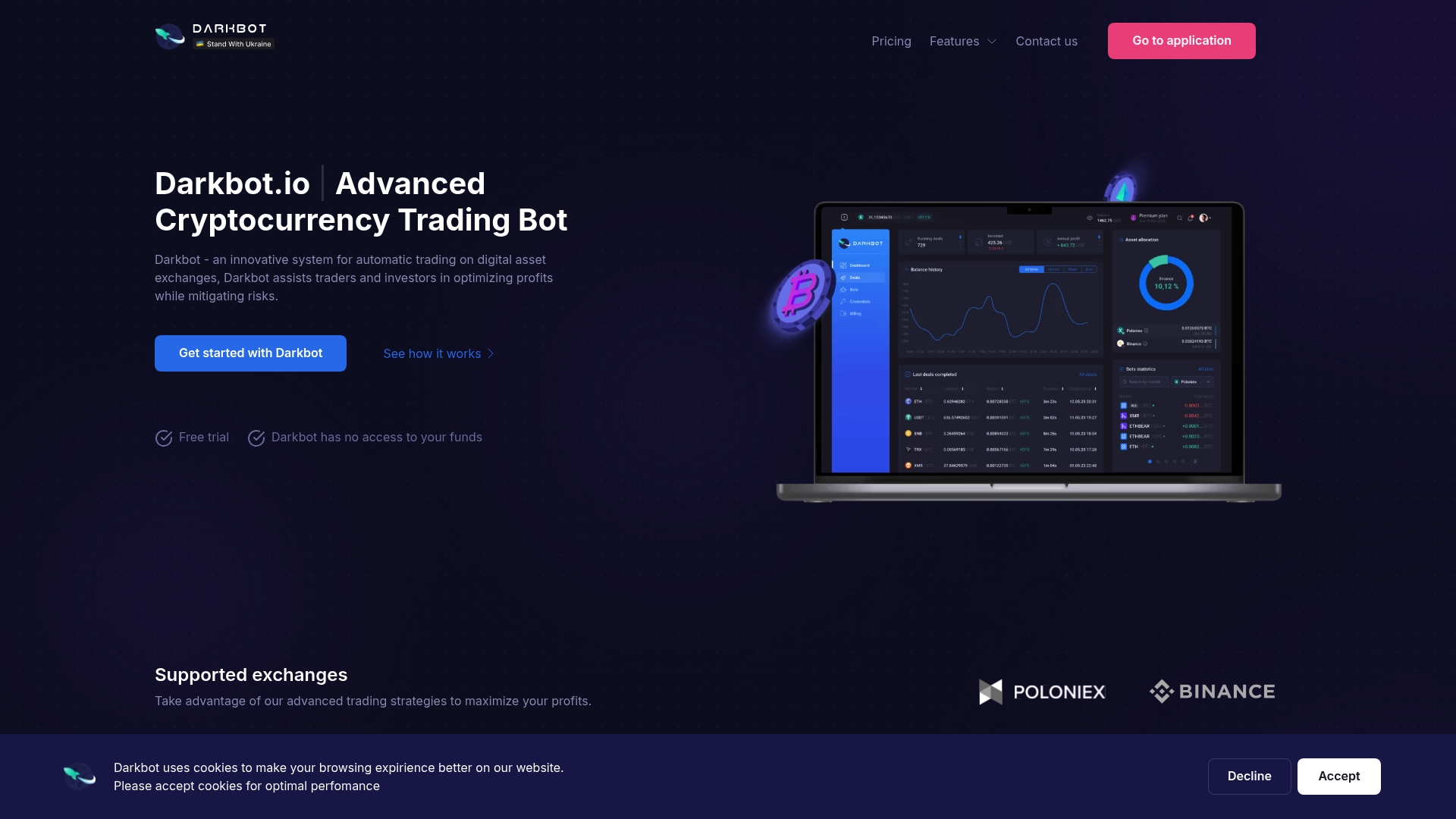
Discover how Darkbot.io empowers you to overcome key trading risks by providing seamless integration across exchanges, intelligent portfolio management, and fine-tuned strategy customization. With features such as multi-bot deployment and live analytics, you can confidently automate your cryptocurrency trading while maintaining full control over risk parameters. Start minimizing surprises and maximizing opportunities today by visiting Darkbot.io and exploring the advanced automated trading bot solution. Secure your advantage before market volatility strikes again.
Frequently Asked Questions
What are the primary risks associated with automated trading?
Automated trading carries several risks, including technical infrastructure vulnerabilities, algorithmic execution errors, potential market manipulation, unexpected strategy failures, and security and data protection risks.
How can traders mitigate the risks of using crypto trading bots?
Traders can mitigate risks by implementing rigorous backtesting, maintaining manual override capabilities, ensuring robust network and API connections, and incorporating real-time monitoring and adaptable risk management strategies.
Is automated trading guaranteed to be profitable?
No, automated trading is not guaranteed to be profitable. While it offers systematic execution of predefined trading strategies, it requires continuous monitoring, algorithmic refinement, and a strong understanding of market dynamics.
What are the common mistakes traders make with automated trading?
Common mistakes include inadequate risk management, overconfidence in algorithmic performance, insufficient backtesting, neglecting market context complexities, and allowing emotional decision-making to override automated systems.
Recommended

Start trading on Darkbot with ease
Come and explore our crypto trading platform by connecting your free account!
Free plan available • No credit card required