What Is Algorithmic Trading 2025: Impact and Insights

Market volatility can disrupt even the most disciplined trading plans, leading many professionals to seek automated solutions for handling complex decisions and risk management. Algorithmic trading uses advanced software and mathematical models, replacing emotional choices with rapid, data-driven strategies across global markets. As nearly 92 percent of Forex trades are now executed by algorithms, this technology offers a powerful way to optimize profits and reduce errors. Discover how algorithmic trading empowers traders to navigate uncertainty with speed and precision.
Key Takeaways
| Point | Details |
|---|---|
| Automated Execution | Algorithmic trading executes trades automatically, minimizing human error and emotional bias. |
| Diverse Strategies | Various strategies like Trend Following and Arbitrage cater to different market opportunities and risk profiles. |
| Evolving Technologies | Modern systems leverage AI and machine learning for better decision-making and risk assessment. |
| Regulatory Awareness | Stay updated on global regulations as compliance is critical in algorithmic and crypto trading. |
Algorithmic Trading Defined and Debunked
Algorithmic trading represents an advanced method of executing financial transactions through automated, pre-programmed instructions. Sophisticated computer systems analyze multiple market variables simultaneously, enabling traders to make rapid, data-driven decisions beyond human computational capabilities.
At its core, algorithmic trading leverages mathematical models and software to execute trades based on specific parameters like time, price, and volume. The approach transforms traditional trading by removing emotional decision-making and introducing systematic, rule-based strategies. Key characteristics include:
- Automated trade execution without direct human intervention
- Rapid processing of complex market data
- Ability to implement multiple trading strategies simultaneously
- Reduced human error and emotional bias
- Enhanced trade precision and speed
Modern algorithmic trading spans diverse financial markets, including stocks, futures, foreign exchange, and cryptocurrencies. Market efficiency models demonstrate that approximately 92% of forex trades now occur through algorithmic systems, highlighting the technology’s transformative impact.
Contrary to popular misconceptions, algorithmic trading isn’t about guaranteed profits but rather about creating structured, repeatable trading approaches that manage risk and capitalize on market inefficiencies. Successful implementation requires robust strategy design, continuous monitoring, and adaptive algorithms.
Pro tip: Always backtest your algorithmic trading strategies using historical market data to validate their potential effectiveness before deploying real capital.
Main Types and How They Differ
Algorithmic trading encompasses several distinct strategies, each designed to capitalize on unique market opportunities and technological capabilities. Machine learning models have increasingly refined these approaches, enabling more sophisticated trading techniques across different market environments.
The primary types of algorithmic trading strategies include:
- Trend Following: Identifies and trades based on established market momentum
- Arbitrage: Exploits price differentials across different markets or exchanges
- Market Making: Provides liquidity by continuously quoting buy and sell prices
- High-Frequency Trading (HFT): Executes extremely rapid trades using advanced computational systems
- Statistical Arbitrage: Uses complex mathematical models to predict short-term price movements
Cryptocurrency trading algorithms demonstrate remarkable diversity, ranging from predictive models targeting price movements to reinforcement learning approaches focused on executing profitable trades. Each strategy requires unique technological infrastructure and risk management protocols.
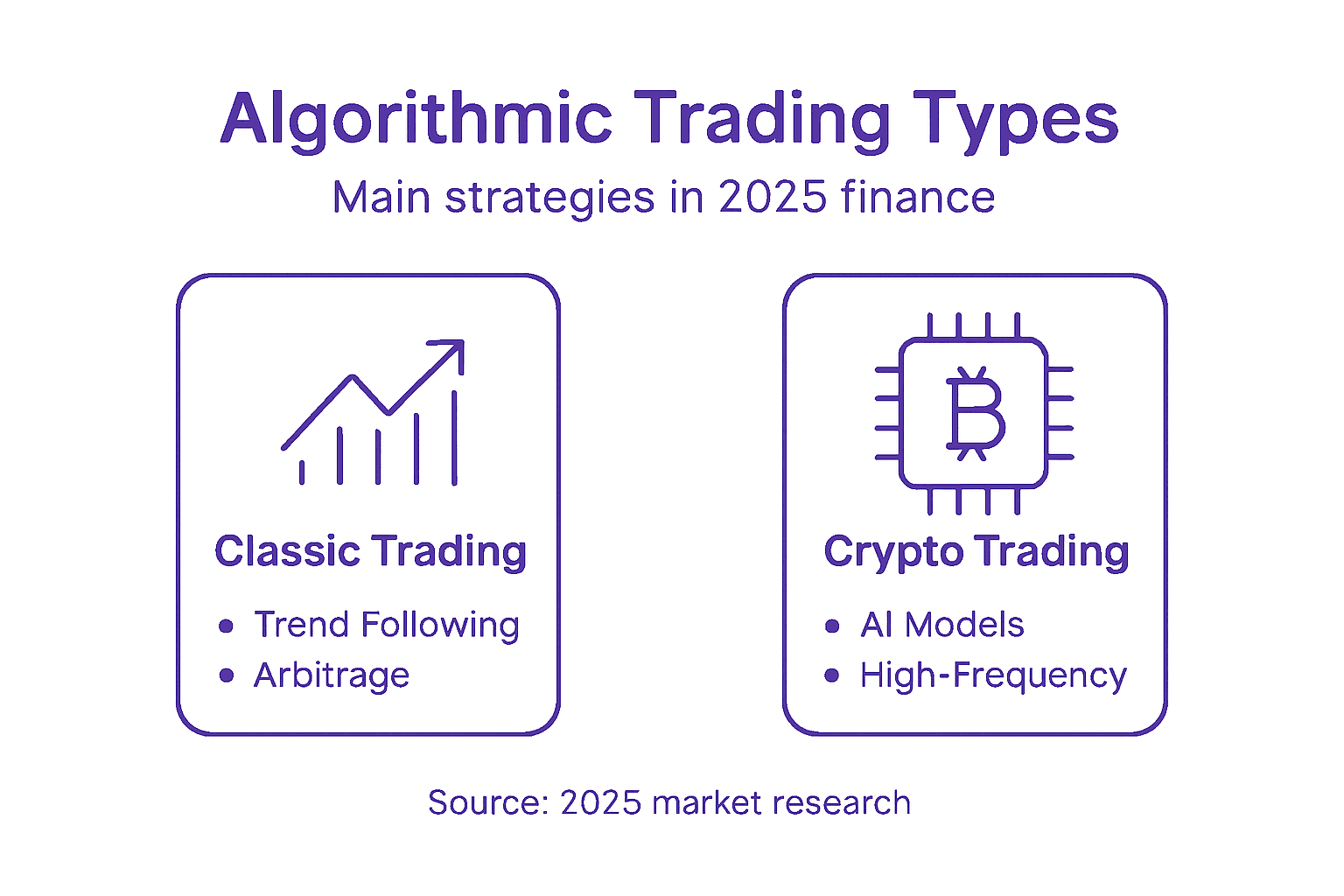
Different algorithmic trading types present distinct risk profiles and performance characteristics. High-frequency trading demands ultra-low latency systems and microsecond-level execution speeds, while arbitrage strategies require comprehensive cross-market data analysis and rapid decision-making capabilities. The selection of an appropriate algorithmic trading approach depends on factors like market volatility, available technology, and specific investment objectives.
Here’s a concise comparison of major algorithmic trading strategies and their typical market applications:
| Strategy Type | Typical Assets | Required Technology | Main Trading Focus |
|---|---|---|---|
| Trend Following | Stocks, Forex | Charting tools, automation | Momentum and price direction |
| Arbitrage | Crypto, Forex | Cross-market data feeds | Price differences |
| Market Making | Equities, Derivatives | Real-time order systems | Liquidity provision |
| High-Frequency Trading | Futures, Stocks | Ultra-fast servers | Execution speed |
| Statistical Arbitrage | All asset classes | Modeling software, AI | Short-term pricing patterns |
Pro tip: Carefully match your algorithmic trading strategy to your risk tolerance and technological capabilities, understanding that no single approach guarantees consistent market success.
How Algorithmic Trading Works in 2025
Algorithmic trading has evolved dramatically, transforming from simple rule-based systems to sophisticated AI-driven decision-making platforms. These advanced systems now integrate multiple complex technologies to analyze and execute trades with unprecedented precision and speed.
The modern algorithmic trading workflow encompasses several critical stages:
- Data Collection: Aggregating real-time market data from multiple sources
- Signal Generation: Identifying potential trading opportunities using machine learning
- Risk Assessment: Evaluating potential trade risks and market conditions
- Strategy Execution: Implementing trades with automated precision
- Continuous Monitoring: Tracking performance and adapting strategies dynamically
Advanced computational systems now leverage artificial intelligence to process vast datasets, incorporating elements like natural language processing, sentiment analysis, and neural network algorithms. These technologies enable trading platforms to capture nuanced market signals from numerical data, news feeds, social media, and other textual information sources.

The most sophisticated algorithmic trading systems in 2025 operate with remarkable adaptability, using cloud computing and AI to optimize strategies across multiple global markets. They can simultaneously analyze complex market conditions, assess risk, and execute trades across different asset classes with millisecond-level precision, dramatically outperforming traditional human-driven trading approaches.
Pro tip: Invest time in understanding the underlying machine learning models and data sources that power your algorithmic trading strategy, as technological comprehension is key to successful automated trading.
New Compliance and Crypto Laws Worldwide
Global regulatory frameworks for algorithmic trading and cryptocurrencies are experiencing unprecedented transformation, driven by technological complexity and market volatility. Cryptocurrency compliance requirements have become increasingly sophisticated, responding to emerging challenges in digital asset markets.
Key regulatory developments across major jurisdictions include:
- United States: Enhanced reporting requirements for algorithmic trading platforms
- European Union: Comprehensive crypto asset regulation framework (MiCA)
- United Kingdom: Stricter anti-money laundering protocols for digital assets
- Singapore: Advanced licensing mechanisms for crypto trading entities
- Japan: Robust consumer protection regulations for algorithmic trading
Regulatory approaches now emphasize comprehensive oversight, focusing on critical areas such as market integrity, systemic risk mitigation, and preventing algorithmic manipulation. These evolving legal frameworks aim to balance technological innovation with investor protection, requiring unprecedented transparency from trading platforms and cryptocurrency exchanges.
The most significant emerging legal trends involve creating standardized compliance mechanisms that address the unique challenges of algorithmic and crypto trading. Governments worldwide are developing nuanced regulations that require detailed risk management protocols, mandatory algorithmic strategy disclosures, and robust anti-manipulation safeguards. These legislative efforts seek to create a more stable, predictable environment for digital asset trading while protecting individual investors from potential systemic risks.
Pro tip: Stay continuously updated on international regulatory changes, as compliance requirements can significantly impact your algorithmic trading strategies and operational capabilities.
Key Risks and Practical Pitfalls to Avoid
Algorithmic trading presents complex challenges that demand careful strategic consideration and proactive risk management. Automated trading systems carry inherent risks that can potentially compromise financial stability if not properly understood and mitigated.
Critical risks investors must recognize include:
- Technology Failure: Sudden system crashes or algorithmic errors
- Data Bias: Algorithmic models trained on limited or outdated datasets
- Market Unpredictability: Inability to adapt to unprecedented market conditions
- Regulatory Compliance: Potential violations of emerging financial regulations
- Cybersecurity Vulnerabilities: Exposure to potential hacking and data breaches
Operational risk management requires comprehensive strategies addressing technological, financial, and systemic challenges. Sophisticated investors must develop robust frameworks that incorporate continuous monitoring, adaptive risk controls, and advanced testing protocols to minimize potential trading disruptions.
For a helpful overview, here’s a summary of common risk mitigation practices for automated trading:
| Risk Type | Mitigation Method | Business Impact |
|---|---|---|
| System Failure | Redundant infrastructure | Minimizes downtime losses |
| Data Bias | Diverse dataset integration | Improves model reliability |
| Market Volatility | Adaptive algorithms | Reduces unexpected losses |
| Regulatory Changes | Real-time compliance monitoring | Prevents legal penalties |
| Cybersecurity Threats | Advanced encryption protocols | Safeguards data and assets |
The most significant pitfalls stem from overconfidence in algorithmic systems and insufficient understanding of their limitations. Successful traders recognize that algorithms are tools, not infallible predictors, and must be continuously refined, tested, and supervised. This approach demands ongoing education, technical expertise, and a disciplined methodology for identifying and addressing potential systemic weaknesses.
Pro tip: Implement a rigorous backtesting and simulation protocol that stress-tests your algorithmic trading strategy under multiple market scenarios before deploying real capital.
Take Control of Your Crypto Trades with Advanced Algorithmic Automation
The article highlights crucial challenges like managing complex market data, adapting AI-driven strategies, and mitigating risks in the fast-paced world of algorithmic trading. If you want to overcome common pitfalls such as technology failures or data bias while maximizing the potential of high-frequency and machine learning-based approaches, you need a dependable platform designed for today’s volatile crypto markets.
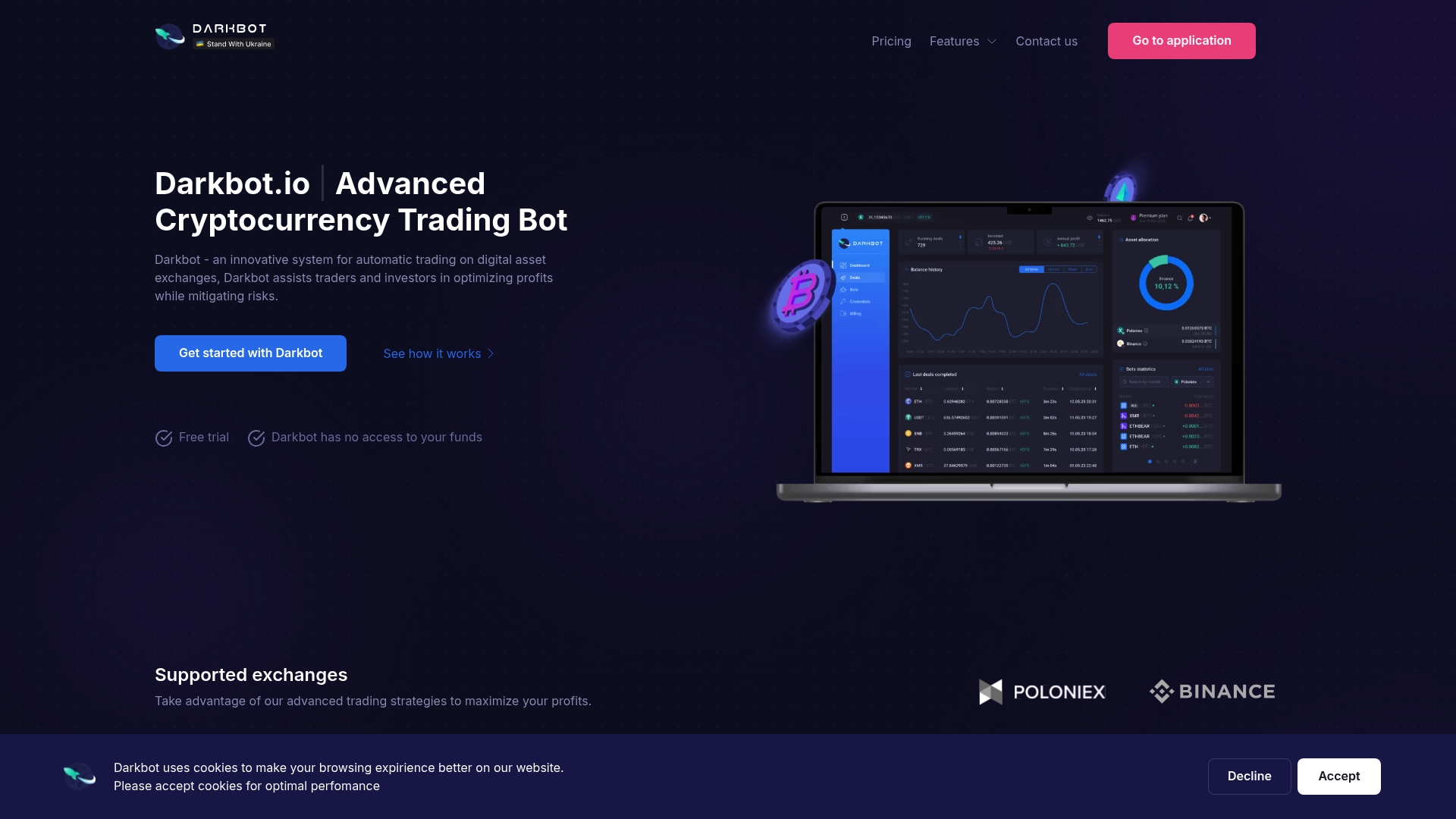
Unlock the power of automation with Darkbot.io, a cutting-edge solution that simplifies sophisticated algorithmic trading concepts into an intuitive and secure platform. Leverage features like seamless API exchange integration, customizable strategies, real-time analytics, and portfolio rebalancing to optimize your trades with confidence. Don’t let complexity hold you back—start automating your cryptocurrency trading strategies now and experience the edge that smart, AI-driven bots provide. Visit Darkbot.io to begin your journey toward consistent, efficient trading today.
Frequently Asked Questions
What is algorithmic trading?
Algorithmic trading is the use of automated, pre-programmed instructions to execute financial transactions, leveraging sophisticated computer systems that analyze multiple market variables to make data-driven decisions.
How has algorithmic trading evolved by 2025?
By 2025, algorithmic trading has transformed into advanced AI-driven platforms that integrate multiple technologies, enabling high precision and speed in trade executions, alongside adaptive strategies across global markets.
What are the main types of algorithmic trading strategies?
The primary types of algorithmic trading strategies include trend following, arbitrage, market making, high-frequency trading (HFT), and statistical arbitrage, each designed to exploit different market opportunities.
What are the key risks associated with algorithmic trading?
Key risks include technology failures, data bias, market unpredictability, regulatory compliance issues, and cybersecurity vulnerabilities, all of which require robust risk management strategies to mitigate potential impacts.
Recommended
- Algorithmic Trading: Automating Crypto for Profit and Control
- Cryptocurrency Trading Strategies 2025: AI’s Role in Volatile Markets
- Trading Bot Algorithms: Optimizing Crypto Profits
- Cryptocurrency Trading Algorithms: Smarter Profits, Fewer Risks
- Defining MT5 Trading: Powering Automated Forex Success

Start trading on Darkbot with ease
Come and explore our crypto trading platform by connecting your free account!
Free plan available • No credit card required