What is arbitrage trading: a 2026 cryptocurrency guide

Crypto arbitrage opportunities flash across exchanges in milliseconds, not minutes. In 2026, price discrepancies lasting mere seconds demand split-second execution that no human trader can match. Automation isn’t optional anymore. It’s the only way to capture fleeting profits before markets correct. This guide reveals how modern traders leverage bots and AI to systematically exploit these brief windows, turning market inefficiencies into consistent returns.
Key takeaways
| Point | Details |
|---|---|
| Arbitrage exploits price gaps | Crypto assets trade at different prices across exchanges due to liquidity, demand, and latency differences. |
| Automation is mandatory | Price windows close in milliseconds, making manual execution impossible and requiring bot-driven trading. |
| Multiple strategies exist | Cross-exchange, triangular, and statistical arbitrage each offer distinct risk-reward profiles for different trader types. |
| Costs erode profits quickly | Transaction fees, withdrawal costs, and slippage must be calculated precisely or profits disappear. |
| Risk management is critical | Pre-funded exchange balances, low-latency infrastructure, and regulatory compliance separate successful arbitrageurs from failed attempts. |
Understanding crypto arbitrage
Crypto arbitrage profits from simultaneous price differences of identical assets across exchanges. Buy Bitcoin at $67,000 on Exchange A, sell it at $67,150 on Exchange B, pocket $150 per coin. Simple concept, brutal execution.

Why do these gaps exist? Regional demand differences, liquidity depth, regulatory constraints, and price update latencies create temporary inefficiencies. An Ethereum token might trade $5 higher in Seoul than San Francisco due to local buying pressure. Exchange liquidity varies wildly. A small platform with thin order books updates slower than major exchanges with institutional market makers.
These opportunities vanish fast. A $200 price gap might exist for 800 milliseconds before arbitrage bots flood in and eliminate the difference. Markets self-correct through arbitrage activity itself. The more traders chase these gaps, the faster they close.
Fragmentation drives arbitrage potential. Hundreds of crypto exchanges operate globally with no centralized pricing authority. Each exchange sets its own order book based on local supply and demand. This decentralized structure guarantees price discrepancies will continue appearing, though automated competition makes them harder to capture profitably.
The basic mechanism requires asset positions on multiple exchanges simultaneously. You can’t wait to transfer funds after spotting an opportunity. By the time Bitcoin moves between wallets, the price gap has closed and reversed. Successful arbitrage demands pre-positioned capital, instant execution, and sophisticated monitoring across dozens of trading pairs.
Types of crypto arbitrage strategies
Multiple crypto arbitrage types exist, each with distinct mechanics and complexity levels. Understanding these differences helps traders select strategies matching their risk tolerance and capital availability.
Cross-exchange arbitrage is the most straightforward approach. You monitor the same trading pair across different platforms. When Bitcoin trades at $68,000 on Binance but $68,200 on Kraken, you buy on Binance and sell on Kraken simultaneously. This strategy requires maintaining balances on multiple exchanges and managing transfer delays if you need to rebalance positions.
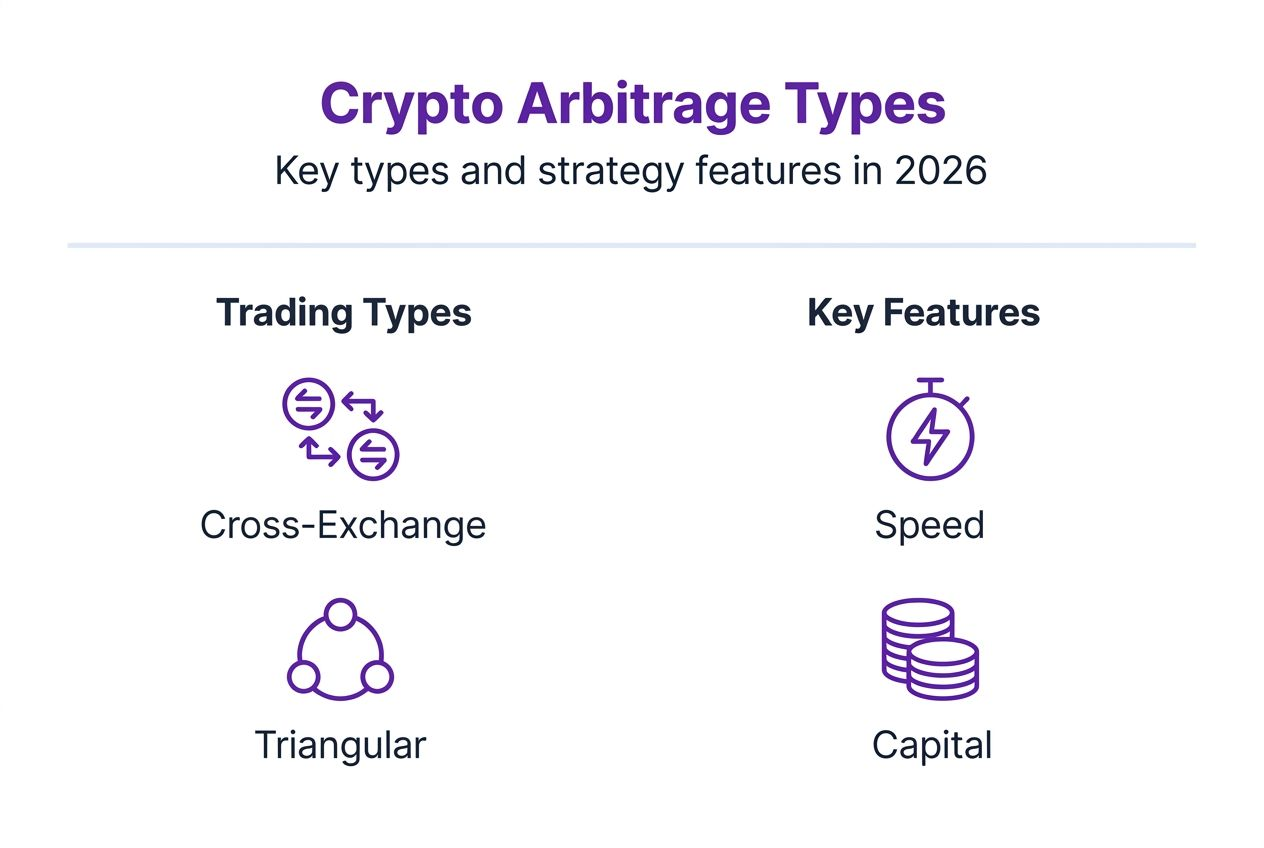
Triangular arbitrage within a single exchange exploits pricing inefficiencies between three cryptocurrencies without cross-platform transfers. You might trade BTC to ETH, ETH to USDT, then USDT back to BTC, ending with more Bitcoin than you started. This eliminates transfer delay risk but requires deep understanding of exchange fee structures and order book dynamics.
Statistical arbitrage uses quantitative models to identify mean reversion opportunities. Advanced traders analyze historical price correlations between assets, betting temporary divergences will correct. Flash loan arbitrage represents the bleeding edge, borrowing massive capital for single-block transactions on DeFi protocols, executing arbitrage, and repaying loans instantly.
| Strategy Type | Execution Speed | Complexity Level | Capital Requirements | Primary Risk |
|---|---|---|---|---|
| Cross-exchange | 1-30 seconds | Low to Medium | High (multi-exchange balances) | Transfer delays, fees |
| Triangular | Under 1 second | Medium | Medium (single exchange) | Execution slippage |
| Statistical | Minutes to hours | High | High (hedging positions) | Model accuracy |
| Flash loan | Single transaction | Very High | Low (borrowed capital) | Smart contract bugs |
Each strategy demands different technical infrastructure. Cross-exchange arbitrage needs robust API connections and low-latency networks. Triangular arbitrage requires sophisticated order routing algorithms. Statistical models need extensive historical data and computational power. Flash loans demand smart contract development expertise.
Traders often combine strategies. Different types of trading bots can run multiple arbitrage approaches simultaneously, diversifying opportunity capture while managing correlation risk between strategies.
Automation and technology in arbitrage trading
Manual crypto arbitrage died years ago. Human reaction times measure in hundreds of milliseconds. Profitable arbitrage windows now close in single-digit milliseconds. You spot a gap, blink, and it’s gone.
Trading bots dominate because they never blink. They monitor dozens of exchanges simultaneously, calculating potential profits across thousands of trading pairs every second. AI trading bots learn from market patterns, predicting where gaps will appear before they fully form. Machine learning algorithms optimize entry and exit timing, adapting to changing market microstructure.
API integration determines success or failure. Direct exchange connections via REST and WebSocket APIs eliminate browser-based delays. Smart crypto trading bots maintain persistent connections to multiple platforms, receiving price updates the instant they occur. Colocation services place bot servers physically near exchange data centers, shaving microseconds off execution time.
Key technical requirements for competitive arbitrage include:
- Low-latency internet connections with redundant failover systems
- Multi-exchange API keys with trading permissions enabled
- Pre-funded balances on all monitored exchanges to enable instant execution
- Real-time order book depth analysis across platforms
- Automated fee calculation and profit threshold filtering
- Smart order routing to minimize slippage on thin liquidity pairs
Crypto trading automation benefits extend beyond speed. Bots execute emotionlessly, never chasing losses or hesitating on profitable setups. They maintain discipline through volatility that would paralyze human traders.
Capital must be parked on multiple exchanges simultaneously to execute without time lag. This creates operational complexity. You’re managing multiple custody relationships, tracking balances across platforms, and handling periodic rebalancing when one exchange accumulates too much capital.
Pro Tip: Select bots offering multi-exchange portfolio management with automated rebalancing. The best platforms monitor your capital distribution and suggest optimal allocation adjustments based on current arbitrage opportunity flow across different exchange pairs.
Infrastructure reliability matters as much as speed. Server downtime during a profitable arbitrage window means lost revenue. Redundant systems, backup internet connections, and failover automation protect against technical failures that would otherwise cost you money.
Challenges and risk management
Transaction costs kill more arbitrage profits than any other factor. You spot a $100 price gap, execute both trades, then realize fees consumed $85 of your expected profit. Exchange trading fees typically range from 0.1% to 0.5% per trade. Withdrawal fees add another layer, especially for Bitcoin and Ethereum network transactions during congestion periods.
Monitoring multiple exchanges, executing quickly, and managing transfers efficiently separates profitable arbitrageurs from those bleeding capital. Transfer delays between exchanges create execution risk. You buy on Exchange A, but by the time you move assets to Exchange B for the sell side, prices have shifted against you. This slippage turns theoretical profits into real losses.
Liquidity constraints bite hard on smaller exchanges. That attractive price gap exists because the exchange has thin order books. You place a large order and your own trade moves the price, eliminating the arbitrage opportunity mid-execution. Market depth analysis must precede every trade decision.
Major risks and mitigation strategies:
- Fee accumulation: Calculate net profit after all fees before executing; maintain detailed spreadsheets tracking costs per exchange and trading pair
- Transfer delays: Keep permanent balances on all active exchanges rather than moving funds between platforms
- Liquidity gaps: Limit order sizes to fractions of available order book depth; split large trades across multiple smaller executions
- Exchange failures: Diversify capital across reputable platforms; avoid concentrating funds on unproven exchanges offering suspiciously wide spreads
- Regulatory reporting: Track every transaction for tax purposes; consult compliance professionals for jurisdiction-specific requirements
- Smart contract risk: Test flash loan strategies on testnets before deploying real capital; audit all contract code thoroughly
Volatility cuts both ways. Rapid price movements create arbitrage opportunities but also increase execution risk. A sudden 5% Bitcoin drop might flip your planned profit into a loss if one leg executes before the other during violent price swings.
Risk management in crypto trading requires position sizing discipline. Never commit capital you can’t afford to have temporarily stuck on an exchange. Platform outages, withdrawal freezes, and technical issues happen. Diversification across exchanges protects against single-point failures.
Crypto risk management fundamentals apply equally to arbitrage strategies. Stop-loss mechanisms, capital allocation limits, and regular performance audits keep operations sustainable long-term. Crypto trading bots risk management features should include automatic trade halting when profitability thresholds aren’t met.
Pro Tip: Continuously review fee structures across your exchange network. Platforms frequently adjust fees, introduce volume discounts, or launch maker-taker programs that dramatically impact arbitrage profitability. Update your profit calculation models monthly.
Regulatory compliance isn’t optional. Arbitrage profits are taxable events requiring proper reporting. Jurisdiction matters. Some countries classify each arbitrage trade as a taxable disposal, others apply different rules. Professional tax advice saves money and prevents legal headaches.
Common misconceptions about arbitrage trading
Arbitrage isn’t free money despite what YouTube gurus claim. Every trade carries execution risk, technology risk, and counterparty risk. Exchange hacks, withdrawal freezes, and sudden regulatory actions can trap capital on platforms overnight.
The
Recommended

Start trading on Darkbot with ease
Come and explore our crypto trading platform by connecting your free account!
Free plan available • No credit card required