Defining risk management in crypto for safer trading 2026
Cryptocurrency trading presents unique challenges that traditional investment strategies cannot address. Markets exhibit intraday price swings exceeding 100%, making unmanaged risk a trader’s greatest enemy. This guide defines risk management specifically tailored for cryptocurrency trading, empowering you to protect your portfolio through automated, multi-exchange strategies. You will learn to identify crypto-specific risks, apply proven frameworks, and leverage AI-driven tools for consistent, safer trading outcomes in volatile markets.
Key takeaways
| Point | Details |
|---|---|
| Crypto risk extends beyond volatility | Technological failures, security breaches, and liquidity gaps create unique dangers not found in traditional markets. |
| Diversification alone fails in correlated crashes | Portfolios lose significant value during market-wide downturns despite asset variety, requiring additional protective measures. |
| AI automation reduces human error | Real-time analytics and adaptive adjustments minimize emotional trading mistakes while maintaining consistent risk controls. |
| Multi-layered strategies work best | Combining position sizing, stop-losses, rebalancing, and secure API practices creates robust protection across exchanges. |
| Continuous monitoring remains essential | Even automated systems require regular parameter reviews and adjustments to respond to evolving market conditions. |
Introduction to risk management in cryptocurrency trading
Risk in cryptocurrency trading means the potential for financial loss due to adverse price movements, technical failures, or security breaches. Unlike traditional assets, crypto markets operate 24/7 with minimal regulation, creating unprecedented volatility and unpredictability. Understanding these unique characteristics forms the foundation of effective risk management.
Three primary risk categories dominate cryptocurrency trading. Market risk involves price volatility and liquidity challenges. Technological risk encompasses smart contract bugs, exchange platform failures, and blockchain vulnerabilities. Security risk covers API key compromises, wallet breaches, and exchange insolvency.
These categories overlap and amplify each other in ways traditional finance never experiences. Cryptocurrency risk includes technological risks such as smart contract bugs and exchange insolvency, unique compared to traditional assets. For automated trading across multiple exchanges, each category demands specialized attention and mitigation strategies.
Successful crypto traders recognize that risk management is not optional. It forms the core discipline separating consistent profits from devastating losses. Your automated trading bot can execute perfect strategies, but without proper risk controls, a single market event can wipe out months of gains. Learning crypto trading risk explained helps you build robust defenses.
Understanding cryptocurrency market risks
Market volatility in cryptocurrency far exceeds traditional assets. Bitcoin can drop 30% in days, altcoins can lose 50% in hours. This extreme price action creates opportunities but also existential threats to your capital. Position sizing becomes critical when assets regularly experience double-digit percentage swings.
Liquidity risk manifests differently across exchanges and trading pairs. Popular coins like Bitcoin maintain deep order books, but smaller altcoins can experience slippage exceeding 5% on moderate orders. When managing bots across multiple exchanges, you face varying liquidity profiles that impact execution quality and exit strategies.
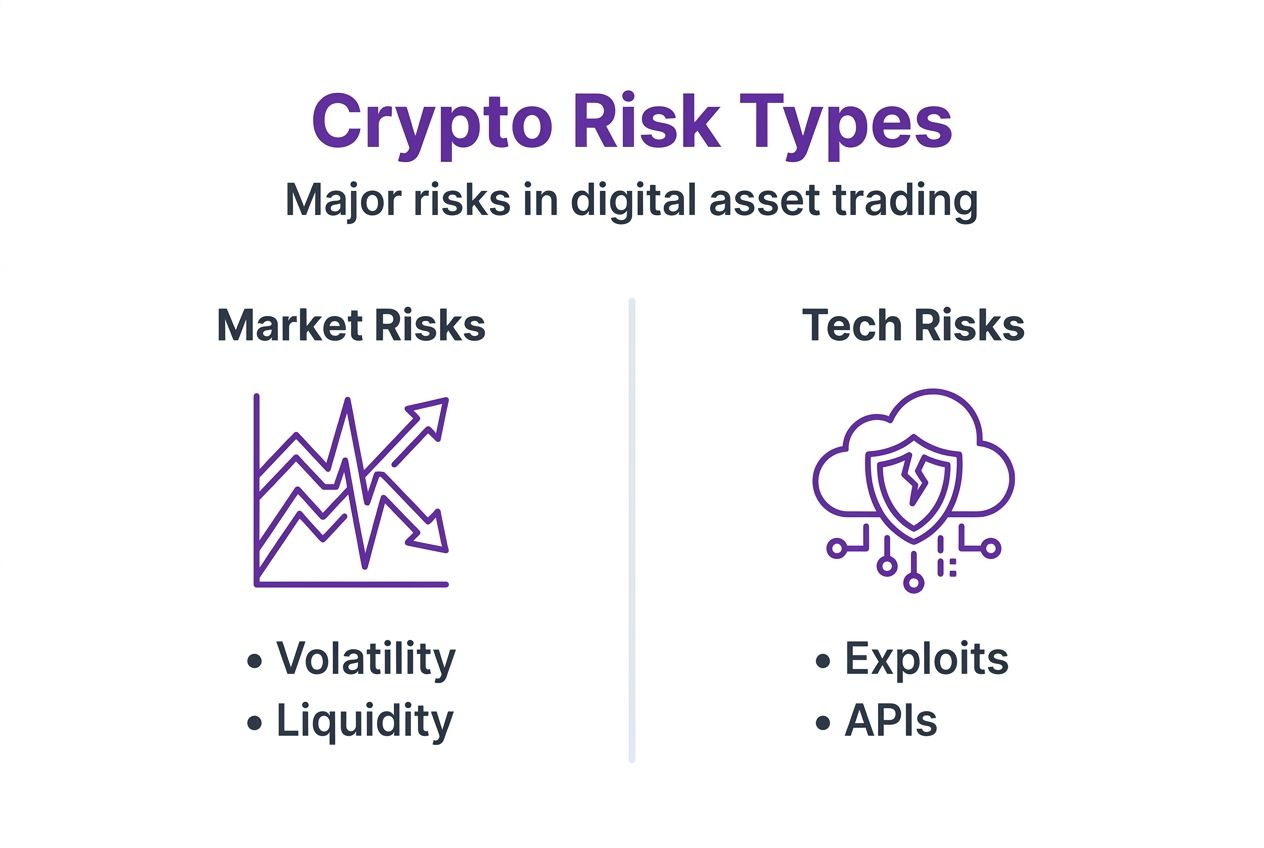
Technological risks introduce dangers absent from stock trading. Exchange platforms can halt withdrawals, smart contracts can contain fatal bugs, and blockchain networks can experience congestion. Technological incidents cause average losses of 15% to 20% in affected crypto portfolios. These failures can trap your funds or trigger unexpected liquidations.
Security vulnerabilities multiply when connecting trading bots via API keys. Each exchange integration creates potential attack vectors. Poorly configured API permissions can allow unauthorized withdrawals. Understanding key risks in automated trading helps you implement proper safeguards.
| Risk Category | Specific Examples | Potential Impact |
|---|---|---|
| Market Risk | Sudden 40% price drops, flash crashes, low liquidity | Portfolio value decline, forced liquidations |
| Technological Risk | Exchange outages, smart contract bugs, blockchain congestion | Trapped funds, failed trades, unexpected losses |
| Security Risk | API key compromise, exchange hacks, wallet breaches | Total capital loss, unauthorized withdrawals |
| Regulatory Risk | Sudden trading bans, tax law changes, exchange restrictions | Frozen accounts, legal liability |
Regulatory uncertainty adds another layer of complexity. Governments worldwide continue developing cryptocurrency frameworks, with rules changing rapidly. A jurisdiction that welcomes crypto today may ban it tomorrow, leaving traders scrambling to relocate funds. The comprehensive crypto risk factors report details how regulatory shifts create cascading effects across markets.
Pro Tip: Track regulatory developments in jurisdictions where your exchanges operate. Subscribe to official announcements and maintain withdrawal plans for each platform in case sudden restrictions emerge.
Common misconceptions in crypto risk management
Many traders believe diversification provides complete protection. Reality proves otherwise. During market-wide crashes, correlations between cryptocurrencies approach 1.0, meaning everything falls together. Diversified portfolios can lose over 40% during correlated crashes, destroying the supposed safety of spreading investments across multiple coins.
The misconception that risk only means price volatility misses critical threats. You can perfectly predict price direction yet still lose money through exchange insolvency, regulatory seizures, or technological failures. Comprehensive risk management in crypto trading bots addresses all threat vectors, not just market movements.
Automated trading bots do not eliminate risk. They shift risk from emotional decision-making to configuration errors and technical failures. A bot with incorrect parameters can execute hundreds of losing trades before you notice. Bots cannot anticipate black swan events or adapt to unprecedented market conditions without proper oversight.
“The greatest risk in cryptocurrency trading is not what you prepare for, but what you assume cannot happen. Traders who survive long-term maintain healthy paranoia about every system, exchange, and strategy they employ.”
Another dangerous belief suggests that past performance predicts future results in crypto markets. Strategies that worked brilliantly during bull markets often catastrophically fail during bear phases. Market structure changes, new participants enter, and old patterns break down. Rigid adherence to historical patterns invites disaster.
Traders also underestimate tail risk. Extreme events occur far more frequently in crypto than statistical models predict. The “once in a century” event happens multiple times per year. Preparing only for normal market conditions leaves you vulnerable to the very situations that cause the most damage.
Frameworks and strategies for cryptocurrency risk management
Effective risk management follows a structured approach. Start by determining your maximum acceptable loss per trade and overall portfolio drawdown. Never risk more than 1% to 2% of your capital on any single position. This fundamental rule ensures that even a string of losses will not eliminate your trading account.
Position sizing must account for cryptocurrency’s extreme volatility. Calculate position size using the formula: Position Size = (Account Risk / Trade Risk) × Account Size. For a $10,000 account risking 1% with a 10% stop-loss, you invest $1,000. This mathematical approach removes emotion and enforces discipline.

Stop-loss automation forms your primary defense against catastrophic losses. Set stop-losses at technical levels that invalidate your trade thesis, typically 8% to 15% below entry for volatile cryptocurrencies. Your trading bot should enforce these stops without exception, preventing the common mistake of moving stops further away as losses mount.
Portfolio rebalancing maintains your desired risk exposure as market values shift. Automatically sell winners and buy losers to return to target allocations. This contrarian approach forces you to take profits during rallies and accumulate during dips, implementing the classic “buy low, sell high” principle systematically.
Dynamic risk adjustment responds to changing market conditions. During high-volatility periods, reduce position sizes and tighten stops. When volatility compresses, you can carefully increase exposure. AI-driven bots excel at this adaptive behavior, continuously monitoring volatility indicators and adjusting parameters.
Security practices for API key management:
- Create API keys with the minimum permissions necessary, typically enabling only trading without withdrawal rights.
- Use different API keys for each exchange and regularly rotate them every 60 to 90 days.
- Store keys in encrypted vaults, never in plain text files or email.
- Enable IP whitelisting when exchanges offer this feature, restricting API access to known addresses.
- Monitor API activity logs daily for unauthorized access attempts or suspicious patterns.
Pro Tip: Test your stop-loss automation during low-stakes periods before trusting it with significant capital. Verify that stops execute as expected across different market conditions and exchange behaviors.
Leveraging AI and automation in crypto risk management
AI-powered trading bots provide continuous risk monitoring that humans cannot match. They analyze thousands of data points per second, detecting subtle shifts in market structure, volatility regimes, and correlation patterns. This real-time awareness enables proactive risk adjustments before problems escalate.
Automation eliminates emotional decision-making during stressful market events. When Bitcoin drops 15% in an hour, human traders panic and make irrational choices. AI systems execute predetermined risk protocols without fear or greed, maintaining discipline when you need it most. Understanding the role of AI in crypto trading reveals how technology transforms risk management.
Machine learning models identify risk patterns invisible to manual analysis. They detect early warning signs of market stress by analyzing order book depth, trading volume patterns, social sentiment, and cross-asset correlations. When risk indicators flash warning signals, AI bots automatically reduce exposure or tighten protective stops.
Dynamic stop-loss adjustment represents one of AI’s most powerful risk tools. Traditional static stops can trigger unnecessarily during normal volatility or fail to protect during extreme moves. AI algorithms calculate optimal stop distances based on current volatility, time of day, and market microstructure, balancing protection against premature exits.
Portfolio rebalancing through AI optimization maintains risk targets while maximizing returns. Instead of simple periodic rebalancing, AI systems identify optimal rebalancing moments by analyzing transaction costs, tax implications, and market momentum. This intelligent approach outperforms mechanical strategies. Explore crypto trading smart automation for implementation details.
Key benefits of AI-driven risk management:
- Continuous 24/7 monitoring across all trading pairs and exchanges simultaneously
- Instant execution of risk protocols faster than human reaction time
- Emotionless adherence to predefined risk parameters during market chaos
- Adaptive learning from market behavior to refine risk models
- Scalable monitoring of complex multi-exchange, multi-strategy portfolios
Pro Tip: Review your AI bot’s risk decisions weekly, not just trading results. Understanding why the system adjusted risk parameters helps you verify it operates correctly and refine settings for better alignment with your risk tolerance.
Case studies: Automated risk management in action
Comparing manual versus automated risk management reveals dramatic performance differences. A 2025 analysis tracked 100 traders over six months. Manual traders experienced average maximum drawdowns of 42%, while those using automated risk controls limited drawdowns to 18%. The automated group achieved higher risk-adjusted returns despite similar gross profits.
One trader using crypto trading bots risk management features implemented strict 2% position sizing and automated stop-losses across five exchanges. During a sudden market crash, their bot exited all positions within seconds, limiting losses to 8%. Manual traders in the same market lost 25% on average, paralyzed by shock and unable to execute exits quickly.
Failure cases teach equally valuable lessons. A trader configured their bot with overly tight stops, getting stopped out repeatedly during normal volatility. Despite being directionally correct on trades, they accumulated death by a thousand cuts through excessive stop-loss triggers. The lesson: stops must account for typical price behavior, not just protect against disasters.
Another failure involved inadequate exchange API security. A trader used API keys with full withdrawal permissions, violating best practices. When their computer was compromised, attackers drained the exchange account within minutes. Proper API configuration with withdrawal restrictions would have prevented this total loss. Review risks in automated trading to avoid similar mistakes.
| Scenario | Manual Trading | Automated Risk Management | Performance Difference |
|---|---|---|---|
| Volatile market entry | Average 3.2% slippage due to delayed execution | 0.8% slippage through instant order placement | 2.4% improvement |
| Flash crash response | 42% average portfolio loss | 18% average portfolio loss | 24% protection |
| Emotional trading mistakes | Frequent revenge trading after losses | Zero emotional decisions | Eliminated behavioral losses |
| Risk parameter consistency | Inconsistent application, often ignored under stress | Perfect adherence to rules | Consistent risk exposure |
| Multi-exchange coordination | Delayed rebalancing, missed opportunities | Real-time optimization | 12% higher risk-adjusted returns |
The most successful implementations combine automated execution with human oversight. Traders who review bot performance weekly, adjust parameters quarterly, and maintain kill switches for emergency shutdown achieve optimal results. Automation handles execution discipline while human judgment provides strategic direction.
Practical implementation for multi-exchange automated trading
Setting up secure API connections starts with exchange selection. Choose platforms with strong security track records and robust API documentation. Visit each exchange’s API management section and create new keys specifically for bot trading. Never reuse keys across multiple applications or bots.
Configure API permissions with minimal scope. Enable spot trading only, disabling futures, margin, and especially withdrawal capabilities. Even if an attacker compromises your API key, they cannot steal funds without withdrawal permissions. Check the connecting crypto exchanges guide for detailed setup instructions.
Building custom risk parameters within your trading platform:
- Set maximum position size as a percentage of total portfolio, typically 5% to 15% per position
- Define stop-loss rules using both percentage and volatility-based distances
- Establish daily loss limits that pause trading if exceeded, preventing cascade failures
- Configure correlation limits preventing overexposure to similar assets
- Set maximum total exposure across all positions, maintaining cash reserves
Real-time analytics monitoring provides crucial oversight. Your dashboard should display current positions, unrealized profit and loss, risk exposure by exchange, and active stop-loss levels. Set alerts for unusual activity like rapid drawdowns, failed API calls, or approaching risk limits. The cryptocurrency portfolio management tools enable comprehensive tracking.
Regular parameter reviews keep your system aligned with evolving markets. Every month, analyze which risk settings triggered most frequently and whether they protected you or hindered performance. Adjust stop distances if you experienced excessive whipsaws. Tighten position sizes if drawdowns approached uncomfortable levels.
Testing risk protocols in simulation before live deployment prevents costly mistakes. Run your bot configuration against historical data spanning various market conditions. Verify that stops execute correctly, position sizing calculates accurately, and portfolio limits enforce properly. Only after successful simulation should you trust the system with real capital.
Pro Tip: Maintain a trading journal documenting every risk parameter change and the reasoning behind it. This record helps you learn from experience and avoid repeating mistakes when market conditions cycle back to previous patterns.
Conclusion and future trends in crypto risk management
Effective cryptocurrency risk management combines understanding unique market characteristics, implementing multi-layered protective strategies, and leveraging AI-driven automation for disciplined execution. You have learned that diversification alone fails, that technology introduces risks beyond volatility, and that consistent parameter application through automation outperforms emotional human decision-making.
The crypto risk landscape continues evolving. Decentralized finance introduces smart contract risks and impermanent loss challenges absent from centralized exchanges. Regulatory frameworks worldwide are tightening, creating compliance risks that did not exist in crypto’s early years. New attack vectors emerge as hackers target DeFi protocols and cross-chain bridges.
Staying ahead requires continuous education and adaptive strategies. Markets that reward one approach today may punish it tomorrow. Subscribe to security bulletins from exchanges you use. Monitor regulatory developments in key jurisdictions. Test new risk management techniques in small sizes before scaling. The traders who survive long-term treat risk management as an evolving discipline, not a solved problem.
Discover Darkbot: Your ally in crypto risk management
Managing risk across multiple exchanges demands sophisticated tools that automate complex decisions while you maintain strategic control. Darkbot combines AI-driven risk analytics with customizable automation, letting you implement every strategy discussed in this guide. The platform monitors your portfolio continuously, adjusting positions and executing protective stops faster than humanly possible.
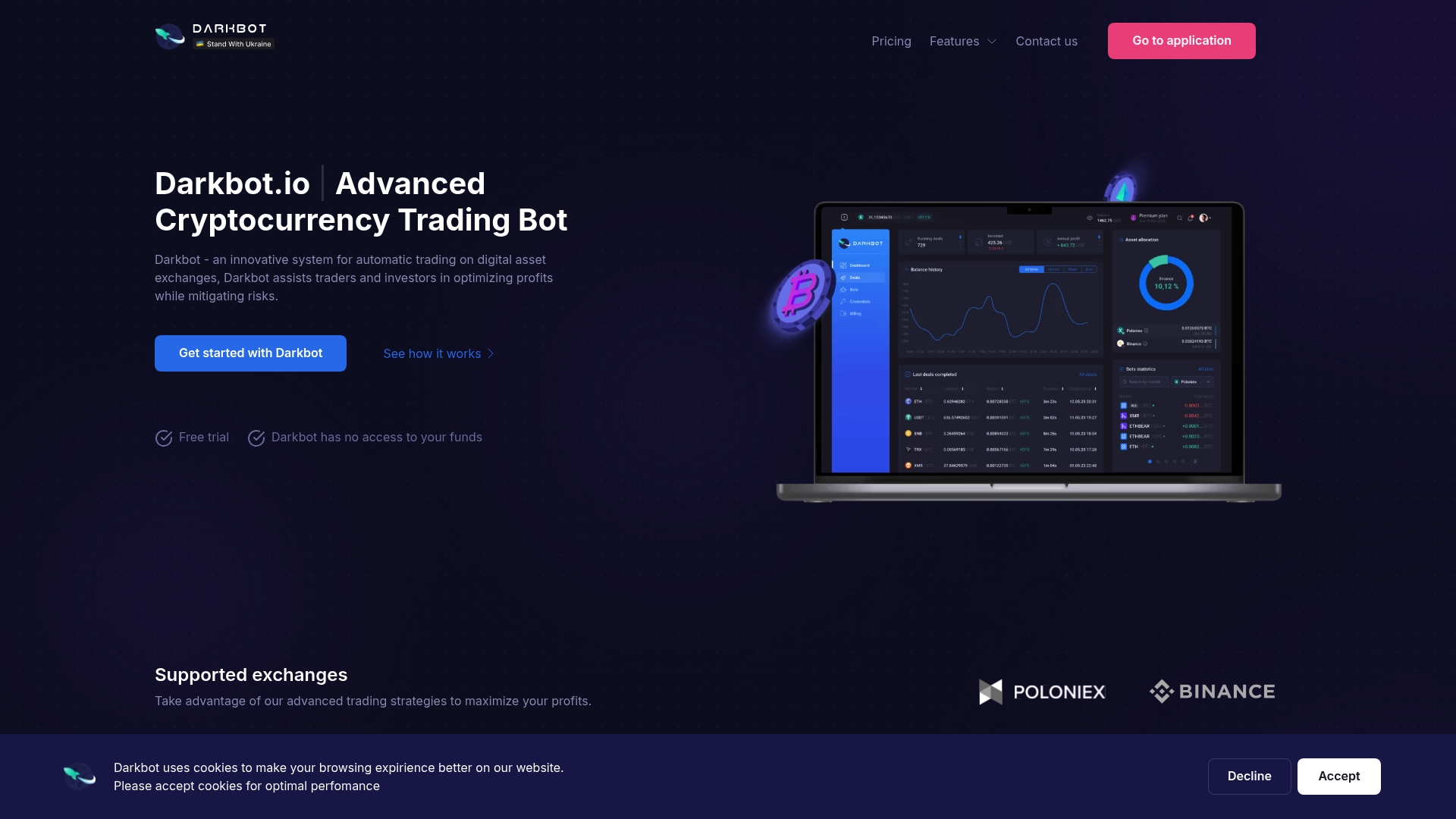
Connect exchanges securely through the Darkbot exchange connection guide, configure your risk parameters, and let AI handle execution discipline. Whether you are protecting a small portfolio or managing significant capital across multiple markets, cryptocurrency portfolio management with Darkbot provides the automation and analytics you need. Visit Darkbot to discover how advanced risk management transforms your trading results.
FAQ
What are the main categories of risks in cryptocurrency trading?
Market risk involves price volatility and liquidity challenges unique to crypto assets. Technological risk encompasses exchange failures, smart contract bugs, and blockchain vulnerabilities. Security risk covers API compromises, wallet breaches, and platform insolvency. Understanding these categories helps you build comprehensive protection strategies addressing threats from multiple angles simultaneously.
How do AI and automation improve risk management in crypto trading?
AI provides real-time analytics processing thousands of market signals per second, detecting risk pattern shifts humans miss. Automation enforces predefined risk rules without emotional interference, executing stops and position adjustments instantly during market stress. Together, they maintain consistent discipline across all market conditions, eliminating the behavioral errors that destroy manual trading accounts.
Is diversification enough to protect my crypto portfolio?
Diversification reduces some risks but fails during correlated market crashes when all cryptocurrencies decline together. Portfolios spread across multiple coins still lose 40% or more in severe downturns. You need additional protections including automated stop-losses, position sizing limits, and dynamic rebalancing to survive extreme events that overwhelm simple diversification strategies.
What steps can I take to secure API keys when using automated trading bots?
Create API keys with trading-only permissions, explicitly disabling withdrawal capabilities to prevent fund theft. Use unique keys for each exchange and rotate them every 60 to 90 days. Enable IP whitelisting when available and store keys in encrypted vaults, never in plain text. Monitor API activity logs daily for suspicious patterns indicating potential compromise.
How often should I review and adjust my automated trading bot’s risk parameters?
Review risk settings monthly at minimum, analyzing which rules triggered most frequently and their effectiveness. Adjust parameters quarterly or when market volatility regimes change significantly. After any unusual market event or bot behavior, conduct immediate reviews to verify proper operation. Continuous monitoring through real-time alerts supplements these scheduled reviews, catching problems before they escalate.
Recommended

Start trading on Darkbot with ease
Come and explore our crypto trading platform by connecting your free account!
Free plan available • No credit card required