AI Trading Strategy Tutorial: Automate Crypto Profits Now
Managing cryptocurrency trades often feels overwhelming, especially when time is limited and the risk of error is high. Novice traders and busy professionals from regions like South America or Southeast Asia need a system that handles the complexities for them while protecting their hard-earned capital. By using automated AI trading strategies and focusing on secure exchange account connections, you gain the opportunity to optimize profits and reduce risk with confidence. This practical guide walks you through each essential step, from secure setup to continual improvement, helping you trade smarter with minimal effort.
Quick Summary
| Key Point | Explanation |
|---|---|
| 1. Securely Connect Exchange Accounts | Generate and use API keys cautiously. Limit permissions to only what your trading platform needs to prevent unauthorized access. |
| 2. Customize Trading Strategies to Goals | Tailor your AI trading strategy based on your specific investment objectives and risk tolerance for better alignment with your financial goals. |
| 3. Configure Risk Management Parameters | Establish clear per-trade risk limits and maximum drawdown thresholds to protect your capital and ensure your automated trading system operates within defined constraints. |
| 4. Monitor Bot Performance Regularly | Conduct weekly evaluations of your bot’s trades and adjust parameters as necessary to maintain effectiveness under changing market conditions. |
| 5. Document Adjustments and Insights | Keep detailed records of your bot’s performance and any changes made to strategies, offering valuable insights for future decision-making and optimization. |
Step 1: Connect Your Exchange Accounts Securely
Connecting your cryptocurrency exchange account to an automated trading platform requires careful attention to security. This step establishes the secure bridge between your exchange and the automation system, allowing it to execute trades while protecting your funds and credentials. You will generate exchange API credentials, configure permissions, and verify the connection.
Begin by logging into your exchange account and navigating to the security or API settings section. Most major exchanges include an API management area where you can create new keys. When generating these credentials, you will see two critical components: the API key and the secret key. The secret key is your most sensitive piece of information; it acts as a password that grants access to your account. Never share this key, never paste it into insecure applications, and never store it in plain text. Treat it with the same protection you would give your private wallet keys.
When setting up the connection on your trading automation platform, you will paste the API key and secret key into the designated fields. The platform should use robust authentication and encryption methods to protect these credentials from compromise during transmission and storage. Before confirming the connection, verify that you have restricted the API permissions on your exchange to exactly what the automation platform needs. Most platforms require only trading and market data permissions; explicitly disable withdrawal permissions. This means even if someone gained access to your API credentials, they could not move your funds off the exchange.
Once you complete the initial connection, test it with a small practice trade or a market data query. Watch your exchange’s activity log to confirm that the connection is genuine and that only expected actions appear. Some platforms allow you to set additional safeguards such as IP whitelisting on the API key, which restricts where the key can be used geographically. If your exchange supports this feature, enable it.
Regulatory guidance on crypto account management emphasizes that secure handling of cryptographic keys, multi-factor authentication, and regular security audits form the foundation of sound practice. Ensure your exchange account itself uses two-factor authentication on login, preferably using an authenticator application rather than SMS. This protects the exchange account from unauthorized access even if someone obtains your password.
Pro tip: Periodically review your active API keys on your exchange account and remove any keys you no longer use, then rotate your active keys every 90 days by creating a new key, updating your trading platform, and deleting the old one.
Step 2: Customize AI Trading Strategies to Your Goals
Customizing an AI trading strategy transforms a generic automation tool into a system aligned with your specific investment objectives and risk tolerance. This step involves configuring how the AI evaluates market conditions, determines entry and exit points, and manages your positions. You will define your goals, select relevant technical indicators and data inputs, and then fine-tune the strategy parameters to match your approach.
Start by clearly articulating what success looks like for your trading. Are you seeking consistent monthly returns, capital preservation with limited drawdown, or aggressive growth? Are you trading a specific cryptocurrency or managing a diversified portfolio? Your goals directly influence strategy configuration. The AI can work with multiple technical indicators such as moving average crossovers, volume-weighted pricing, and sentiment analysis to generate trading signals. When setting up these components, consider which indicators align with your market view. For instance, if you believe momentum-based signals will outperform in your target market, weight those indicators heavily. If you prefer mean-reversion strategies that capitalize on overbought and oversold conditions, configure the AI accordingly.
Advanced AI systems can incorporate customizable algorithmic trading strategies including moving average crossover, volume-weighted price, and sentiment analysis methods to optimize for your specific objectives. This flexibility matters because different traders succeed with different approaches. One trader might profit from short-term volatility while another focuses on longer-term trend following. The platform should allow you to adjust timeframes, indicator sensitivity, and position sizing rules without requiring technical expertise.
Here’s a comparison of common technical indicators used in AI trading strategies and their typical use cases:
| Indicator | What It Measures | Ideal Market Condition |
|---|---|---|
| Moving Average Crossover | Trend direction and changes | Trending markets |
| Volume-Weighted Price | Price relative to traded volume | High-volume periods |
| Sentiment Analysis | Market mood from news/social data | Volatile or event-driven markets |
| RSI (Relative Strength Index) | Overbought/oversold conditions | Range-bound markets |
| MACD (Moving Average Convergence Divergence) | Trend momentum and reversals | All market types |
Next, establish clear risk parameters. Decide what percentage of your account you are willing to risk on each trade. Define your maximum acceptable drawdown, the point at which the strategy pauses to prevent catastrophic losses. Set portfolio allocation rules that determine how much capital flows into individual positions versus staying in reserve. These guardrails ensure the AI operates within boundaries you have chosen, preventing aggressive behavior during volatile periods. When configuring these limits, be realistic about your financial situation. If losing 10 percent of your account would cause genuine concern, set your maximum drawdown lower than 10 percent.
Once you have defined goals and risk parameters, the system can adjust trading actions dynamically using technical indicators, sentiment indices, and portfolio information to optimize performance across multiple cryptocurrencies in response to changing market conditions. The AI does not predict the future; it responds to current data using your configured rules. This adaptive approach helps strategies remain relevant as markets shift. However, you should regularly review your configuration. If market conditions change significantly or your personal circumstances shift, revisit your strategy settings. What worked during a bull market may underperform during consolidation phases.
Start with conservative parameters and gradually adjust them based on backtested performance and live results. The platform should provide detailed analytics showing how your configuration performed against historical data. Study these results carefully. Look for consistency, not just peak returns. A strategy that makes 5 percent per month with minimal drawdown is more sustainable than one that makes 20 percent one month and loses 15 percent the next. As you become comfortable with the system, you can refine parameters further or test alternative configurations alongside your primary strategy.
Pro tip: Create multiple strategy versions with slightly different parameters and run them simultaneously on separate smaller allocations to identify which configuration performs best in current market conditions, then consolidate capital behind the strongest performer once you have sufficient data.
Step 3: Configure Risk Management Settings
Configuring risk management settings establishes the protective boundaries that keep your automated trading system from accumulating losses beyond your tolerance level. This step involves translating your financial constraints and comfort zone into specific numerical parameters that the AI system uses to regulate position sizes, limit exposure, and pause trading when necessary. Proper configuration prevents emotional decision-making and ensures the automation operates within guardrails you have consciously set.
Begin by assessing your total trading capital and determining how much you can realistically afford to lose without affecting your daily life. This figure becomes your risk ceiling. From there, work backward to establish individual trade parameters. Most professional traders limit single-trade risk to between 1 and 3 percent of total account value. This means if you have a $10,000 account and set a 2 percent risk limit, any individual losing trade should not exceed $200 in losses. When configuring this in your platform, input this percentage directly. The system will then automatically calculate position sizes based on your stop loss level, ensuring you never risk more than you have authorized.
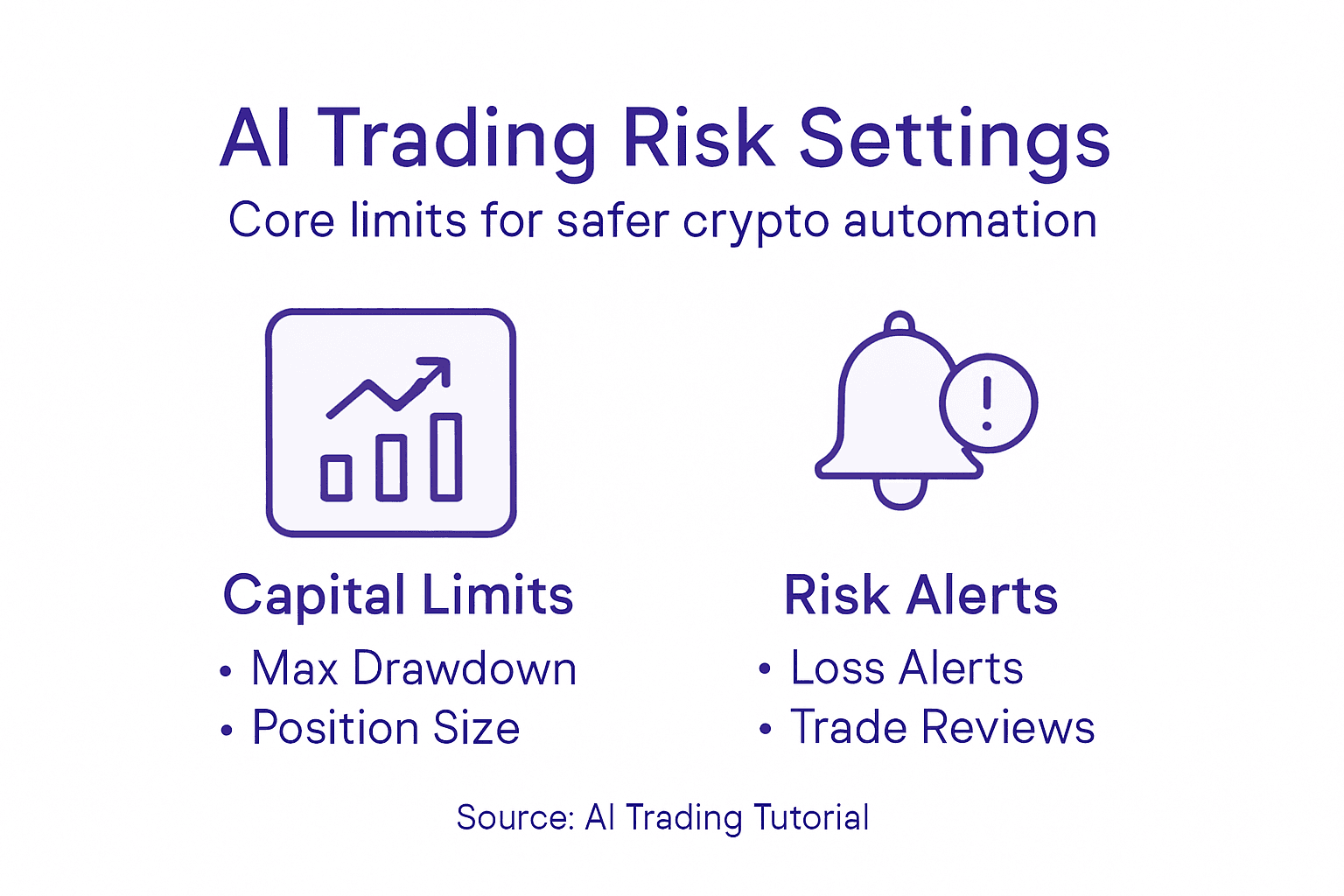
Next, define your maximum drawdown threshold. Drawdown measures the peak-to-trough decline in your account value during a losing streak. If your account grows to $11,000 and then falls to $10,100, you experienced a $900 drawdown or approximately 8.2 percent from peak. Set a drawdown limit where the strategy automatically halts trading and waits for you to review conditions. Many traders set this between 10 and 25 percent depending on their psychological comfort and financial situation. A conservative trader uncomfortable watching a 20 percent decline should set the limit at 10 percent instead. The risk management process includes identifying and assessing market volatility, cybersecurity threats, and liquidity challenges through systematic analysis to ensure your settings address realistic threats.
Configure position concentration limits to prevent overexposure to single cryptocurrencies. If you are trading Bitcoin, Ethereum, and several altcoins, you might set a rule that no single position can exceed 25 percent of your trading capital. This diversification rule prevents a catastrophic loss from destroying your entire account if one asset experiences a sharp decline. Similarly, set time-based limits that prevent the system from opening too many positions simultaneously. Opening 20 positions at once concentrates risk dramatically. A better approach limits the system to 3 or 4 concurrent positions, forcing it to be selective about entries.
Liquidity management is equally important. Configure minimum trade sizes that ensure you can actually enter and exit positions without experiencing significant slippage or getting stuck in illiquid markets. Real-time risk monitoring frameworks measure liquidity risks and adjust exposure through systematic controls to enhance financial soundness in dynamic market environments. Set your platform to avoid trading cryptocurrencies with insufficient daily volume on your chosen exchange. If a token only trades $50,000 daily and you want to enter a $5,000 position, you will likely move the market against yourself and pay premium prices.
Finally, configure alert systems. Set thresholds where you receive notifications if the strategy experiences consecutive losing trades, approaches your maximum drawdown limit, or encounters unexpected behavior. These alerts keep you informed without requiring constant monitoring. Review your configured settings quarterly. As your account grows, your numerical limits should grow proportionally. A 2 percent risk on a $10,000 account ($200 per trade) becomes a 2 percent risk on a $50,000 account ($1,000 per trade). Update these thresholds to maintain appropriate scaling.
Pro tip: Document your risk settings and the reasoning behind each parameter in a trading journal, then review this journal after significant market events to assess whether your settings remain appropriate for current conditions and your evolving financial situation.
Below is a summary of key risk management parameters and their impacts on automated trading:
| Parameter | Purpose | Example Setting | Impact on Trading |
|---|---|---|---|
| Per-Trade Risk Limit | Limits loss on single trade | 2% of account value | Prevents large account drawdowns |
| Maximum Drawdown | Halts trading after big losses | 10% of account value | Forces strategy review during volatility |
| Position Concentration | Caps exposure to one asset | Max 25% in any asset | Maintains portfolio diversification |
| Liquidity Filter | Avoids illiquid assets | Skip assets below $100k daily volume | Reduces slippage risk |
Step 4: Launch Automated AI Trading Bots
Launching your automated trading bots is the moment your configured strategy becomes operational, executing trades around the clock without requiring your constant attention. This step involves activating your bots, funding your trading account with capital, and then monitoring initial performance to ensure everything operates as intended. You are moving from planning and configuration into live execution.
Begin by ensuring your exchange account has sufficient funding for your intended trading activity. Transfer the capital you have allocated to your trading account on the exchange, keeping in mind that this money will be deployed into positions according to your strategy. Do not fund your account with money you cannot afford to lose. The amount you transfer should match your predetermined risk capital, not your life savings or emergency funds. Once funding is complete, return to your trading automation platform and review all settings one final time. Verify that your API credentials are active, your risk parameters are configured correctly, and your strategy parameters match your intentions. A small configuration error caught before launch prevents significant losses later.
When you are ready, activate your first bot. Most platforms allow you to start with a single bot running on a limited portion of your capital. This approach lets you observe real-world performance without exposing your entire account to operational risk. Launching automated AI trading bots involves using software that analyzes market data in real time to identify trading opportunities and execute trades based on user-defined parameters. The bot will begin scanning market conditions, evaluating signals according to your configuration, and opening positions when entry criteria are met. Watch the initial trades closely. Do they match your expectations? Are entry prices reasonable? Is the bot respecting your risk limits? These observations inform whether your configuration is functioning correctly.
During the first week of operation, check your bot daily. Review the trades it has executed, the reasoning logged by the system, and any alerts it has generated. Many traders discover configuration issues during this period that were not apparent during backtesting. For instance, your stop loss might be triggering too frequently, or your entry signals might be generating false breakouts in choppy markets. If you identify problems, pause the bot, adjust your settings, and restart it. This iterative refinement process is normal and expected. Advanced trading systems can integrate real-time sentiment analysis with technical indicators to make actionable decisions while maintaining adaptability through scalable infrastructure, allowing you to benefit from multiple data sources working in concert.
As you gain confidence in your bot’s performance, gradually increase the capital it deploys. If your first week shows consistent results with minimal drawdown, move from 25 percent of your trading capital to 50 percent. If performance remains stable for another two weeks, deploy 75 percent. Only after several weeks of strong performance should you consider deploying 100 percent of your planned capital. This graduated approach protects you from catastrophic losses if an unexpected market event exposes a flaw in your strategy.
Establish a weekly review routine. Every Sunday or Monday, spend 30 minutes analyzing your bot’s performance from the previous week. Calculate your return percentage, identify your winning and losing trades, and assess whether the strategy is performing consistently or if results are erratic. Track realized profits or losses and compare them to your expectations. This disciplined review process helps you spot trends early. If your bot performs well for eight weeks and then loses 15 percent in one week, that shift warrants investigation. Perhaps market conditions have changed, or perhaps a parameter needs adjustment.
Keep detailed records of when you launch bots, what settings you used, and what results you achieved. Over time, these records become invaluable for understanding which configurations work best in different market environments. Some traders maintain multiple bots with different strategies running simultaneously, allowing them to benefit from diversified approaches while analyzing which performs best under varying conditions.
Pro tip: Launch your bots during periods of normal market volatility rather than during major news events or announced economic releases, allowing you to observe baseline performance without the distortion of unusual price movements that might occur during high-impact announcements.
Step 5: Monitor Results and Adjust Strategies
Monitoring your trading results and making informed adjustments keeps your strategy performing effectively as market conditions evolve. This step involves analyzing your bot’s performance data, comparing results against your expectations, and modifying parameters when necessary to maintain edge and profitability. Without active monitoring and adjustment, even well-designed strategies eventually underperform as markets shift and conditions change.
Begin by establishing a structured review schedule. Weekly reviews work well for most traders because they provide enough data to identify patterns without requiring excessive time commitment. During each review, pull your performance report from your trading platform and examine several key metrics. Calculate your win rate, the percentage of trades that closed profitably. Review your average winning trade size versus your average losing trade size. A strategy where winning trades average $150 and losing trades average $80 is superior to one with reversed proportions, even if the win rate is identical. Analyze your maximum drawdown during the review period and compare it to your configured limit. Track your Sharpe ratio if available, a measure combining returns with consistency.
Look beyond raw numbers. Monitoring strategy performance involves regular analysis of portfolio results relative to benchmarks and market conditions while adjusting parameters to respond to transaction costs and volatility ensures your approach remains aligned with current market dynamics. Study your individual trades. Were losing trades concentrated in specific market conditions, such as overnight gaps or during low liquidity hours? If so, perhaps adding time restrictions makes sense. Conversely, if your most profitable trades occurred during particular patterns, consider emphasizing those conditions in your configuration. This trade-level analysis reveals optimization opportunities that aggregate metrics cannot show.
Compare your actual results to your backtested expectations. Backtests show theoretical performance under historical conditions, but live trading includes slippage, fees, and market microstructure that backtest simulations may underestimate. If your backtest projected 8 percent monthly returns but you are achieving 6 percent, that 2 percent gap might reflect realistic friction costs. However, if you are achieving only 2 percent when backtests showed 8 percent, something has changed. Perhaps your parameters no longer match current market conditions, or perhaps the market environment has fundamentally shifted. Investigation is warranted.
When you identify underperformance, resist the urge to make dramatic changes immediately. Instead, make small adjustments to one parameter at a time and monitor results for another week or two. For instance, if your strategy generates too many false breakout signals, slightly increase the breakout confirmation threshold. If it misses fast-moving trends, consider shortening your moving average periods slightly. Document these changes and track their impact. Advanced trading systems incorporate continuous feedback mechanisms to monitor outcomes and adjust algorithmic parameters, with real-time data inputs permitting dynamic strategy optimization that improves decision accuracy over time. This iterative refinement process gradually improves your strategy without introducing unnecessary risk.
Recognize when market conditions warrant strategy suspension. If your strategy typically thrives in trending markets but you are currently in a choppy, sideways market, consider pausing it temporarily. Some traders run different strategies for different market phases, activating trend-following bots in trending markets and mean-reversion bots during consolidation periods. This flexibility prevents your strategy from fighting the market environment.
Track seasonal and timeframe variations. You might discover your strategy performs better during certain months, specific days of the week, or particular times of day. Use this information to add conditional logic to your configuration. If your strategy underperforms during summer months or on Fridays, adjust your position sizing or add filters to reduce activity during those periods.
Maintain comprehensive records of your monitoring observations and adjustments. Over months and years, these records become invaluable for understanding which modifications improved performance and which made things worse. They also provide context when explaining your results to yourself or others, grounding your decisions in data rather than emotion.
Pro tip: Create a simple spreadsheet tracking weekly metrics alongside market conditions, then review this spreadsheet monthly to identify correlations between specific market environments and your strategy’s performance, revealing optimization opportunities you might otherwise miss.
Take Control of Your Crypto Trading with AI Automation Today
The “AI Trading Strategy Tutorial” reveals the critical challenges of securely connecting exchanges, customizing AI strategies, managing risk, and actively monitoring your automated trades. If you are seeking to transform complex manual processes into streamlined, profitable routines while avoiding common pitfalls like excessive drawdowns or strategy misalignment, you need a trusted solution tailored to your goals. Darkbot.io addresses these exact pain points by offering a fully integrated platform that lets you securely link your exchange accounts via API keys, customize advanced AI trading algorithms, and automate risk controls.
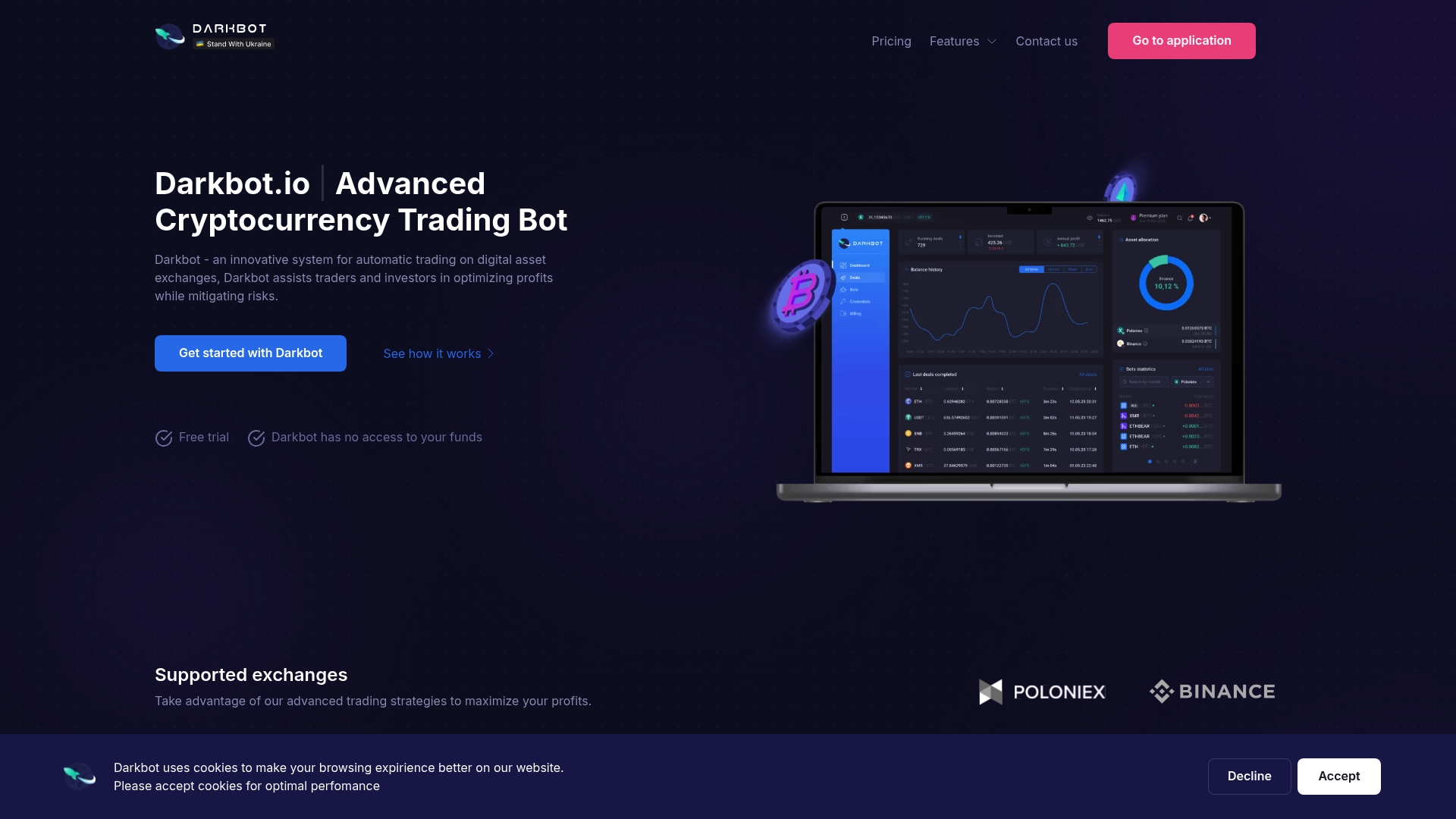
Experience the ease of deploying multiple AI trading bots that adapt in real time across diverse cryptocurrencies without constant supervision. Optimize your strategies with fine-tuning capabilities that align with your unique risk parameters and investment objectives. Visit Darkbot.io now to simplify and elevate your crypto trading experience. Start with a free plan or explore premium options that grow with your confidence and capital. Take the first step to automate your crypto profits and manage your portfolio effortlessly.
Frequently Asked Questions
How do I securely connect my cryptocurrency exchange account to the automated trading platform?
To securely connect your exchange account, log in to your exchange and navigate to the API settings. Generate your API key and secret key, ensuring you only enable the permissions needed for trading and market data, while disabling withdrawal permissions. Once generated, paste these into your trading platform to establish a secure connection.
What parameters should I customize for my AI trading strategy?
To customize your AI trading strategy, clearly define your trading goals, realistic risk tolerance, and the technical indicators you prefer. For example, if you’re aiming for consistent monthly returns, set specific parameters based on indicators like moving averages or sentiment analysis to align with your financial objectives. Adjust these settings based on your trading style and market conditions.
How can I configure risk management settings for my automated trading?
Configure risk management by determining how much of your total trading capital you are willing to risk per trade and set a maximum drawdown limit. For example, limit your per-trade risk to 2% of your total account value, ensuring you avoid significant losses. Regularly review and adjust these settings as your account grows or market conditions change.
How do I monitor the results of my AI trading bots?
To monitor your AI trading bot’s results, establish a regular review schedule, such as weekly, to analyze performance data. Check key metrics like win rate and maximum drawdown, and document your observations to assess how well your strategy is performing against your expectations. Make small adjustments as needed based on your findings.
What steps should I take if my automated trading strategy underperforms?
If your trading strategy underperforms, refrain from making drastic changes right away. Instead, make one small adjustment to a parameter and observe the effects over the following weeks. For instance, if you’re noticing too many losing trades, increasing your breakout confirmation threshold slightly might improve performance.
How can I launch my automated trading bots effectively?
To effectively launch your automated trading bots, start with funding your exchange account using only the capital you’re willing to risk. Activate your first bot with a limited portion of your capital and closely monitor its initial performance for any configuration issues. Gradually increase the capital allocation based on consistent performance within a few weeks.
Recommended

Start trading on Darkbot with ease
Come and explore our crypto trading platform by connecting your free account!
Free plan available • No credit card required