Building a Binance Testnet Bot: A Developer's Setup Guide
Build and test your bot on Binance Testnet, not mainnet. Generate testnet API keys at the official testnet URLs first, then work through library setup, endpoint configuration, and exchange-filter validation before writing a single order function. This guide covers key generation, API nuances including the December 2025 conditional-order migration, input validation, a minimal architecture, and the safety checks that keep an experiment from turning into an expensive mistake.
TL;DR:
- Testnet keys are isolated, reset periodically, and should only have trading permissions; never enable withdrawal rights.
- Validation of order parameters using cached exchange info prevents most order rejections and reduces debugging time.
- Supporting code architecture should include modules for connection, validation, strategy, execution, logging, and monitoring to ensure safety and reproducibility.
- Upgrading to December 2025’s conditional order endpoint is critical, as legacy endpoints generate errors for new order types.
- Using a managed platform like Darkbot simplifies exchange integration, logging, and safety procedures, shortening safe transition to live trading.
How Do I Set Up a Binance Testnet Bot with API Keys?
Every Binance testnet bot starts with credentials scoped to a sandbox, not your real account. Spot testing uses Testnet, which requires a GitHub login before it issues keys. Futures testing runs on a separate system entirely: Testnet has its own dashboard, its own credentials, and its own faucet for demo funds. Treat spot and futures testnet keys as two unrelated sets of secrets, because they are.
Once you’re logged in, generating the key pair takes seconds. Configuring it correctly takes more care:
- Enable TRADE and USER_DATA permissions only; the bot needs to place orders and read account state, nothing more.
- Never enable withdrawal permissions on a testnet key, even though testnet funds carry no real value. Building the habit now prevents a costly slip when you move to mainnet.
- Store the API key and secret in a
.envfile or a secrets manager, never hardcoded in source files that might get committed. - Add
.envto.gitignorebefore your first commit, not after.
Testnet keys are isolated from your mainnet account, get reset periodically, and can be shared across multiple test accounts on Binance’s infrastructure, so some rate limits or resets may feel inconsistent from time to time. The official testnet docs confirm this is expected sandbox behavior, not a bug in your setup.
What Tools Do You Need to Run a Testnet Trading Bot?

A working testnet bot needs surprisingly few dependencies. For Python, the standard combination is Python 3.10 or newer, python-binance or ccxt for exchange communication, and python-dotenv to load credentials without hardcoding them. Developers who prefer JavaScript can reach for node-binance-api or ccxt’s JS build, though most public example repos favor Python.
A clean project layout saves hours of debugging later. Structure it like this:
config/for environment loading and constants (symbol lists, risk limits).client.pyfor the authenticated exchange connection.validators.pyfor tick size, step size, and min notional checks.strategy.pyfor your actual trading logic, kept separate from execution.execution.pyto handle order placement and retries.logger.pyfor structured, timestamped logs.
Install the core stack with pip install python-binance python-dotenv ccxt, then load your .env file at the top of your entry script before anything else touches the API. For manual testing, a lightweight Streamlit dashboard gives you buttons and live output without building a UI from scratch. A CLI is faster to build and better suited to headless automation once your strategy logic is stable.
Which API Endpoints and Order Types Does Testnet Support?
Spot and futures testnets are separate systems with separate base URLs, and mixing them up is one of the most common early mistakes. Spot requests go to the testnet.binance.vision host; futures requests go to testnet.binancefuture.com. Both expose an exchangeInfo endpoint you should call before doing anything else, since it returns the trading rules your bot must respect.
Key endpoints to know:
GET /api/v3/exchangeInfo(spot) orGET /fapi/v1/exchangeInfo(futures) for symbol rules and filters.POST /api/v3/order(spot) orPOST /fapi/v1/order(futures) for MARKET, LIMIT, and STOP_LIMIT orders.GET /api/v3/orderto check order status after submission.
As of December 2025, Binance moved conditional order types, including STOP and TAKE_PROFIT variants, to a dedicated
/fapi/v1/algoOrderendpoint on futures. Bots still submitting these order types through the legacy/fapi/v1/orderpath will hit error-4120. The new endpoint uses different request fields, includingalgoType, and returns identifiers likealgoIdand status values likealgoStatusthat older response parsers won’t recognize.
If your bot or any reference repository you’re building from predates this change, audit every conditional-order call before running it. Every signed request, regardless of endpoint, needs an HMAC-SHA256 signature built from your query string and secret key, plus a timestamp and typically a recvWindow of a few thousand milliseconds. A basic MARKET order needs symbol, side, type, and quantity at minimum; a LIMIT order adds price and timeInForce.
How Do You Validate Orders Against Exchange Filters?

Two errors account for most failed testnet orders: -2021 (order would immediately trigger, usually from a limit price too close to market) and -4120 (the algoOrder migration issue covered above). Both are avoidable with validation logic that runs before any network call, not after a rejection.
The exchangeInfo response includes a filters array for every symbol. Parse it once at startup and cache the results:
| Filter type | Field | Purpose |
|---|---|---|
| PRICE_FILTER | tickSize |
Minimum price increment allowed |
| LOT_SIZE | stepSize, minQty |
Minimum quantity increment and floor |
| MIN_NOTIONAL | minNotional |
Minimum order value (price × quantity) |
Round every price to the nearest tickSize and every quantity down to the nearest stepSize before constructing a request. A common pattern: rounded_price = round(price / tick_size) * tick_size, then format to the correct decimal precision to avoid floating-point rounding artifacts. Practitioner repos also recommend building limit prices with a small buffer away from the current market price, which avoids the immediate-trigger rejection entirely, an insight confirmed by multiple testnet bot examples.
Pro Tip: Validate locally and log the exact filter values that failed before you ever send a request. A rejected order with no logged context wastes far more debugging time than a five-line validation function ever costs to write.
What Does a Minimal Testnet Bot Architecture Look Like?
A testnet bot doesn’t need to be complicated to be correct. Six modules cover nearly every functional requirement:
- Auth/client: handles signing and connection to the correct testnet host.
- Validators: checks every order against cached exchange filters.
- Strategy core: generates signals, isolated from execution logic.
- Execution queue: submits validated orders and handles retries.
- Logger/audit: records every request and response with secrets redacted.
- Monitor/alerts: flags unusual error rates or unexpected fills.
Getting from zero to a first executed test order follows a predictable sequence:
- Generate spot or futures testnet API keys.
- Load credentials into environment variables, never into code.
- Fetch
exchangeInfoand cache the filters for symbols you plan to trade. - Implement and unit-test your validator functions independently of the API.
- Sign and submit a small MARKET order as a smoke test.
- Confirm the order status and check logs for the full request/response cycle.
On runtime patterns, polling exchangeInfo on a schedule, roughly every few minutes, catches mid-session changes to tick sizes or notional minimums that a startup-only fetch would miss. Websocket streams, by contrast, matter for order-book data and live order updates, where polling introduces latency a fast strategy can’t tolerate. Use polling for infrequently changing reference data and websockets for anything time-sensitive. Several open-source demos pair a Streamlit dashboard for manual verification with a headless script for automated runs, a split worth copying if you want to eyeball orders before trusting the bot unattended.
How Do You Keep Testnet Experiments Safe and Reproducible?
Separation is the core safety principle. Keep distinct configuration files for testnet and mainnet, and make testnet the default in any development branch so a misconfigured environment variable can’t accidentally route a live order.
A few operational habits matter more than they might seem to at first:
- Log every signed request and response with the HMAC signature redacted, not the full secret in plaintext.
- Categorize exceptions into validation errors, API errors, and network errors so alerts point to the right fix.
- Set alerts for spikes in rejected orders, which usually signal a stale filter cache or an endpoint change like the algoOrder migration.
- Whitelist IPs where the exchange interface allows it, and revoke test keys once an experiment concludes.
Layered exception handling that maps error categories to distinct exit codes or alert channels makes automated pipelines far easier to debug when something breaks at 3 a.m., a practice reflected in more mature testnet bot codebases. None of this guarantees a strategy will perform a certain way. It guarantees that when something fails, you’ll know why within minutes instead of hours.
Why Most Testnet Guides Skip the Part That Actually Breaks Bots
Most tutorials treat the testnet as a formality, a box to check before “real” development starts on mainnet. That framing gets the priorities backward. The exchange-filter validation logic, the signing flow, and the order-type migration are the real work. Strategy logic is comparatively simple to write; handling a -2021 rejection gracefully at 2 a.m. during an automated run is not.
The December 2025 algoOrder migration is a useful case study in why implementation details deserve more attention than they get. Anyone treating STOP and TAKE_PROFIT orders as static API calls got a -4120 error with no clear diagnosis unless they’d read the endpoint documentation closely. Automated systems don’t tolerate ambiguity the way a manual trader clicking through an interface can.
If there’s one adjustment worth making, it’s this: build validation and logging before strategy logic, not after. A bot that fails safely and logs why is far more useful during development than one that occasionally produces a profitable-looking test run but can’t explain its own rejections. Systematic trading rewards discipline in the boring parts first.
— Grisha
Darkbot: A Managed Path from Testnet to Production
Everything covered above, key handling, filter validation, order logging, and endpoint migrations, is operational overhead that a development team has to build and maintain themselves. Darkbot removes that layer by handling exchange-filter validation, secure key storage, and structured execution logging inside a managed platform, so the testing-to-production path doesn’t depend on one engineer keeping every API nuance in their head.
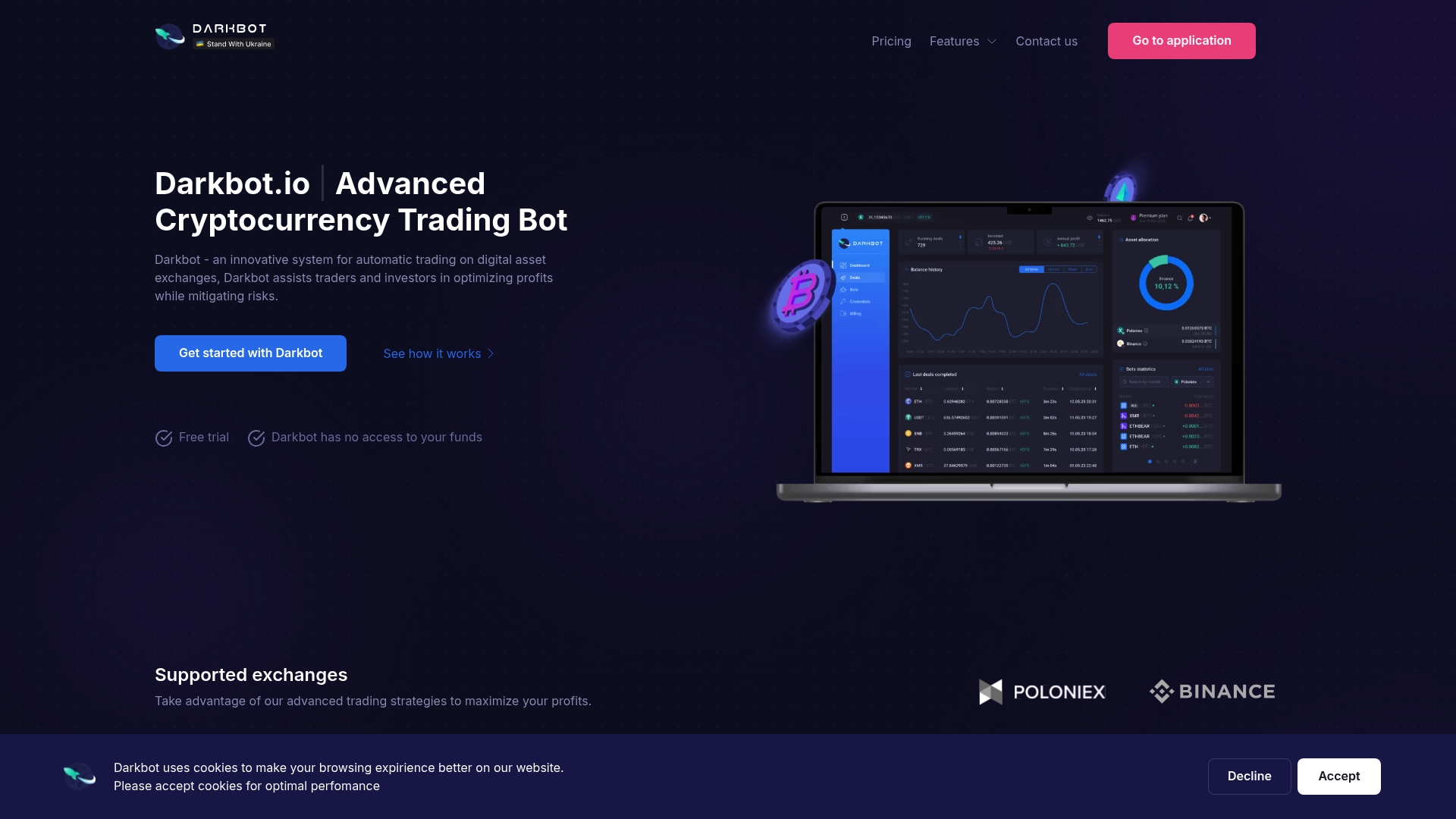
Darkbot’s API integration connects to supported exchanges through the same key-based authentication model this guide walks through, paired with paper trading for strategy validation before any capital is committed. Strategy templates give you a structured starting point instead of a blank file, and real-time analytics surface the same kind of rejection and execution data you’d otherwise have to build logging for yourself. For teams that want the discipline of systematic execution without maintaining the infrastructure underneath it, the Darkbot platform is worth a direct look. Visit the landing page to review current plans and start with the free tier.
Sources
FAQ
Does Binance Allow Bot Trading?
Yes. Binance permits automated trading through its API on both mainnet and testnet, provided bots comply with signing requirements and rate limits set out in the official API documentation.
Is Binance Testnet Free?
Yes. Binance Testnet is free to use for both spot and futures, and testnet.binancefuture.com provides demo funds through a faucet so you can test order logic without risking real capital.
How Do I Get Started with Automated Trading Without Coding a Bot Myself?
Platforms like Darkbot handle exchange API integration, execution, and monitoring through a managed interface, which suits traders who want systematic execution without building and maintaining custom testnet infrastructure.
Can a Testnet Bot Guarantee Daily Profit Targets?
No. Testnet exists to validate order logic, API handling, and risk controls in a risk-free sandbox, not to demonstrate or predict any specific profit outcome once a strategy moves to a live account.
What’s the Biggest Difference Between Testnet and Mainnet for Bot Development?
Testnet uses separate API endpoints, demo funds, and periodically reset infrastructure, while mainnet involves real capital and stricter consequences for validation errors, which is why filter and error handling deserve full attention before any migration.
Recommended

Start trading on Darkbot with ease
Come and explore our crypto trading platform by connecting your free account!
Free plan available • No credit card required