BitcoinBlackhat.com Alternatives for Traders: AI-First Picks
For US-based traders who want systematic, AI-driven automation, Darkbot.io is the recommended immediate replacement for BitcoinBlackhat.com. BitcoinBlackhat operates primarily as a forum and information hub, not a rule-based trading engine, so the comparison is really about upgrading from informal signal-sharing to structured, audited automation.
Three categories worth evaluating:
- Integrated SaaS platforms (like Darkbot.io): best for active, strategy-based automated trading with API exchange integration, backtesting, and portfolio management across multiple US-accessible exchanges.
- Exchange-native bots: built directly into exchanges such as Coinbase or Kraken; lower setup friction, but limited strategy customization and no cross-exchange logic.
- Self-hosted scripting platforms: maximum control for developers willing to manage infrastructure; higher technical overhead and no managed compliance signals.
Trust signals to verify on any candidate: SOC 2 audit evidence, clear API documentation, and Proof of Reserves from the underlying exchange. Jump to the migration checklist below to act immediately.
How Do BitcoinBlackhat.com Alternatives Compare?
| Platform type | Best for | AI/automation features | Backtesting & paper trading | US exchanges supported | Security & compliance signals | Pricing & trial | API docs / developer access | Ease of use | Support & community |
|---|---|---|---|---|---|---|---|---|---|
| Darkbot.io | Active strategy-based automated trading | AI/ML strategy logic, prebuilt and custom strategies | Yes — backtesting and paper trading included | Coinbase, Kraken, Binance US, others | Secure API handling, trade-only key guidance, audit-focused controls | Freemium entry; standard and premium tiers; 14-day money-back guarantee | Documented API integration; developer resources available | Intuitive interface; onboarding support | Personalized support; active blog and community |
| BitcoinBlackhat | Forum discussion, informal signal sharing | None (forum/content model) | None | N/A (no direct exchange integration) | No audit evidence; no custody model | Free (ad-supported content) | None | Low barrier; browser-based | Community forum only |
| Integrated SaaS platforms | Multi-exchange automation, DCA, rebalancing | Varies; some offer ML-based signals | Often available; quality varies | Typically Coinbase, Kraken, Binance US | Varies widely; check SOC 2 status individually | Subscription tiers; some freemium | Generally documented; quality varies | Moderate to high | Ticketed support; community forums |
| Exchange-native bots | Passive rebalancing, DCA on a single exchange | Limited; rule-based only | Rarely available | Single exchange only | Exchange-level custody and insurance | Often free with exchange account | Exchange API docs only | Low friction | Exchange support channels |
| Self-hosted scripting platforms | Developer-led custom strategies | Fully custom; no managed AI | Manual setup required | Depends on developer implementation | No managed compliance; operator responsibility | One-time license or open source | Extensive; code-level access | High technical barrier | Developer forums; GitHub communities |
A few structural notes on pricing and custody worth keeping in mind:
- Freemium tiers let you test strategy logic before committing capital. Subscription models (monthly or annual) are the norm for managed SaaS platforms, while self-hosted tools often use a one-time license.
- Exchange-native bots keep custody at the exchange level, which means your assets sit under the exchange’s insurance and audit framework. SaaS platforms connect via API and never hold your funds directly, a meaningful distinction for risk management.
- For US traders, regulatory compliance is now a primary differentiator. Platforms that advertise audit transparency and SOC 2-style controls are increasingly preferred by professionals over informal alternatives.
- Exchanges explicitly supporting US traders include Coinbase, Kraken, and Binance US. Verify that any SaaS platform you evaluate has tested, documented integrations with at least one of these before committing.
What Actually Differs Between These Platforms and BitcoinBlackhat?
BitcoinBlackhat is a content and forum platform, not a trading engine. The practical gap between it and a rule-based SaaS bot is wide, and it shows up in four specific areas.
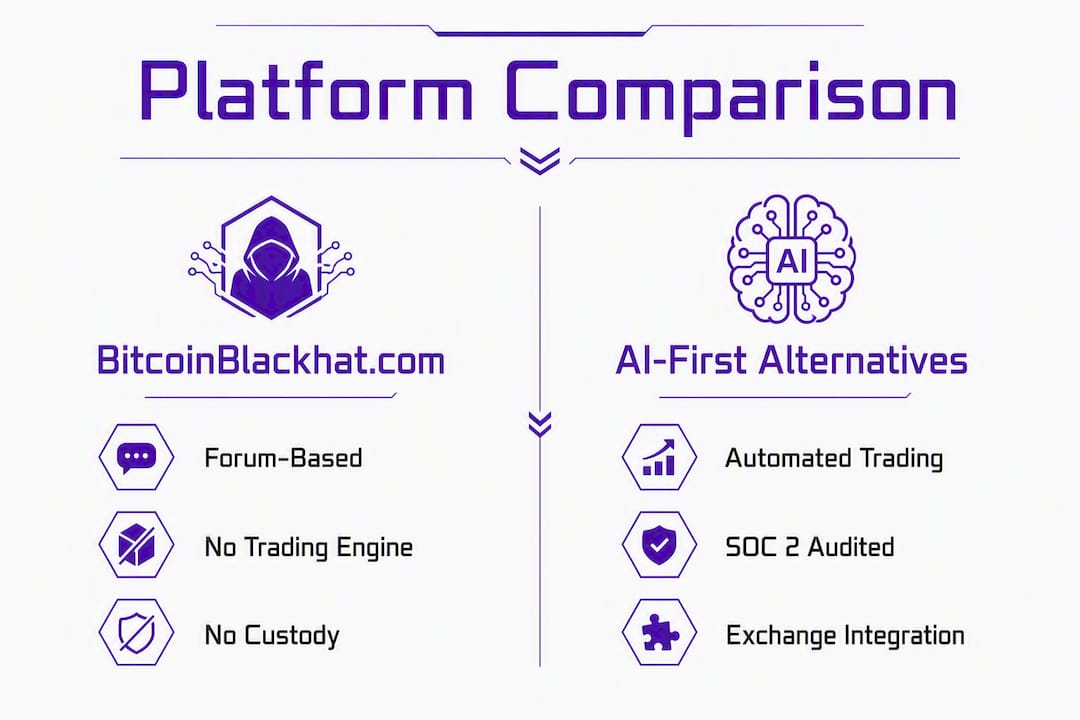
Governance and audit evidence. Professional platforms increasingly publish SOC 2 attestations or equivalent audit artifacts. BitcoinBlackhat has no such documentation. When evaluating a replacement, ask for audit evidence directly, not just a marketing claim.
Custody model. BitcoinBlackhat holds no assets and executes no trades. SaaS platforms connect to your exchange account via API and operate on your behalf without taking custody. Exchange-native bots sit inside the exchange’s custody perimeter. Self-hosted platforms put custody responsibility entirely on you. Each model carries different risk and insurance implications.
Backtesting and paper trading. Forum-based platforms offer neither. Reproducible backtesting against historical data, and paper trading before live deployment, are baseline requirements for any systematic strategy. Historical order-book depth matters here: small-margin strategies can fail in live conditions if slippage on low-liquidity pairs was never stress-tested.
Key functional differences that affect trading outcomes:
- Paper trading availability before live capital deployment
- API permission controls (trade-only vs. full-access keys)
- Strategy customization depth (prebuilt templates vs. custom scripting)
- Exportable trade logs for tax and audit purposes
Pro Tip: The single most important thing to verify first when vetting any candidate: confirm that the platform supports trade-only API keys with withdrawal permissions disabled. If a platform requires withdrawal-enabled API access, that is a structural security risk, not a configuration preference.

How Do You Choose the Right Replacement for Your Trading Goals?
The decision starts with your core objective, because platform categories are built around fundamentally different use cases.
Active strategy-based automated trading calls for a SaaS platform with AI/ML strategy logic, backtesting, paper trading, and multi-exchange API support. This is where Darkbot.io and similar integrated platforms fit. If you run systematic strategies across multiple pairs or exchanges, a managed SaaS with documented integrations is the appropriate category.
Passive rebalancing or DCA can often be handled by exchange-native bots or simpler SaaS tools. The tradeoff is reduced customization in exchange for lower setup complexity. Matching platform type to objective is a consistent recommendation from practitioners: SaaS rule-based automation for active systematic trading; custody-first services for long-term Bitcoin wealth management.
Custody-first wealth management belongs in a different category entirely, one focused on Proof of Reserves and institutional-grade custody rather than execution speed.
Evaluation checklist before signing up:
- Security: Does the platform support trade-only API keys, IP whitelisting, and multi-factor authentication?
- Exchange coverage: Are Coinbase, Kraken, or Binance US explicitly listed and tested?
- Automation features: Are backtesting and paper trading available before live deployment?
- Developer access: Is API documentation public, versioned, and actively maintained?
- Pricing: Is there a free tier or trial period? Are costs transparent with no hidden fees?
Vendor questions worth asking directly: What is the KYC scope? Is there a SOC 2 report or equivalent audit? What are the API rate limits per exchange? Does the platform support IP whitelisting? Are withdrawal permissions disabled by default on API keys?
Red flags: no public API documentation, unverifiable custody claims, no paper trading mode, opaque or bundled pricing. A realistic migration timeline runs two to four weeks, covering account setup, API configuration, paper trading validation, and phased capital deployment. Subscription costs for managed SaaS platforms vary, but freemium entry points reduce initial financial commitment.
Migration Checklist: Move Safely from BitcoinBlackhat to a New Platform
- Audit your existing strategies. Document every active strategy, parameter set, and exchange pair currently in use. Export any configuration files or notes from BitcoinBlackhat.
- Open your new platform account. Complete KYC verification and review the platform’s security documentation before connecting any exchange.
- Generate trade-only API keys. On your exchange (Coinbase, Kraken, or Binance US), create new API keys with trade permissions only. Disable withdrawal permissions and enable IP whitelisting to the platform’s documented IP range.
- Connect the API to your new platform. Follow the platform’s documented integration steps. Confirm the connection is read/write for trading only.
- Run paper trading first. Replicate your strategy logic in paper trading mode. Monitor for at least five to ten trading days before touching live capital.
- Evaluate paper trading results. Track slippage, fill rates, and drawdown against your historical expectations. Set acceptance criteria before going live: if slippage exceeds your margin threshold, adjust pair selection or position sizing.
- Phase in live capital. Start with a small allocation, roughly 10–20% of intended position size. Scale up only after live results match paper trading behavior over a meaningful sample.
- Rotate and retire old API keys. After migration, revoke any API keys previously used with BitcoinBlackhat or any interim platform. Keep withdrawal disabled on all bot-facing keys.
- Maintain exportable trade logs. Export transaction records regularly for tax reporting and audit purposes. Timestamps and order IDs matter for compliance.
- Confirm custody model and Proof of Reserves. For any exchange holding significant balances, verify that Proof of Reserves documentation is publicly available and current.
Pro Tip: Backtest your strategy against historical order-book depth, not just price data. A strategy that looks profitable on OHLCV data can fail in live conditions if the pairs you trade have thin order books. Most professional platforms let you filter backtest results by liquidity tier, use that filter.
Security and regulatory considerations for US traders
US traders operate under a specific compliance context that should directly influence platform selection. KYC/AML policies are now standard on regulated exchanges, and any SaaS platform connecting to those exchanges should have a clear, documented stance on data handling and user verification.
SOC 2 attestations, or equivalent third-party audit evidence, signal that a platform has been evaluated on security, availability, and confidentiality controls. This matters more as account sizes grow. For large balances, multi-institution custody and on-chain Proof of Reserves reduce rehypothecation and insolvency risk in ways that standard exchange custody does not.
Operationally, the security baseline for any automated trading setup should include: trade-only API keys with withdrawal disabled, IP whitelisting, role-based access if the platform supports it, and multi-factor authentication on both the exchange and the SaaS platform. A trader security checklist covering these controls is worth reviewing before any live deployment.
Tax recordkeeping is a compliance requirement, not optional. Keep exportable logs with timestamps, order IDs, and pair-level detail. On-chain evidence and Proof of Reserves from your exchange reduce insolvency risk and can serve as supporting documentation in the event of a dispute.
Why Darkbot.io Is the Recommended Primary Alternative
Darkbot.io is built around systematic execution, not signal distribution. That distinction matters when replacing a forum-based platform like BitcoinBlackhat.
Core features relevant to the migration:
- AI/ML strategy support: probabilistic pattern evaluation and rule-driven adaptation across multiple strategy types
- Backtesting and paper trading: reproducible testing before live capital deployment
- Exchange integrations via secure API: documented connections to major US-accessible exchanges, including Coinbase, Kraken, and Binance US (see the full supported exchanges list)
- Portfolio management and automated rebalancing: passive and active portfolio logic in a single platform
- Risk management tools: position sizing controls, drawdown limits, and configurable stop parameters
- Developer documentation: public API docs and integration resources for traders who want to extend or customize
Pricing follows a freemium model: a free tier with limited features, standard and premium subscription tiers, and a 14-day money-back guarantee. That structure lets you run paper trading and validate strategy logic before any financial commitment. Darkbot.io’s automated trading bot advantages and its comparison of alternative platforms are worth reading for additional context on how it positions within the broader automation category.
Darkbot.io Offers a Low-Risk Way to Start
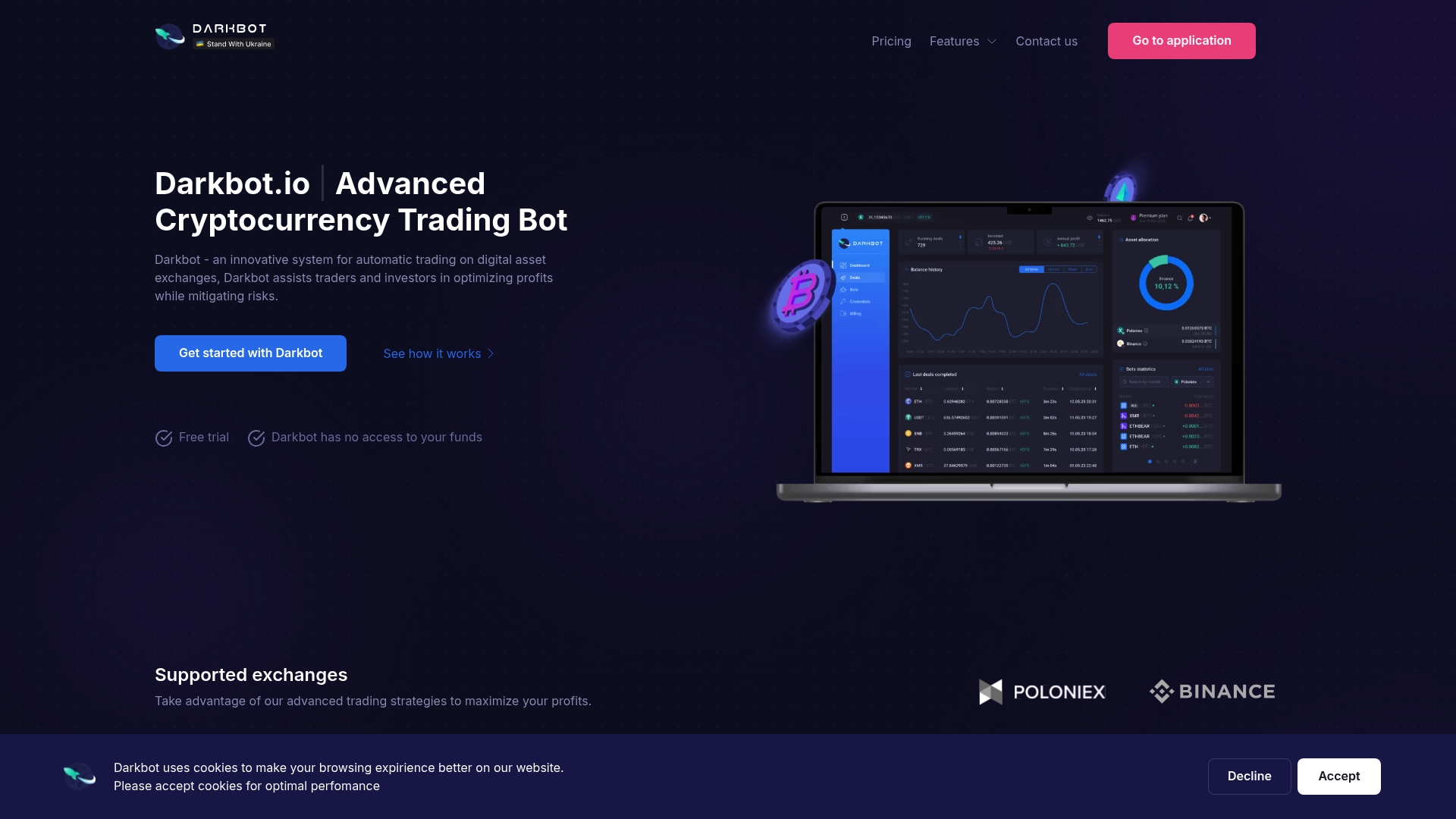
Darkbot.io’s freemium entry point and 14-day money-back guarantee mean you can run a full paper trading cycle, validate your strategy logic against live market conditions, and confirm exchange connectivity before committing to a paid plan. Start with a single strategy on a paper account, monitor slippage and fill rates over a meaningful sample period, then scale to multiple bots after your acceptance criteria are met.
The portfolio management tools handle rebalancing and position-level risk controls alongside active bot strategies, so you are not managing two separate systems as your setup grows. To get started, open a free account at Darkbot.io, connect a trade-only API key from your exchange, and run your first strategy in paper mode.
Key Takeaways
Darkbot.io is the recommended primary replacement for BitcoinBlackhat.com for US traders who want AI-driven, systematic automation with audited exchange integrations and reproducible backtesting.
| Point | Details |
|---|---|
| Recommended platform | Darkbot.io offers AI/ML strategy logic, paper trading, and documented US-exchange integrations with a freemium entry point. |
| Top security must-checks | Use trade-only API keys with withdrawal disabled, enable IP whitelisting, and verify SOC 2 or equivalent audit evidence before onboarding. |
| Migration priority | Paper trade first, phase in live capital at 10–20% of intended size, and export trade logs for tax and compliance from day one. |
| Custody distinction | SaaS platforms connect via API and never hold funds; verify Proof of Reserves at the exchange level for large balances. |
| Darkbot.io onboarding | Start free, validate with paper trading, then scale to paid tiers after acceptance criteria are met with a 14-day money-back guarantee. |
An Analytical Note on Automation and Risk
The structural shift from forum-led, informal automation to professional, API-first platforms with audited infrastructure is well underway. BitcoinBlackhat served a purpose as an information hub, but it was never an execution engine. Replacing it with a rule-based SaaS platform is not a lateral move; it is a category upgrade.
What practitioners underestimate is how much the migration process itself reveals about a platform’s quality. A platform with clear API documentation, a working paper trading mode, and transparent pricing is telling you something about its operational discipline. One that obscures any of those three things is also telling you something.
AI in this context is a mechanism for consistency and probabilistic pattern evaluation. It does not predict markets. Treat it as a tool for systematic execution and disciplined decision-making, monitor your bots actively, maintain manual override controls, and keep exportable logs. Automation reduces manual effort; it does not eliminate the need for judgment.
This article is general information, not financial or investment advice. Verify current platform terms, exchange availability, and regulatory requirements for your specific situation before making any trading or migration decisions.
Authoritative sources and further reading
When performing vendor due diligence or filling the migration checklist, start with these sources:
- Kraken — API documentation, paper trading simulator, and exchange security practices
- Investopedia: Best Crypto Exchanges 2026 — regulatory compliance analysis and US exchange rankings
- Coinbase — API key management guidance, trade log exports, and KYC/AML documentation
- NerdWallet: Best Crypto Exchanges 2026 — order-book depth and liquidity analysis for automated trading
- Onramp Bitcoin — multi-institution custody architecture and Proof of Reserves documentation
- Darkbot.io — platform features, pricing, and exchange integration pages
- Darkbot.io: Gunbot Alternatives Comparison — migration patterns and platform category comparisons
- Ollatrade: Secure Trading Guide — trading safety practices and account security tools
Prioritize API documentation pages, SOC 2 or audit pages, Proof of Reserves statements, and exchange integration pages when evaluating any candidate platform.
Recommended

Start trading on Darkbot with ease
Come and explore our crypto trading platform by connecting your free account!
Free plan available • No credit card required