Hiaah.com Alternatives for Crypto Traders: What to Use

TL;DR:
- HIAAH is a licensed healthcare provider offering mental health services, not a crypto trading platform. U.S. traders need purpose-built platforms with verified API, backtesting, and security features to automate crypto strategies effectively.
If you searched for “hiaah.com alternatives” expecting crypto trading bots, you’ve hit a category mismatch. HIAAH is a licensed clinical healthcare provider offering mental health counseling, psychiatric care, medical weight loss, and practice administration services for licensed care providers. It has no exchange API, no backtesting engine, and no order-routing infrastructure. For U.S. traders looking to automate crypto strategies, the right starting point is a purpose-built platform like Darkbot, which provides API exchange integration, backtesting, paper trading, and documented risk controls.
Why HIAAH is not a crypto trading platform
HIAAH’s core business is clinical care. Its administrative services cover billing, revenue cycle management, credentialing, and provider scheduling for healthcare practices across New York, Florida, Nevada, and Connecticut. Psychology Today lists HIAAH as a licensed counseling practice. Local business directories classify it as a mental health clinic.
None of that infrastructure overlaps with what automated trading requires:
- Secure exchange API connections with read/write trading permissions
- Low-latency market data feeds and order routing
- A backtesting engine with cleaned historical price data
- Position sizing, stop-loss automation, and circuit-breakers
- Encrypted API key vaulting and multi-factor authentication
Confusing a healthcare B2B firm with a fintech platform is a search-intent mismatch, not a product gap. HIAAH cannot be configured, extended, or adapted to serve crypto automation needs. The two categories share no technical or regulatory overlap.
How do you choose a legitimate automated crypto trading platform?
The most important criteria are documented API integration, verifiable backtesting, clear risk controls, and confirmed U.S. availability. Platforms that cannot demonstrate all four should not receive live capital.
| Dimension | Entry-level platforms | Advanced retail platforms |
|---|---|---|
| API & exchange integration | Limited exchanges, read-only or basic trading | Multiple major exchanges, full trading permissions |
| Backtesting & paper trading | Basic historical simulation | Cleaned data, paper-trade mode, exportable records |
| Strategy customization | Pre-built templates only | Custom logic, parameter tuning, multi-bot support |
| Security: API key handling | Stored in plaintext or unspecified | Encrypted vaulting, 2FA, role-based access |
| Pricing & trial | Paid-only, no trial | Free tier or trial period, transparent pricing |
| Support & documentation | Community forum only | Dedicated support, structured documentation |
| U.S. availability | Unconfirmed or geo-restricted | Confirmed U.S. operations and support |
| Suitable user level | Beginner | Beginner through advanced |
Before committing to any platform, ask these questions directly:
- Which exchanges do you support, and are they available to U.S. residents?
- Are API keys stored with encryption, and where are they vaulted?
- Can I export backtest records and paper-trade P&L history?
- What is the trial or refund policy?
- How are rate limits and failed orders handled?
Red flags to avoid: no paper-trading mode, opaque backtest methodology, no documented security controls, fees that only appear at checkout, and no U.S.-based support or operations.
Pro Tip: Request a sample backtest export before subscribing. A platform confident in its methodology will share one. If the response is vague or unavailable, treat that as a signal about documentation quality across the board.
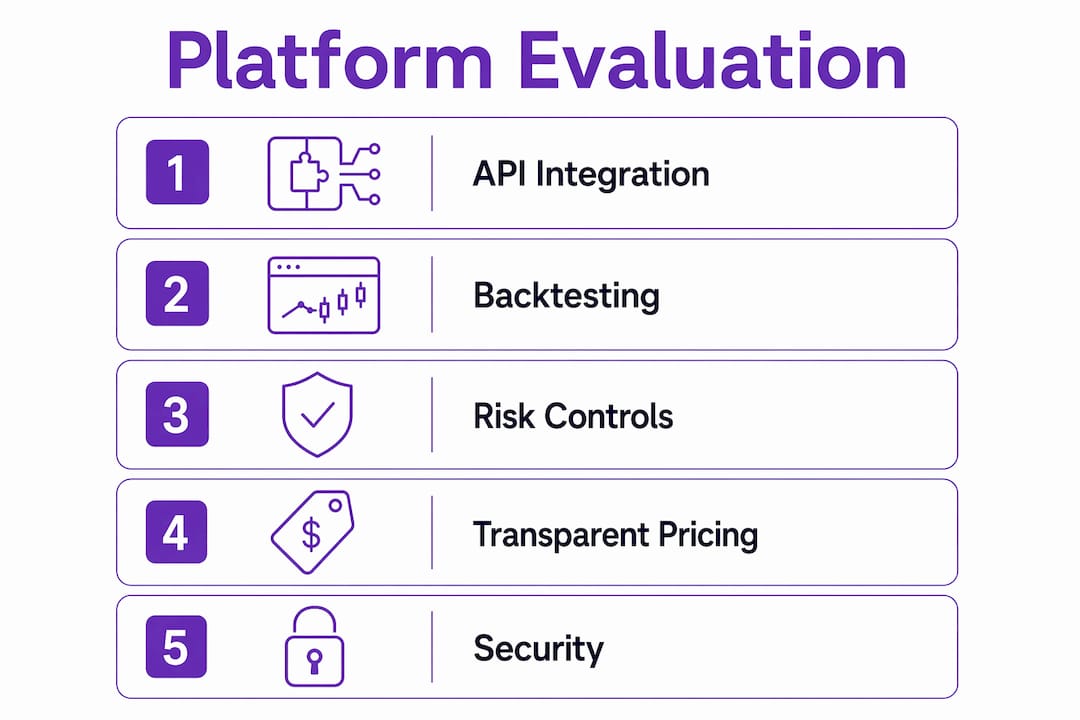
Trust signals worth weighing: transparent pricing pages, a free tier or trial period, published security descriptions covering API key encryption and 2FA, and accessible documentation. These are table-stakes for automated crypto trading, not differentiators.
Why Darkbot fits U.S. automated crypto traders
Darkbot is a purpose-built automated crypto trading platform designed for both novice and advanced U.S. traders. It operates on a subscription SaaS model with free, standard, and premium tiers, plus a 14-day money-back guarantee, which means you can validate the platform before committing capital.
| Capability | Darkbot |
|---|---|
| API & exchange integration | Multiple major exchanges via encrypted API keys |
| Backtesting & paper trading | Available; supports strategy validation before live deployment |
| Strategy customization | Pre-built strategies plus custom parameter tuning; multiple simultaneous bots |
| Security: API key handling | Encrypted vaulting, 2FA, documented data handling |
| Pricing & trial | Free tier, standard and premium subscriptions, 14-day money-back guarantee |
| Support & U.S. availability | Dedicated support, documentation, U.S. availability confirmed |
| Suitable user level | Beginner through advanced |
Darkbot’s AI operates as a rule-driven execution layer, not a prediction engine. It evaluates probabilistic patterns, applies pre-defined strategy logic, and executes orders consistently without emotional deviation. That consistency is the core value proposition, not any specific return outcome.

Pro Tip: Before going live, run the same strategy in paper-trade mode for at least five trading days. Compare the simulated P&L against your risk tolerance. Only after that stability check should you allocate a small live position.
For traders evaluating the broader platform landscape, Darkbot’s combination of free entry point, documented security posture, and multi-bot support covers the criteria that matter most at the evaluation stage.
What does the setup timeline look like?
Expect 1–10 days from signup to a stable live bot, depending on exchange KYC approval speed and how much time you spend validating strategy parameters.
- Create your Darkbot account (5–10 minutes): Sign up, verify email, and review the documentation index before touching any settings.
- Complete KYC on your chosen exchange (1–3 days): U.S. exchanges require identity verification. Submit documents early; approval timelines vary by exchange.
- Generate API keys with minimum required permissions (10–15 minutes): Enable trading permissions only. Disable withdrawal permissions entirely. Copy keys directly into Darkbot’s encrypted vault; never store them in a text file.
- Run a backtest on your chosen strategy (30–60 minutes): Use at least 90 days of historical data. Review drawdown periods, not just aggregate returns.
- Paper-trade for 3–5 days (ongoing monitoring): Confirm that live market conditions produce P&L behavior consistent with the backtest. Watch for order fill discrepancies.
- Allocate a small live position (minutes to configure): Start with an amount you can afford to lose entirely. Monitor for 48 hours before scaling.
- Set monitoring alerts (15–20 minutes): Configure email or webhook alerts for failed orders, latency spikes, and exchange errors.
A note on U.S.-specific requirements: every major U.S.-accessible exchange enforces KYC. Budget time for that step. It is the most common reason onboarding takes longer than expected.
What risk controls should you run with automated bots?
Automation shifts execution risk away from manual error, but it introduces its own failure modes: runaway strategies, API permission overreach, and unmonitored drawdowns. Disciplined controls close those gaps.
API permission hygiene
Grant only the permissions a strategy actually needs. A market-making bot needs trading permissions; it does not need withdrawal access. Restricting permissions limits the blast radius if an API key is ever compromised. Review and rotate keys on a scheduled basis.
Position sizing and circuit-breakers
Set a hard maximum position size per asset and a portfolio-level exposure cap. Implement a drawdown circuit-breaker: if the portfolio drops a defined percentage within a session, the bot pauses automatically. This prevents a single bad market condition from compounding into a larger loss. Partner resources on risk scaling in automation outline practical thresholds for different account sizes.
Stop-loss and take-profit automation
Hard-coded stop-loss levels remove the temptation to override them manually during volatility. Automated take-profit targets enforce discipline on the upside. Both should be set before a strategy goes live, not adjusted reactively.
Monitoring procedures
Watch three telemetry signals daily: order fill rate, API latency, and exchange error codes. Set alerts for any failed order sequence longer than two consecutive attempts. A daily five-minute review of the bot log catches configuration drift before it becomes a position problem. For a structured approach to crypto trading risk controls, documented frameworks are more reliable than ad-hoc checks.
If you detect suspicious activity or unexpected position changes, pause all strategies immediately, revoke the affected API keys from the exchange dashboard, and review the exchange audit log before resuming. Speed matters more than diagnosis at that moment.
Pro Tip: Keep a separate exchange sub-account for bot trading. It isolates bot activity from manual trades, simplifies audit logs, and makes it easier to calculate bot-specific P&L.
Key Takeaways
The core finding here is direct: HIAAH is a clinical healthcare provider, not a crypto trading platform, and U.S. traders need a purpose-built automated solution with verified API integration, backtesting, and security controls.
| Point | Details |
|---|---|
| HIAAH is not a crypto platform | HIAAH provides mental health, clinical care, and practice administration — no trading infrastructure exists. |
| Vet API, backtesting, and security first | Confirm exchange support, encrypted key storage, and exportable backtest records before subscribing. |
| Paper-trade before live capital | Run any strategy in paper-trade mode for at least five days to validate behavior under real market conditions. |
| U.S. regulatory requirements apply | KYC on exchanges is mandatory for U.S. traders; budget 1–3 days for approval during onboarding. |
| Darkbot covers the core criteria | Free tier, encrypted API handling, backtesting, paper trading, and U.S. availability make it a vetted starting point. |
This article is general information, not financial or legal advice. Confirm current exchange availability, regulatory requirements, and platform terms with the relevant providers before deploying capital.
The gap between “management platform” and trading automation
The phrase “practice management” appears in both healthcare and fintech, and that surface-level overlap is almost certainly what drives searches landing on HIAAH in a crypto context. But the similarity ends at the label. Healthcare practice management handles billing codes, insurance credentialing, and clinical scheduling. Trading automation handles order routing, position logic, and market-data latency. The engineering stacks, compliance frameworks, and security models are entirely different categories.
What concerns me more than the search mismatch is the broader pattern it represents: traders sometimes evaluate platforms based on name recognition or surface-level descriptions rather than verifiable technical criteria. A platform that cannot produce an exportable backtest, a documented security architecture, or a clear statement of which exchanges it supports should not receive live capital, regardless of how polished its marketing looks. The checklist in this article is not a formality. It is the minimum due diligence that separates systematic trading from speculation dressed up as automation.
The practical next step is straightforward: run the vendor checklist questions against any platform you are evaluating, paper-trade for at least five days, and start live with a position size that does not change your financial situation if it goes to zero.
Darkbot is ready when you are
If you want a purpose-built automated crypto trading platform today, Darkbot supports API integration with major exchanges, backtesting, paper trading, and confirmed U.S. availability. The free tier lets you evaluate the platform before any subscription commitment, and the 14-day money-back guarantee on paid plans removes the financial risk of testing.
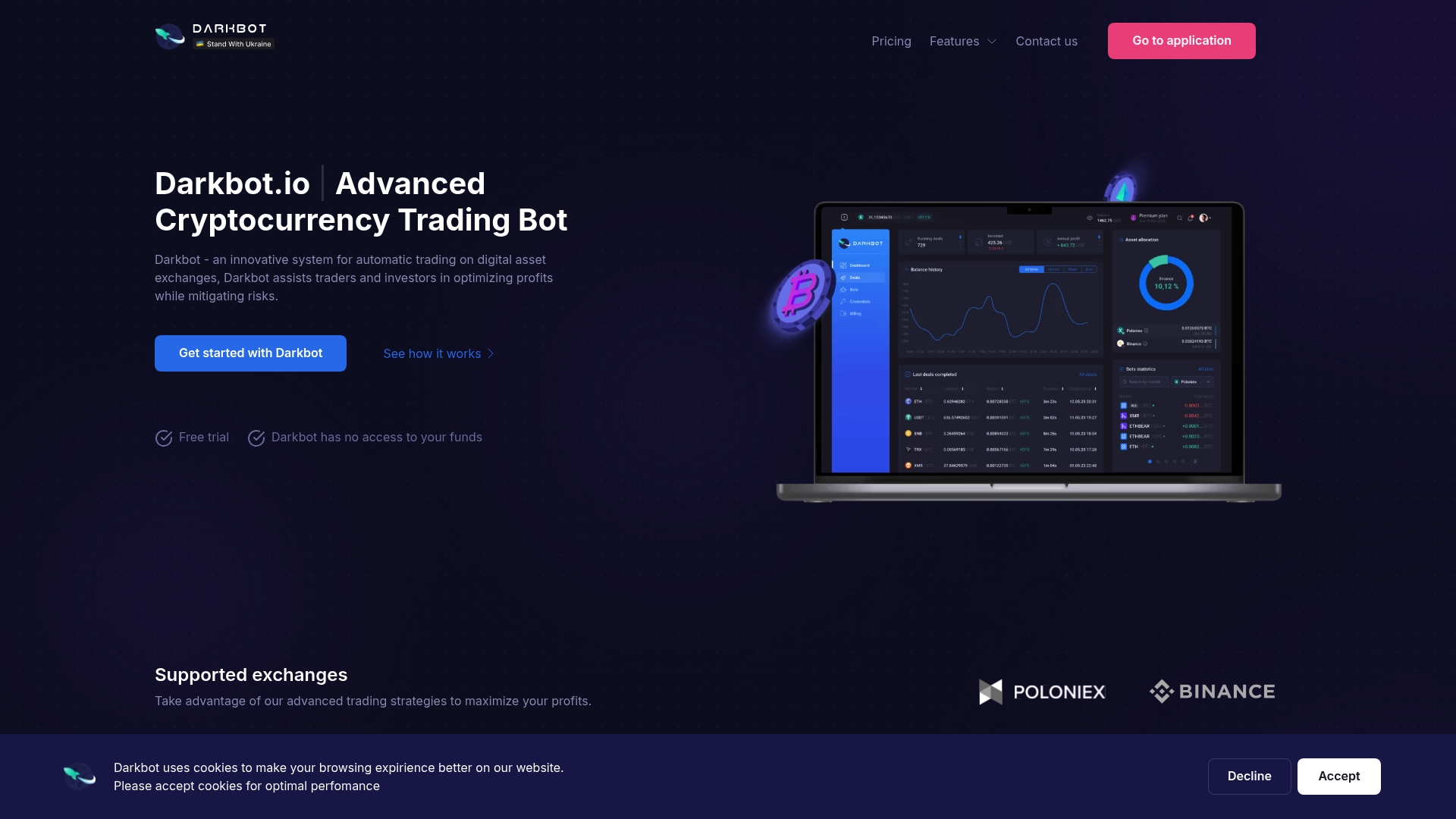
Darkbot’s portfolio management tools cover automated rebalancing, multi-bot deployment, and real-time analytics, giving you the infrastructure to run systematic strategies without building it from scratch. The documentation and support structure are designed for traders at every level, from first automation to multi-strategy deployment.
Start with the free tier at Darkbot, run the paper-trade validation described in this article, and scale only after the strategy behavior matches your risk parameters.
Useful sources and references
HIAAH primary pages (verification of what HIAAH does):
- HIAAH homepage: clinical and mental health services
- HIAAH administrative services blog post
- HIAAH Psychology Today listing
Darkbot proof points and documentation:
- Darkbot: AI-powered crypto trading platform
- How to automate crypto trading
- Risk management in crypto trading bots
- Top automated crypto platforms for 2026
- Darkbot portfolio management
Partner risk-management references:
- Risk scaling in automation: a trader’s guide
- Risk management in trading: strategies that actually work
Recommended

Start trading on Darkbot with ease
Come and explore our crypto trading platform by connecting your free account!
Free plan available • No credit card required