Darkbot First: Neutral Hummingbot Alternatives and a Buyer Checklist

Darkbot stands out among Hummingbot alternatives for traders who want managed automation with structured risk controls but the right choice depends on strategy type. Self-hosted frameworks like Freqtrade and OctoBot suit developers building directional strategies. Cloud SaaS platforms such as WunderTrading, 3Commas, and Bitsgap suit traders who want no-code setup. Exchange-built and marketplace bots suit those prioritizing simplicity over customization.
TL;DR:
- Managed platforms like Darkbot suit systematic traders focusing on risk controls and automation without self-hosting, especially for multi-bot management and backtesting.
- Cloud SaaS options such as WunderTrading and 3Commas provide prebuilt strategies or portfolio tracking, ideal for traders seeking ease of use over customization scope.
- Self-hosted or open-source options like OctoBot and HaasOnline are better for users needing granular control, lower custody reliance, and advanced scripting capabilities.
- Strategy type determines the best fit, with market-making and arbitrage benefiting from low-latency, connector-rich tools, while directional strategies favor robust backtesting features.
- Always test new platforms with paper trading through full market cycles, and consider hosting costs, custody, and risk controls to avoid costly mistakes.
What Are the Best Hummingbot Alternatives?
Hummingbot was built for one job: market making and cross-exchange arbitrage across a wide connector network, as Cryptgo. If your strategy is directional, or if you want a managed platform instead of self-hosted infrastructure, the calculus changes entirely. Here is a scan of the platforms traders most often evaluate instead.
Darkbot is a SaaS platform combining AI and machine learning with API-based exchange integration, backtesting, and multi-bot management. It fits traders who want systematic execution and structured risk controls without maintaining their own server. Darkbot offers multiple subscription options including free, standard, premium, and enterprise tiers, with details available on the Darkbot pricing page.
The other eleven platforms split roughly into three camps: cloud SaaS bots, open-source frameworks, and marketplace or exchange-native tools.
- WunderTrading runs entirely in the cloud and adds copy-trading marketplaces, which suits traders who want to follow vetted strategies rather than build their own, according to SoftwareSuggest’s alternatives roundup.
- EazyBot leans on a visual workflow editor with prebuilt templates, aimed at beginners who want to be trading within minutes rather than tuning parameters.
- Trality offers a Python-based strategy notebook with cloud execution and backtesting, a middle ground for developers who don’t want to manage their own servers.
- Coinrule uses plain-language rule templates and a marketplace-style catalog of strategies, built for retail traders who find code intimidating.
- 3Commas bundles DCA bots, grid bots, and multi-exchange portfolio tracking into one cloud dashboard, a common pick for traders who want several bot types under one login.
- HaasOnline offers advanced scripting and a large indicator library, positioned toward experienced traders who want granular control over logic.
- Bitsgap focuses on cross-exchange arbitrage and grid strategies with a unified multi-exchange portfolio view.
- Tuned centers on automated parameter tuning, aimed at traders who want machine-assisted optimization without manually testing every variable.
- Mudrex operates as a marketplace where investors buy into vetted algorithmic strategies rather than building their own.
- OctoBot is open-source and self-hosted, built around modular strategies and community-contributed extensions.
- OctoBot Market Making is a specialized module within the OctoBot ecosystem, aimed at users who want market-making logic without adopting Hummingbot’s full architecture.
- goodcryptoX wraps built-in automation tools inside a broader trading app interface, useful for traders who want bot features without a separate platform.
- ProfitTrailer is a longstanding commercial bot with configurable trading strategies, generally chosen by traders who want a self-managed setup outside the cloud SaaS model.
How Do These Alternatives Actually Differ?
The real split isn’t feature lists. It’s custody, strategy scope, and how far each tool lets you push a strategy before you hit a wall.
- Custody model: Darkbot, WunderTrading, 3Commas, Bitsgap, Coinrule, Mudrex, and Tuned run as cloud SaaS with API-key based execution. OctoBot, OctoBot Market Making, HaasOnline, and ProfitTrailer are typically self-hosted or locally run.
- Strategy breadth: grid and DCA dominate the cloud tools; market making and arbitrage concentrate in Bitsgap, Hummingbot itself, and OctoBot Market Making; directional and rule-based logic shows up in Coinrule, Trality, and HaasOnline.
- Ease of use vs ceiling: no-code platforms get you running fast but cap how complex a strategy can get.
Platform ceiling risk: Traders who start on visual, no-code editors often hit a wall when a strategy needs low-latency coordination or multi-leg market making, forcing a migration to Python-based frameworks, as Hackernoon’s comparison documents. Factor that migration cost in before committing to a purely visual tool.
How Should You Choose Between These Platforms?
Strategy type should drive the decision before any feature checklist does. Market making and arbitrage need low-latency execution and deep connector support. Directional and algorithmic strategies need strong backtesting and, often, hyperparameter search. Grid and DCA strategies tolerate more platform simplicity. Copy trading needs almost no technical setup at all.
- Match the platform to your strategy family first. A platform built for grid bots won’t serve a funding-rate arbitrage strategy well, regardless of its interface polish.
- Check who holds custody and how orders route. Confirm whether the platform uses read-only API permissions, direct order routing, or full custodial control, and what monitoring you’re expected to do yourself.
- Test backtesting and paper trading before funding anything. Platforms with real hyperparameter optimization save weeks of manual tuning versus trial and error.
- Budget for hosting and fees, not just subscription cost. Self-hosted frameworks commonly run $5 to $40 a month in VPS costs, on top of exchange fees and slippage.
- Confirm risk controls exist before going live. Look for a kill switch, position limits, inventory skew controls, and logging you can actually audit.
Pro Tip: Run any new platform in paper trading for at least two full market cycles, not just a few days, before allocating real capital. Volatility regimes change bot behavior more than most demos reveal.
For readers building out a full strategy stack, our guide on strategy optimization and backtesting walks through the tuning process in more detail.

How We Compared These Hummingbot Alternatives
This shortlist was built on five criteria: strategy support, custody model, backtesting depth, documentation and community size, and pricing structure. Evidence came from product documentation, GitHub repositories, and third-party comparison coverage, not from running large-scale live performance benchmarks across every platform. Darkbot is included as a direct alternative and listed first because it is the publisher of this article, not because it topped every criterion.
- Strategy support: does the platform handle market making, directional, grid/DCA, or copy trading, and how well?
- Custody and API security: who holds keys, and how are orders routed?
- Backtesting and community: is there a real simulation environment, and how large is the GitHub or user base?
- Pricing shape: free, freemium, or subscription, and what does that unlock?
Why AI and No-Code Claims Deserve Skepticism
AI in trading automation works best as probabilistic tooling for parameter tuning and monitoring, not as a promise of outcomes. No-code platforms solve onboarding speed, but they trade away expressiveness. Before you pick a tool, ask whether your edge comes from predicting price direction or from providing liquidity. That single question, more than any feature list, predicts whether a platform will still fit your strategy a year from now.
— Grisha
Try Darkbot as Your Next Trading Platform
Darkbot gives you AI and machine learning assisted automation without requiring you to manage your own server infrastructure, unlike the self-hosted frameworks covered above. You get API-based exchange integration, backtesting, paper trading, and multi-bot management under one account, with structured risk controls built into execution rather than bolted on afterward.
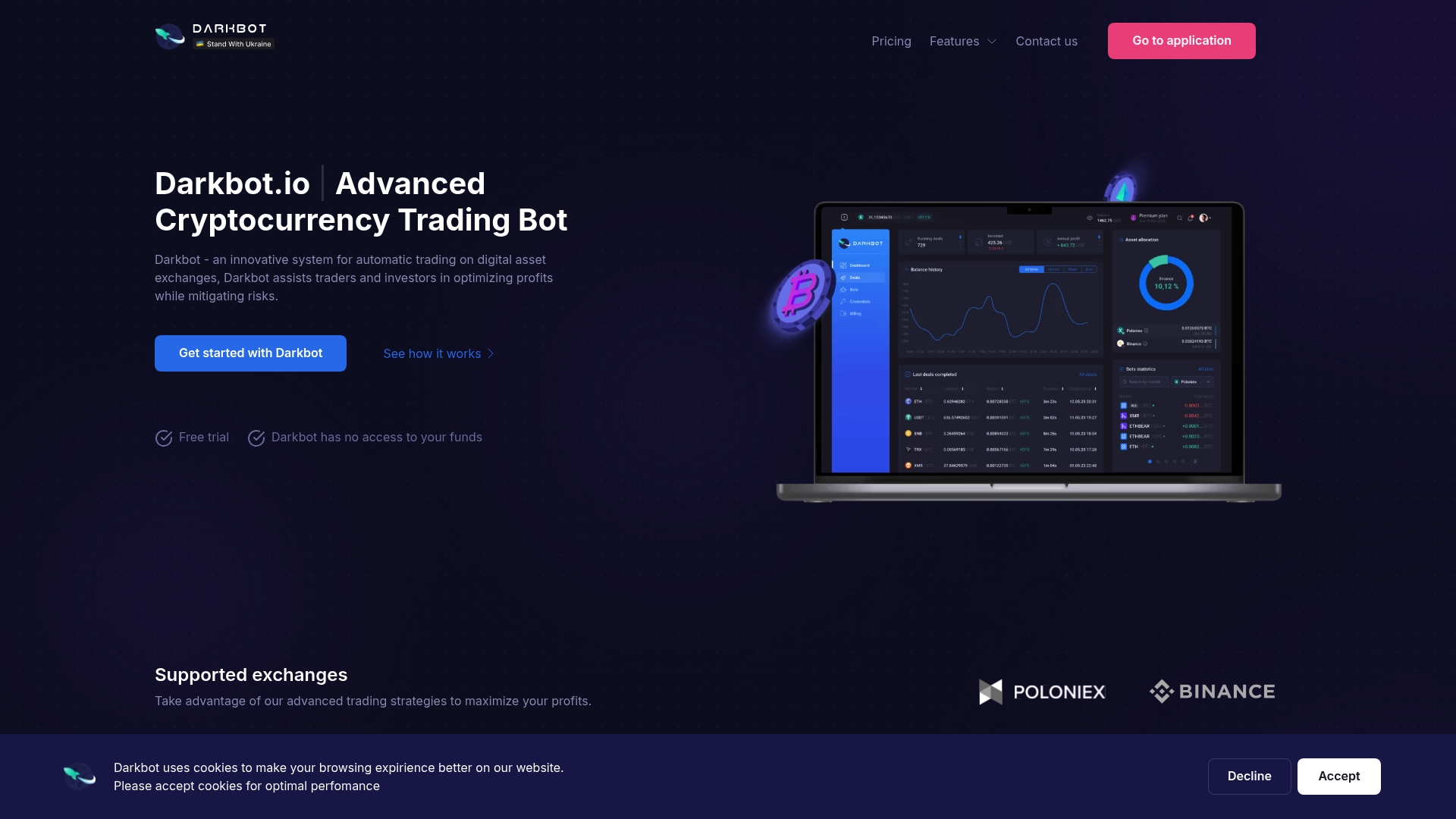
The platform suits systematic traders who want disciplined, rule-driven automation and a clear path from testing to live deployment. Start with the free tier to test the interface, then consider higher subscription tiers as your bot count and strategy complexity grow. Full plan details, including available tiers, are on the Darkbot pricing page, where you can compare options before committing.
Sources
- Cryptgo
- Hummingbot vs godzilla.dev — an honest comparison for funding-rate arbitrage and market-making (Hackernoon)
- 10 Best Hummingbot Alternatives & Competitors in 2026 | SoftwareSuggest
FAQ
Is Hummingbot Free to Use?
Yes, Hummingbot is open-source and free to download and run, though you still cover your own hosting and exchange fees.
What Is the Most Successful AI Trading Bot?
No platform can be labeled the single most successful AI trading bot, since results depend on strategy, market conditions, and execution discipline. Darkbot is built around AI-assisted parameter tuning and structured risk controls rather than performance promises, which is a more reliable way to judge a platform than headline claims.
What Is the Best Arbitrage Trading Bot?
Bitsgap and OctoBot Market Making are commonly cited for cross-exchange arbitrage, while Hummingbot itself remains the reference point for connector breadth in this category.
Can I Make $100 a Day From Crypto Trading Bots?
Daily returns depend entirely on capital, strategy, and market volatility, and no bot guarantees a fixed daily outcome. Treat any platform, including Darkbot, as a tool for disciplined execution and risk management, not a fixed-income generator.

Start trading on Darkbot with ease
Come and explore our crypto trading platform by connecting your free account!
Free plan available • No credit card required