Small Scripts Beat ML: Passive Income Bots for Engineers
Bots can generate income, but they are not fully passive. They require engineering, monitoring, and realistic risk limits before they produce anything reliable. The approaches worth prototyping first are scheduled DCA bots, simple arbitrage or execution scripts, micro-sell agents that handle digital products or microtasks, and scheduled rebalancers. Start small: build a single-purpose script, backtest it, then paper-trade before any capital goes live.
TL;DR:
- Building small, focused bots like scheduled DCA or simple arbitrage scripts generally requires fewer resources and offers easier observability than complex strategies.
- Most live bots need weeks of backtesting and paper trading to ensure consistent performance before risking real capital.
- Implementing safeguards such as retries, stop-losses, and proper risk management reduces operational, market, and financial risks inherent in automated trading.
- Using managed platforms like Darkbot can streamline setup and maintenance, allowing traders to focus on strategy rather than infrastructure.
- Achieving $1,000 in passive monthly income with bots usually involves combining multiple small income streams rather than relying on a single strategy.
What Types of Passive Income Bots Exist?
Not every bot fits every trader, and matching the architecture to your capital and time budget matters more than picking the “best” strategy.
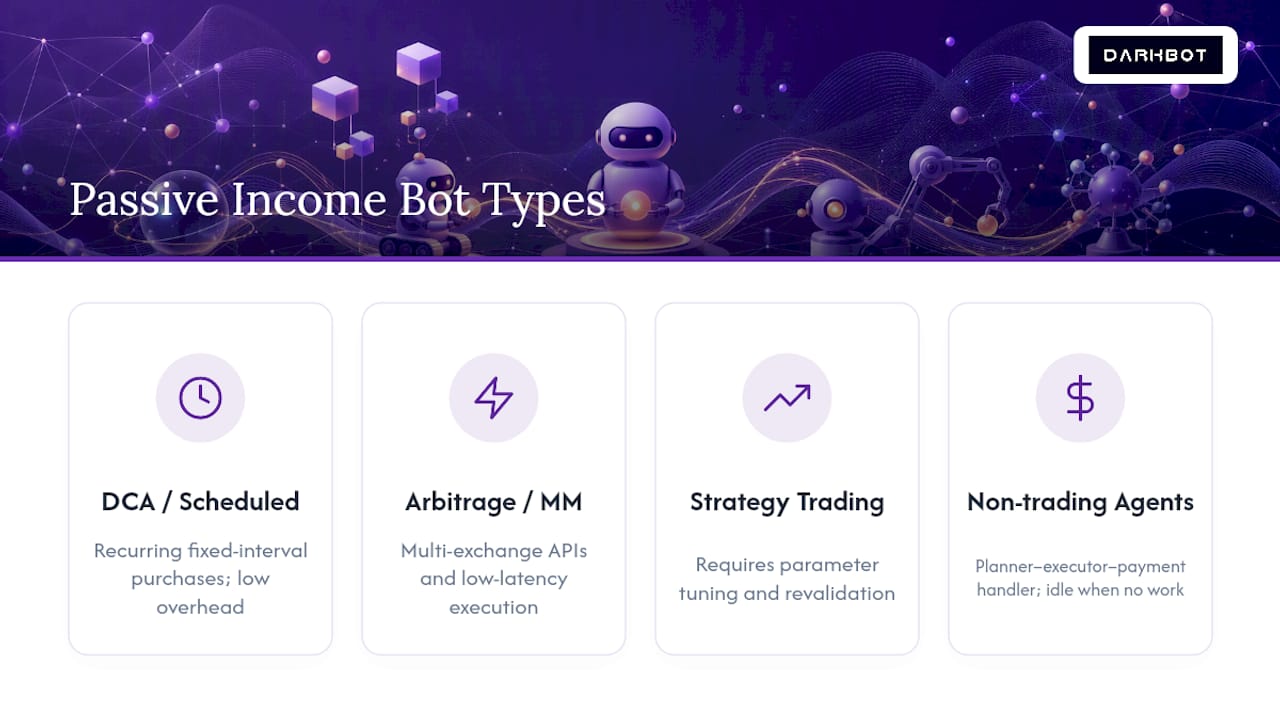
DCA and scheduled buy bots automate recurring purchases on a fixed interval. They carry the lowest operational overhead of any category, since there’s no real-time decision-making involved, just a schedule and an execution call.
Arbitrage and market-making bots exploit price gaps across exchanges or provide liquidity for a spread. These demand multi-exchange API access, low-latency execution, and constant monitoring, because the profit margin per trade is often thin and disappears quickly if your infrastructure lags.
Strategy-based trading bots (trend-following, mean reversion) need parameter tuning and ongoing revalidation. Markets shift, and a strategy tuned for one volatility regime can underperform in another without continual adjustment.
Non-trading income agents are worth serious consideration too. These include autonomous agents that sell digital products or complete microtasks for a small fee, with a planner, executor, and payment-handler architecture keeping cloud costs down by staying idle when there’s no work. They carry different risk than market exposure, mostly platform and demand risk, owner instruction 0, risk. For a broader breakdown of bot categories and their use cases, see this overview of types of trading bots.
Are Realistic Returns Different From What People Expect?
Yes, and the gap between expectation and reality is where most builders get discouraged. The word “passive” implies set-and-forget, but automated trading is not comparable to holding an index fund. It requires ongoing attention after deployment, including drawdown management, tax record-keeping, and the psychological discipline to not override the system mid-drawdown.
A useful way to frame it:
- DCA bots: low complexity, low fees relative to trade size, but returns track the underlying asset’s performance, not a distinct alpha source.
- Arbitrage bots: capital-intensive (you often need funds parked on multiple exchanges simultaneously), fee-sensitive, and dependent on execution speed.
- Micro-sell or microtask agents: one documented example estimated a single-digit dollar net daily profit at modest task volumes with $0.02-per-task pricing, small but genuinely low-maintenance once running.
A stable live deployment usually takes weeks of paper-trading and iteration before it’s trustworthy, not days. “Consistent income” in this space typically means small, tracked amounts across multiple bots rather than one strategy carrying the load.
What Risks Should You Plan For Before Going Live?
Every bot category shares four risk classes, and each has a concrete mitigation you can implement before your first live trade.
- Execution failures. API outages, slippage, and network partitions will happen. Build in retries with exponential backoff, sanity checks on returned data, and hard order-size limits so a bad tick can’t trigger an oversized trade.
- Operational risks. Compromised API keys and bad deploys cause more damage than bad strategies. Rotate keys on a fixed schedule, run automated tests before every deploy, and use canary launches with a small fraction of capital first.
- Market risk and model drift. A strategy that worked last quarter can decay silently. Use stop-losses, cap position sizes as a percentage of the portfolio, and revalidate performance against fresh data on a recurring basis.
- Financial risk. Trading fees and taxes erode returns faster than most new builders expect. Model fees explicitly into your expected return calculation, not as an afterthought.
For a deeper look at where automated systems typically break down operationally, this rundown of risks in automated trading is worth reading before you scale capital.
Pro Tip: Log every trade decision with the input data that triggered it, not just the outcome. When a strategy drifts, that log is the only way to tell whether the market changed or your logic broke.
How Do You Build a Minimal Viable Bot Safely?
The path from idea to live capital follows a sequence, and skipping steps is the most common reason bots fail in production rather than in testing.
- Prototype a single-purpose script. Keep it small, often 30 to 150 lines, and aim it at one clear money path. Small, focused scripts under 150 lines have produced steady if modest income when they solve a repeatable problem cleanly.
- Backtest with out-of-sample data. Walk-forward testing catches overfitting that a single historical run will hide.
- Paper-trade until metrics stabilize. Watch for consistency across different market conditions, not just one favorable stretch.
- Start small and scale deliberately. Apply strict risk limits from day one rather than loosening them once early results look good.
Before any live allocation, set up monitoring: logging, a simple dashboard, alerts for anomalies, and a written incident runbook. Experienced builders consistently note that small, reliable automations solving a clear operational gap outperform opaque, complex models in real deployments. Reliability beats sophistication almost every time.
What Does a Production Engineering Checklist Look Like?
Provisioning correctly the first time saves weeks of debugging later, and the cost math should be settled before you write a line of strategy code.
- Infrastructure: a small VPS or container instance is sufficient for most single-strategy bots. Reserve larger compute for strategies running multiple concurrent pairs or heavier indicator calculations, often built with libraries like TA-Lib.
- Secrets management: store API keys in a dedicated secrets manager, restrict permissions to trading only (never withdrawal), and rotate keys on a fixed cadence.
- Reproducibility: version your historical data and use deterministic seeds so a backtest run today matches one run next month.
- Monitoring: track fill rates, latency, drawdown, and API error rates, with alerts tied to a runbook that specifies who does what when a threshold trips.
| Cost category | Typical driver | Notes |
|---|---|---|
| Compute (VPS/container) | Instance size, uptime | Idle-capable agents can run on minimal instances |
| Exchange fees | Trade frequency, volume | Compounds fastest for arbitrage-style strategies |
| Data/tooling | Historical data, indicator libraries | Often a fixed, one-time or low recurring cost |
| Monitoring/alerting | Logging and dashboard services | Small but easy to underbudget |
Break-even is the point where net returns after fees and compute cover your time invested, not just the dollar costs. Tools that consolidate multiple small revenue streams, such as income-tracking software, help verify whether a bot is actually profitable once every cost is counted. A structured automation workflow for deployment also reduces the chance of skipping a step under time pressure.
How Does a Managed Platform Like Darkbot Fit This Checklist?
A managed SaaS platform doesn’t remove the checklist above, it absorbs part of it. Darkbot’s exchange API integrations, backtesting engine, and paper-trading environment map directly onto the “prototype, backtest, paper-trade” sequence most builders otherwise assemble from scratch.
- Exchange connectivity: pre-built API integrations reduce the setup work of connecting to multiple exchanges individually.
- Testing before capital exposure: backtesting and paper trading are built into the workflow, not bolted on.
- Portfolio tools: automated rebalancing and multiple simultaneous bots reduce the manual coordination required across strategies.
- Oversight: results run through paper testing with human oversight before any live allocation, rather than trusting a black-box signal.
The practical benefit is time. Less of it goes to infrastructure and secrets handling, more of it goes to evaluating whether a strategy fits your risk tolerance. Darkbot’s blog on algorithm optimization covers more on testing approaches for anyone building strategy logic.
Pro Tip: Treat any managed platform’s default strategy templates as a starting point for your own backtest, not a finished answer. The checklist still applies even when the infrastructure is handled for you.
The One Bot I Would Build First
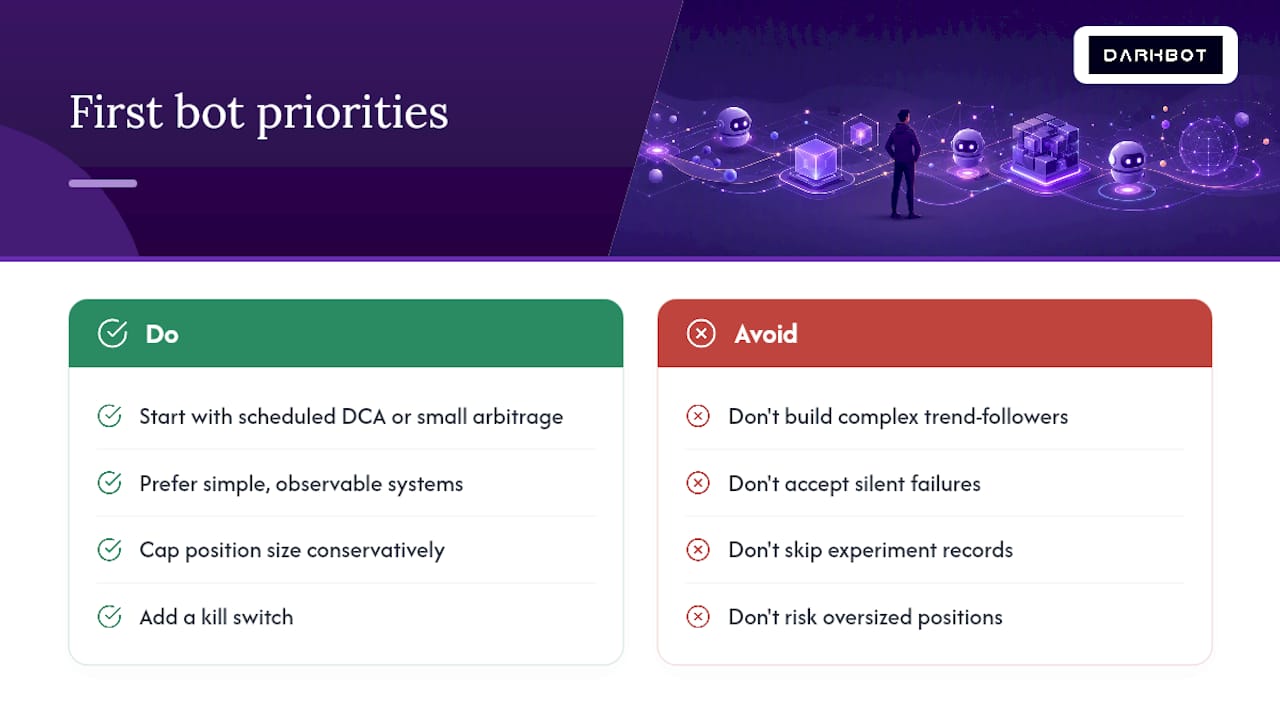
If I were starting from zero, I would build a scheduled DCA bot or a small arbitrage script where latency isn’t the deciding factor, not a trend-following model with a dozen tunable parameters. The reason is observability. A simple system fails in ways you can see and diagnose fast. A complex one fails silently until the drawdown is already painful.
Cap position size conservatively, build in a kill switch, and document every experiment, including the failed ones. Publishing your own results, even informally, forces the kind of discipline that separates a bot that survives six months from one that gets abandoned after the first bad week.
— Grisha
Comparing Managed Automation With Building Your Own
The checklist in this article, backtesting, secrets rotation, monitoring, reproducible data, is the same whether you build it yourself or run it through a platform. The difference is who carries the operational load. Darkbot is built for traders who want that engineering checklist handled by the platform: exchange API integrations, backtesting, paper trading, and portfolio rebalancing are already in place, so your time goes toward strategy decisions instead of infrastructure maintenance.
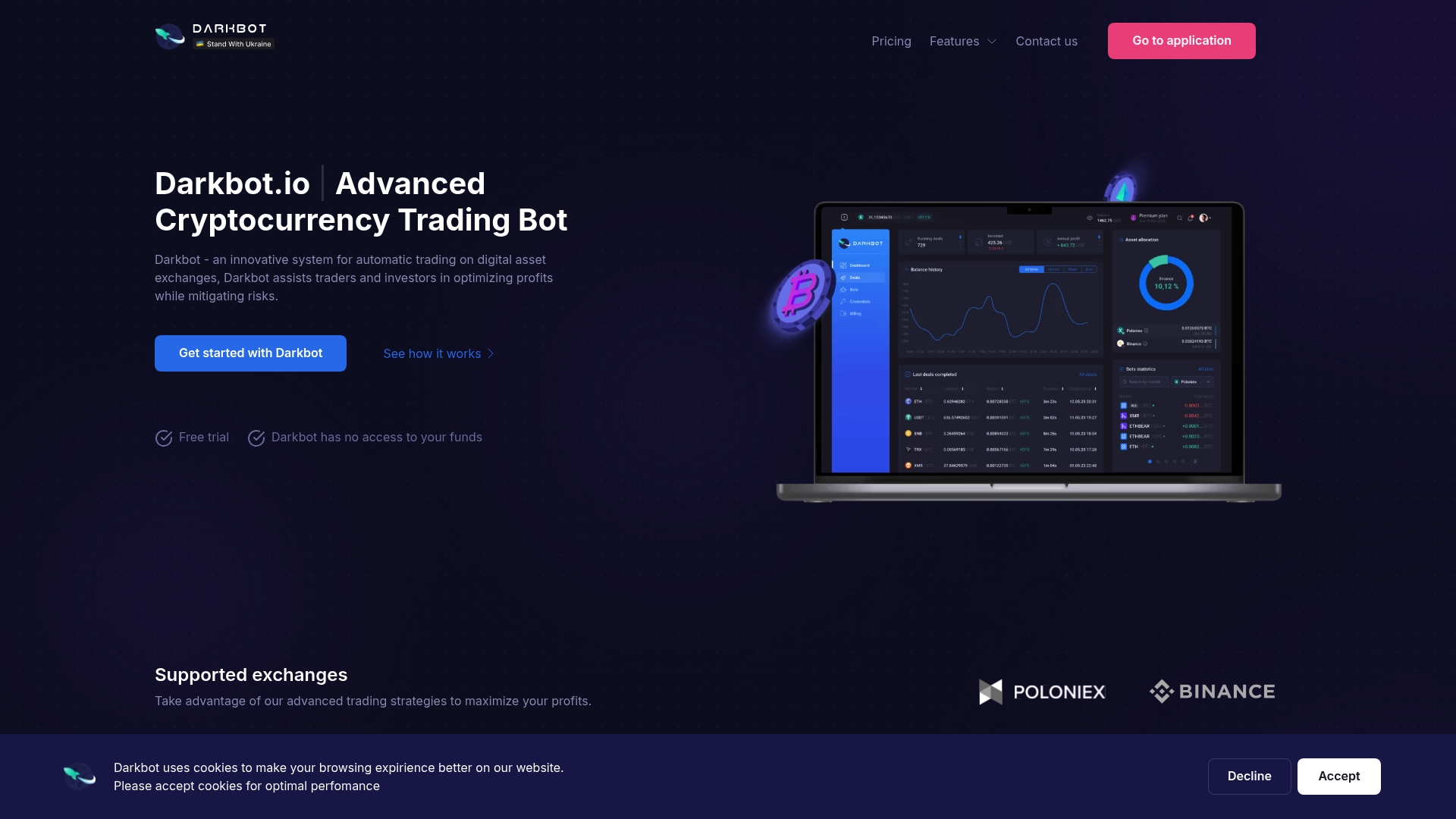
A DIY script makes sense when you want full control over execution logic and are comfortable managing your own VPS, key rotation, and monitoring stack. A managed platform makes more sense when you’d rather spend your engineering hours on strategy evaluation than on server uptime. Darkbot offers multiple subscription tiers including free and paid options with varying features for strategy and portfolio management. Compare the full plan details on the pricing page and start with the tier that matches how much of the checklist you want to hand off.
This article is general information, not a substitute for advice from a qualified financial advisor. Consult a qualified financial professional about your own circumstances before acting on anything here.
Sources
- I’ve built 30 automations — the ones making clients money
- I built 3 tiny Python bots that earn money automatically — And none of them are fancy
- How my trading bots actually make and lose money
FAQ
How can I make $1,000 a month in passive income with bots?
Realistically, this takes multiple income streams running in parallel, such as several small bots or agents, rather than one strategy carrying the full amount. Small Python bots under 150 lines have produced dozens to low hundreds of dollars monthly per bot in documented examples, so stacking a few is a more realistic path than relying on one.
Can bots make $1,000 a day using AI?
Figures at that scale are not supported by the documented examples in this space. AI-driven agents can produce steady modest income, one documented microtask agent estimated single-digit dollars in daily net profit, so treat any claim of consistent four-figure daily returns from a bot with skepticism.
Do AI trading bots actually make money?
They can, but they are not purely passive. Bots that succeed tend to be small, focused, and closely monitored rather than complex predictive models left unattended, and returns depend heavily on fees, capital, and strategy fit.
Can you use bots to make money without trading?
Yes. Non-trading agents that sell digital products or complete microtasks are a documented path, with architectures combining a planner, executor, and payment handler to keep costs low. Platforms like Darkbot, by contrast, focus specifically on automating crypto trading execution and portfolio management rather than non-trading agent work.
What does Darkbot cost?
Darkbot provides several subscription plans, with detailed pricing available on their official website. Full details are on the pricing page.
Recommended

Start trading on Darkbot with ease
Come and explore our crypto trading platform by connecting your free account!
Free plan available • No credit card required