Master algorithmic trading step by step for crypto success
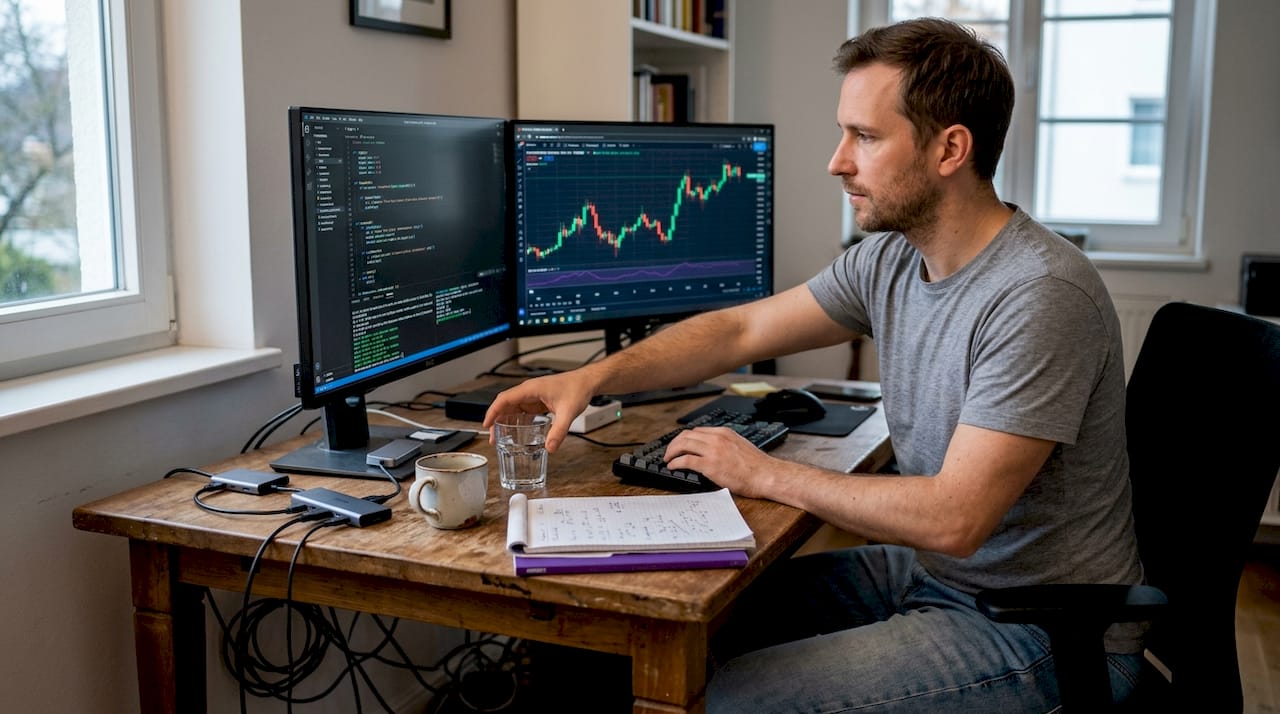
Trading cryptocurrency manually feels like running a marathon at sprint speed. Volatile markets never sleep, and emotional decisions pile up fast when prices swing wildly every hour. Algorithmic trading offers a systematic solution by automating buy and sell decisions based on proven strategies, removing emotion and enabling 24/7 execution. This guide walks you through each critical step, from initial preparation and strategy development to live deployment and ongoing optimization, helping you build a reliable automated trading system that balances profit potential with disciplined risk management in the fast-moving crypto markets.
Key Takeaways
| Point | Details |
|---|---|
| Backtest and paper trade | Backtest strategies on historical data and use sandbox environments to simulate live trading before risking real capital. |
| Risk management rule | Limit risk per trade to 1 to 2 percent of total capital and size positions dynamically based on stop distance. |
| BTC and ETH testing | Begin with Bitcoin and Ethereum to leverage deep liquidity and stable testing environments. |
| Error handling robustness | Implement robust error handling and continuous logging to sustain operation in 24/7 markets. |
| Momentum and triple barrier | Automate with momentum signals and triple barrier exits to govern entries and exits. |
Step 1: Prepare your algorithmic trading setup
Your algorithmic trading journey starts with gathering the right tools and defining clear boundaries. Select exchanges that offer reliable APIs and strong security track records. Binance, Coinbase Pro, and Kraken provide robust API documentation and high liquidity for major pairs. Focus initially on Bitcoin and Ethereum since these assets offer the most stable testing environments with deep order books and minimal manipulation risk.

Set up your development environment with Python or JavaScript libraries designed for crypto trading. Popular choices include CCXT for exchange connectivity, pandas for data manipulation, and backtrader for strategy testing. Install these dependencies in a virtual environment to keep your project isolated and reproducible. Configure API keys with read and trade permissions, but never withdrawal rights, to limit potential damage from security breaches.
Implement preliminary risk management rules before writing a single line of strategy code. The 1-2% rule remains the gold standard: never risk more than 1-2% of your total capital on any single trade. Calculate position sizes dynamically based on your stop loss distance and account balance. This mathematical approach prevents emotional decisions and ensures you survive inevitable losing streaks without depleting your trading capital.
Pro Tip: Create a detailed strategy hypothesis document before coding. Write down exactly what market conditions trigger entries, how you’ll exit winners and losers, and why you believe this edge exists. This clarity prevents scope creep and helps you stay disciplined during development.
Prepare paper trading environments that mirror live conditions as closely as possible. Most exchanges offer sandbox APIs that simulate real trading without actual money at risk. Configure your bot to log every decision, entry price, exit price, and reasoning. These logs become invaluable when debugging unexpected behavior or explaining performance to yourself later. Consider using trading workflow automation frameworks that handle common infrastructure tasks so you can focus on strategy logic.
| Setup component | Recommended tools | Purpose |
|---|---|---|
| Exchange APIs | CCXT library | Unified interface across multiple exchanges |
| Data analysis | pandas, NumPy | Process price history and calculate indicators |
| Backtesting | backtrader, Zipline | Simulate strategy on historical data |
| Paper trading | Exchange sandbox APIs | Test live without risking capital |
| Risk calculator | Custom Python script | Enforce position sizing rules automatically |
Step 2: Develop and backtest your algorithmic trading strategy
Building a profitable strategy requires combining solid trading logic with rigorous testing methodology. Start by encoding clear entry and exit signals based on quantitative factors. Momentum and size factors have shown significant profitability in peer-reviewed research, making them excellent starting points. Momentum strategies buy assets showing recent price strength and sell weakness, while size factors exploit the tendency of smaller cap cryptos to outperform during bull markets.
Apply advanced backtesting techniques that go beyond simple moving average crossovers. Information-driven bars sample price data based on volume or dollar value traded rather than fixed time intervals, capturing market activity more accurately during volatile periods. The triple barrier method defines three exit conditions simultaneously: a profit target above entry, a stop loss below entry, and a maximum holding period. This framework forces you to think probabilistically about each trade’s potential outcomes rather than hoping for unlimited upside.
- Load historical OHLCV data for your chosen trading pairs covering at least two years
- Calculate technical indicators and factor scores for each bar in your dataset
- Generate entry signals when your conditions align, recording exact entry prices
- Apply triple barrier exits to each position, simulating realistic profit-taking and loss-cutting
- Subtract realistic transaction costs of 0.1-0.2% per trade and model slippage based on order size
- Calculate performance metrics including Sharpe ratio, maximum drawdown, and win rate
- Run Monte Carlo simulations randomizing entry timing to test strategy robustness
Deep learning models offer optional enhancements for traders comfortable with machine learning. Train neural networks on your factor scores to predict short-term price movements, but treat these predictions as additional signals rather than absolute truth. Research shows that combining traditional factors with deep learning can improve post-cost profitability, but only when properly validated to avoid overfitting.
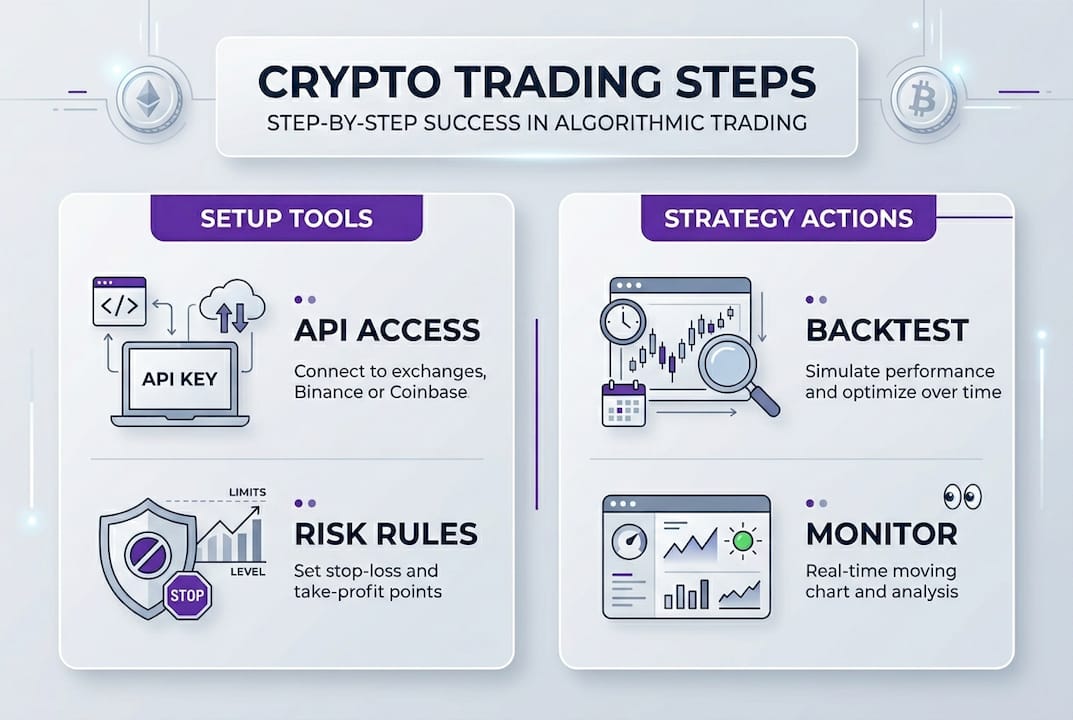
Pro Tip: Walk-forward analysis prevents overfitting better than single backtest runs. Split your data into training and testing periods, optimize parameters on training data only, then validate on unseen test data. Repeat this process by rolling the window forward through time to simulate how your strategy would have performed in real deployment.
Analyze your backtest results with brutal honesty. A strategy that looks amazing on paper often fails in live trading due to unrealistic assumptions. Check that your entry prices are achievable given typical bid-ask spreads. Verify that your exit logic doesn’t rely on perfect timing that would be impossible with API latency. Review the crypto trading strategy guide to compare your approach against proven frameworks and identify potential blind spots.
| Performance metric | Good target | Why it matters |
|---|---|---|
| Sharpe ratio | Above 1.5 | Measures risk-adjusted returns |
| Maximum drawdown | Below 25% | Shows worst-case loss scenario |
| Win rate | 45-55% | Indicates strategy consistency |
| Profit factor | Above 1.5 | Ratio of gross profits to losses |
| Average trade duration | Aligned with strategy type | Confirms execution is practical |
Step 3: Deploy algorithmic trading bot and monitor performance
Launching your bot into live markets requires careful attention to operational reliability and risk controls. Implement comprehensive error handling that catches API failures, network timeouts, and unexpected data formats. Crypto markets operate continuously, so your bot must recover gracefully from issues without manual intervention. Use try-except blocks around every external API call and log all exceptions with full context for later debugging.
Set up real-time monitoring and alert systems before going live. Configure notifications via Telegram, email, or SMS when your bot places trades, encounters errors, or detects unusual market conditions. Monitor key metrics like current positions, unrealized profit and loss, and daily trading volume to catch problems early. Dashboard tools like Grafana or custom web interfaces help you visualize bot performance at a glance without diving into log files.
- Implement circuit breakers that pause trading after consecutive losses or during extreme volatility
- Set maximum position limits to prevent accidentally over-leveraging your account
- Use kill switches accessible from your phone to shut down the bot instantly if needed
- Schedule regular health checks that verify API connectivity and data freshness
- Maintain backup capital reserves separate from your trading account for emergencies
Crypto markets amplify traditional algorithmic trading risks through extreme volatility, technical infrastructure challenges, and cybersecurity threats. Flash crashes can trigger stop losses across entire portfolios in seconds. Exchange outages may prevent your bot from exiting positions during critical moments. Phishing attacks and API key theft remain constant threats requiring vigilant security practices.
Pro Tip: Start with tiny position sizes when first going live, even if your backtest suggests larger allocations are safe. Real market conditions always surprise you in ways historical data cannot capture. Gradually scale up over weeks as you gain confidence in your bot’s behavior.
Prepare detailed contingency plans for common failure scenarios. What happens if your internet connection drops? How will you manually close positions if the exchange API goes down? Where are your API keys stored, and who has access? Document step-by-step procedures for each emergency so you can act quickly under pressure rather than improvising. Review resources on automated trading risks to identify vulnerabilities you might have overlooked.
“Automation does not eliminate risk. It shifts the nature of errors from emotional mistakes to technical failures and logic bugs. Successful algorithmic traders master both strategy development and operational resilience.”
Regularly update your algorithms as market conditions evolve. Volatility regimes change, correlations break down, and previously profitable patterns disappear as more traders exploit them. Schedule monthly reviews of your bot’s performance and market structure. When returns deteriorate, investigate whether the issue stems from temporary market conditions or fundamental strategy breakdown. Apply lessons from crypto risk management automation to keep your risk controls current with evolving threats.
Step 4: Evaluate results and optimize your trading algorithm
Tracking live performance against backtested expectations reveals whether your strategy translates successfully to real markets. Compare actual trade entries, exits, and profit factors with your simulation results. Small deviations are normal due to market microstructure, but large gaps signal problems requiring investigation. Common culprits include slippage from insufficient liquidity, latency causing missed entries, or bugs in your production code that behaved differently than your backtest version.
Use systematic checklists to debug performance issues efficiently:
- Verify all trades executed at intended prices by reviewing exchange fill reports
- Check that indicator calculations match between backtest and live environments
- Measure actual latency from signal generation to order placement
- Confirm position sizing logic correctly accounts for current account balance
- Review logs for any error messages or warnings that might indicate problems
- Compare live market conditions with historical periods used in backtesting
Adjust risk parameters based on recent performance and changing market volatility. If your strategy experiences a drawdown exceeding historical norms, reduce position sizes temporarily until performance stabilizes. Conversely, during periods of exceptional performance, resist the temptation to dramatically increase leverage. Sustainable success comes from consistent execution of a proven edge, not from gambling during hot streaks.
Keep a detailed trading journal documenting every algorithm change, market observation, and performance result. Note what worked, what failed, and why you made each modification. This record becomes invaluable when similar market conditions recur months later. You’ll avoid repeating past mistakes and can confidently stick with strategies that have proven themselves over multiple market cycles.
| Optimization area | Evaluation frequency | Key metrics |
|---|---|---|
| Risk parameters | Weekly | Current drawdown vs. maximum allowed |
| Entry signals | Monthly | Win rate and average profit per trade |
| Exit logic | Monthly | Profit factor and average hold time |
| Position sizing | After major moves | Risk per trade as percentage of capital |
| Overall strategy | Quarterly | Sharpe ratio and correlation to market |
Continuously paper trade new strategy versions before deploying them to your live account. Even minor logic changes can produce unexpected results under real market conditions. Run new versions in parallel with your proven strategy for at least two weeks, comparing their hypothetical performance. Only promote changes to live trading after they demonstrate clear improvement without increasing risk. Follow trading strategy optimization best practices to avoid over-optimizing on recent data that may not represent future conditions.
Pro Tip: Maintain multiple strategy versions running simultaneously with different risk profiles and time horizons. This diversification smooths your equity curve and provides backup income streams if one approach temporarily underperforms. Just ensure each strategy is truly independent rather than variations of the same core logic.
Implement robust crypto bot risk management protocols that evolve with your growing experience. As your account grows, absolute dollar risk per trade increases even if percentage risk stays constant. Periodically recalibrate your risk limits to ensure they still align with your financial goals and emotional comfort level. Remember that successful bot development requires continuous learning and adaptation rather than set-and-forget automation.
Start automating your crypto trades today with Darkbot
You’ve learned the complete process for building and deploying algorithmic trading strategies in cryptocurrency markets. Now it’s time to put that knowledge into action with tools designed specifically for this challenge. Darkbot provides an AI-powered crypto trading bot platform that handles the technical complexity while you focus on strategy refinement. The system integrates seamlessly with major exchanges, enabling true 24/7 automated trading without constant manual oversight.
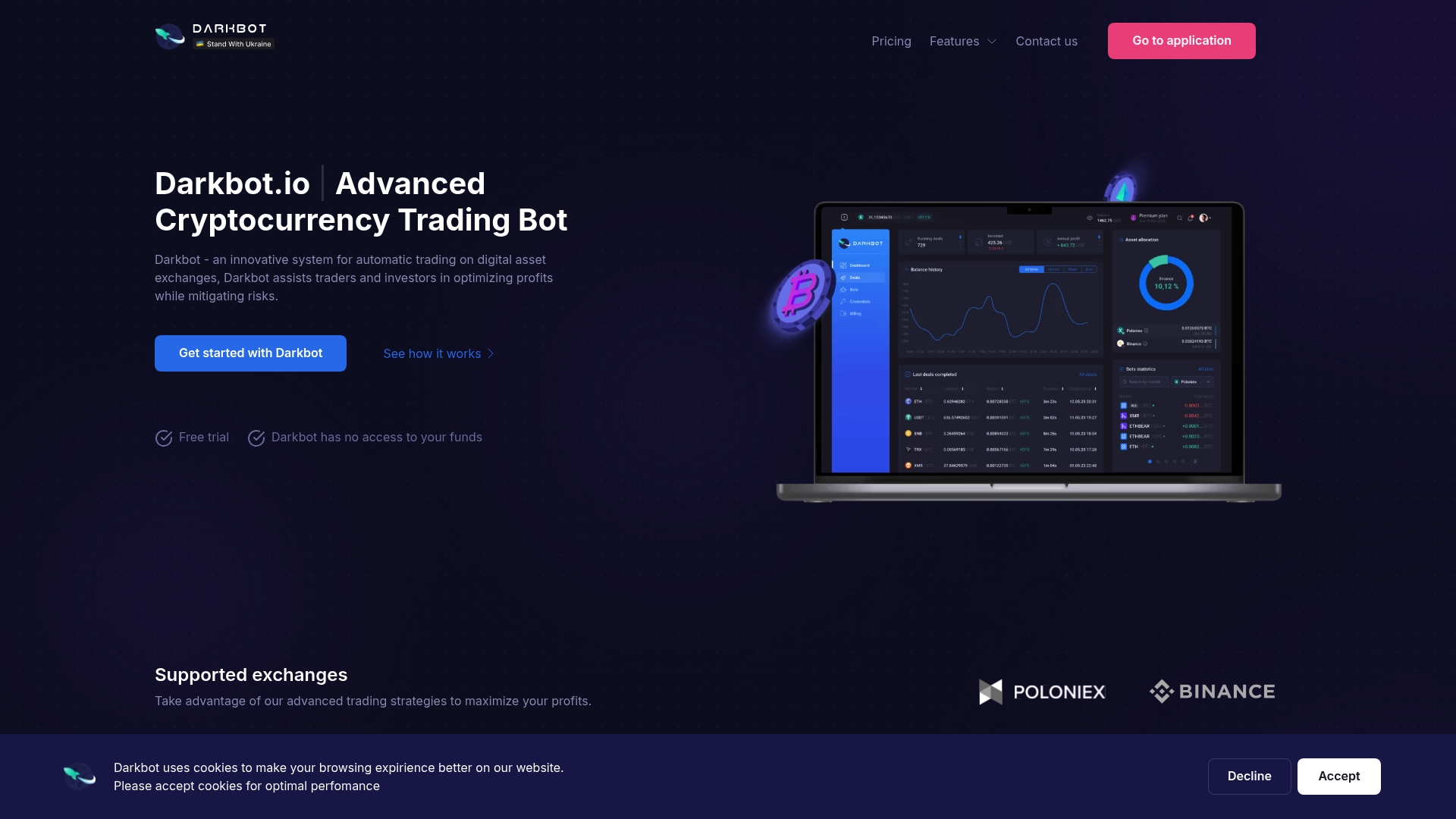
Darkbot’s advanced cryptocurrency portfolio management features let you deploy multiple strategies simultaneously, each with independent risk controls and performance tracking. The platform automates position sizing, rebalancing, and risk monitoring so your algorithms execute exactly as designed. Whether you’re implementing momentum strategies, mean reversion approaches, or custom factor models, Darkbot provides the infrastructure reliability your automated trading system demands.
Frequently asked questions about algorithmic trading step by step
What is algorithmic trading in cryptocurrency?
Algorithmic trading uses computer programs to automatically execute buy and sell orders based on predefined rules and market conditions. In cryptocurrency, these algorithms analyze price movements, volume patterns, and technical indicators to make trading decisions faster and more consistently than manual trading. The approach removes emotional bias and enables 24/7 market participation.
How much capital do I need to start algorithmic trading?
You can start testing algorithmic strategies with as little as $1,000, though $5,000-$10,000 provides more flexibility for proper position sizing and diversification. Begin with smaller amounts during paper trading and initial live deployment to validate your strategy works as expected. Scale up capital only after demonstrating consistent profitability over at least three months of live trading.
What are common mistakes to avoid when starting out?
New algorithmic traders often skip thorough backtesting, use unrealistic assumptions about execution costs, and risk too much capital per trade. Other frequent errors include over-optimizing strategies on historical data, neglecting error handling for 24/7 operations, and scaling up too quickly after early success. Always validate strategies on out-of-sample data and maintain strict risk limits regardless of recent performance.
How often should I update my trading algorithms?
Review your algorithm’s performance monthly and make adjustments only when data clearly indicates a problem or opportunity. Avoid tweaking strategies after every losing trade or bad week, as short-term randomness is normal. Major updates should occur quarterly or when market structure fundamentally changes, such as new regulations or shifts in volatility regimes. Continuous minor adjustments usually hurt performance more than help.
Is paper trading necessary before going live?
Yes, paper trading is essential for identifying bugs, validating execution logic, and building confidence in your strategy without risking real money. Run your algorithm in simulation mode for at least two weeks, preferably a full month, to experience various market conditions. Paper trading reveals issues with API integration, order timing, and risk management that backtests cannot capture. Only transition to live trading after your paper results closely match backtest expectations.
Recommended
- Step by Step Trading Workflow for Automated Crypto Success
- Step by step trading automation: 70% crypto trades automated
- Cryptocurrency Trading Strategy Guide 2025: Automate Success
- Step by Step Trading Strategy Guide for Automated Crypto Success
- Harnessing technology to optimize gold trading strategies

Start trading on Darkbot with ease
Come and explore our crypto trading platform by connecting your free account!
Free plan available • No credit card required