Secure Multiple Exchange Accounts for Crypto Bots With Darkbot

Yes, you can connect multiple exchange accounts to an automated trading bot, and doing so is standard practice for anyone running strategies across more than one venue. The setup means generating a separate API key on each exchange, restricting every key to trade-only permissions, storing credentials in a secrets manager rather than a config file, and mapping each key to one exchange and one strategy. The rule that overrides everything else: a bot key should never carry withdrawal or transfer rights.
TL;DR:
- Each exchange should have a dedicated API key with only trade permissions, no withdrawal rights, to minimize risk if credentials leak.
- Prepare your infrastructure by confirming KYC, securing fixed IP allowlisting, and mapping capital across exchanges before generating keys.
- Use separate keys for each exchange and strategy, store credentials securely in a secrets manager, and implement routine key rotation with parallel verification to reduce exposure.
- For improved isolation, assign individual keys per strategy and consider sub-accounts to limit capital risk and simplify management as your exchange count grows.
- Start with paper trading and enable live trading one exchange at a time, continuously monitor activity, and have a clear incident response plan to handle potential breaches.
What Does “Multiple Exchange Accounts” Mean for a Trading Bot?
In automated crypto trading, “multiple exchange accounts” refers to separate API connections, each tied to its own exchange account, that let a bot place orders, read balances, and manage positions on more than one venue at once. This is different from simply holding funds on several exchanges. The accounts become useful to a bot only once each one has its own API credential, its own permission scope, and its own place in your strategy map.
Traders run multiple accounts for a handful of concrete reasons: access to different liquidity pools, exposure to assets that aren’t listed everywhere, fee structures that favor one exchange for a given pair, and geographic or regulatory access that varies by platform. None of those reasons justify sloppy key management. The technical term worth knowing here is API key scoping, which is the practice of limiting what a credential can do regardless of what the exchange interface allows by default.
What Should You Prepare Before Creating API Keys?
Rushing into key creation before your infrastructure is ready is how operators end up with orphaned keys and undocumented permissions. A short preparation pass avoids that.
Confirm these items before touching any exchange’s API settings:
- Check that each exchange account has completed the KYC tier required for API trading. Lower tiers sometimes cap order size or restrict endpoint access.
- Decide where the bot will run and secure a static IP address, since most allowlisting features require a fixed address rather than a dynamic one.
- Map out capital segmentation. Decide how much of your portfolio sits on each exchange before you start moving funds.
- Set up sub-accounts on exchanges that support them, if you plan to isolate strategies by capital pool.
Work through the setup in this order:
- Confirm KYC status and API eligibility on each exchange.
- Arrange hosting with a fixed egress IP for allowlisting.
- Draft a simple table mapping each strategy to its target exchange and the key that will run it.
- Only then move to key generation.
That mapping document sounds bureaucratic until the day a key gets compromised and you need to know, in seconds, exactly which strategy and exchange it touched.
How Do You Keep API Keys Secure Across Several Exchanges?
Every major exchange separates trading permissions from withdrawal permissions, and that separation exists for a reason. Trade and withdrawal permissions are distinct scopes on exchanges like Binance and Coinbase, and Coinbase’s transfer permission can bypass two-factor authentication entirely. A bot only ever needs to place and manage orders. It never needs to move funds off the platform. Enabling withdrawal on a bot key turns a trading credential into a direct path to your holdings if that key leaks.
Key hygiene gets harder, not easier, as you add exchanges. The fix is discipline, not more tools:
- Generate a distinct key for every exchange you connect, and a separate key for every strategy or application rather than reusing one key across bots.
- Give your monitoring or reporting tools their own read-only keys, separate from execution keys.
- Store every credential in a secrets manager, never in a plaintext config file or a version-controlled repository, and avoid writing secrets to logs.
- Encrypt credentials both at rest and in transit, with no exceptions for “internal” tooling.
Rotation deserves its own routine. Generate the replacement key, run it alongside the old one during a short verification window to confirm it works, then revoke the original. A parallel-run rotation pattern avoids downtime while still closing the exposure window on the old credential.
IP allowlisting is the last line of defense if a key ever leaks. Least-privilege permissions combined with IP allowlisting materially reduce the impact of a compromised key, according to exchange documentation and general security guidance. Audit your allowlists periodically, since a hosting migration or a leftover development server can quietly widen your exposure.
Pro Tip: Keep a single spreadsheet listing every active key, its exchange, its permission scope, and its creation date. When rotation day comes, you won’t be guessing which keys are stale.
A meaningful share of exchange account compromises trace back to credentials with permissions broader than the task required. Trade-only, per-exchange, per-strategy keys close most of that gap before it opens.
Which Architecture Should You Use for Multiple Exchanges?
There’s no single correct pattern for connecting several exchange accounts to a bot. The right choice depends on how many strategies you run and how much isolation you need if one of them fails.
Per-strategy keys give you the cleanest isolation. Each strategy gets its own credential, so a problem in one strategy never touches another. The tradeoff is more keys to track and rotate.
A single key spanning multiple strategies on one exchange is simpler to manage but means a compromised or misbehaving key affects everything running under it.
Hub-and-spoke setups, where one aggregation layer routes orders to several exchanges, simplify monitoring but introduce a latency and ordering consideration: your aggregator becomes a single point of delay, and order sequencing across exchanges is never perfectly simultaneous.
Sub-accounts solve a specific problem: capital isolation. Sub-accounts and per-strategy keys let you isolate capital and limit the damage from a single misbehaving key, which matters more as the number of connected accounts grows.
Asset availability and fee schedules also decide where a strategy belongs, not just security preferences. A pair listed on one exchange but not another makes the placement decision for you, and fee tiers can shift a strategy’s profitability enough to justify running it on a different venue entirely. Building out this kind of strategy-to-exchange mapping before deployment saves a lot of rework later.
How Do You Test and Monitor a Multi-Exchange Bot Safely?
Rolling out a bot across several accounts at once, live, is how small configuration mistakes become expensive ones. A staged approach catches those mistakes while the stakes are low.
- Run every new strategy in paper mode first, on every exchange it will eventually touch, before any live capital is involved.
- Enable live trading one exchange at a time rather than flipping every connection on simultaneously.
- Watch heartbeat signals, order rejection rates, fill quality, and unexpected balance changes on each account during the first live sessions.
- Set a global kill switch that halts every strategy at once, plus per-strategy pause controls for isolated issues.
- Build rate-limit backoff into the bot so a burst of orders doesn’t trip an exchange’s throttling and cascade into rejected trades.
Community-built multi-exchange bots commonly default to paper mode and require explicit per-exchange opt-in before going live, which is a sound default worth copying regardless of what platform you use.
If something does go wrong, the sequence matters: revoke the affected key first, pause the strategies tied to it, reconcile actual positions against what your records show, then issue a fresh key before resuming.
Pro Tip: Treat your incident playbook like a fire drill. Write the exact revoke and reconcile steps down somewhere outside the bot itself, because if the bot’s dashboard is part of the problem, you need a way to act without it.
How Does Darkbot Handle Multi-Exchange Setup?
The discussed architecture includes principles such as isolated API connections, strategy-level deployment, and a portfolio view that consolidates activity without pooling permissions into one credential. Functionalities typically cover:
- API key management per connected exchange with scoped credentials.
- Deployment of multiple simultaneous bots allowing strategies to run independently.
- A consolidated portfolio view to track positions and performance without manually reconciling spreadsheets.
- Automated rebalancing operating within user-defined risk parameters.
- A paper trading mode for validating strategies before committing live capital.
Darkbot’s guides on multi-exchange integration and API-based exchange connections walk through the technical steps of linking accounts, and the step-by-step strategy setup guide covers moving from paper testing to live deployment. None of that removes the need for the security discipline covered above. A managed platform reduces integration friction; it doesn’t replace trade-only permissions, key rotation, or IP allowlisting on your end.
What Operators Get Wrong About Running Several Exchanges
Every additional exchange account adds real operational surface, not just diversification. Each one is another key to rotate, another set of order behaviors to learn, another balance to reconcile. That overhead compounds faster than most traders expect when they’re chasing marginal fee savings or a slightly better price on one pair.
Before adding an exchange, run through four questions: Does this venue give you liquidity you genuinely lack elsewhere? Is the fee difference large enough to matter after accounting for monitoring time? Does it solve a real geographic or access constraint? Does your risk tolerance support managing one more moving part?
Start with fewer accounts than you think you need, and treat each addition as a deliberate step rather than a fee-arbitrage opportunity.
— Grisha
Start Managing Multiple Exchange Accounts With Darkbot
Darkbot is built for exactly the workflow this article describes: connecting several exchange accounts, scoping each strategy to its own execution logic, and keeping portfolio tracking consolidated instead of scattered across browser tabs.
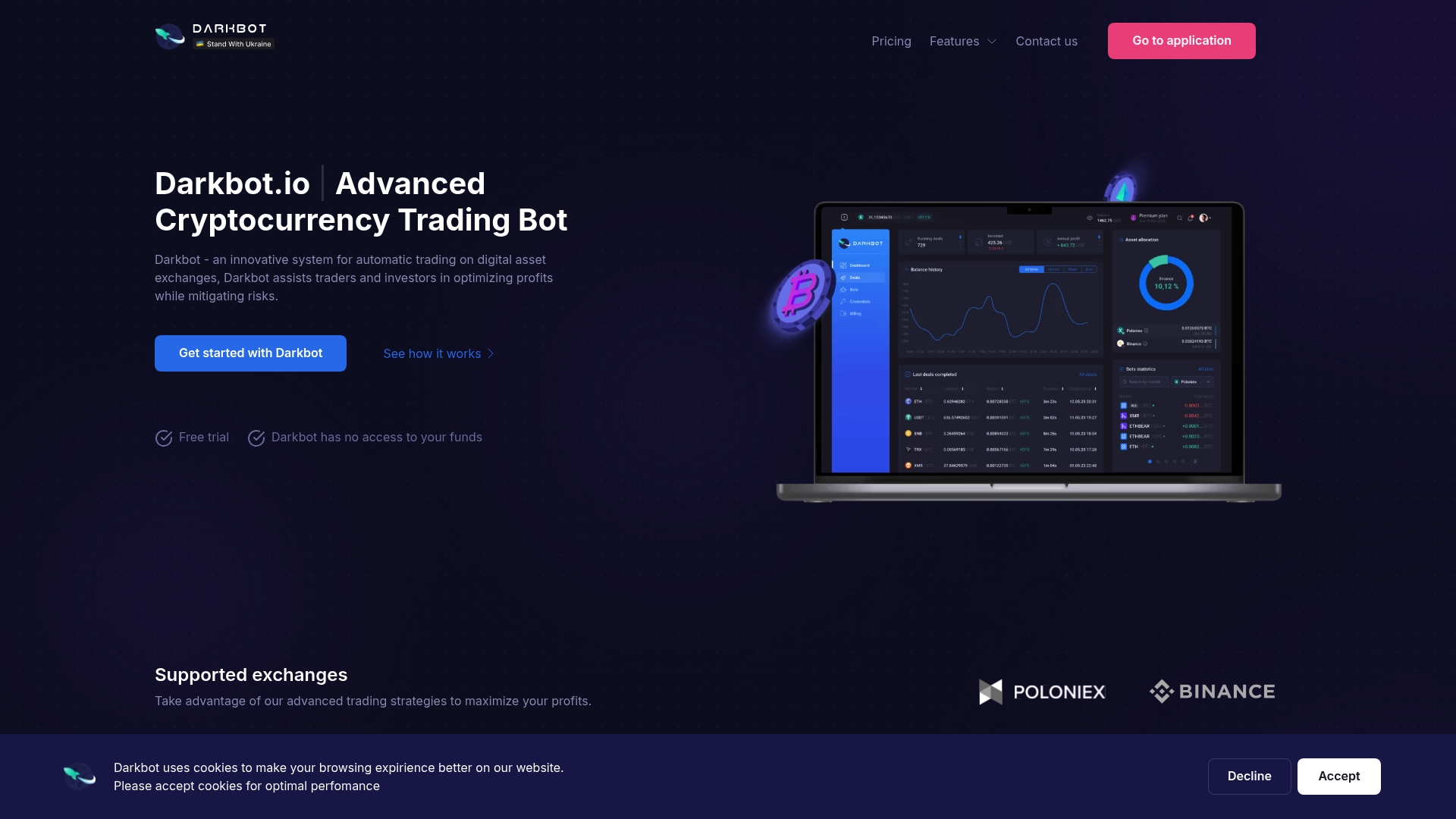
Rather than juggling keys and dashboards manually, Darkbot lets you assign strategies to specific exchange connections and monitor them from a single interface, while automated rebalancing keeps allocations within the parameters you define. Start in paper mode on any new exchange connection, confirm behavior matches expectations, and apply the same key hygiene covered above, trade-only permissions, per-exchange keys, and regular rotation, regardless of which platform manages your execution. You can review plans and begin setup on the Darkbot platform.
This article is general information, not a substitute for advice from a qualified financial advisor. Consult a qualified financial professional about your own circumstances before acting on anything here.
Sources
- API Key Security Best Practices for Automated Crypto Bots
- Guide to Cryptocurrency Exchange API Key Security | KipInCrypto
- I built an open-source crypto trading bot that runs 4 exchanges from one server - DEV Community
FAQ
Should a bot’s API key ever have withdrawal permission?
No. Trading bots need only order placement and account read permissions; withdrawal or transfer rights turn a routine credential into a high-risk control path if compromised.
How many API keys do I need for multiple exchanges?
At minimum, one key per exchange, and ideally one key per strategy per exchange, so a problem with one strategy never affects another running on the same account.
How often should exchange API keys be rotated?
There’s no universal fixed interval, but a documented rotation process using a parallel verification window before revoking the old key is standard practice for reducing long-term exposure.
Do sub-accounts help when running multiple exchange accounts?
Yes. Sub-accounts isolate capital by strategy or exchange, which limits how much is exposed if a single key or strategy misbehaves.
Can Darkbot manage strategies across several exchanges at once?
Darkbot supports connecting multiple exchange accounts with per-exchange API keys, deploying separate strategies to each, and viewing consolidated portfolio activity from one dashboard.
Recommended

Start trading on Darkbot with ease
Come and explore our crypto trading platform by connecting your free account!
Free plan available • No credit card required