Lock Crypto Gains: Trailing Stops for Traders, 2× ATR and 15–20% BTC

A trailing stop crypto order is a dynamic stop loss that follows price by a set trailing delta, locking in gains while leaving room for a position to keep running. It solves the core problem of a fixed stop: you no longer have to choose between protecting profit and capping upside. It does not, however, protect you from price gaps or forced liquidation on leveraged positions.
TL;DR:
- Trailing stops should be set based on the asset’s volatility, usually using a 14-period ATR multiplied by a factor of 2 to 3, depending on the asset.
- Traders must confirm trailing distance remains comfortably outside liquidation prices and set reduce-only orders to prevent accidental position reversal on leveraged trades.
- Using mark-price tracking over last traded price helps avoid premature triggers caused by market spikes and thin liquidity.
- Trailing stops work best in trending markets and can be backfired by whipsaw, gaps, or liquidation risks in volatile or sideways conditions.
- Automation platforms like Darkbot can enforce discipline through API integration, but gaps and liquidation risks still require careful risk management.
How Crypto Trailing Stop Orders Work on Exchanges
The trailing delta is the parameter that does the work. Set as a percentage or a fixed dollar amount, it defines the distance the stop keeps from the highest price reached on a long, or the lowest price on a short. As price moves in your favor, the stop ratchets forward. It never moves backward.
The order runs on the exchange’s servers, not on your device, which is why it stays active even if you close your laptop or lose your internet connection, according to a 2026 overview of crypto trailing stop mechanics. Most platforms let you pick the reference price the trail tracks: last traded price, index price, or mark price. On perpetual futures, mark price matters more than most traders realize, since it filters out momentary spikes from thin order books and reduces the odds of a premature trigger.
A few mechanics worth checking before you place one:
- Some exchanges let you set an optional stop price, which delays the trail from activating until price first reaches that level.
- Kraken’s trailing stop documentation confirms that once triggered, a standard trailing stop converts into a market order, while a trailing stop limit order converts into a limit order at your specified offset.
- The limit version gives you price control at the cost of guaranteed execution.
Trailing Types and How to Size the Trail
A fixed percentage trail is the easiest to set and the easiest to get wrong. A flat 5% works fine on a quiet day and gets shredded the moment volatility spikes, because it does not adapt to how far an asset actually moves. Bitcoin and Ethereum routinely swing several percentage points within a single session, and aggregated crypto volatility data shows how wide that dispersion gets across different assets and timeframes.
Average True Range (ATR) fixes that by sizing the trail to actual recent volatility instead of a guess. The calculation is straightforward:
- Calculate the 14-period ATR on your chosen timeframe.
- Multiply it by a volatility multiplier suited to the asset.
- Subtract that value from the highest price reached (for longs) to set your trailing distance.
Practitioner guidance on ATR-based trailing recommends a 2× multiplier for BTC and ETH on daily charts, widening to 2.5× or 3× for mid-cap altcoins, which tend to move harder and faster on lower liquidity. A third method, structure-based trailing, moves your stop under each new higher low (or above each new lower high) with a small ATR buffer added so normal noise doesn’t stop you out on a technicality.
Pro Tip: Don’t mix methods mid-trade. Pick ATR or structure-based trailing before entry, and let the rule run. Switching tactics after the position moves is how discipline quietly turns into discretion.

Stop-Market vs. Stop-Limit: The Execution Trade-Off
Every trailing stop eventually has to convert into a real order, and that choice carries a trade-off you need to accept before you place it, not after.
- A stop-market order guarantees you get out, but on a fast-moving or illiquid book, it can fill well below your intended exit.
- A stop-limit order caps your worst-case fill price, but if price gaps straight through your limit, the order can sit unfilled while the market keeps falling.
- Order size relative to book depth changes the outcome either way. A large order on a thin book eats through multiple price levels regardless of which type you choose.
Crypto’s volatility compounds this risk. Bitcoin has moved double-digit percentages within hours during past liquidity crunches, and that kind of range is exactly what the broader volatility data captures across the asset class. Trading platforms generally frame the decision as picking which failure mode you’re willing to accept, according to NinjaTrader’s stop-order guidance: guaranteed exit at an uncertain price, or a certain price with no guarantee of exit. On leveraged perpetuals, always set reduce-only, because a stop that isn’t marked reduce-only can accidentally open a new position in the opposite direction instead of closing the one you have.
When Trailing Stops Help, and When They Backfire
A trailing stop strategy performs best in a clean trend. Price grinds one direction, the trail follows, and you capture most of the move without needing to predict the top. The same mechanism falls apart in a choppy, range-bound market, where price oscillates just enough to tag the trail on every small pullback. Traders call this whipsaw, and it’s the single most common complaint about trailing stops in sideways conditions.
Two other failure modes deserve attention:
- Gap risk: a stop can be triggered correctly and still fill far from the trigger price during a fast move or a thin order book.
- Liquidation interaction: on leveraged positions, liquidation engines can close a position before a trailing stop even triggers if the liquidation price is reached first, regardless of what your stop was set to do.
Mitigations exist for most of this. Widen the trail ahead of scheduled events like major economic data or token unlocks, when volatility reliably spikes. Take partial profits early so a full whipsaw doesn’t erase the entire position’s gain. Have a re-entry plan so getting stopped out in a genuine trend doesn’t mean missing the rest of the move.
Pro Tip: If price has crossed your trail level three or more times in a session without a clean breakout, that’s chop, not trend. Widen the trail or step aside until structure clarifies.
Worked Examples: Setting Trailing Stops on Spot and Perpetuals

A common workflow separates entry risk from trend-following risk in two stages. Start with a fixed stop at your invalidation level, the price that proves the trade idea wrong. Once the position moves one full risk unit (1R) in your favor, convert to a trailing stop and let the trade manage itself from there, a sequence outlined in practitioner trailing-stop guidance.
Rough starting ranges by asset and timeframe:
- BTC, daily chart: 15% to 20% trailing delta, or 2× the 14-period ATR.
- BTC, 4-hour chart: 2% to 4% trailing delta, or 2× ATR on that timeframe.
- Altcoins, daily chart: 25% to 35% trailing delta, or 2.5× to 3× ATR, reflecting their typically wider swings.
For perpetuals specifically, run through this before the trail goes live:
- Confirm the trailing distance sits comfortably outside your liquidation price, with real margin to spare.
- Enable reduce-only so the order can only close the position, never flip it.
- Choose mark-price tracking over last price where the exchange offers it, since mark price resists brief liquidity-driven spikes that can trigger a stop prematurely.
It secures something regardless of what happens next while still leaving room for a larger move to pay off.
Implementation Checklist Before You Place a Trailing Stop
Run through this before every trade, not just the first one:
- Confirm the exchange supports trailing orders on the specific pair, and check which reference price it tracks by default.
- On perpetuals, set reduce-only and verify the trail distance clears your liquidation price with margin to spare.
- Decide stop-market or stop-limit up front, based on how much slippage you can tolerate versus how much you need a guaranteed exit.
- Paper-test the setup on small size first, and note the fee impact of each stop-out. Historical volatility data helps you sanity-check whether your trailing distance matches an asset’s actual range before you rely on it live.
Pro Tip: If you automate this through an API, check the symbol’s trailing-delta limits before submitting the order. Values outside the exchange’s allowed range get rejected, not adjusted.
What Actually Separates a Good Trailing Stop From a Lucky One
Most traders treat trailing stop distance as a personality trait: tight because they’re cautious, wide because they’re bold. Neither reasoning holds up. The distance should come from the asset’s own volatility, not from how the trader feels that week. An ATR-based default, staged conversion after 1R, and reduce-only enforced on every leveraged position removes most of the guesswork that turns a sound tool into a source of regret.
— Grisha
How Darkbot Handles Trailing-Stop Execution
An AI-based crypto trading automation platform can enforce the discipline described above consistently, automating processes like volatility-based trail parameter calculation, mark versus last price tracking, and reduce-only logic application on leveraged positions as part of systematic execution rules instead of relying on manual judgment.
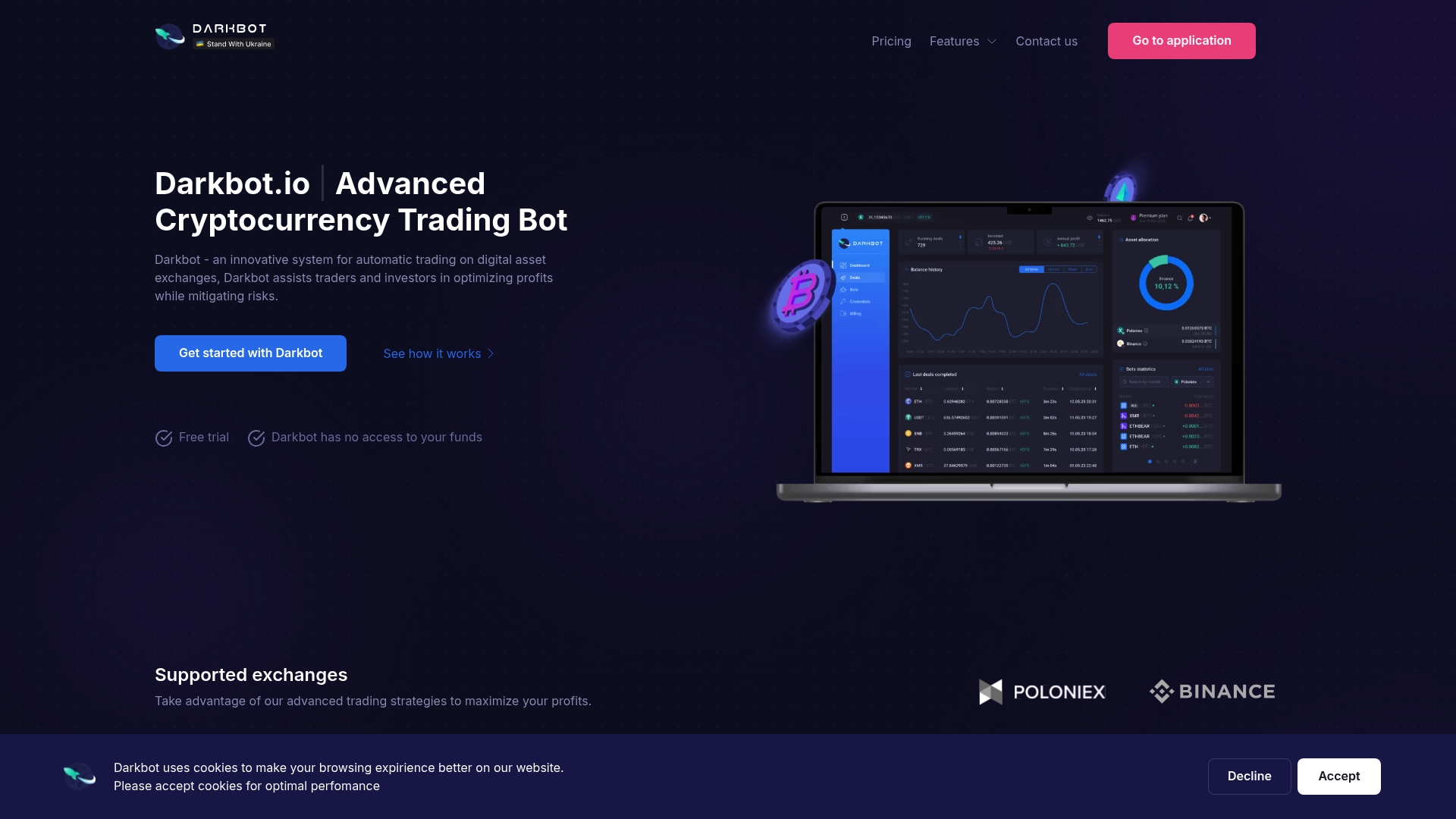
Such platforms often connect to cryptocurrency exchanges through API integration, apply user-selected strategy templates consistently across positions, and provide paper trading features to validate setups before using real capital. None of this changes the underlying trade-offs covered above, gaps and liquidation risk still exist, but it removes the manual steps where discipline typically breaks down. If you want to see how a rule-driven trailing-stop workflow runs in practice, visit the Darkbot platform to review the available plans, including the free tier.
Sources
For deeper mechanics, review Kraken’s trailing stop documentation, the Binance trailingDelta API FAQ, and Blofin’s ATR-based trailing strategy guide. Always confirm your exchange’s specific trailingDelta limits and price-reference settings before trading live.
- What you need to know about crypto trailing stop orders in 2026
- Trailing Stop Orders | Kraken
- Trailing stop strategy: Locking profits without getting shaken out | Blofin
FAQ
Is a Trailing Stop Loss a Good Idea in Crypto?
A trailing stop crypto order works well in trending markets because it locks in gains while letting a position run, but it performs poorly in choppy, range-bound conditions where it can trigger repeatedly on normal price noise.
What Is the 1% Rule in Crypto?
The 1% rule refers to risking no more than 1% of total account capital on a single trade, a position-sizing guideline separate from trailing stop distance but often used alongside it to control overall exposure.
What Does a 25% Trailing Stop Mean?
A 25% trailing stop sets the stop price 25% below the highest price reached since entry on a long position, and it moves up as new highs form but never moves down.
Recommended

Start trading on Darkbot with ease
Come and explore our crypto trading platform by connecting your free account!
Free plan available • No credit card required