The Impact of AI on Blockchain: 2026 Developer Guide

TL;DR:
- AI enhances blockchain by improving security, automation, and throughput through hybrid architectures. Blockchain strengthens AI accountability with tamper-proof records but requires layered governance for full responsibility. Most teams build these systems in silos, but effective convergence demands co-design from the start.
The impact of AI on blockchain is defined by a synergistic convergence where AI adds operational intelligence to distributed ledgers while blockchain provides the tamper-proof infrastructure that AI systems need for accountable, auditable transactions. Together, they form what researchers describe as a globally inclusive ecosystem with complementary strengths: AI contributes prediction, decision-making, and automation, while blockchain delivers decentralized, secure, and transparent data sharing. For developers building on Ethereum or layer-2 networks, investors managing tokenized assets, and tech enthusiasts tracking decentralized finance, understanding this convergence is no longer optional. Regulatory bodies including the SEC and CFTC have already issued formal guidance on AI-mediated blockchain finance, and frameworks like MiCA and the EU AI Act are reshaping product classification across digital asset markets.
How does AI enhance blockchain operations?
AI improves blockchain networks across three distinct layers: security, automation, and throughput. Each layer compounds the value of the other, which is why hybrid AI-blockchain architectures consistently outperform either technology deployed alone.
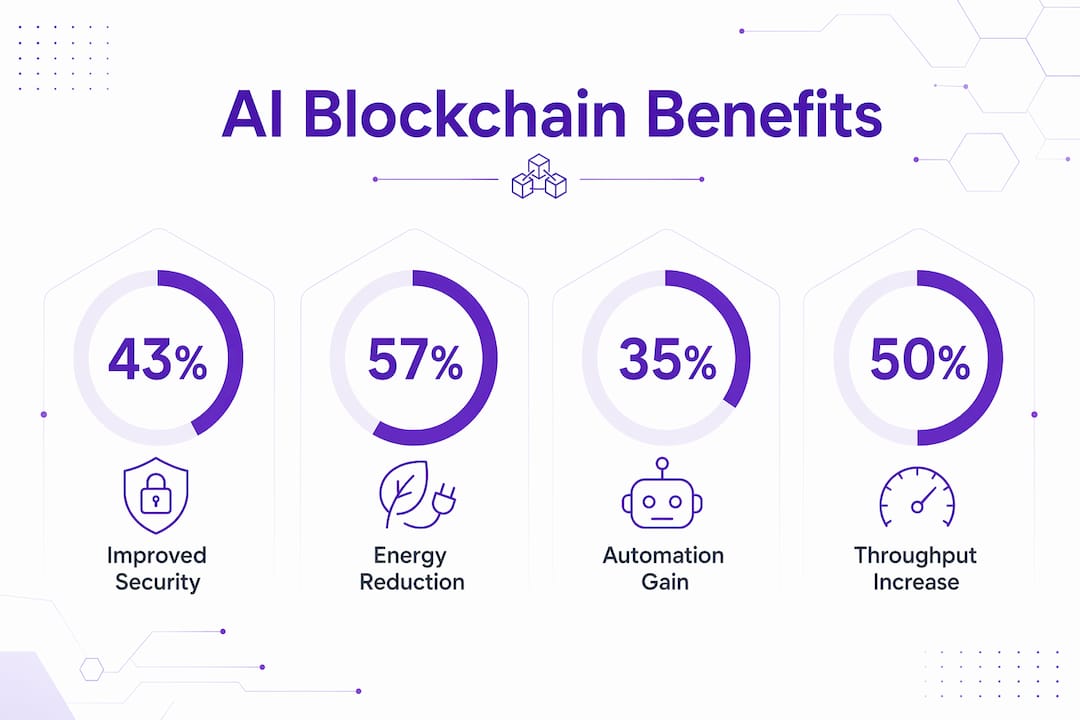
On the security side, deep learning anomaly detection integrated with permissioned blockchains and smart contracts creates a reliability stack that centralized AI solutions cannot replicate. A hybrid AI-blockchain mechanism achieves roughly 42.8% higher throughput and reduces false positives by 60.9% while maintaining low false negatives under variable network loads. Response times hold at 180 ms at low load (5,000 requests per second) and 300 ms at high load (4,200 requests per second). Those numbers matter because they confirm that adding AI inference to blockchain consensus does not create unacceptable latency for production systems.
Automation is the second major contribution. AI does not just analyze off-chain data and feed signals into blockchain systems. It executes on-chain workflows directly. Smart contracts triggered by machine learning models can adjust collateral ratios, rebalance liquidity pools, or flag suspicious wallet behavior without human intervention. This moves AI from an advisory role to an operational one inside the ledger itself.
Pro Tip: When benchmarking an AI-blockchain integration, measure combined inference time, consensus latency, contract execution, and logging overhead together. Optimizing each component in isolation produces misleading results under real threat loads.
Key capabilities AI brings to blockchain operations include:
- Anomaly detection: Deep learning models identify irregular transaction patterns in real time, reducing fraud exposure across permissioned and public chains.
- Predictive consensus: AI models forecast network congestion and adjust validator selection or fee parameters before bottlenecks form.
- Automated contract execution: Machine learning triggers smart contract logic based on probabilistic conditions, not just binary rule sets.
- Throughput management: AI-driven task scheduling distributes computational load across nodes to maintain performance under high demand.
How does blockchain strengthen AI accountability?
Blockchain preserves AI transactional records with tamper-proof audit trails covering inputs, outputs, timestamps, and transaction provenance. That evidentiary foundation is genuinely valuable. It means regulators, auditors, and counterparties can verify what data an AI model received and what action it took, without relying on the operator’s self-reporting.
The limitation is equally important to understand. Blockchain records what an AI did. It does not explain why. The AI black-box problem, where neural network decision logic remains opaque even to its developers, is not solved by writing outputs to an immutable ledger. A blockchain log confirms that a model sold a position at a specific timestamp. It does not reveal which features drove that decision or whether the model was operating within its intended parameters.
Addressing this gap requires layered governance, not just better logging. Accountability must be mapped from control layers, including model deployment, configuration, and service operation, to legal liability frameworks. Blockchain anchoring for AI-generated content provenance using watermarking and semantic fingerprinting shows one direction this is heading. The practical implication for developers is clear:
Blockchain stabilizes the evidentiary record. Legal and governance frameworks must carry the accountability load that blockchain alone cannot bear.
A structured accountability model for AI on blockchain involves three layers:
- Data provenance layer: Blockchain records all inputs fed to the AI model, including data sources, timestamps, and preprocessing steps.
- Decision logging layer: Model outputs and triggered actions are written on-chain with cryptographic signatures linking them to specific model versions.
- Governance layer: Legal frameworks, smart contract access controls, and human oversight protocols assign responsibility when AI decisions cause harm.
What regulations govern AI and blockchain convergence?
The regulatory environment for AI-blockchain convergence shifted materially in 2026. The SEC and CFTC issued joint federal guidance in march 2026 clarifying how federal securities law applies to crypto assets and AI-mediated blockchain finance. Release Nos. 33-11412 and 34-105020 directly affect how agentic on-chain trading systems are classified and supervised. Developers building autonomous AI agents that execute financial transactions on-chain now operate under explicit federal scrutiny.
At the international level, regulators are adapting frameworks including MiCA, the EU AI Act, and DORA to supervise AI-tokenized finance products and autonomous AI agents. These frameworks treat governance models, compute resource economics, and market regulations as inseparable. A product that combines an AI trading agent with a tokenized asset may trigger classification requirements under multiple frameworks simultaneously.
The compliance implications for developers and investors are concrete:
- Product classification: An AI agent executing trades on a blockchain may qualify as a financial instrument, a software service, or both, depending on jurisdiction and transaction type.
- Supervisory alignment: Firms must demonstrate that their AI systems operate within documented risk parameters, not just that they produce acceptable outcomes.
- Compliance baselines: MiCA and the EU AI Act establish minimum documentation, testing, and disclosure requirements that apply before a product reaches market.
- Ongoing adaptation: Regulations are evolving faster than product cycles. Developers and investors face shifting compliance baselines that require continuous monitoring, not one-time legal review.
The practical advice here is straightforward. Build compliance architecture into the system from the start. Retrofitting governance documentation onto a live AI-blockchain product is significantly more expensive than designing for auditability from day one.
Energy efficiency and architecture in AI-enhanced blockchain
Energy consumption has been the most persistent criticism of blockchain at scale. AI-enhanced architecture is changing that calculus. Energy-optimized blockchain frameworks using hybrid consensus mechanisms report a 56.5% reduction in energy consumption compared to standard Proof-of-Stake, a 77% carbon reduction relative to Proof-of-Work, and a 2.4× improvement in throughput. Those gains come from embedding energy and carbon considerations across all architectural layers, not just switching consensus algorithms.

| Architecture component | Performance gain |
|---|---|
| Energy consumption vs. Proof-of-Stake | 56.5% reduction |
| Carbon emissions vs. Proof-of-Work | 77% reduction |
| Throughput improvement | 2.4× increase |
| Consensus mechanism | Hybrid (AI-assisted scheduling) |
The key design principle is co-design. AI task scheduling, carbon accounting modules, and consensus selection work together as a single system. Treating them as separate optimization problems produces suboptimal results because gains in one layer create costs in another. Sustainable blockchain solutions require measuring on-chain carbon footprints continuously, not estimating them at deployment.
Pro Tip: Embed carbon accounting as a first-class metric in your blockchain node telemetry. Systems that track energy consumption per transaction in real time can adjust consensus parameters dynamically, which produces larger efficiency gains than static configuration changes.
Practical applications for developers, investors, and tech enthusiasts
The most consequential near-term application of AI on blockchain is agentic finance. AI agents transact autonomously on Ethereum and layer-2 networks using stablecoins like USDC, enabling 24/7 market making and automated portfolio management without human intervention between decisions. This is not a theoretical capability. It is operational infrastructure that developers are building on today.
For investors, the role of AI in cryptocurrency extends beyond price prediction into systematic risk management. AI models running on blockchain-anchored data feeds can monitor portfolio exposure, trigger rebalancing logic, and log every decision with a verifiable audit trail. That combination of automation and accountability is what distinguishes AI-blockchain systems from conventional algorithmic trading.
Practical applications across the ecosystem include:
- Autonomous market making: AI agents maintain liquidity positions on decentralized exchanges around the clock, adjusting spreads based on volatility signals.
- Fraud detection: Machine learning models flag suspicious wallet behavior and trigger smart contract restrictions before losses occur.
- Tokenized asset management: AI-driven rebalancing of tokenized portfolios executes on-chain without custodian intermediaries.
- Content provenance: Blockchain anchoring verifies the origin and integrity of AI-generated content, a growing requirement in media and legal contexts.
- Compliance automation: Smart contracts enforce regulatory rules automatically, reducing manual compliance overhead for firms operating across multiple jurisdictions.
The machine learning applications in fintech space is expanding rapidly, but the developers and investors who will capture the most value are those who treat regulatory compliance and system architecture as core product decisions, not afterthoughts.
Key Takeaways
AI and blockchain convergence delivers measurable gains in security, throughput, and accountability, but only when governance, compliance, and architecture are treated as integral components of the system design.
| Point | Details |
|---|---|
| AI improves blockchain security | Hybrid AI-blockchain mechanisms achieve 42.8% higher throughput and 60.9% fewer false positives. |
| Blockchain logs AI actions, not reasoning | Immutable audit trails record inputs and outputs but require layered governance to assign legal accountability. |
| Regulation is active and evolving | SEC-CFTC guidance and MiCA directly affect how AI-mediated blockchain products are classified and supervised. |
| Architecture co-design drives efficiency | Embedding AI across all system layers reduces energy use by 56.5% and increases throughput 2.4× versus standard Proof-of-Stake. |
| Agentic finance is operational now | AI agents execute autonomous transactions on Ethereum and layer-2 networks using stablecoins like USDC today. |
Why I think most teams are building this backward
Most development teams I observe treat AI as a feature added to a blockchain product, and blockchain as a logging mechanism bolted onto an AI system. Both framings miss the point. The value of AI-blockchain convergence comes from co-design, where the two systems are architected together from the start, with shared assumptions about latency, governance, and accountability.
The regulatory picture reinforces this. The SEC-CFTC guidance issued in march 2026 does not distinguish between “AI products that happen to use blockchain” and “blockchain products that happen to use AI.” Regulators see a single system and apply classification rules accordingly. Developers who build in silos will face compliance problems that no amount of retroactive documentation can fix.
The sustainability angle is equally underappreciated. The 56.5% energy reduction reported in hybrid consensus architectures does not come from a single design choice. It comes from treating energy as a constraint at every layer. Teams that optimize consensus in isolation and ignore task scheduling or carbon accounting leave most of those gains on the table.
My practical advice: map your control layers before you write a line of code. Know which team or entity is responsible for model deployment, configuration, and service operation. Then build your blockchain logging and governance architecture around those accountability boundaries. The algorithmic trading frameworks that perform best over time are the ones built on clear decision logic and documented risk controls, not the ones chasing the highest short-term throughput numbers.
The forward trajectory is clear. Agentic finance will expand. Regulatory frameworks will tighten. And the teams that treat AI-blockchain convergence as a systems engineering problem, rather than a marketing narrative, will be the ones still operating when the dust settles.
— Grisha
Darkbot and the AI-blockchain stack for crypto traders
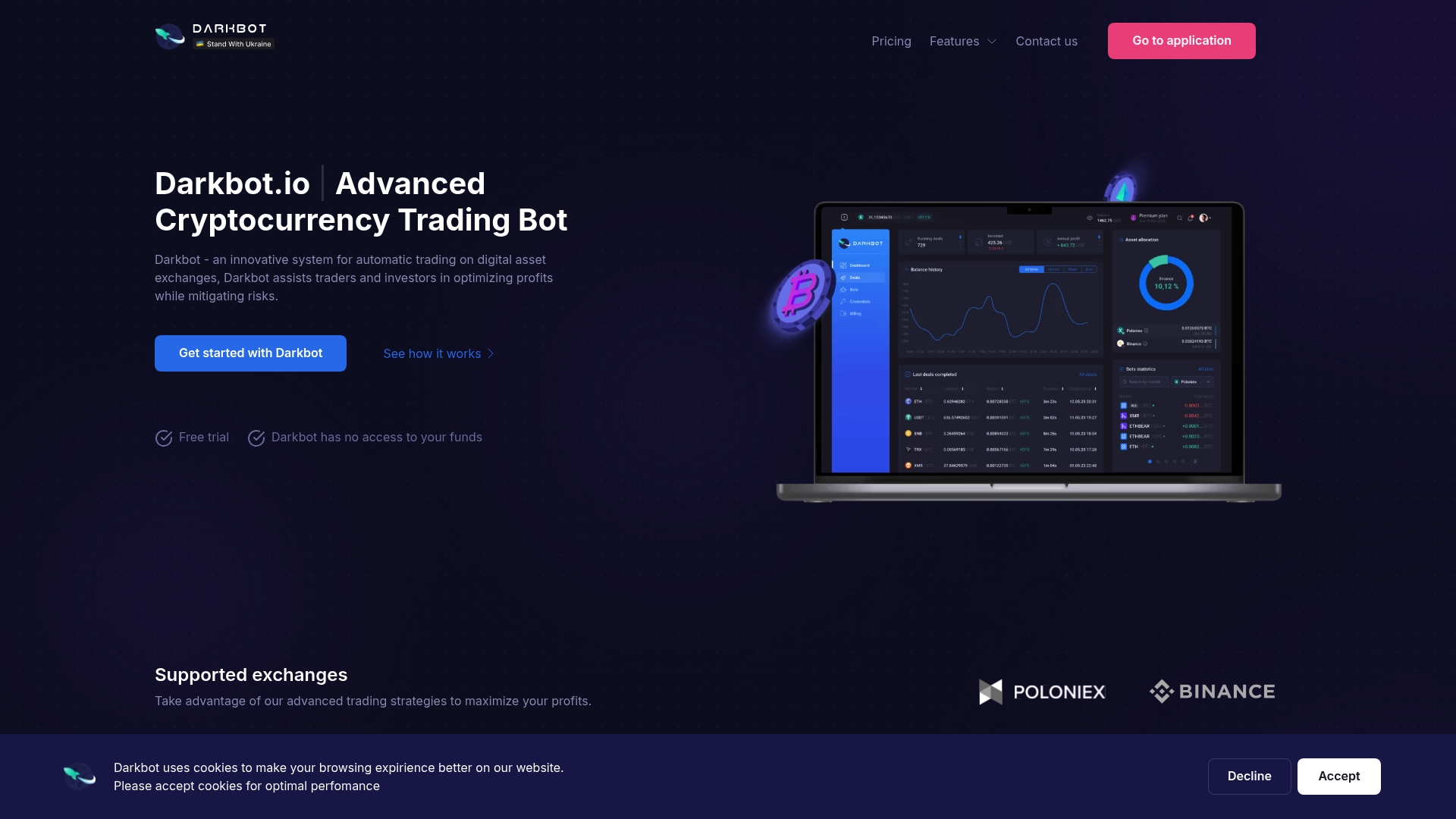
Darkbot applies the same AI-blockchain convergence principles discussed here to automated cryptocurrency trading. The platform connects to multiple exchanges via API keys and executes trading strategies based on rule-driven logic and probabilistic pattern evaluation, not discretionary signals. Every bot action follows a documented decision framework, giving traders a structured audit trail of what ran, when, and under what conditions.
For traders who want systematic execution without building the infrastructure from scratch, Darkbot’s automated trading platform provides configurable strategies, real-time analytics, and multi-bot management across volatile crypto markets. Investors focused on longer-term positioning can use Darkbot’s portfolio management tools to automate rebalancing and monitor exposure within defined risk parameters.
FAQ
What is the impact of AI on blockchain security?
AI integrated with blockchain achieves measurably better security outcomes than either technology alone. A hybrid AI-blockchain mechanism reports 42.8% higher throughput and 60.9% fewer false positives compared to non-AI blockchain security systems.
Does blockchain solve the AI explainability problem?
Blockchain records AI inputs, outputs, and timestamps with tamper-proof accuracy, but it does not explain why an AI model made a specific decision. Solving explainability requires additional governance layers and legal accountability frameworks beyond what blockchain logging provides.
How do SEC and CFTC regulations affect AI-blockchain products?
The SEC and CFTC issued joint guidance in march 2026 clarifying federal securities law application to crypto assets and AI-mediated blockchain finance. Developers building autonomous AI agents that execute on-chain financial transactions now operate under explicit federal classification and supervisory requirements.
What energy savings does AI-enhanced blockchain architecture deliver?
Hybrid AI-blockchain architectures with AI-assisted consensus and task scheduling report 56.5% lower energy consumption than standard Proof-of-Stake and 77% lower carbon emissions than Proof-of-Work, alongside a 2.4× throughput improvement.
What are the main AI blockchain use cases in decentralized finance?
The primary use cases include autonomous market making on decentralized exchanges, AI-driven portfolio rebalancing of tokenized assets, real-time fraud detection via machine learning, and blockchain-anchored provenance verification for AI-generated content.
Recommended

Start trading on Darkbot with ease
Come and explore our crypto trading platform by connecting your free account!
Free plan available • No credit card required