Trading Bot Algorithms: Optimizing Crypto Profits
Nearly half of all American cryptocurrency trades are now executed by automated algorithms. For tech-savvy investors and busy professionals, the speed and precision of these systems have transformed global crypto markets. Understanding how trading bot algorithms work can help you harness automation that acts faster and thinks deeper than any manual approach, giving you an edge in profit optimization and risk management.
Key Takeaways
| Point | Details |
|---|---|
| Understanding Trading Bots | Trading bot algorithms automate cryptocurrency trading using predefined rules, enabling systematic execution of strategies without manual intervention. |
| Types of Algorithms | Various trading algorithms, including Trend-Following and Arbitrage, cater to different market conditions and trading goals, enhancing efficiency. |
| Machine Learning Impact | Machine learning techniques improve trading algorithms’ ability to analyze data, recognize patterns, and generate accurate trading signals. |
| Regulatory Awareness | Traders must navigate complex global regulations and ensure compliance to mitigate legal risks associated with automated trading systems. |
Defining Trading Bot Algorithms in Crypto
Trading bot algorithms represent sophisticated computational systems designed to automate cryptocurrency trading processes through predefined mathematical rules and strategic decision-making protocols. These advanced algorithmic frameworks enable traders to systematically execute complex trading strategies without constant manual intervention. By leveraging advanced computational techniques, trading bots process extensive market datasets and execute trades with precision.
At their core, trading bot algorithms function through intricate decision-making mechanisms that analyze market conditions, assess historical price movements, and generate trade signals based on preset parameters. These algorithms incorporate multiple technical indicators, statistical models, and machine learning techniques to evaluate potential trading opportunities across diverse cryptocurrency markets. AI-driven trading bots utilize artificial intelligence to process large market datasets and make informed trading decisions, transforming raw market information into actionable trading strategies.
The primary components of trading bot algorithms typically include:
- Market Data Analysis: Real-time processing of price movements, trading volumes, and market sentiment
- Risk Management: Automated rules for position sizing, stop-loss implementation, and portfolio protection
- Strategy Execution: Systematic trade entry and exit based on predefined mathematical conditions
- Performance Monitoring: Continuous tracking and adjustment of trading performance metrics
Pro Tip for Crypto Traders: Always backtest your trading bot algorithm using historical market data to validate its performance and understand potential risks before deploying real capital in live trading scenarios.
Understanding these algorithmic frameworks enables cryptocurrency investors to leverage sophisticated automation tools that can operate with greater speed, consistency, and emotional neutrality compared to manual trading approaches.
Main Types of Trading Algorithms Used
Cryptocurrency trading algorithms encompass several strategic approaches designed to maximize trading efficiency and capitalize on market opportunities. A systematic mapping study reveals multiple algorithmic methodologies used in digital asset trading, each targeting specific market conditions and trading objectives. These algorithms range from relatively straightforward trend-following strategies to complex machine learning-driven approaches that adapt dynamically to changing market environments.
The primary categories of trading algorithms in cryptocurrency markets include:
- Trend-Following Algorithms: Identify and capitalize on sustained price momentum in specific directions
- Arbitrage Algorithms: Exploit price differences across multiple exchanges to generate profits
- Mean Reversion Algorithms: Assume prices will eventually return to historical average levels
- Market Making Algorithms: Provide liquidity by continuously placing buy and sell orders
- High-Frequency Trading (HFT) Algorithms: Execute multiple trades within milliseconds to capture minimal price movements
Cryptocurrency trading algorithms employ sophisticated techniques like neural networks and deep learning to analyze market dynamics, transforming raw market data into actionable trading insights. These advanced computational models can process vast amounts of historical and real-time market information, identifying patterns and potential trading opportunities that human traders might overlook. Machine learning approaches enable these algorithms to continuously adapt and improve their decision-making processes based on evolving market conditions.
Pro Tip for Advanced Traders: Always thoroughly backtest and simulate your chosen trading algorithm across multiple market scenarios to validate its performance and understand its potential risks and limitations before deploying real capital.
Understanding these algorithmic approaches empowers cryptocurrency investors to leverage sophisticated trading strategies that can operate with greater speed, precision, and analytical depth compared to traditional manual trading methods.
Here’s a comparison of major trading algorithm types and their ideal use cases:
| Algorithm Type | Ideal Market Condition | Key Advantage |
|---|---|---|
| Trend-Following | Strong momentum, clear trend | Captures large price moves |
| Arbitrage | Price differences across venues | Profits from inefficiencies |
| Mean Reversion | Range-bound, stable periods | Exploits price corrections |
| Market Making | Low volatility, high volume | Earns spread, adds liquidity |
| High-Frequency (HFT) | Fast-moving, liquid markets | Profits from micro-movements |
How Machine Learning Powers Trading Decisions
Machine learning represents a transformative approach to cryptocurrency trading, enabling sophisticated algorithms to analyze complex market dynamics with unprecedented precision. Comparative analyses of machine learning models reveal powerful techniques for predicting price movements and generating actionable trading signals, fundamentally changing how traders approach market analysis and decision making. These advanced computational models can process vast amounts of historical and real-time data, identifying nuanced patterns that traditional analytical methods might overlook.
The core machine learning techniques employed in crypto trading algorithms include:
- Supervised Learning Models: Trained on historical market data to predict future price trends
- Unsupervised Learning Techniques: Identify hidden market patterns and clustering opportunities
- Reinforcement Learning Algorithms: Continuously adapt trading strategies based on market performance
- Neural Network Architectures: Process complex, multidimensional market data with high computational efficiency
- Ensemble Learning Methods: Combine multiple predictive models to improve overall accuracy and reliability
Extensive research investigating over 40 different machine learning models demonstrates their potential for developing robust, adaptive trading strategies, highlighting the computational power behind modern trading approaches. These models leverage advanced techniques like Gradient Boosting, XGBoost, and Long Short-Term Memory (LSTM) networks to analyze market conditions, assess risk, and generate sophisticated trading recommendations. By processing multiple data streams simultaneously, machine learning algorithms can quickly detect emerging market trends and make split-second trading decisions that would be impossible for human traders.
Pro Tip for Advanced Traders: Regularly validate and retrain your machine learning models using fresh market data to ensure their continued performance and adaptability in changing market conditions.
Understanding machine learning’s role in trading empowers investors to leverage cutting-edge technological approaches that transform raw market data into strategic, data-driven investment decisions.
Legal Regulations for Automated Crypto Trading
Automated cryptocurrency trading exists within a complex and evolving global regulatory landscape that varies significantly across different jurisdictions. A comprehensive global analysis reveals a wide spectrum of regulatory approaches toward automated trading systems, ranging from completely restrictive frameworks to more progressive and innovation-friendly legal environments. Traders and developers must navigate these intricate regulatory requirements carefully to ensure compliance and mitigate potential legal risks associated with algorithmic trading platforms.
The primary regulatory considerations for automated crypto trading typically involve:
- Licensing Requirements: Obtaining necessary operational permits from financial authorities
- Consumer Protection Standards: Implementing safeguards against potential financial fraud
- Anti-Money Laundering (AML) Protocols: Establishing robust verification and monitoring mechanisms
- Data Privacy Regulations: Protecting user information and transaction details
- Reporting and Transparency Obligations: Maintaining comprehensive transaction records
International trends in cryptocurrency regulation demonstrate a convergent approach toward establishing comprehensive legal frameworks for digital asset trading platforms, with increasing emphasis on creating standardized compliance mechanisms. Different countries have adopted varied strategies ranging from strict regulatory control to more permissive innovation-friendly environments. These regulatory approaches aim to balance technological innovation with essential consumer protection measures, recognizing the unique challenges presented by decentralized and automated trading systems.
Pro Tip for Compliance-Minded Traders: Always consult local financial regulators and legal professionals specializing in cryptocurrency law before deploying any automated trading system to ensure full compliance with regional regulations.
Understanding the nuanced legal landscape is crucial for cryptocurrency traders seeking to leverage automated trading technologies while maintaining strict adherence to evolving regulatory standards.
Risks, Security, and Common Pitfalls
Cryptocurrency trading bots introduce complex technological and financial risks that require careful navigation and strategic management. A comprehensive guide reveals multiple critical vulnerabilities inherent in automated trading systems, emphasizing the importance of understanding potential technical and operational challenges before deploying algorithmic trading strategies.
The most significant risks associated with cryptocurrency trading bots include:
- Technical Failures: Unexpected software malfunctions or connectivity disruptions
- Over-Optimization: Creating strategies that perform exceptionally well in historical data but poorly in live markets
- Market Volatility Exposure: Potential for rapid, significant losses during extreme price fluctuations
- Security Vulnerabilities: Potential unauthorized access through compromised API keys
- Algorithmic Limitations: Strategies that cannot adapt quickly to changing market conditions
Comprehensive security assessments highlight critical safeguards necessary for protecting cryptocurrency trading automation systems, including implementing robust authentication protocols, restricting API permissions, and maintaining continuous monitoring mechanisms. Advanced traders must develop multifaceted risk management approaches that combine technological vigilance with strategic flexibility, recognizing that no automated system can completely eliminate investment risks.
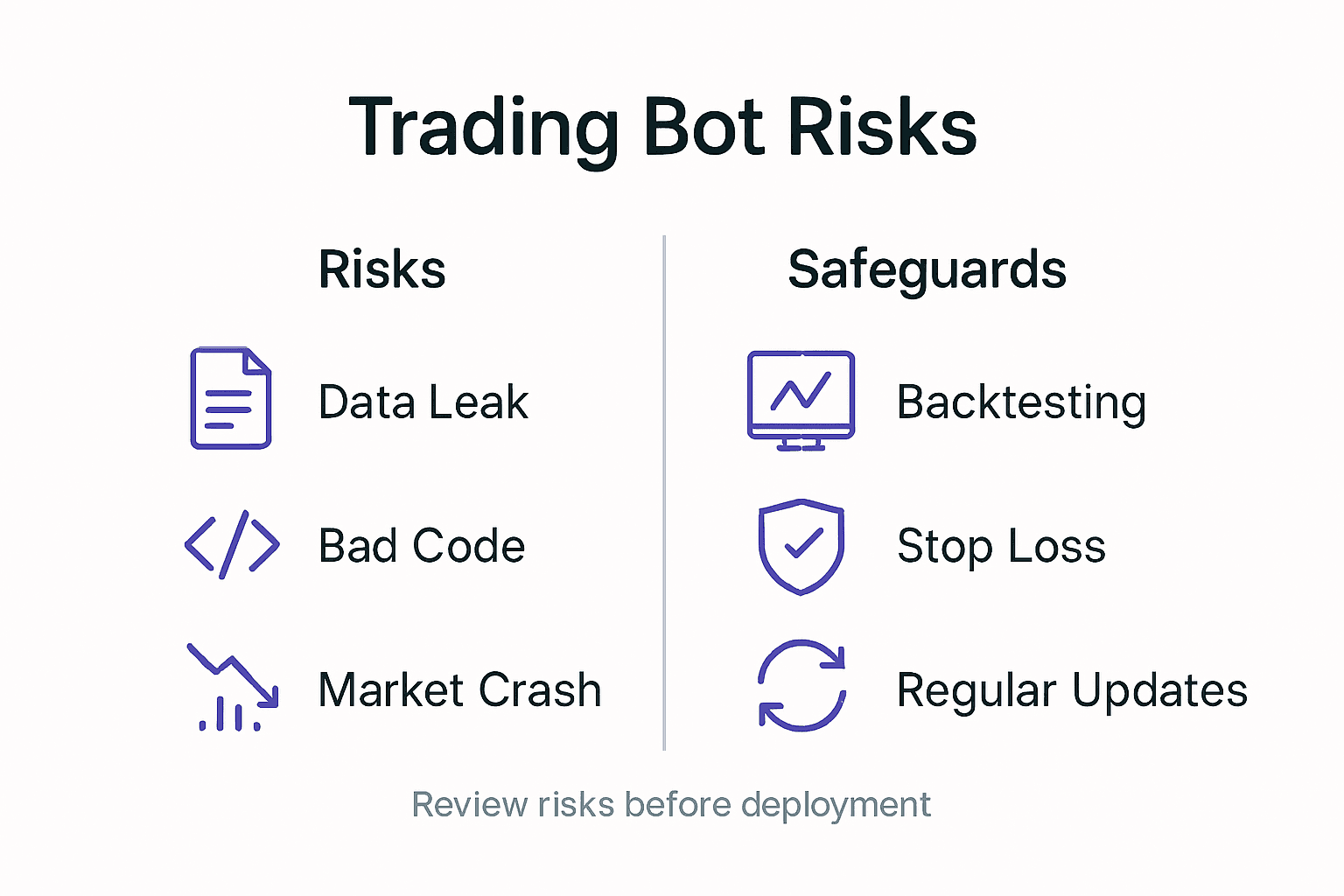
Pro Tip for Risk-Aware Traders: Implement strict risk management controls, limit your bot’s trading capital to a small percentage of your total portfolio, and continuously monitor its performance to quickly identify and address potential issues.
Successful cryptocurrency trading bot deployment requires a balanced approach that acknowledges technological capabilities while maintaining realistic expectations about automated trading performance.
Below is a summary of key technical and operational risks for crypto trading bots:
| Risk Category | Example Scenario | Impact on Trader |
|---|---|---|
| Technical Failures | Exchange API outage | Missed trades, losses |
| Security Breaches | Stolen or leaked API keys | Unauthorized fund access |
| Over-Optimization | Strategy fits past data too closely | Poor live performance |
| Market Volatility | Sudden large price swings | Rapid unexpected losses |
| Algorithmic Limits | Bot cannot adapt to new market regimes | Missed opportunities, losses |
Unlock the Power of Trading Bot Algorithms to Maximize Your Crypto Profits
The article highlights the complexity and challenges of building effective trading bot algorithms that leverage AI and machine learning while managing risk in volatile crypto markets. If you want to eliminate the headache of technical failures, over-optimization, and the constant need for backtesting your strategies, Darkbot.io offers the perfect solution. Our platform integrates seamlessly across multiple exchanges via API keys and empowers you to customize trading strategies with advanced algorithmic precision and real-time analytics.
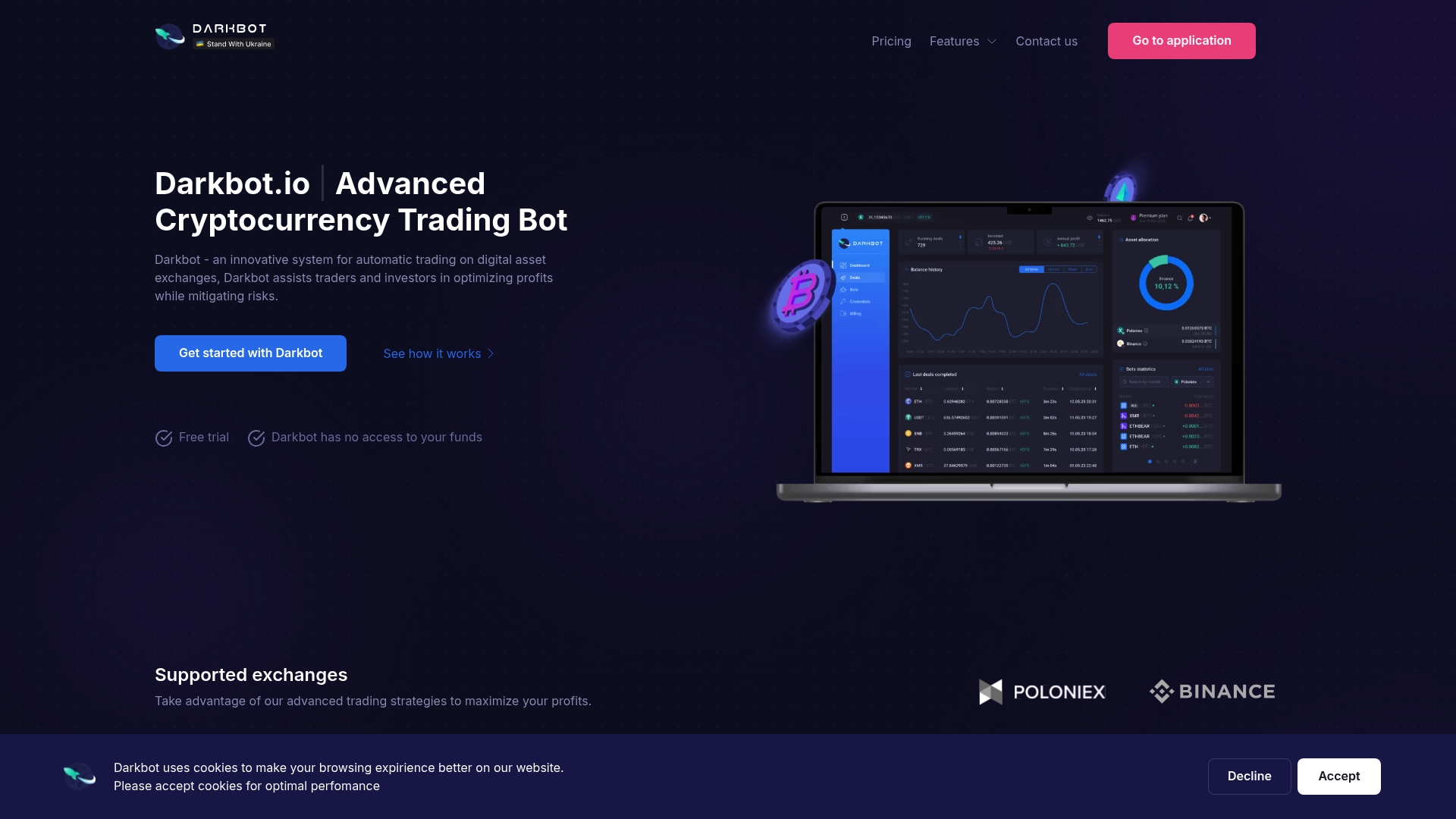
Discover how you can take control of your crypto trading with features designed for both beginners and experienced users. Benefit from automated portfolio management, strategy fine-tuning, and secure data handling that work together to help you optimize profits while minimizing risks. Visit Darkbot.io now to explore our free, standard, and premium plans and start automating your trading with confidence today.
Frequently Asked Questions
What are trading bot algorithms in cryptocurrency?
Trading bot algorithms are sophisticated computational systems that automate cryptocurrency trading through predefined mathematical rules and decision-making protocols, allowing for systematic execution of trading strategies without constant manual intervention.
How do trading bots optimize profits in crypto trading?
Trading bots optimize profits by utilizing advanced algorithms that analyze market data, execute trades based on predefined strategies, incorporate risk management tactics, and continuously monitor performance to adapt to market changes.
What types of trading algorithms are commonly used in cryptocurrency?
Common types of trading algorithms in cryptocurrency include trend-following algorithms, arbitrage algorithms, mean reversion algorithms, market making algorithms, and high-frequency trading (HFT) algorithms, each targeting specific market conditions and trading strategies.
How does machine learning enhance trading bot performance?
Machine learning enhances trading bot performance by enabling algorithms to analyze complex market dynamics, identify patterns in large datasets, and adapt trading strategies based on evolving market conditions, ultimately improving accuracy and decision-making.
Recommended

Start trading on Darkbot with ease
Come and explore our crypto trading platform by connecting your free account!
Free plan available • No credit card required