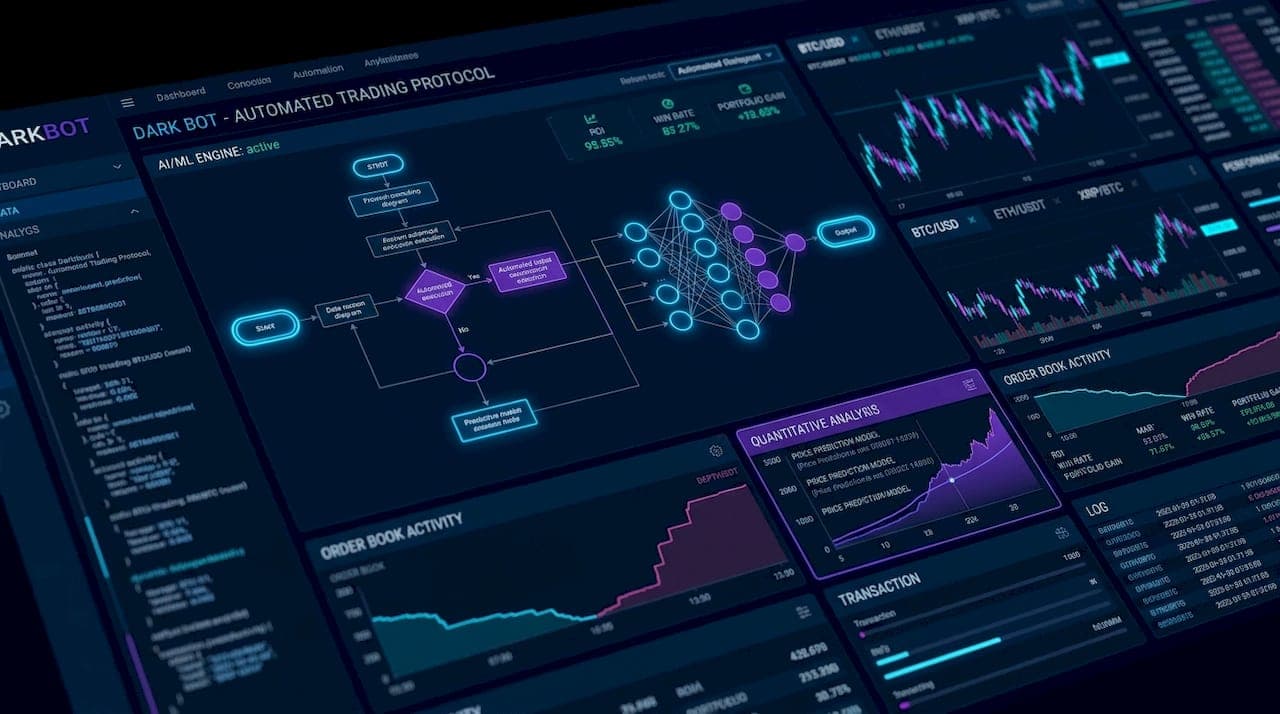
Crypto trading optimization process: 25-40% ROI with bots
Manual crypto trading exhausts you. Markets never sleep, emotions sabotage decisions, and constant monitoring drains energy while mistakes erode profits. Automated trading bots solve this by executing strategies 24/7, removing emotion, and optimizing entries and exits based on data. This guide walks you through the crypto trading optimization process using automation to enhance strategy performance, reduce workload, and boost returns systematically.
Key takeaways
| Point | Details |
|---|---|
| Automation improves consistency | Bots execute strategies without emotional interference, reducing costly manual errors in volatile markets. |
| API security is critical | Restricted API keys with trading-only permissions protect funds from unauthorized withdrawals. |
| Strategy customization maximizes returns | Tailoring bot parameters to risk tolerance and market conditions increases profitability by up to 40%. |
| Continuous monitoring prevents losses | Regular reviews and adjustments maintain performance and prevent strategy decay in changing markets. |
| Risk management reduces volatility | Proper controls lower drawdowns by 20-35% and stabilize portfolio performance over time. |
Prerequisites: tools and knowledge needed before automation
Before launching automated crypto trading, you need the right foundation. Success depends on selecting proper tools, understanding security fundamentals, and preparing your capital strategy.
Start by choosing reputable crypto exchanges that offer robust API access and strong security features. Platforms like Binance, Coinbase Pro, and Kraken provide reliable API infrastructure essential for bot connectivity. Your exchange must support the trading pairs and features your strategy requires, so verify compatibility before committing funds.
API key configuration demands careful attention. Understanding API permissions ensures you grant only necessary access rights, never withdrawal privileges. This step by step trading workflow for automated crypto success approach protects your capital from security breaches while enabling trading functionality.
Basic crypto trading knowledge forms your strategic foundation:
- Understand core trading strategies like grid trading, dollar cost averaging, trend following, and arbitrage
- Grasp risk management principles including position sizing, stop losses, and portfolio allocation
- Recognize market conditions and when different strategies perform best
- Know how to read basic trading metrics like ROI, drawdown, and win rate
Technical requirements matter too. Ensure stable internet connectivity and decide whether to run bots locally or via cloud services. Local hosting gives you control but requires reliable hardware and uptime. Cloud solutions offer convenience but add subscription costs.
Finally, assess your risk tolerance honestly. Define how much capital you can allocate to automated trading without affecting your financial stability. This trading bot guide for automated crypto profits helps you plan appropriate capital allocation aligned with your goals and comfort level.
Step 1: setting up secure API integration with exchanges
Secure API integration protects your funds while enabling automated trading functionality. This step demands precision because configuration mistakes create security vulnerabilities that expose your capital to theft.
Follow these steps to establish safe connectivity:
- Log into your exchange account and navigate to API management settings
- Generate new API keys specifically for bot trading
- Configure permissions to enable trading only, explicitly disabling withdrawal rights
- Whitelist IP addresses if your exchange supports this feature for added protection
- Store API credentials securely using encrypted password managers, never plain text files
- Test connectivity with small test trades before deploying full capital
Using restricted API keys (trading only) minimizes security risks dramatically. Even if credentials are compromised, attackers cannot withdraw your funds, limiting potential damage to trading losses only.
Multi-exchange integration expands opportunities. Connecting your bot to several exchanges simultaneously unlocks arbitrage possibilities and broader market access. Different platforms offer varying liquidity, trading pairs, and fee structures, so diversification improves execution quality and profit potential.
Enable two-factor authentication (2FA) on every exchange account you connect. This adds a critical security layer beyond passwords, making unauthorized access exponentially harder even if credentials leak.
Pro Tip: Create separate API keys for each bot or strategy you run. This isolation makes troubleshooting easier and limits damage if one key is compromised, protecting other trading activities.
This API integration for automated trading foundation ensures your optimization process starts on secure footing. Never rush this step, security errors cost far more than the time invested in proper configuration.
Step 2: customizing automated trading strategies aligned with goals
Strategy selection and customization determine your automated trading success. No single strategy works for every market condition or risk profile, so alignment with your goals is essential.
Bot types fall into two categories: AI-powered and rule-based systems. AI trading bots employing machine learning adapt strategies based on market data for 18% better performance compared to static rule-based approaches. However, AI bots require more computational resources and sophisticated monitoring, while rule-based systems offer simplicity and predictability.
Match your strategy type to current market conditions:
- Trend following bots excel in strong directional moves but underperform in sideways markets
- Grid trading strategies profit from range-bound volatility but risk losses during breakouts
- Dollar cost averaging (DCA) bots accumulate positions gradually, ideal for long-term accumulation
- Arbitrage bots exploit price differences across exchanges, requiring fast execution and multiple integrations
- Futures bots leverage positions for amplified gains but demand strict risk controls
Risk management controls form your safety net. Set stop loss orders to cap maximum loss per trade, typically 2-5% of position size. Configure take profit targets that align with your risk-reward ratio, commonly 1:2 or higher. Position sizing should never allocate more than 10% of total capital to any single trade.
Backtesting validates strategies before risking real capital. Run your bot configuration against historical market data spanning various conditions. Look for consistent performance across bull markets, bear markets, and sideways consolidation periods. Paper trading extends validation by testing strategies in real-time market conditions without financial risk.
Define clear performance benchmarks. Target specific profit percentages, acceptable drawdown limits, and minimum win rates. These metrics guide your optimization efforts and signal when strategies need adjustment.
Pro Tip: Start with conservative parameters and tighten them gradually as you gain experience. Aggressive settings may show higher backtested returns but often fail in live markets due to slippage, fees, and unexpected volatility spikes.
This trading strategy optimization guide provides detailed frameworks for matching strategies to goals. Proper customization transforms generic bots into profit engines tailored to your specific circumstances and market view.
Step 3: launching and monitoring your automated trading bots
Starting live trading requires a disciplined approach that balances opportunity with risk management. Even thoroughly tested strategies can behave unexpectedly in live markets, so cautious deployment protects your capital during the learning phase.
Bots started with small capital and scaled gradually reduce risk exposure while you validate real-world performance. Begin with 5-10% of your intended trading capital, monitor results for at least two weeks, then increase allocation incrementally as confidence builds.
Real-time monitoring prevents small issues from becoming major losses. Implement these tracking practices:
- Use dashboard tools that display ROI, current drawdown percentage, and win rate at a glance
- Set up alert systems that notify you immediately when drawdown exceeds predetermined thresholds
- Track trade frequency to ensure bots are executing as expected, neither overtrading nor missing opportunities
- Monitor exchange connectivity status to catch API failures or rate limiting issues
- Review daily performance summaries to identify patterns and anomalies early
Anomaly detection saves accounts. Unusual trading patterns, unexpected losses, or connectivity interruptions demand immediate investigation. Set alerts for trades that deviate from strategy parameters or positions that exceed size limits.
Schedule regular performance reviews beyond automated monitoring. Weekly deep dives into trading logs reveal insights that real-time dashboards miss. Look for strategy drift, changing win rates across different market conditions, and opportunities to optimize parameters based on recent data.
This trading workflow guide establishes systematic monitoring routines that catch problems early while identifying optimization opportunities. Monitoring is not passive observation but active management that keeps your automated system aligned with goals and market realities.
Step 4: continuous optimization and strategy adjustment
Markets evolve constantly, rendering once-profitable strategies ineffective without ongoing refinement. The optimization process never ends; successful automated trading demands iterative improvement based on performance data and market feedback.
Follow this optimization workflow:
- Collect comprehensive performance data from bot logs and exchange history
- Analyze metrics including win rate, average profit per trade, maximum drawdown, and Sharpe ratio
- Identify underperforming parameters like entry triggers, position sizes, or exit conditions
- Formulate specific adjustment hypotheses based on data analysis
- Backtest proposed changes against recent market data to validate improvements
- Implement changes incrementally, adjusting one parameter at a time for clear cause-effect relationships
- Monitor results for statistically significant periods before making additional changes
Historical data reveals patterns invisible in real-time trading. Compare current performance against past periods with similar market conditions. If your trend-following bot excelled in Q1 2026 but struggles now, analyze what changed. Did volatility decrease? Are trading ranges tighter? Adjust parameters to match current conditions.
Risk thresholds require dynamic adjustment. Up to 70% of automated bot losses stem from neglected strategy reviews, particularly failure to adjust risk controls as market volatility shifts. When implied volatility spikes, tighten stop losses and reduce position sizes. During low volatility periods, you can afford slightly wider stops without increasing absolute risk.
Sandbox testing prevents costly mistakes. Most platforms offer paper trading or testnet environments where you can trial new configurations without financial risk. Run adjusted parameters for at least 100 trades or two weeks before deploying to live accounts.
Document every optimization attempt:
| Date | Parameter Changed | Reason | Expected Impact | Actual Result | Keep/Revert |
|---|---|---|---|---|---|
| 2026-03-15 | Stop loss 3% to 2.5% | Reduce drawdown | Lower max DD by 15% | DD reduced 12%, win rate unchanged | Keep |
| 2026-03-22 | Take profit 4% to 5% | Capture larger moves | Increase avg profit | Avg profit up 8%, fewer wins | Keep |
Know when to pause bots. If drawdown exceeds your predetermined maximum, stop trading immediately and diagnose the issue. Markets sometimes become untradeable for specific strategies, and preservation of capital outweighs potential opportunity costs.
This machine learning in trading approach uses data to drive decisions rather than emotions or hunches. Systematic optimization compounds small improvements into significant performance gains over time.
Common mistakes and troubleshooting in automated crypto trading
Even experienced traders make predictable errors when automating crypto strategies. Recognizing these pitfalls helps you avoid costly lessons and maintain consistent profitability.
The set-and-forget mentality destroys accounts. Many traders configure bots once and ignore them for weeks or months. Markets shift, volatility changes, and correlations break down. 70% of bot losses are due to neglected strategy updates and mismatches with current conditions. Schedule mandatory weekly reviews regardless of current performance.
Avoid these common configuration errors:
- Granting excessive API permissions including withdrawal rights exposes funds to theft
- Running strategies designed for trending markets during sideways consolidation periods
- Skipping backtesting and paper trading phases, deploying untested configurations to live accounts
- Failing to update bot software, missing critical security patches and performance improvements
- Ignoring exchange-specific quirks like minimum order sizes, fee structures, and rate limits
Security lapses cost traders millions annually. Always configure API key security tips with minimal necessary permissions. Enable 2FA on exchange accounts and bot management interfaces. Regularly rotate API keys as a precautionary measure, even if no breach is suspected.
Strategy-market mismatches waste capital. A grid bot optimized for 2% daily ranges will hemorrhage money if volatility explodes to 10% swings. Monitor implied volatility indicators and adjust or pause strategies when conditions fall outside tested parameters.
Position sizing errors amplify losses. Never allocate entire trading capital to a single bot or strategy. Diversify across multiple approaches and asset pairs to reduce correlation risk. This maximizing security with risk management framework protects accounts from catastrophic drawdowns.
Troubleshooting starts with systematic diagnosis. When performance degrades, check connectivity first, then review recent parameter changes, finally analyze market condition shifts. Most issues trace to one of these three categories, making resolution straightforward once identified.
Expected outcomes and success metrics for automated trading
Realistic expectations anchor your optimization journey. Understanding typical performance ranges helps you assess whether your bots are succeeding or need adjustment.
Algorithmic high-frequency trading strategies report average ROIs of 25-40% annually when properly optimized and maintained. These returns significantly exceed passive buy-and-hold approaches while requiring less time than manual active trading. However, individual results vary based on market conditions, strategy selection, and optimization discipline.
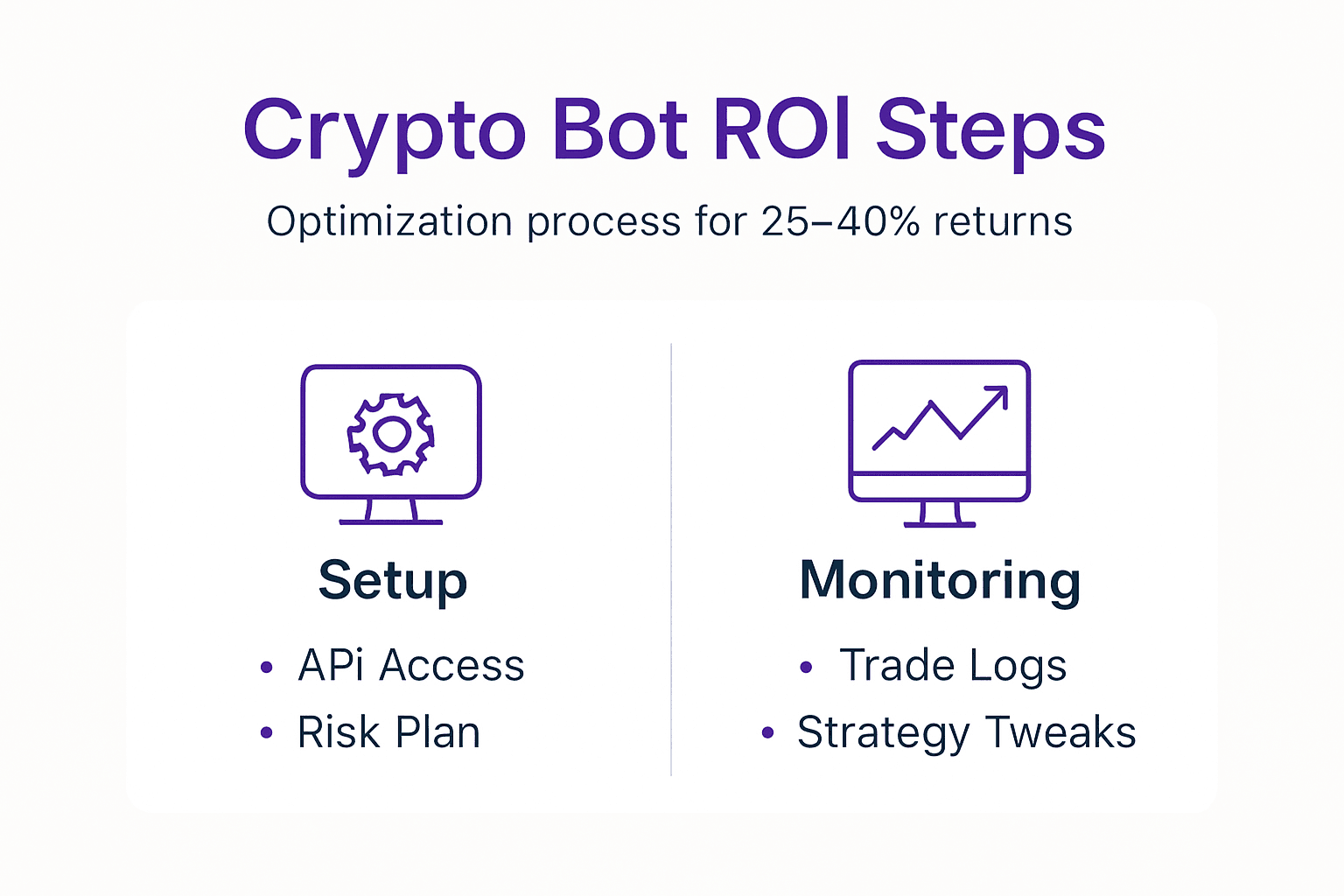
Risk reduction metrics matter as much as returns:
| Metric | Typical Range | What It Means |
|---|---|---|
| Annual ROI | 25-40% | Total profit as percentage of starting capital |
| Maximum Drawdown | 15-25% | Largest peak-to-trough decline during period |
| Win Rate | 55-65% | Percentage of trades that close profitably |
| Profit Factor | 1.5-2.5 | Gross profit divided by gross loss |
| Sharpe Ratio | 1.0-2.0 | Risk-adjusted return measurement |
Proper risk management outcomes include reducing drawdowns by 20-35% compared to unmanaged strategies. Stop losses and position sizing limits prevent single trades from devastating accounts, while diversification across strategies lowers portfolio volatility by 15-20%.
Win rates above 60% are achievable with ongoing optimization. While no strategy wins every trade, consistent refinement improves edge and execution quality. Focus on average win size exceeding average loss size, allowing profitability even with sub-50% win rates.
Rapid anomaly detection provides competitive advantage. Automated monitoring enables reaction times under one hour when issues emerge, preventing small problems from compounding into major losses. Manual traders cannot match this responsiveness across 24/7 crypto markets.
“Automated trading removes emotional decision-making and executes strategies consistently, leading to more predictable outcomes and better long-term results than discretionary approaches.” - Professional Crypto Trading Framework
This trading optimization results data comes from aggregated industry performance across various strategies and market conditions. Your individual results will depend on strategy selection, capital allocation, risk management discipline, and optimization consistency.
Optimize your crypto trading with Darkbot automation
Implementing the optimization process requires robust tools and infrastructure. Darkbot provides AI-powered crypto trading bots with customizable strategies that adapt to your goals and market conditions automatically.
Secure API integration and real-time monitoring come built-in, eliminating technical complexity. Connect to major exchanges in minutes, configure risk parameters through an intuitive interface, and track performance via comprehensive dashboards. Regular strategy optimization tools help you refine parameters based on actual trading data, maximizing ROI while managing risk effectively.
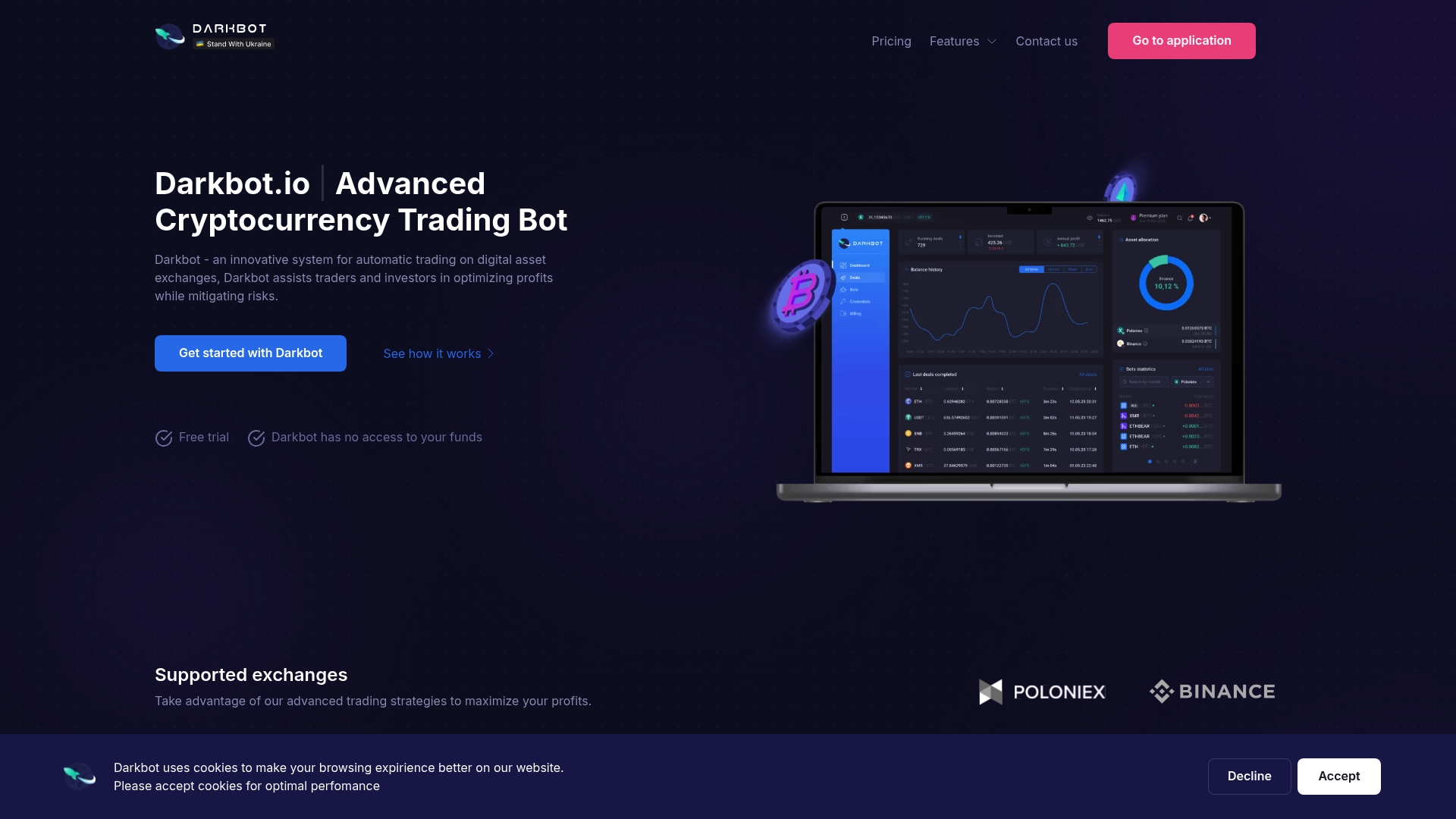
Access detailed implementation guides including this trading bot setup guide and AI-powered crypto trading optimization resources that walk you through every step. Whether you’re starting with basic strategies or implementing advanced multi-bot portfolios, Darkbot’s platform scales with your needs. Start optimizing your crypto trading today with the Darkbot AI-powered trading bot and join thousands of traders achieving consistent automated returns.
Frequently asked questions
What is the crypto trading optimization process?
The crypto trading optimization process is an iterative cycle of setup, execution, monitoring, and refinement using automated bots. You start by configuring secure API connections and customizing strategies to match your goals and risk tolerance. After launching with small capital, you continuously monitor performance metrics and adjust parameters based on market conditions and trading data. This trading strategy guide details the complete workflow for sustained success.
How do I secure my API keys for automated trading?
Use restricted API keys that grant trading permissions only, explicitly disabling withdrawal rights to protect funds even if credentials are compromised. Enable two-factor authentication on your exchange account for an additional security layer. Store API credentials in encrypted password managers rather than plain text files, and consider whitelisting IP addresses if your exchange supports this feature. This API key security guide covers advanced protection strategies.
What metrics show if my crypto trading bot is successful?
ROI, maximum drawdown percentage, win rate, and trade frequency are primary success metrics that indicate bot performance. Target annual ROIs between 25-40%, drawdowns under 25%, and win rates above 55% for well-optimized strategies. Consistent monitoring of these metrics combined with profit factor and Sharpe ratio calculations guides effective optimization decisions. Track performance using this trading bot performance metrics framework.
How often should I review and update my trading bot strategies?
Review bot performance at least weekly or immediately after significant market shifts to prevent strategy decay. Regular analysis of trading logs, metric trends, and market condition changes helps you identify optimization opportunities early. Adjust risk parameters, entry triggers, or position sizes based on performance data rather than emotions or hunches. This trading bot review schedule ensures systematic maintenance that sustains profitability over time.
Recommended

Start trading on Darkbot with ease
Come and explore our crypto trading platform by connecting your free account!
Free plan available • No credit card required