AI Applications in Digital Currencies: 2026 Trader's Guide

TL;DR:
- AI in digital currencies uses machine learning to analyze market data and automate trades effectively. Proper risk controls, cost-aware filters, and proposal-only architectures are essential for sustainable performance and security. Combining AI signals with human oversight and structured safeguards enhances investment outcomes in volatile markets.
AI applications in digital currencies are defined as the deployment of machine learning models, predictive analytics systems, and automated execution engines to analyze market data, manage portfolio risk, and execute trades across digital asset exchanges. These tools have moved well beyond simple rule-based bots. Today, models like XGBoost and LSTM networks process BTC/USDT tick data in real time, while platforms like Darkbot and autonomous wallet systems like MetaMask Agent Wallet apply AI to enforce trade logic and risk constraints at the execution layer. For investors and traders, the practical value is clear: AI reduces emotional decision-making, enforces consistent strategy rules, and processes data volumes no human analyst can match.
How machine learning models optimize cryptocurrency trading strategies
Machine learning in cryptocurrency trading centers on one core problem: extracting repeatable signal from extremely noisy price data. Models like XGBoost and LSTM networks are well-suited to this task because they identify nonlinear relationships between features such as volume, momentum, and order book depth that traditional statistical models miss.
The evidence for ML-driven performance is specific. Hourly BTC/USDT trading with cost-aware execution filters achieves annualized returns above 65% and Sharpe ratios over 1.0, outperforming naive ML strategies after transaction costs are accounted for. A Sharpe ratio above 1.0 means the strategy generates more than one unit of return for every unit of risk taken, which is a meaningful threshold in volatile crypto markets.
Cost-aware execution is the detail most traders overlook. Without filters that compare predicted returns against transaction costs, ML models generate excessive trade frequency. Cost-aware filters reduce portfolio turnover by 56%–83% by blocking trades where predicted returns do not exceed execution costs. That turnover reduction translates directly into higher net profitability, not just lower fees.
Walk-forward validation is the other non-negotiable. Excluding future data points during backtesting prevents data leakage and overfitting, which are the two most common reasons a backtest looks strong but live performance collapses. Any ML strategy that skips this step produces results that cannot be trusted.
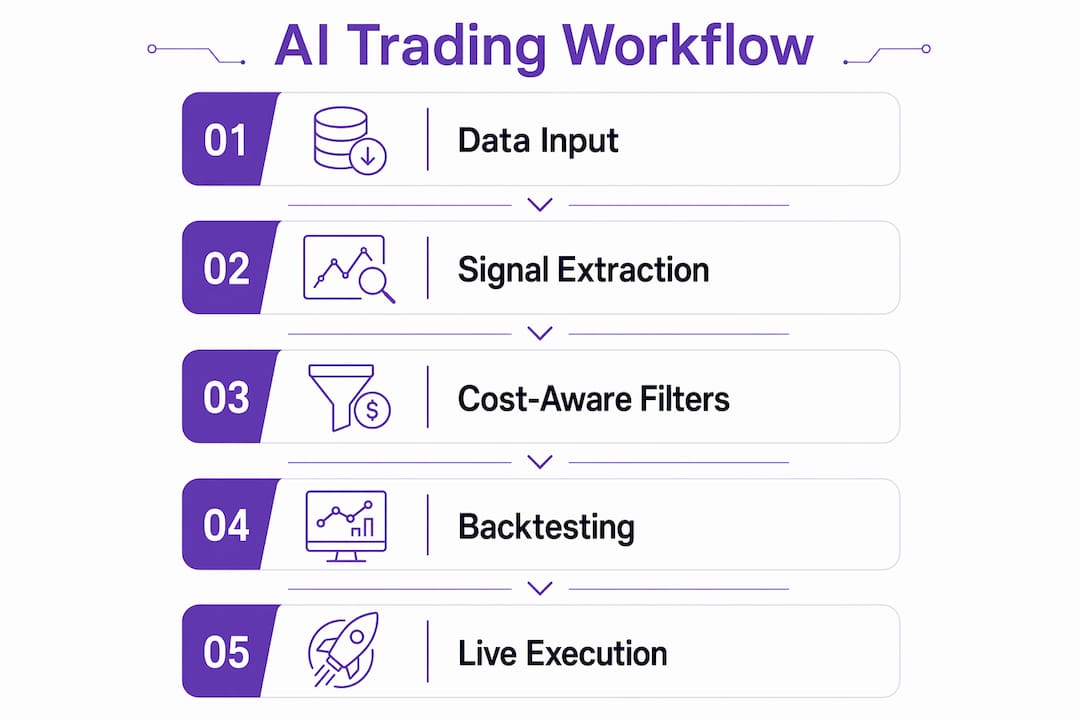
Pro Tip: Before deploying any ML model on live capital, run it through at least three non-overlapping walk-forward windows. If performance degrades significantly across windows, the model is fitting noise, not signal.
Key practices for ML-based crypto strategy development:
- Use cost-aware execution filters to limit trades to those where predicted returns exceed transaction costs
- Apply walk-forward validation with strict data partitioning to prevent overfitting
- Evaluate strategies on Sharpe ratio and maximum drawdown, not raw return alone
- Retrain models on rolling data windows to account for regime changes in crypto markets
How do autonomous AI trading systems compare on security?
Autonomous AI trading agents introduce a different category of risk: the agent itself can be compromised or act outside intended parameters. The global AI agent market for DeFi trading is projected to grow from $5.4 billion in 2024 to $236 billion by 2034. That growth also brings concentrated security exposure, with forecasts suggesting 1 in 4 enterprise breaches will involve AI agents by 2028.
The architectural response to this risk is the “proposal-only” model. Under this design, the AI generates a signed trade intent but cannot execute it unilaterally. The Aegis Vault architecture, for example, uses EIP-712 signed intents that a smart contract vault verifies against on-chain policy rules before any transaction executes. The AI proposes; the vault enforces.
| Architecture type | AI autonomy level | Execution control | Security mechanism |
|---|---|---|---|
| Fully autonomous agent | High | AI-controlled | Relies on agent integrity |
| Proposal-only (Aegis Vault) | Medium | Smart contract vault | EIP-712 intents, policy verification |
| Human-in-the-loop | Low | User-approved | Manual confirmation required |
| MetaMask Agent Wallet | Medium | Mandatory simulation | Transaction simulation, threat scanning |
MetaMask Agent Wallet takes a parallel approach. It integrates mandatory transaction simulations and threat scanning before any trade executes. Asset whitelists, fee caps, and commit-reveal schemes add additional layers. The trade-off is clear: higher autonomy increases execution speed but requires more robust on-chain guardrails to remain safe.
Proven secure architectures maintain a proposal-only model with user-controlled execution and on-chain policy vetting. This design means a compromised AI agent cannot drain a wallet unilaterally. For traders evaluating AI-driven platforms, the presence of on-chain policy enforcement is a more reliable security signal than any marketing claim.
Pro Tip: When evaluating any autonomous trading system, ask specifically whether the AI can execute transactions independently or only propose them. Proposal-only architectures with smart contract enforcement are materially safer than fully autonomous agents.
What role does predictive analytics play in crypto portfolio management?
Predictive analytics in crypto goes beyond price forecasting. The most effective systems fuse multiple independent data streams: on-chain metrics like wallet accumulation, technical indicators like RSI and MACD, and NLP-based sentiment extracted from news and social feeds. Converging independent indicators such as on-chain accumulation, sentiment divergence, and technical breakouts increases price reversal predictability more than any single signal alone.

Platforms like CryptoPulse demonstrate what multi-source fusion looks like in practice. CryptoPulse generates trading signals across 50+ crypto assets by combining on-chain data, technical indicators, and NLP sentiment, validated through walk-forward testing. That breadth matters because correlation between assets shifts during market stress, and a single-asset model misses portfolio-level risk.
Sentiment analysis using large language models adds another dimension. LLM-based sentiment analysis significantly improves expected return estimates, but it also introduces drawdown risk during periods of market stress when sentiment signals become noisy or contradictory. This means sentiment tools require a dedicated risk management module running in parallel, not as a standalone signal.
The strongest evidence points toward hybrid models. Hybrid AI-human approaches that combine AI-generated signals with human validation outperform both pure algorithmic and pure human analysis. Human expertise catches regime changes and black swan events that models trained on historical data cannot anticipate. You can read more about automated portfolio management and how AI applies to digital asset allocation in practice.
Key data sources for AI-driven portfolio analytics:
- On-chain metrics: wallet accumulation, exchange inflows, miner behavior
- Technical indicators: momentum, volume, volatility measures
- NLP sentiment: news feeds, social media, earnings calls for correlated assets
- Macro signals: interest rate expectations, stablecoin flows, regulatory announcements
Practical best practices for AI in volatile digital currency markets
Applying AI-driven investment strategies in live crypto markets requires more than a well-trained model. Risk controls, cost management, and disciplined execution rules determine whether a strategy survives real market conditions.
Circuit breakers are the most underused tool in AI-driven portfolios. Integrating topological and geometric circuit breakers into AI portfolio models reduces maximum drawdown by 28%–38% compared to traditional strategies. A 30% reduction in maximum drawdown is not a minor improvement. It is the difference between a strategy that survives a market crash and one that forces a liquidation at the worst possible moment.
Position sizing and stop-loss rules must be defined before deployment, not adjusted reactively. AI systems that allow dynamic position sizing without hard limits tend to concentrate risk during high-confidence signals, which are often the moments when model assumptions break down. Fixed position size limits and pre-set stop-loss thresholds act as a floor beneath the model’s judgment.
Transaction costs in crypto markets are not static. Advanced AI strategies model transaction costs as geometric and topological dynamics rather than fixed percentages. Slippage, spread, and gas fees all vary with market conditions. A strategy that ignores this variation will underperform its backtest consistently. For more on building structured risk frameworks, the risk management in crypto trading guide covers dedicated frameworks for AI-driven portfolios.
Pro Tip: Set a maximum daily drawdown limit in your trading system. When the AI hits that limit, it stops trading for the session. This single rule prevents the compounding losses that occur when a model operates in a regime it was not trained on.
The numbered checklist for live AI deployment:
- Define maximum position size per asset before going live
- Set circuit breaker thresholds that halt trading after a defined drawdown
- Apply cost-aware filters to block low-confidence, high-cost trades
- Validate the model on out-of-sample data from at least the last 90 days
- Monitor live performance against backtest benchmarks weekly and retrain on schedule
Key Takeaways
AI applications in digital currencies deliver measurable performance improvements only when cost-aware execution, walk-forward validation, and dedicated risk controls are built into the strategy from the start.
| Point | Details |
|---|---|
| Cost-aware execution matters | Filters that block low-return trades reduce portfolio turnover by 56%–83% and improve net profitability. |
| Proposal-only architectures are safer | AI agents that propose but cannot execute unilaterally reduce the risk of unauthorized or compromised transactions. |
| Hybrid models outperform pure AI | Combining AI-generated signals with human validation produces better market intelligence than either approach alone. |
| Circuit breakers reduce drawdowns | Topological and geometric circuit breakers cut maximum drawdown by 28%–38% versus traditional strategies. |
| Walk-forward validation is non-negotiable | Backtests without strict data partitioning overfit to historical noise and fail in live markets. |
Why I think most traders are using AI wrong in crypto
The most common mistake I see is treating AI as a prediction engine rather than a consistency engine. Traders deploy a model, see strong backtest numbers, and expect the live results to match. They rarely do, and the reason is almost always one of three things: overfitting to historical regimes, ignoring transaction costs, or running without any circuit breaker logic.
The research on cost-aware filters is particularly striking to me. A 56%–83% reduction in portfolio turnover from a single execution filter is not a marginal gain. It fundamentally changes the economics of a strategy. Yet most retail traders running automated systems never implement this. They optimize for signal accuracy and ignore execution efficiency entirely.
The security architecture discussion is where I think the field is genuinely advancing. Proposal-only models with on-chain policy enforcement are a real structural improvement over earlier autonomous agent designs. The MetaMask Agent Wallet approach, with mandatory transaction simulation before execution, is the kind of design that makes autonomous trading credible for serious capital. I expect this architecture to become the standard within two years.
The honest expectation for AI in crypto trading is this: it will not eliminate losses, and it will not predict market tops or bottoms. What it does well is enforce rules consistently, process more data than any human analyst, and reduce the behavioral errors that cost traders the most. That is a significant edge. It is just not the edge most people are marketing.
The traders who benefit most from AI tools are the ones who treat them as execution infrastructure, not as oracles. Build the risk framework first. Then let the model operate within it.
— Grisha
Put AI-driven trading to work with Darkbot
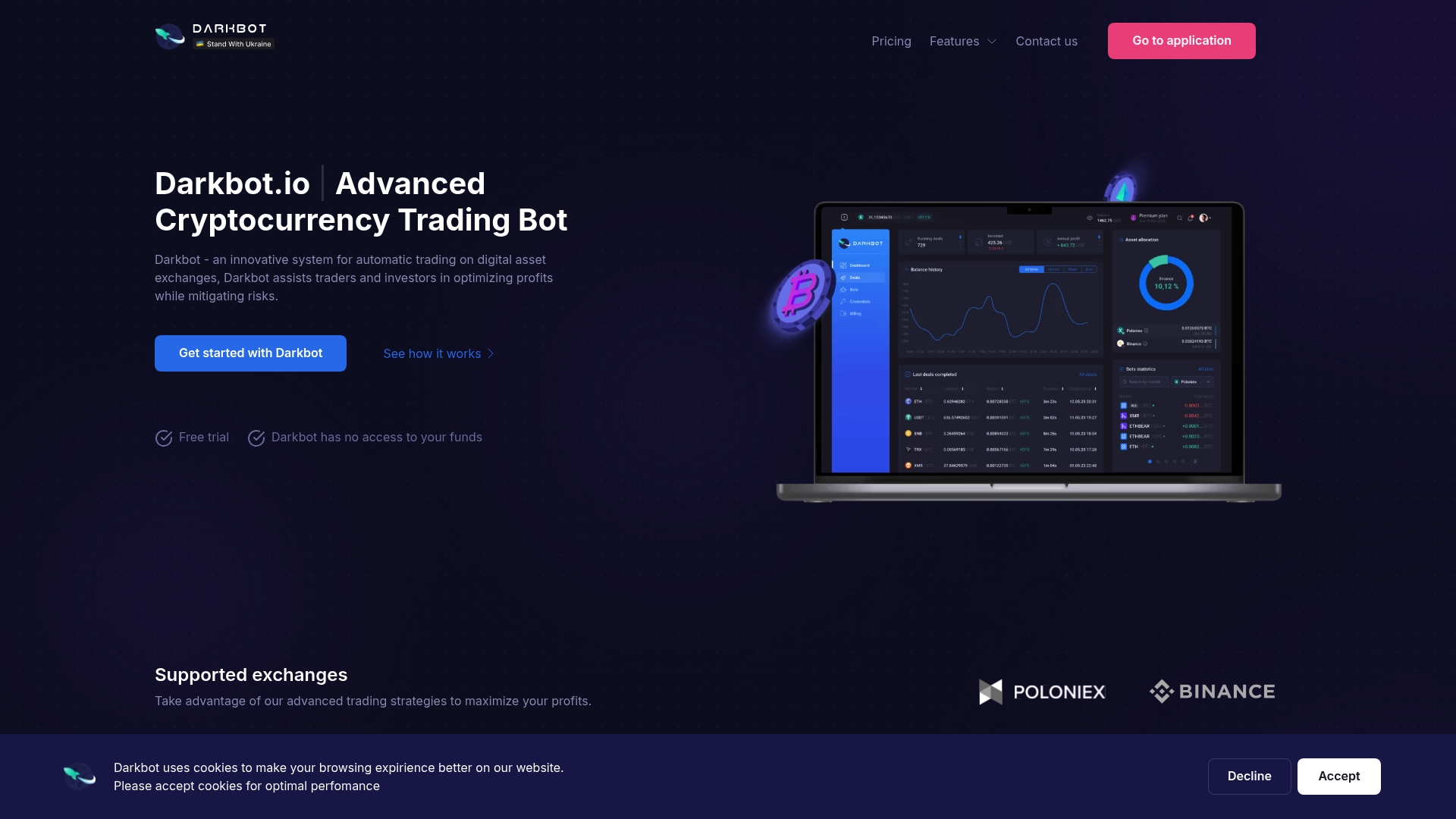
Darkbot is built for traders who want systematic execution without the complexity of building and maintaining their own AI infrastructure. The platform connects to multiple digital asset exchanges via API, runs multiple simultaneous trading bots, and applies machine learning logic to strategy execution and portfolio rebalancing in real time. Risk controls including position limits, stop-loss rules, and rebalancing thresholds are configurable without writing code. Whether you are managing a single asset or a diversified crypto portfolio, Darkbot provides the structured execution layer that AI-driven strategies require. Explore the full platform at Darkbot and see how automated strategy execution applies to your trading approach.
FAQ
What are AI applications in digital currencies?
AI applications in digital currencies include machine learning models for price signal extraction, NLP-based sentiment analysis, autonomous trading agents, and AI-driven portfolio optimization systems. These tools process on-chain data, technical indicators, and market sentiment to support systematic trading and risk management.
How does machine learning improve crypto trading performance?
Machine learning models like XGBoost and LSTM identify nonlinear patterns in price and volume data that traditional models miss. With cost-aware execution filters, hourly BTC/USDT strategies have achieved annualized returns above 65% and Sharpe ratios over 1.0 after transaction costs.
What is a proposal-only AI trading architecture?
A proposal-only architecture means the AI generates a signed trade intent but cannot execute it without verification by a smart contract vault. Systems like Aegis Vault use EIP-712 intents to enforce on-chain policy rules, preventing unauthorized or out-of-policy transactions even if the AI agent is compromised.
Why do AI crypto strategies fail in live markets?
The most common causes are overfitting to historical data, ignoring transaction costs, and operating without circuit breakers. Walk-forward validation and cost-aware execution filters address the first two. Dedicated risk management modules with drawdown limits address the third.
How does sentiment analysis affect crypto portfolio management?
LLM-based sentiment analysis improves expected return estimates by incorporating news and social signal data. However, it introduces drawdown risk during market stress periods, which means it requires a parallel risk management module rather than operating as a standalone signal source.
Recommended

Start trading on Darkbot with ease
Come and explore our crypto trading platform by connecting your free account!
Free plan available • No credit card required