AI Impact on Crypto Trading: What Traders Must Know
TL;DR:
- AI in crypto trading emphasizes rapid rule execution over prediction, transforming liquidity and market dynamics. It accounts for 65 to 80% of trading volume, with AI systems operating at speeds under 10 milliseconds and managing broader data inputs than humans. Regulatory bodies now mandate documented AI governance, risk management, and human oversight to address emerging security and fraud risks in machine-driven markets.
The AI impact on crypto trading is one of the most consequential structural shifts in financial markets right now, and most traders still misread what it actually means. AI is not a prediction engine. It does not know where Bitcoin is heading next. What it does is execute rules faster, with greater discipline, and across more data inputs than any human trader can manage. That distinction matters enormously, because the traders who treat AI as an oracle tend to make the same costly mistakes as those who ignore it entirely. Understanding what AI actually does in crypto markets is the foundation for trading smarter within them.
Key takeaways
| Point | Details |
|---|---|
| AI is reactive, not predictive | AI systems execute preconfigured rules based on live data. They do not forecast market direction. |
| Market liquidity is now dynamic | AI algorithms continuously place and cancel orders, changing how liquidity behaves in real time. |
| Execution speed creates real ROI gaps | Manual trading caps ROI significantly compared to AI-powered cross-exchange execution. |
| Risk management is rule-gated | Well-configured AI validates every trade against pre-set risk parameters before execution. |
| Regulatory scrutiny is growing | FINRA and the CFTC now require documented AI governance and human oversight for trading algorithms. |
How the AI impact on crypto trading actually works
At its core, an AI trading system is a logic engine. It reads market data, evaluates it against a set of rules, and executes or withholds a trade. The process is mechanical, not intuitive. That framing is worth holding onto throughout every section that follows.
The data inputs these systems consume are considerably broader than most manual traders monitor. A typical AI trading bot processes price feeds, order book depth, volatility readings, trade flow direction, and sentiment signals from news sources or social platforms, all simultaneously. The system does not interpret these signals the way a human analyst would. It compares current state to historical patterns and executes the prescribed action when thresholds are met.
Speed is where the operational difference becomes stark. AI bots execute trades in under 10 milliseconds, compared to a human reaction time of 200 to 250 milliseconds. That gap is not a minor technical footnote. In a volatile crypto market, price can move meaningfully in the window between a human recognizing a signal and clicking a button. AI systems close that window entirely.
The scale of AI participation is what truly defines the modern crypto market structure. AI-driven systems now account for 65 to 80% of crypto trading volume, with reported win rates in the 60 to 80% range across systematic strategies. You are not trading against a market composed mostly of human decision-makers. You are trading within a market that is predominantly machine-driven.
Key inputs that AI trading systems process in real time:
- Limit order book depth at multiple price levels across exchanges
- Trade flow imbalance indicating directional pressure from buyers or sellers
- Volatility metrics that adjust position sizing and entry criteria dynamically
- Sentiment signals parsed from news wires, social feeds, and on-chain activity
- Cross-exchange price spreads used to identify arbitrage and routing opportunities
Pro Tip: If you are backtesting a strategy that relies on signal timing, verify that your data feed’s timestamp resolution matches the actual execution environment. A mismatch of even 100 milliseconds can invalidate assumptions in fast-moving crypto markets.
Market structure and liquidity dynamics under AI
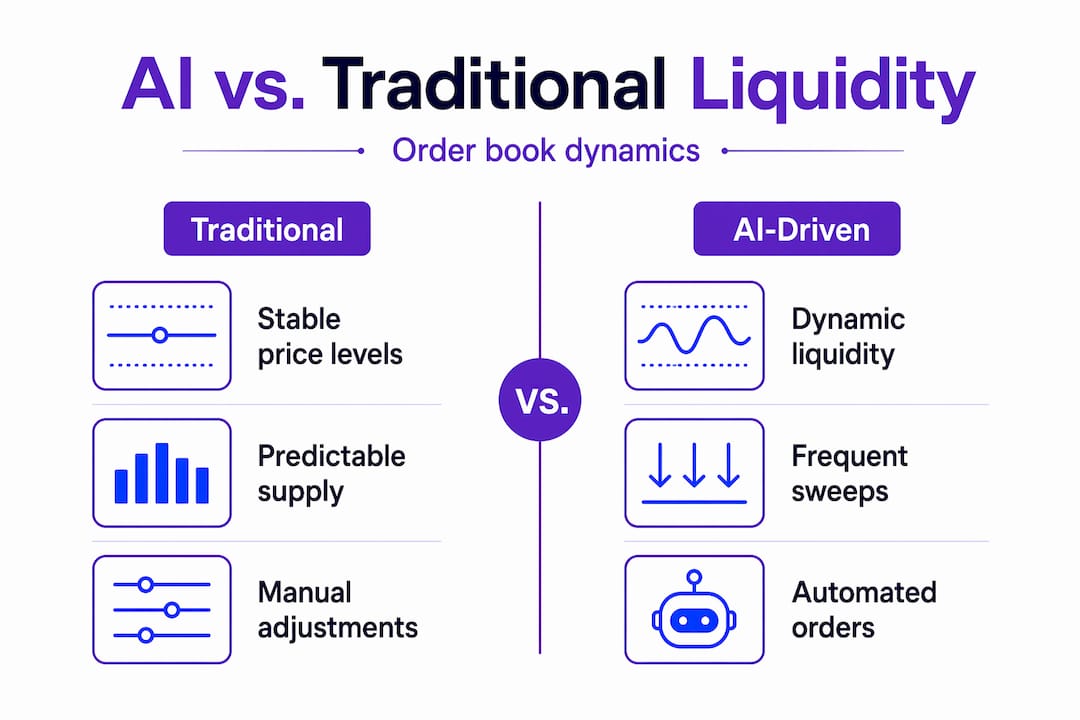
Traditional market analysis assumes liquidity is relatively stable around key price levels. That assumption no longer holds in crypto. AI transforms liquidity from fixed to dynamic, with algorithms continuously adjusting, placing, and canceling orders in response to each other’s behavior. The result is a liquidity environment that can shift substantially within seconds.
This creates a specific phenomenon traders need to understand: the liquidity sweep. When multiple AI systems simultaneously detect the same threshold or pattern, they can collectively drain liquidity at a price level faster than any individual participant can respond. What looks like a support zone on a chart can evaporate in milliseconds when the algorithms managing it all withdraw at once.
The following comparison illustrates how market behavior differs between human-dominated and AI-dominated trading environments:
| Characteristic | Human-dominated market | AI-dominated market |
|---|---|---|
| Liquidity stability | Relatively static between sessions | Continuously repositioned |
| Price movement pattern | Gradual trend development | Sharp bursts followed by rapid reversals |
| Reaction to news | Delayed, sentiment-driven | Immediate, rule-triggered |
| Order book depth | Predictable around key levels | Algorithmically adjusted in real time |
| Signal reliability | Standard technical analysis applies | Traditional patterns require revalidation |
“The shift from static to dynamic liquidity is not just a technical detail. It changes the meaning of every chart pattern and order book reading a trader relies on.” — adapted from market structure analysis in How AI and Automation Are Changing Trading Models
The practical implication for traders is that reading an order book in the traditional sense has become a conditional exercise. A large bid wall visible at a key level may represent genuine demand, or it may be a ghost order placed and withdrawn algorithmically. Developing pattern recognition for which is which requires understanding that the market you see is being actively shaped by systems that do not share your time horizon or risk profile.
Risk management and execution precision
One of the clearest benefits of AI in crypto trading is what it does to risk management discipline. Humans hesitate. They second-guess stops. They hold losing positions longer than their rules dictate because the emotional cost of realizing a loss is real. AI does none of that. It validates and executes according to the rules it was given, every time.

The execution precision advantage extends beyond individual trades. AI systems can implement pre-trade risk gates that check margin availability, aggregate exposure across positions, and verify that a new order does not create contradictory exposure on another exchange before the trade is placed. That kind of consolidated risk check is nearly impossible to replicate manually across multiple venues.
The ROI difference this creates is measurable. Manual cross-exchange execution caps monthly ROI at roughly 0.5%, while AI-powered systems capturing latency and routing advantages can reach 3%. The gap is not primarily about better signals. It is about execution quality and the ability to aggregate and act on information faster than the fragmented manual process allows.
Steps for applying AI-assisted risk management effectively:
- Define position-level limits before deployment. Set maximum exposure per asset, per exchange, and per strategy. The AI enforces what you specify.
- Implement pre-trade risk validation. Every order should pass checks on margin usage, leverage limits, and portfolio concentration before it executes.
- Aggregate positions across exchanges. Cross-exchange risk must be viewed at the portfolio level. Holding a long on one exchange and a short on another without visibility into net exposure is a structural failure.
- Model fees and slippage honestly in backtests. At a 5 basis point taker fee, 100x leverage round-trips cost 10% equity in fees alone. Strategies that look profitable on paper often are not.
- Set automated liquidation prevention thresholds. Configure your AI to reduce or exit positions before margin levels reach forced-liquidation territory.
Pro Tip: Avoid placing stops at round numbers or obvious technical levels. Liquidation trap mechanisms specifically target clustered stop orders. Randomizing your stop placement by a small percentage makes your position significantly less predictable to algorithms scanning for harvestable liquidity.
Regulatory and security implications
The regulatory environment around AI in crypto trading is tightening, and the direction of travel is clear. FINRA now requires generative AI risk management programs, and the CFTC deploys AI-driven surveillance tools to monitor market behavior. The expectation is not just that firms use AI responsibly. It is that they document how they use it, who oversees it, and what governance structures are in place.
FINRA and the SEC now expect comprehensive AI use case inventories from financial market participants. For retail traders using automated systems, this is largely a background concern, but for anyone operating at an institutional or professional scale, the compliance requirements are already operational obligations.
The security risk profile deserves separate attention. AI has not just changed how markets trade. It has changed how fraud operates.
- Deepfake-based trading scams use AI-generated audio and video to impersonate credible sources and promote fraudulent platforms
- Synthetic identity fraud allows bad actors to create convincing fake personas that pass basic verification checks
- AI-manipulated platform interfaces mimic legitimate exchange interfaces to capture credentials and funds
- AI-enabled crypto fraud increased 500% in one year, generating an estimated $20 billion in losses
- One documented case saw a trader lose $300,000 over three months to an AI-manipulated fake trading platform
The same technology that enables better execution also enables better deception. Vigilance about the tools and platforms you connect to is a non-negotiable part of operating in an AI-driven trading environment.
Practical applications for crypto traders
Translating all of this into actual practice comes down to a few specific areas where AI-driven trading strategies either protect you or leave you exposed.
The liquidation trap is the most common and most costly structural risk for retail crypto traders. Exchanges and large participants use stop order visibility to identify clustered stop levels and trigger cascades that force liquidations before price resumes its prior direction. Countering this requires order type selection that limits visibility, position diversification across venues, and stop placement that does not conform to predictable patterns.
Cross-exchange position management is a structural gap in most retail approaches. When positions exist on multiple exchanges without consolidated risk visibility, exposure can compound in ways that are not apparent until a volatile move forces reckoning. AI-powered portfolio management tools exist specifically to solve this problem, aggregating real-time risk data across venues.
Realistic simulation before live deployment separates professional from amateur AI strategy deployment. Backtesting that ignores fee drag produces results that live trading cannot replicate. Include actual taker and maker fee schedules, realistic slippage estimates for your position size, and latency assumptions that reflect your actual infrastructure, not ideal conditions.
The future of AI in crypto favors traders who treat AI as a structural tool rather than a trading signal. The edge it provides is in execution consistency, risk discipline, and the capacity to process far more information simultaneously than any human. Those are genuine, durable advantages when applied within a well-defined strategy framework.
My honest take on AI and the trading edge illusion
What I find most interesting about how AI is reshaping crypto markets is not the speed advantage. Speed has always been competed away relatively quickly. What actually matters is that competitive advantage in AI-driven markets has shifted from unique signals to execution intelligence. Scale, adaptability, and system quality now determine outcomes more than any specific analytical insight.
I have seen traders spend enormous energy trying to find an AI that tells them where price is going. That framing will cost you money. The more productive question is whether your execution system is consistent enough, and your risk rules disciplined enough, to let a modest edge compound over time without being eroded by fees, slippage, and emotional decision-making.
The microstructure effects are also underappreciated. The algorithmic liquidity sweeps I described earlier are not random. They exploit pattern recognition across thousands of similar trading accounts. If your stops are predictable, they will be targeted. The practical response is not to abandon structure, but to randomize placement, diversify venues, and configure pre-trade risk gates that prevent single events from compounding into account-level damage.
My broader observation is this: AI has not made crypto trading easier. It has made the competitive field more mechanically demanding. Traders who succeed going forward will be those who understand both what AI can execute reliably and where human judgment on strategy design still adds genuine value.
— Grisha
How Darkbot applies these principles in practice
If the concepts covered in this article sound demanding to implement manually, that is because they are. Consistent pre-trade risk validation, cross-exchange position aggregation, fee-adjusted execution logic, and dynamic order management require infrastructure that goes well beyond spreadsheets and manual monitoring.
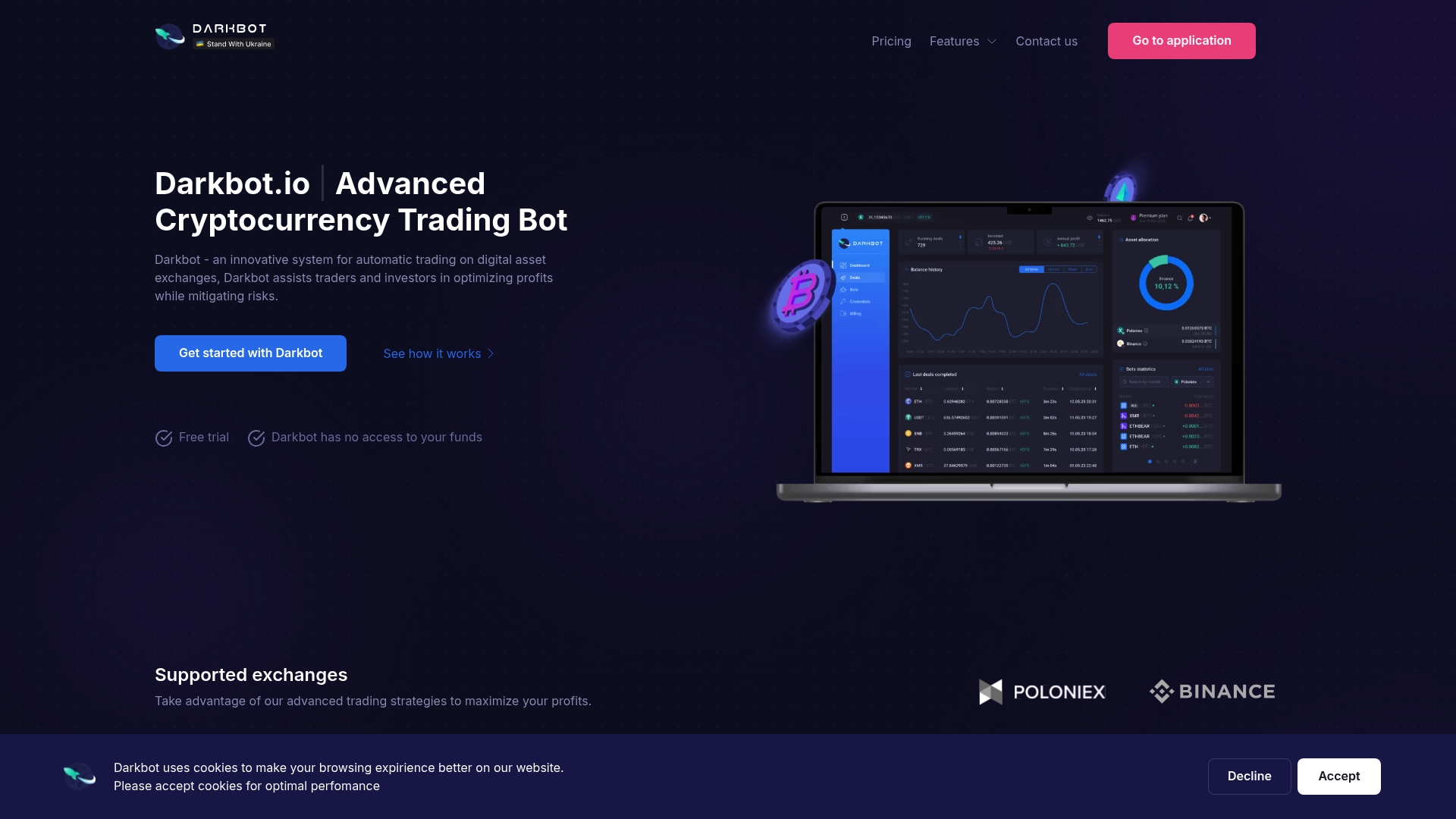
Darkbot is built around exactly these mechanisms. The platform automates trading execution across multiple exchanges with real-time risk gating, position-level monitoring, and strategy customization that reflects how AI actually functions: as a rule-driven system, not a prediction tool. Whether you are deploying your first automated strategy or managing a diversified multi-exchange portfolio, Darkbot’s AI-powered trading platform gives you the structural tools to execute consistently and manage risk at the level the current market demands.
FAQ
What percentage of crypto trading is AI-driven?
AI-driven systems currently account for 65 to 80% of crypto trading volume, with execution speeds under 10 milliseconds. This means the majority of order flow in most crypto markets is machine-generated.
Does AI predict cryptocurrency price movements?
No. AI trading systems execute preconfigured rules based on live market data. They react to conditions rather than forecast outcomes, and no AI system reliably predicts price direction with certainty.
How does AI affect liquidity in crypto markets?
AI algorithms continuously place and cancel orders, converting liquidity from a relatively stable resource into a dynamic one. This can cause sudden liquidity sweeps at key price levels, which is a structural feature that traditional chart analysis does not account for.
What are the biggest risks of using AI trading tools?
The primary operational risks include fee drag in high-frequency strategies, liquidation traps targeting predictable stop placement, unmanaged cross-exchange exposure, and security risks from AI-facilitated fraud. Realistic backtesting and documented risk parameters reduce most of these.
What do regulators require from AI crypto traders?
Regulatory bodies including FINRA and the CFTC require documented AI governance, risk management programs, and evidence of human oversight for automated trading systems. Compliance obligations are expanding and now extend to use case inventories for AI-deployed strategies.
Recommended

Start trading on Darkbot with ease
Come and explore our crypto trading platform by connecting your free account!
Free plan available • No credit card required