Machine Learning in Financial Engineering: 2026 Guide

TL;DR:
- Machine learning in financial engineering involves adapting statistical algorithms to predict, assess risk, and automate trading in complex markets. Modern approaches emphasize regime-aware, decision-focused frameworks like agentic control, which outperform traditional prediction models. Success relies on matching models to data structure, building robust infrastructure, and integrating transparency for deployment.
Machine learning in financial engineering is defined as the systematic application of statistical learning algorithms to financial data for the purpose of predictive modeling, risk quantification, and automated trade execution. Where traditional econometric models rely on fixed assumptions about return distributions and market structure, ML-based approaches adapt to new data continuously, making them better suited to the non-stationary, high-dimensional nature of financial markets. Institutions from Renaissance Technologies to JPMorgan’s quantitative research division now treat ML not as a supplementary tool but as the primary modeling framework. Programs like Baruch College’s 8-week ML course for financial engineers reflect how deeply this shift has penetrated formal training, with strong emphasis on Python and C++ for implementation.
What are the primary machine learning algorithms used in financial engineering?
The algorithm selection problem in financial engineering is not about finding the single best model. It is about matching model architecture to the structure of the data and the decision horizon of the strategy.

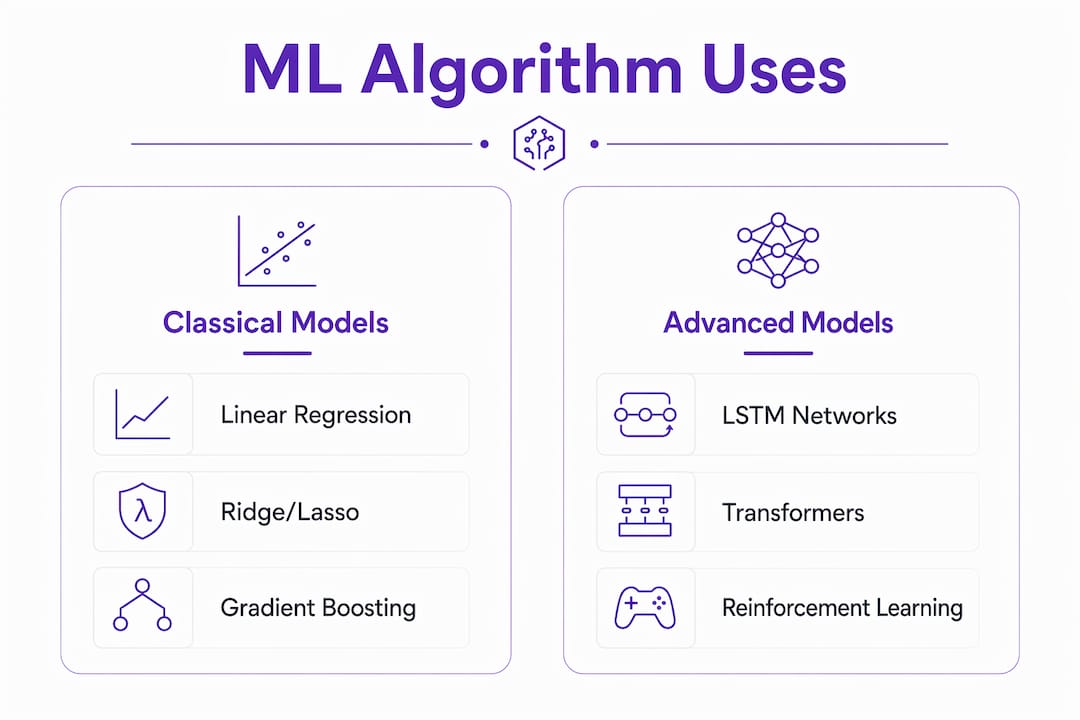
Classical models remain relevant for specific tasks. Linear regression and regularized variants like Ridge and Lasso work well for factor exposure estimation where interpretability matters. Support vector machines handle classification problems in credit scoring and event detection. Random forests provide strong baseline performance for tabular financial data, and modern toolkits like Finverse enable simultaneous training on 80+ companies using Gradient Boosting Machines with 80% confidence in ticker-level forecasts, alongside automated GARCH volatility estimation and Isolation Forest for anomaly detection. That combination of speed and breadth is difficult to replicate with hand-tuned single-asset models.
Deep learning architectures address problems that classical models cannot. Long short-term memory networks (LSTMs) capture temporal dependencies in price and volume sequences. Convolutional neural networks (CNNs) extract local patterns from multi-asset return matrices. Graph attention networks (GATs) model cross-asset relationships by treating the market as a graph where edges represent correlation or causal linkages. Among sequence models, Transformer architectures outperform LSTM/GRU for long sequences, high-frequency data, and multi-asset cross-sectional analysis, because self-attention computes relationships between all sequence positions simultaneously rather than processing them one step at a time.
Reinforcement learning (RL) occupies a distinct category. Rather than predicting a target variable, RL agents learn a policy that maps market states to trading actions by maximizing a cumulative reward signal. This makes RL architectures naturally suited to execution optimization, where the cost of each trade depends on the sequence of prior decisions.
Pro Tip: Match your model class to your data regime. Use tree-based models for structured tabular data with many categorical features, LSTMs or Transformers for sequential price data with long-range dependencies, and reinforcement learning agents for multi-step execution problems where feedback is delayed.
| Model class | Best use case | Key limitation |
|---|---|---|
| Gradient Boosting Machines | Factor forecasting, tabular data | Requires manual feature engineering |
| LSTM / GRU | Time-series prediction, sequence modeling | Slow training, vanishing gradients on long sequences |
| Transformer | Multi-asset cross-sectional, high-frequency | High memory cost, needs large datasets |
| Graph Neural Networks | Cross-asset dependency modeling | Graph construction is non-trivial |
| Reinforcement Learning | Execution optimization, dynamic allocation | Reward design is difficult; prone to overfitting |
How have ML techniques evolved in financial engineering?
The evolution of quantitative finance through a machine learning lens follows three distinct waves, each defined by how models acquire and process information.
-
Wave 1: Manual feature engineering (2000s to early 2010s). Practitioners built features by hand: momentum signals, mean-reversion indicators, volatility ratios. SVMs and random forests consumed these features and produced predictions. The bottleneck was the quality of human-designed inputs, and models were brittle when market regimes shifted.
-
Wave 2: Automatic feature extraction (mid-2010s to early 2020s). Deep learning eliminated the need for manual feature construction. LSTMs learned temporal structure directly from raw price sequences. CNNs extracted spatial patterns from return matrices. GATs modeled inter-asset relationships without requiring a predefined correlation structure. This wave dramatically expanded the complexity of problems that could be addressed, though it introduced new challenges around interpretability and training stability.
-
Wave 3: Agentic reinforcement learning and regime-aware systems (2022 to present). The current frontier treats the portfolio manager as an agent operating within a structured environment. These systems integrate regime inference and LLM signals with friction-aware convex optimization in a unified adaptive framework. The shift from prediction to decision-making is the defining characteristic of this wave.
The practical implication of this progression is significant. A Wave 1 model produces a forecast. A Wave 3 system produces a trade, sized and timed according to current market conditions, transaction cost estimates, and risk budget constraints. For practitioners working on ML trading efficiency, understanding which wave your current infrastructure belongs to determines what class of problems you can realistically solve.
What are the main challenges when applying ML to financial data?
Financial data violates nearly every assumption that makes ML straightforward in other domains. Recognizing these violations before model design begins is what separates practitioners who produce deployable systems from those who produce impressive backtests.
The core data challenges include:
- Asynchronous ragged filtration. Financial instruments report data at different frequencies and with different lags. Mixing daily equity prices with quarterly earnings and intraday order flow creates non-aligned time series. The Directed Delay mechanism in DeePM addresses this by prioritizing causal impulse-response learning over contemporaneous correlation, which reduces spurious overfitting to timing artifacts.
- Low signal-to-noise ratio. Financial returns contain very little predictable signal relative to noise. Models that appear to generalize in cross-validation often fail out-of-sample because they have learned noise patterns specific to the training period.
- Surrogate loss misalignment. Optimizing MSE does not correlate well with realized profit and loss. Practitioners who build fully differentiable trading simulators and optimize Sharpe ratio or maximum drawdown directly within the computation graph consistently outperform those who use prediction accuracy as a proxy for trading performance.
- Interpretability constraints. Regulators and risk committees require explanations for model-driven decisions. Generic neural network libraries produce black-box outputs. Finance-native data contracts that separate factor-premium forecasting from asset mapping preserve interpretability without sacrificing model complexity.
Pro Tip: Before training any model on financial data, build a differentiable mark-to-market simulator that reflects your actual cost structure. Optimizing against realized Sharpe or drawdown from the start eliminates the surrogate loss problem entirely.
Traditional grid-based numerical methods also fail above roughly 10 state dimensions, which is why random-weight neural networks (RWNNs) have gained traction for high-dimensional option pricing. RWNNs achieve comparable accuracy to fully trained deep nets while requiring significantly less computation, making them practical for real-time pricing applications.
How are ML models applied to portfolio optimization and algorithmic trading?
The most consequential application of machine learning for financial engineering is not prediction. It is decision-making under uncertainty at the portfolio level, where the objective is not to forecast returns accurately but to construct and execute positions that maximize risk-adjusted performance net of costs.
Static mean-variance optimization, the Markowitz framework, requires stable covariance estimates and produces portfolios that are highly sensitive to input errors. ML-driven approaches replace static inputs with adaptive estimates and add regime-conditioning to the allocation logic.
| Framework | Inputs | Adaptation mechanism | Key limitation |
|---|---|---|---|
| Mean-variance (Markowitz) | Historical returns, covariance | None | Sensitive to estimation error |
| ML factor model | ML-predicted factor exposures | Periodic retraining | Regime blindness between retrains |
| DeePM structured deep learning | Graph priors, macro signals | Directed Delay, causal sieve | Requires extensive data infrastructure |
| Agentic RL framework | Regime signals, LLM inputs, cost estimates | Continuous policy updates | Complex reward design |
DeePM, a structured deep-learning macro portfolio manager, demonstrates what is achievable at the current frontier. Models using the Directed Delay mechanism and graph priors improve upon Momentum Transformer by approximately 50%, and the overall system achieves roughly double the risk-adjusted returns of classical trend-following strategies. That performance gap reflects the value of causal structure and regime awareness, not simply more parameters.
Agentic frameworks take this further by integrating regime inference, forward-looking large language model signals, and friction-aware convex optimization within a single system. Research published in 2026 shows these frameworks outperform non-agentic benchmarks with Sharpe ratio gains of +0.373 net of transaction costs. The deterministic state-action controller within these systems replaces trial-and-error RL loops with explicit mappings for dynamic risk budget adjustments and execution gating, which improves both interpretability and cost discipline under regime shifts.
For practitioners building crypto trading strategies, the same principles apply. Regime-aware allocation, cost-conscious execution, and Sharpe-gated trade activation are architecture decisions, not asset-class-specific features.
Key takeaways
Machine learning in financial engineering delivers its highest value when models are matched to data structure, optimized against realized trading objectives, and embedded within regime-aware execution frameworks rather than used as standalone prediction engines.
| Point | Details |
|---|---|
| Algorithm selection matters | Match Gradient Boosting to tabular data, Transformers to sequential multi-asset data, and RL to execution problems. |
| Three evolutionary waves | Financial ML progressed from manual features to deep learning to agentic regime-aware systems. |
| Surrogate loss is a trap | Optimize Sharpe ratio or drawdown directly using differentiable simulators, not MSE or prediction accuracy. |
| Agentic frameworks lead performance | Unified agentic systems show Sharpe ratio gains of +0.373 net of costs over non-agentic benchmarks. |
| Interpretability requires architecture | Finance-native modular contracts separate forecasting from allocation to preserve explainability. |
Where financial ML is actually heading, from my perspective
The research community has moved faster than most practitioners realize. The gap between what is published and what is deployed in production systems is widening, and the practitioners who close that gap fastest will have a structural advantage.
My view is that the most underrated development is not Transformer architectures or large language model integration. It is the shift from reward-driven reinforcement learning to deterministic agentic control. Reward-driven RL is notoriously difficult to stabilize in live markets because the reward signal is noisy and non-stationary. Deterministic controllers that map states to actions explicitly are easier to audit, easier to constrain, and more consistent under regime shifts. That combination of transparency and stability is what risk committees actually need before approving a model for live capital.
Physics-informed neural networks and RWNNs are also underutilized. Most practitioners default to standard deep nets for option pricing and volatility surface modeling, but high-dimensional PDE solvers based on RWNNs offer faster training and provable error bounds. That matters when you need to price thousands of instruments in real time.
The honest challenge is that none of these techniques work without clean data infrastructure, disciplined backtesting, and a clear link between model outputs and execution logic. The teams that get this right treat the trading simulator as a first-class engineering artifact, not an afterthought. For anyone exploring ML in fintech applications, that infrastructure investment is where the real work begins.
— Grisha
How Darkbot applies systematic ML logic to crypto trading
The principles covered in this article, including regime-aware allocation, cost-conscious execution, and rule-driven risk control, are the same principles that underpin how Darkbot approaches automated cryptocurrency trading. Darkbot is an AI-based trading automation platform built around systematic execution and structured decision-making rather than discretionary signals. The platform supports strategy customization, automated portfolio rebalancing, and real-time analytics across multiple exchanges via API integration. For data scientists and finance professionals who want to apply these frameworks to digital asset markets without building execution infrastructure from scratch, Darkbot’s portfolio management tools provide a structured starting point. Explore the full platform at Darkbot.
FAQ
What is machine learning in financial engineering?
Machine learning in financial engineering is the application of statistical learning algorithms to financial data for predictive modeling, risk assessment, and automated trade execution. It differs from traditional econometric modeling by adapting continuously to new data rather than relying on fixed distributional assumptions.
Which ML algorithms are most used in quantitative finance?
Gradient Boosting Machines, LSTM networks, Transformer architectures, and reinforcement learning agents are the most widely used. Transformer models outperform LSTM and GRU for long sequences and multi-asset cross-sectional analysis due to their self-attention mechanism.
Why does optimizing for prediction accuracy fail in trading?
Optimizing surrogate losses like MSE does not correlate well with realized profit and loss. Practitioners achieve better results by building differentiable trading simulators and optimizing directly for Sharpe ratio or drawdown within the computation graph.
What is an agentic portfolio optimization framework?
An agentic framework integrates regime inference, LLM-based forward signals, and friction-aware convex optimization into a unified system that continuously updates its allocation policy. Research shows these systems deliver Sharpe ratio gains of +0.373 net of transaction costs over non-agentic benchmarks.
How do practitioners handle interpretability in financial ML models?
Finance-native data contracts that separate factor-premium forecasting from asset mapping preserve model interpretability without reducing complexity. This modular architecture allows risk teams to audit individual components rather than treating the entire system as a black box.
Recommended

Start trading on Darkbot with ease
Come and explore our crypto trading platform by connecting your free account!
Free plan available • No credit card required