API-based exchange integration in crypto trading

Managing trades across multiple crypto exchanges while watching market movements 24/7 is exhausting and error-prone. API-based exchange integration automates this entire process, letting you execute sophisticated trading strategies programmatically across all your accounts. This guide explains how API integration works, the security measures you need, and practical steps to start automating your crypto trading today.
Key takeaways
| Point | Details |
|---|---|
| Automated multi-exchange trading | API integration connects your trading bots to multiple exchanges simultaneously, executing strategies without manual intervention. |
| Speed and accuracy advantages | Automation eliminates manual delays and reduces execution errors, improving trade timing and portfolio performance. |
| Security requires diligence | Protect API keys through permission limits, IP whitelisting, encrypted storage, and regular monitoring to prevent unauthorized access. |
| Exchange APIs vary significantly | Rate limits, protocol support, and security features differ across platforms, requiring careful evaluation before integration. |
| Implementation needs testing | Generate keys with minimal permissions, test connections safely, and monitor bot performance continuously for optimal results. |
Introduction to API-based exchange integration
An Application Programming Interface (API) serves as a bridge between your trading software and cryptocurrency exchanges, enabling programmatic access to market data and order execution. Exchange integration refers to connecting these APIs to automated trading bots that can monitor markets, analyze opportunities, and execute trades based on predefined strategies without human intervention.
This automation transforms how traders manage their portfolios. Instead of manually placing orders on different exchange websites, API integration allows simultaneous management of multiple accounts from a single interface. The speed advantage is substantial because bots can react to market movements in milliseconds rather than the seconds or minutes required for manual trading.
The adoption of robust API support has become standard across major exchanges. Benefits extend beyond speed:
- Execute complex strategies involving multiple exchanges and trading pairs simultaneously
- Scale operations without proportionally increasing time investment or human resources
- Maintain consistent strategy application without emotional interference or fatigue
- Access historical and real-time data feeds for advanced analytics and backtesting
As cryptocurrency markets operate continuously without closing hours, API-based automation becomes essential for traders seeking to capitalize on opportunities around the clock. The technology democratizes sophisticated trading approaches previously available only to institutional players with dedicated trading desks.

How API integration enables automated trading
Cryptocurrency exchanges expose their trading functionality through two primary protocols. REST APIs provide request-response interactions for actions like placing orders, checking balances, or retrieving historical data. WebSocket APIs maintain persistent connections that stream real-time price updates and order book changes, enabling bots to react instantly to market movements.
Trading bots leverage these protocols to operate autonomously. They continuously fetch live market prices, analyze trends using technical indicators, and execute buy or sell orders based on algorithmic logic. When a bot detects a trading signal that matches its strategy parameters, it sends an authenticated API request to the exchange to place the order immediately.
Modern AI-powered bots add another layer of sophistication. They use machine learning models trained on historical market data to predict price movements and optimize entry and exit points. This automated crypto trading approach can adapt strategies dynamically based on changing market conditions.
Key technical capabilities that APIs provide:
- Real-time access to order books, recent trades, and ticker data across all trading pairs
- Order management functions including market orders, limit orders, stop losses, and order cancellations
- Account information retrieval for checking balances, open positions, and transaction history
- Authenticated secure communication using API keys and secret signatures to verify identity
Pro Tip: Start with paper trading or very small position sizes when first deploying API-connected bots. This lets you verify your bot’s logic and API integration work correctly before risking significant capital.
The elimination of manual intervention means trades execute at optimal moments without delay. When arbitrage opportunities appear between exchanges, bots can exploit price differences in seconds before they disappear. This programmatic speed advantage explains why cryptocurrency API integration has become fundamental to competitive trading in 2026.
Security considerations and best practices
API access introduces security risks that require careful management. Compromised API keys grant attackers control over your exchange accounts, potentially allowing unauthorized trades or, if withdrawal permissions are enabled, theft of your assets. Data breaches affecting exchanges or trading platforms can expose API credentials if not properly secured.
The most critical security practice involves limiting API key permissions. Most exchanges allow granular control over what actions each key can perform. Create keys with only the minimum permissions required for your bot’s functionality. If your strategy only needs to read market data and place trades, never enable withdrawal rights on that key.
Implementing robust API key security measures should include:
- IP address whitelisting to restrict API access to known, trusted IP addresses only
- Encrypted storage of keys using secure credential management systems rather than plain text files
- Regular key rotation every 30 to 90 days to limit exposure windows if credentials are compromised
- Two-factor authentication (2FA) on exchange accounts as an additional security layer
- Activity monitoring through exchange logs to detect unusual API calls or unauthorized access attempts
Pro Tip: Many exchanges support IP security features that dramatically reduce risk. Always enable IP whitelisting when available, even if it requires a static IP address setup.
Never share API keys through unsecured channels like email or messaging apps. If you need to provide keys to a trading platform or service, verify their security practices and reputation thoroughly. Reputable platforms implement API key integration with secure handling protocols, but due diligence remains your responsibility.
If you suspect a key has been compromised, revoke it immediately through the exchange interface and generate new credentials. Most security incidents result from poor key management practices rather than technical exploits, making human discipline the most important security factor.
Comparison of API features across cryptocurrency exchanges
Major cryptocurrency exchanges offer varying API capabilities that significantly impact bot performance and security. Understanding these differences helps you select platforms aligned with your trading requirements and technical expertise.
| Exchange | Rate Limits | Protocol Support | Security Features | Best For |
|---|---|---|---|---|
| Binance | 2400 requests/min (weight system) | REST, WebSocket, WebSocket Streams | IP whitelisting, permission controls, withdrawal whitelist | High-frequency trading, advanced strategies |
| Coinbase Pro | 15 requests/sec public, 10/sec private | REST, WebSocket | API secret rotation, IP restrictions | Beginners, simple strategies |
| Kraken | 20 requests/sec (tier-based) | REST, WebSocket | IP whitelisting, permission granularity, 2FA lock | Security-focused users, moderate volume |
| Bybit | 120 requests/min (varies by endpoint) | REST, WebSocket | IP restriction, read-only keys, sub-accounts | Derivatives trading, leverage strategies |
Binance provides the most generous rate limits using a weight-based system where different endpoints consume varying amounts of quota. This flexibility suits sophisticated bots making numerous API calls for market analysis and rapid order adjustments. The comprehensive WebSocket support delivers real-time data with minimal latency.

Coinbase Pro offers a more straightforward API structure with lower rate limits, making it accessible for those new to API integration. The simplified approach reduces complexity but may constrain bots requiring frequent data updates or managing many simultaneous positions.
Kraken balances security features with reasonable rate limits. The tier-based system rewards higher trading volumes with increased API access. Strong IP whitelisting capabilities and granular permission controls make it attractive for security-conscious traders.
Bybit specializes in derivatives trading with APIs optimized for perpetual contracts and futures. Rate limits vary significantly by endpoint, requiring careful planning to avoid throttling during peak bot activity.
Trade-offs exist between feature richness and implementation complexity. Exchanges with advanced capabilities require more sophisticated error handling and rate limit management in your bot code. Those prioritizing ease of use may accept lower limits for simpler integration.
Implementing API-based exchange integration with trading bots
Successfully deploying API-connected trading bots requires systematic implementation following security best practices. This step-by-step approach minimizes risks while establishing reliable automation.
-
Generate API keys with restricted permissions. Log into your chosen exchange and navigate to the API management section. Create a new key specifically for bot trading. Enable only “Read” and “Trade” permissions initially. Never enable “Withdraw” unless your strategy explicitly requires automated withdrawals, which most don’t.
-
Configure IP whitelisting if available. Add your bot’s server IP address or your home network IP to the whitelist. This ensures API requests from other locations are rejected automatically, preventing unauthorized access even if keys are somehow exposed.
-
Securely store credentials in your bot. Use environment variables or encrypted configuration files rather than hardcoding keys directly into your bot’s source code. Many trading bot setup guides recommend credential management systems that encrypt keys at rest.
-
Test API connections in a safe environment. Before deploying with real capital, verify your bot can successfully authenticate, retrieve market data, and place small test orders. Many exchanges offer testnet environments or you can simply use minimal position sizes initially.
-
Implement error handling and rate limit management. Your bot must gracefully handle API errors, network issues, and rate limit responses. Build in exponential backoff when encountering rate limits and logging for all API interactions to troubleshoot problems.
-
Monitor performance and adjust strategies regularly. Even after successful deployment, continuously review bot performance metrics, order execution logs, and exchange API status. Market conditions change, requiring trading workflow adjustments to maintain effectiveness.
-
Set up alerts for unusual activity. Configure notifications for unexpected behaviors like failed authentication attempts, unusual trading volumes, or significant losses that might indicate bot malfunction or security issues.
Pro Tip: Document your entire API configuration process, including which permissions are enabled and why. This documentation becomes invaluable when troubleshooting issues or scaling to additional exchanges later.
Regular maintenance ensures ongoing reliability. Review exchange API changelog announcements since providers occasionally deprecate endpoints or modify rate limits. Following a comprehensive trading bot guide helps structure your implementation to avoid common pitfalls that lead to bot failures or security vulnerabilities.
Risk management remains critical even with automation. Set maximum position sizes, daily loss limits, and circuit breakers that pause trading during extreme volatility. API integration enables sophisticated automation, but human oversight through proper monitoring and periodic strategy evaluation ensures long-term success.
Explore your API trading automation options with Darkbot
Implementing API-based exchange integration manually requires significant technical expertise and ongoing maintenance. Darkbot eliminates this complexity by providing AI-powered crypto trading bots with seamless multi-exchange API integration built in. You get sophisticated automation without writing code or managing infrastructure.
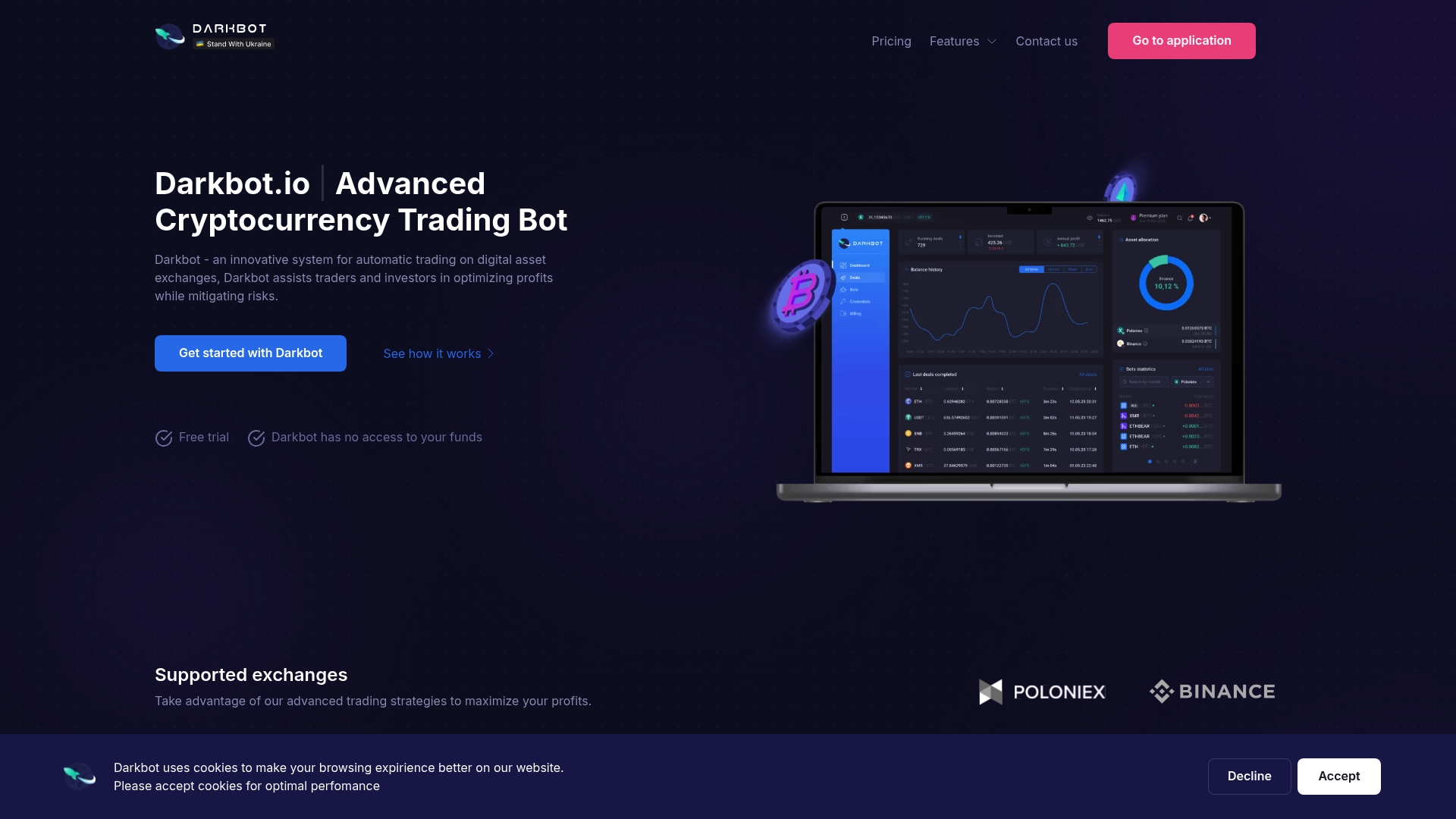
Our platform handles the technical challenges of exchange connectivity, rate limit management, and secure credential storage. You focus on strategy while Darkbot executes trades across your connected exchanges simultaneously. Advanced portfolio management tools optimize your digital asset allocation automatically, rebalancing positions based on market conditions and your risk preferences.
Whether you’re new to automated trading or an experienced trader seeking better tools, Darkbot’s intuitive interface and personalized support help you deploy effective strategies quickly. Start with our free tier to explore capabilities, then scale to premium features as your trading grows.
Frequently asked questions
What is API-based exchange integration in crypto trading?
API-based exchange integration connects automated trading software to cryptocurrency exchanges through programming interfaces. This allows bots to access market data, execute trades, and manage positions programmatically without manual intervention. The integration enables traders to implement sophisticated strategies across multiple exchanges simultaneously while maintaining 24/7 market presence.
How do APIs improve speed and efficiency for cryptocurrency traders?
APIs execute trades in milliseconds compared to the seconds or minutes required for manual order placement. Real-time data feeds through WebSocket connections enable instant reaction to market movements. Automation eliminates human delays and reduces errors from manual entry, improving timing and consistency in strategy execution.
Are API trading bots guaranteed to make a profit?
No, API bots automate execution but cannot guarantee profits. Success depends on the quality of your trading algorithms, market conditions, and risk management practices. Even sophisticated AI-powered bots require active monitoring, strategy refinement, and adaptation to changing market dynamics. Bots eliminate manual effort but don’t eliminate market risk.
What security measures should I take to protect my API keys?
Limit API key permissions to only necessary functions, avoiding withdrawal rights unless required. Enable IP whitelisting to restrict access to known addresses. Store keys in encrypted formats using secure credential management systems, never in plain text files. Rotate keys every 30 to 90 days and monitor API activity logs regularly for suspicious behavior.
Can I use one trading bot across multiple cryptocurrency exchanges?
Yes, most modern trading bots support multi-exchange integration through standardized API implementations. You configure separate API keys for each exchange within the bot, allowing unified strategy execution across all connected platforms. This approach enables cross-exchange arbitrage opportunities and centralized portfolio management from a single interface.
What happens if my exchange API goes down or has issues?
Well-designed trading bots implement error handling to gracefully manage API outages. They typically pause trading activity, log the issue, and send alerts to notify you of the problem. Some advanced bots can failover to backup exchanges or switch to read-only mode until connectivity restores. Always monitor bot status and have manual access to your exchange accounts as a backup.
Recommended

Start trading on Darkbot with ease
Come and explore our crypto trading platform by connecting your free account!
Free plan available • No credit card required