Automated Trading Strategies Guide for Profitable Crypto Trades

The pressure of juggling active trades with a demanding work schedule is a daily reality for many crypto day traders. Staying ahead of market swings is tough when your focus is divided, yet ignoring volatility can threaten long-term gains. This guide reveals how you can use automated trading solutions that combine strong encryption and customizable strategy preferences to keep your accounts secure and strategies optimized, allowing you to trade confidently even when you are away from the screen.
Quick Summary
| Key Insight | Explanation |
|---|---|
| 1. Secure API Key Management | Generate API keys with restricted permissions and unique passwords to enhance security and limit exposures. |
| 2. Define Clear Trading Preferences | Configure your automated trading bot settings to reflect your risk tolerance, technical indicators, and strategic goals. |
| 3. Implement Comprehensive Risk Controls | Establish multi-layered risk management strategies to dynamically adjust trading exposure and protect your investments. |
| 4. Conduct Rigorous Testing | Use backtesting frameworks to validate your trading algorithms under various market conditions before live deployment. |
| 5. Regularly Monitor Performance | Consistent assessment of automated trades through real-time tracking helps identify optimization opportunities and potential issues. |
Step 1: Connect Exchange Accounts Securely
Securing your cryptocurrency exchange connections is the critical first step in setting up automated trading strategies. The process involves establishing a robust and encrypted connection between your trading bot and exchange platforms while maintaining stringent security protocols.
To connect your exchange accounts, you’ll need to generate API keys that provide secure, controlled access for your automated trading system. These keys act as specialized credentials that allow the trading bot to execute trades on your behalf without exposing your full account credentials. When generating API keys, follow these critical security guidelines:
- Select exchanges that support restricted API permissions
- Enable read-only trading access when possible
- Create keys with limited withdrawal capabilities
- Use unique passwords for each exchange platform
When integrating your accounts, you’ll want to leverage advanced cryptographic security protocols that protect your trading credentials. This involves using strong encryption methods and multi-factor authentication to prevent unauthorized access.
Security Insight: Never share your API keys or store them in unsecured locations. Treat them like sensitive financial credentials.
After generating your API keys, carefully input them into your trading platform, double-checking each character to ensure accuracy. Most automated trading platforms will provide a secure key validation process that checks the credentials without storing the complete key.
Pro tip: Regularly rotate your API keys and remove access for unused or outdated trading configurations to maintain optimal security.
Here’s a summary of key security measures for connecting exchange accounts securely:
| Security Measure | Purpose | Impact on Trading Bot Security |
|---|---|---|
| Restricted API Permissions | Limit access to specific functions | Reduces unauthorized actions |
| Read-Only Trading Access | Prevents unwanted trade execution | Protects trading and funds |
| Limited Withdrawal Rights | Restricts fund transfers | Minimizes financial risk |
| Unique Exchange Passwords | Prevents cross-platform breaches | Enhances account isolation |
| Cryptographic Protocols | Encrypts sensitive credentials | Secures data transmission |
Step 2: Configure Automated Trading Preferences
Configuring your automated trading preferences is where you transform generic trading tools into a personalized strategy that reflects your unique investment goals and risk tolerance. This crucial step allows you to fine-tune how your trading bot interacts with cryptocurrency markets, ensuring it operates precisely according to your specifications.
To set up effective trading preferences, you’ll want to leverage customizable strategy parameters that enable granular control over your trading approach. These configurations typically involve several key components:
- Define your risk management thresholds
- Select specific technical indicators for analysis
- Set entry and exit point criteria
- Configure position sizing rules
- Establish stop-loss and take-profit levels
When configuring your trading strategy, focus on creating a balanced approach that combines systematic rules with flexible adaptability. Most advanced trading platforms offer intuitive interfaces that allow you to adjust parameters like maximum trade size, trading frequency, and market asset selection.
Strategic Insight: Your trading preferences should reflect a disciplined approach that prioritizes consistent performance over high-risk, sporadic gains.
Carefully review each configuration setting, understanding how they interact to create your overall trading logic. This might include setting up specific conditions like trading only during certain market volatility levels or restricting trades to selected cryptocurrency pairs.

The goal is to create a repeatable trading system that can execute trades automatically while maintaining your predefined risk management strategy. By thoughtfully configuring your preferences, you transform an automated trading tool into a precise, personalized investment mechanism.
Pro tip: Start with conservative settings and gradually refine your strategy based on actual performance data, allowing your automated trading approach to evolve systematically.
Here’s a comparison of common trading strategy parameters and their relevance in automated crypto trading:
| Parameter | Description | Importance for Automation |
|---|---|---|
| Risk Threshold | Maximum exposure per trade | Maintains account stability |
| Technical Indicators | Tools for market analysis | Guides entry/exit actions |
| Position Sizing Rule | Defines trade amount per position | Controls trade impact |
| Stop-Loss Level | Automated loss mitigation | Limits downside risk |
| Take-Profit Level | Secure gains automatically | Locks in profits |
Step 3: Customize Strategy Rules and Algorithms
Customizing your trading strategy’s rules and algorithms transforms a generic automated system into a personalized trading mechanism that precisely matches your investment philosophy. This critical step allows you to design a unique approach that reflects your risk tolerance, market understanding, and specific trading objectives.
To develop a robust trading algorithm, you’ll want to leverage modular strategy architectures that enable flexible rule configurations. Your customization process should focus on several key algorithmic components:
- Define technical indicator combinations
- Configure entry and exit signal logic
- Establish risk management parameters
- Set portfolio allocation rules
- Design dynamic rebalancing mechanisms
When developing your algorithm, consider creating multiple strategy variations that can adapt to different market conditions. Advanced platforms allow you to implement complex decision trees that combine multiple technical indicators like Relative Strength Index (RSI), Moving Average Convergence Divergence (MACD), and Bollinger Bands.
Strategic Insight: Successful algorithmic trading requires a balance between mathematical precision and adaptive flexibility.
Your algorithm should incorporate both deterministic rules and probabilistic decision-making frameworks. This means creating a system that follows predefined logic while maintaining the ability to adjust to unexpected market movements.

The most effective trading algorithms blend systematic rule execution with intelligent risk management. By carefully crafting your strategy’s underlying logic, you transform raw trading data into a structured decision-making framework that can operate consistently across various market scenarios.
Pro tip: Implement a rigorous backtesting process to validate your algorithm’s performance across different market conditions before deploying it with real capital.
Step 4: Set Up Risk Management Controls
Establishing robust risk management controls is the cornerstone of sustainable automated crypto trading. This critical step transforms your trading strategy from a speculative approach to a disciplined, systematic investment mechanism that protects your capital while seeking consistent returns.
To implement comprehensive risk controls, you’ll want to leverage machine learning risk assessment models that dynamically adjust your portfolio’s risk exposure. Your risk management framework should incorporate several key protective strategies:
- Set maximum loss thresholds
- Implement position sizing rules
- Create automatic stop-loss triggers
- Define portfolio diversification limits
- Establish volatility-based trading constraints
Effective risk management goes beyond simple percentage-based limitations. Advanced trading platforms enable you to create multi-layered risk controls that adapt to real-time market conditions. This might include dynamic position sizing that automatically reduces trade exposure during high volatility periods.
Strategic Insight: True risk management is about preserving capital through intelligent, adaptive controls, not just avoiding losses.
Your risk management system should balance mathematical precision with flexible decision-making. This means creating a framework that can quickly respond to market changes while maintaining predefined risk parameters.
The most sophisticated risk control strategies integrate machine learning algorithms that continuously analyze market conditions, detecting potential anomalies and adjusting your trading approach proactively. By implementing these intelligent controls, you transform your trading bot from a simple execution tool into a sophisticated risk management system.
Pro tip: Regularly backtest and recalibrate your risk management controls to ensure they remain effective across different market environments and evolving cryptocurrency landscapes.
Step 5: Test and Monitor Automated Trades Effectively
Testing and monitoring your automated crypto trading strategies is crucial for ensuring consistent performance and minimizing potential risks. This step transforms your theoretical strategy into a reliable, real-world trading mechanism by validating its effectiveness through comprehensive analysis and continuous observation.
To establish a robust monitoring framework, you’ll want to implement advanced backtesting frameworks that provide detailed insights into your trading bot’s performance. Your monitoring approach should encompass several critical evaluation techniques:
- Analyze historical performance metrics
- Track real-time trade execution
- Monitor strategy deviation indicators
- Review risk-adjusted return measurements
- Assess comparative benchmark performance
Effective trade monitoring goes beyond simple profit tracking. Advanced platforms enable you to create multi-dimensional performance dashboards that provide granular insights into your trading strategy’s behavior under various market conditions. This comprehensive approach helps you understand not just the outcomes, but the underlying mechanisms driving your trading decisions.
Strategic Insight: Consistent monitoring is the key to transforming a good trading strategy into an exceptional, adaptable system.
Your monitoring process should integrate both quantitative analysis and qualitative assessment. This means looking beyond raw numbers to understand the logic and adaptability of your trading algorithm across different market scenarios.
The most sophisticated monitoring strategies employ machine learning techniques that continuously analyze your bot’s performance, identifying potential optimization opportunities and detecting subtle shifts in market dynamics that might impact your trading approach.
Pro tip: Create a systematic review schedule where you comprehensively evaluate your trading strategy’s performance at least once per month, allowing for data-driven refinements.
Secure and Optimize Your Crypto Trading with Darkbot.io
Navigating the complexities of automated trading strategies can be overwhelming given the critical need for secure exchange connections, personalized strategy customization, and dynamic risk management outlined in the guide. If you want to eliminate the pain of manually configuring API keys and algorithmic parameters while enhancing your control over profitable trades Darkbot.io offers a trustworthy SaaS platform tailored just for that. The platform’s advanced AI-driven tools address your key challenges by seamlessly integrating multi-exchange accounts securely and providing intuitive interfaces for customizing your trading rules and risk thresholds.
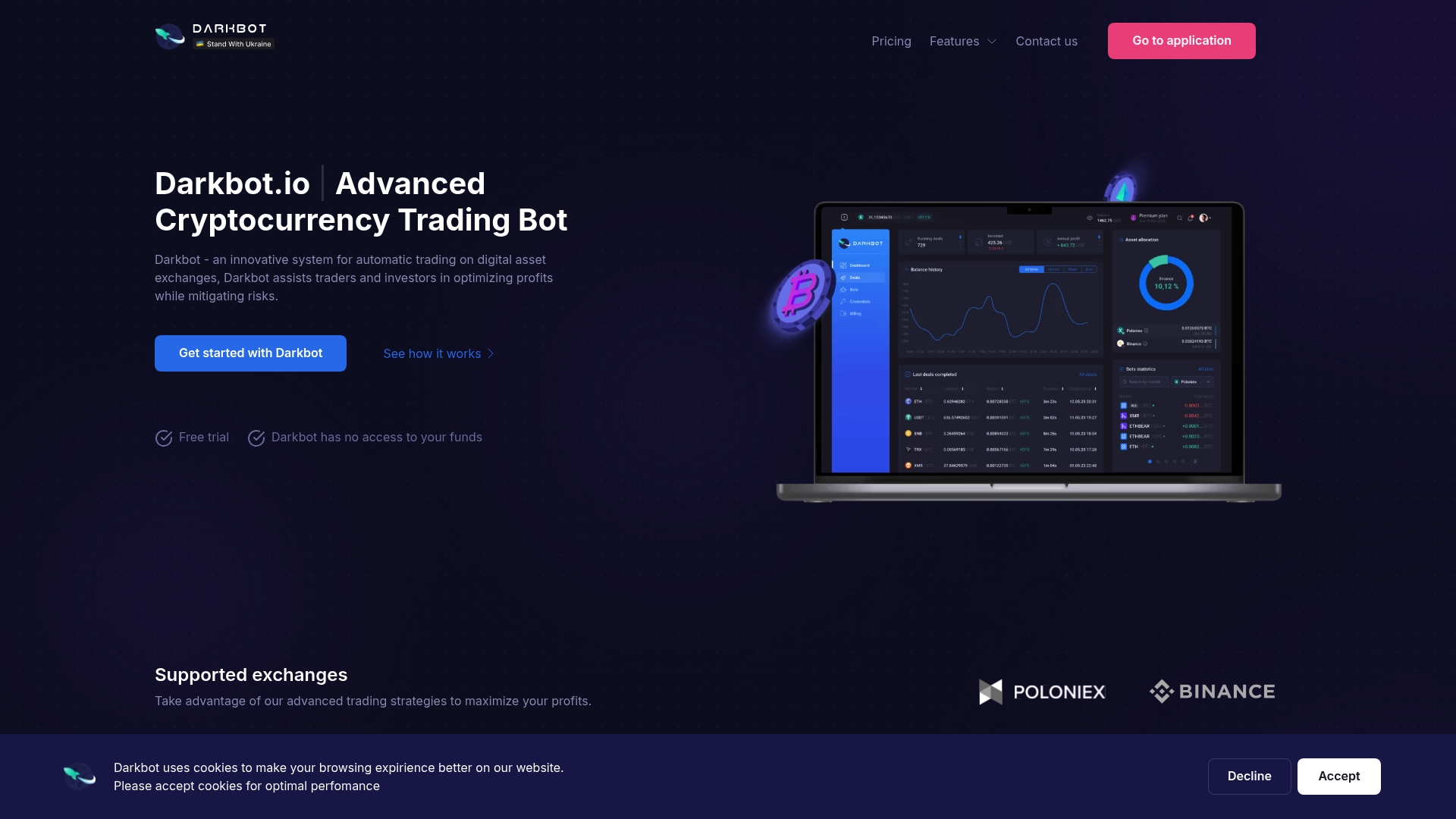
Ready to turn your automated crypto strategy into a consistent profit machine? Visit Darkbot.io to experience easy yet sophisticated bot deployment, real-time analytics, and personalized support that streamlines your entire trading workflow. Don’t wait to take control of your crypto investments with an automated system that grows smarter with you. Start your journey now by exploring advanced automated cryptocurrency trading bot solutions built specifically to meet the needs highlighted in the Automated Trading Strategies Guide for Profitable Crypto Trades. Unlock your trading potential with Darkbot today.
Frequently Asked Questions
How do I connect my cryptocurrency exchange accounts securely for automated trading?
To connect your cryptocurrency exchange accounts securely, generate API keys that provide controlled access for your trading bot. Make sure to select exchanges with restricted API permissions and enable read-only trading access where possible.
What parameters should I configure for my automated trading preferences?
You should configure parameters such as risk management thresholds, technical indicators, entry and exit point criteria, position sizing rules, and stop-loss and take-profit levels. Begin by defining your risk tolerance to create a balanced trading strategy that aligns with your investment goals.
How can I customize my automated trading strategy’s rules and algorithms?
Customize your trading strategy by defining technical indicator combinations, entry and exit signal logic, risk management parameters, and portfolio allocation rules. Consider creating multiple strategy variations to adapt to changing market conditions, ensuring your trading approach remains effective.
What risk management controls should I implement for automated trading?
Implement risk management controls such as maximum loss thresholds, position sizing rules, automatic stop-loss triggers, and portfolio diversification limits. Establishing these controls will help you preserve capital and minimize potential losses in your trading activities.
How do I effectively test and monitor my automated trading strategies?
Effectively test and monitor your automated trading strategies by analyzing historical performance metrics, tracking real-time trade execution, and reviewing risk-adjusted return measurements. Create a systematic review schedule to evaluate performance at least once a month, allowing for necessary adjustments based on data-driven insights.
Recommended

Start trading on Darkbot with ease
Come and explore our crypto trading platform by connecting your free account!
Free plan available • No credit card required