Automated trading systems: smarter crypto strategies in 2026

Over 70% of crypto trading volume is now handled by automated systems, and that number keeps climbing. For individual traders and investors, this raises real questions: How do these systems actually work? Are they worth using? And how do you avoid the traps that catch most beginners off guard? This guide cuts through the noise and walks you through everything from the core mechanics to practical risk controls, so you can make informed decisions about whether and how to put automation to work in your own crypto strategy.
Key Takeaways
| Point | Details |
|---|---|
| Widespread adoption | Most crypto trading activity is now powered by automated systems, enabling speed and continuous market access. |
| Smart automation pays | Well-designed, supervised automation can boost returns and cut emotional bias versus manual trading. |
| Know the risks | Automated systems need robust risk controls and human oversight to prevent costly errors during market volatility. |
| Blend AI and human insight | Hybrid supervision—combining machine speed and human judgment—offers the best defense against unexpected failures. |
| Start simple, build expertise | New users should start with tested strategies and gradually layer on complexity as they master the tools. |
What is an automated trading system?
An automated trading system is software that monitors markets, generates trade signals, and executes buy or sell orders without you needing to click a button. At its core, it connects to a crypto exchange through an API (application programming interface), reads live market data, applies a set of rules or a trained model, and places trades based on what it finds.
These systems generally fall into three categories:
- Rule-based bots: Follow fixed logic like “buy when RSI drops below 30, sell when it crosses 70.” Fast and predictable, but limited to conditions you’ve already thought of.
- AI-driven bots: Use machine learning to identify patterns in historical and live data, adapting over time. They can handle more complexity but require careful tuning.
- Hybrid human-AI systems: Combine algorithmic execution with human oversight for strategy adjustments. This is increasingly the preferred model for serious traders.
The reason automation has taken over is straightforward. Crypto markets run 24 hours a day, seven days a week, across hundreds of exchanges. No human can monitor all of that simultaneously. Over 70% of crypto trading volume is now automated, and the gap between manual and automated performance keeps widening as markets get faster and more complex.
For traders exploring smarter automated trading with machine learning, the appeal is obvious: systems that learn from data rather than just following static rules. But the benefits of automated trading go beyond speed alone. Automation removes emotional decision-making, enforces discipline, and lets you run multiple strategies at once across different assets.
How automated trading systems work: Key features and workflow
Understanding the workflow helps you use these tools more effectively and spot problems before they cost you money. Here’s the typical sequence:
- Signal generation: The system scans market data (price, volume, order book depth, sentiment feeds) and identifies a potential trade opportunity based on its strategy logic.
- Order execution: Once a signal is confirmed, the bot places the order through the exchange API. Bots execute trades in milliseconds, far faster than any human reaction time.
- Trade monitoring: After execution, the system tracks the open position, applies stop-loss or take-profit rules, and adjusts if conditions change.
- Performance logging: Every trade is recorded for review, feeding back into strategy refinement.
Most platforms include these core features:
| Feature | What it does | Why it matters |
|---|---|---|
| Backtesting | Tests strategy on historical data | Validates logic before risking capital |
| Risk controls | Sets position size, stop-loss limits | Prevents catastrophic losses |
| Performance dashboard | Tracks win rate, ROI, drawdown | Guides ongoing optimization |
| API integration | Connects to exchanges securely | Enables real-time execution |
AI and machine learning add another layer. Deep learning models in trading can detect non-linear patterns that rule-based systems miss entirely. However, they also carry real limits: they can overfit to historical data, struggle during regime shifts, and sometimes generate signals that look great in backtests but fail in live conditions.

Pro Tip: Always run a strategy through at least 12 months of historical data before going live. A strategy that only works in a bull market will look brilliant until conditions change.
For a deeper look at building effective automated trading strategies, it helps to understand how algorithmic trading AI balances pattern recognition with risk-adjusted execution.
Performance, advantages, and limitations of automated crypto trading
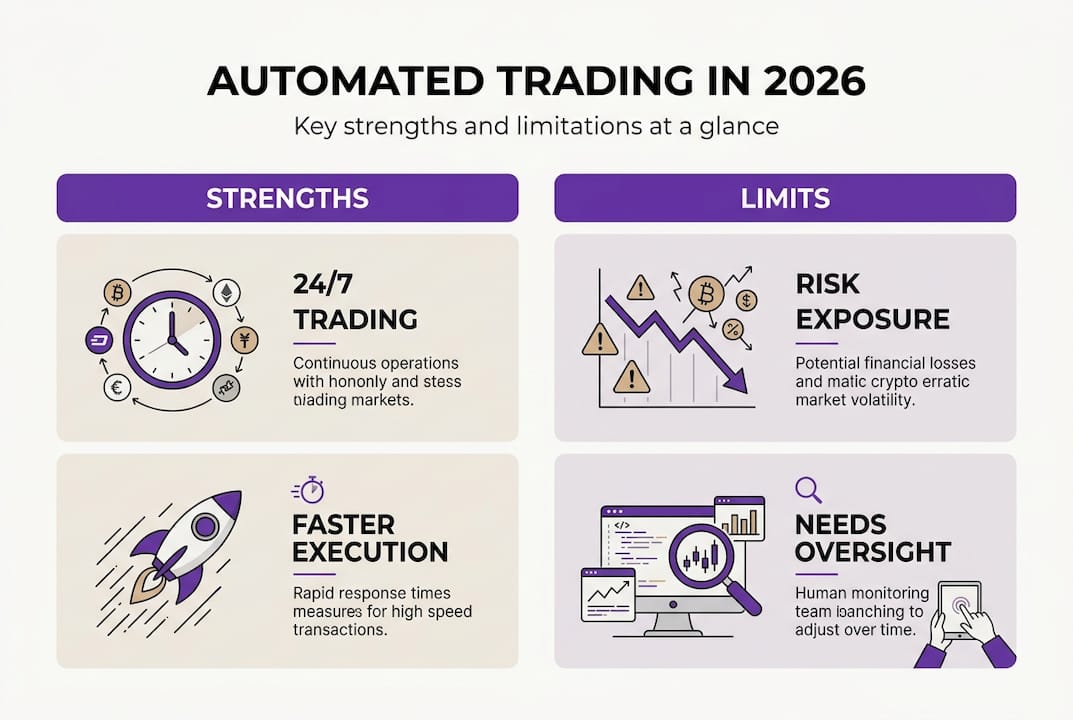
Let’s talk numbers. Recent data from the Crypto Quant Strategy Index July 2025 shows AI-assisted ROI at 34% over a six-month average, compared to 29% for fully automated systems and just 19% for manual trading. That’s not a small gap.
“The data is clear: human judgment combined with algorithmic execution consistently outperforms either approach alone.”
The main advantages automated systems deliver:
- Speed: Execution in milliseconds, capturing opportunities that disappear before a human can react.
- Objectivity: No fear, no greed, no second-guessing. The system follows its rules every time.
- 24/7 coverage: Markets don’t sleep, and neither does your bot.
- Precise risk management: Position sizing and stop-losses are enforced automatically, not forgotten under pressure.
But the limitations are just as real:
- Overfitting: A strategy tuned too tightly to past data often fails when market conditions shift.
- Slippage: In low-liquidity conditions or during volatility spikes, orders fill at worse prices than expected.
- Technical failures: Exchange downtime, API errors, or connectivity issues can leave positions unmanaged.
- Black swan events: Extreme market events can trigger cascading losses faster than any circuit breaker can respond.
Pro Tip: Don’t judge a bot’s performance over just a few weeks. Evaluate it across different market regimes, including trending, ranging, and high-volatility periods.
Exploring the AI trading advantages in depth, or reviewing AI trading bots benefits, gives you a clearer picture of where automation genuinely earns its keep. For active traders, day trading AI tools can be particularly powerful when paired with solid risk controls.
Managing risk and ensuring safety with automated strategies
Automation doesn’t eliminate risk. It changes where the risk lives. Most losses from automated systems don’t come from bad markets. They come from poor setup, neglected supervision, and failure to adapt.
AI agents can introduce new risks including overfitting, slippage, API and exchange downtime, algorithmic feedback loops, and even prompt injection attacks. These require robust controls and ongoing human oversight, not a set-it-and-forget-it mindset.
Here’s a practical safety checklist every automated trader should follow:
- Whitelist API access: Restrict your API keys to specific IP addresses so they can’t be used from unauthorized locations.
- Use withdrawal-disabled APIs: Never give a trading bot permission to withdraw funds. Trading access only.
- Set circuit breakers: Configure maximum daily loss limits that automatically pause the bot if hit.
- Backtest across regimes: Test your strategy in bull markets, bear markets, and sideways conditions.
- Diversify strategies: Don’t run a single bot on a single asset. Spread exposure across uncorrelated strategies.
- Review performance weekly: Markets evolve. A strategy that worked three months ago may need recalibration.
Pro Tip: Treat your bot like a junior trader. You wouldn’t leave a new hire unsupervised for weeks. Check in regularly, review the logs, and be ready to intervene.
The US Treasury AI risk management framework reinforces this point: even sophisticated AI systems in financial services require layered human controls. For practical guidance on improving outcomes, the crypto optimization steps framework and automated portfolio management principles both emphasize supervision as a core component, not an afterthought.
Our perspective: The real breakthrough (and blind spots) of automated trading systems
Most articles about automated trading spend 90% of their time on the technology and almost none on the human layer that makes or breaks results. That’s backwards.
The real breakthrough isn’t that bots are fast. It’s that they force you to define your strategy explicitly. You can’t automate vague intuition. You have to write down your rules, test them, and defend them with data. That discipline alone improves trading outcomes, even before the bot places a single trade.
The blind spot most traders carry is assuming that once automation is running, the hard work is done. In reality, the hardest work starts after deployment. Markets shift. Correlations break. New attack vectors emerge. Hybrid human-AI supervision mitigates systemic risks like flash crashes, because even the smartest models need a human who understands context.
The traders who get the most from automation aren’t the ones who trust it blindly. They’re the ones who use it as a tool for executing a disciplined strategy, while staying actively engaged with algorithmic risk management and market conditions. Automation amplifies your edge. It also amplifies your mistakes.
Explore smarter automated trading for your crypto journey
If you’ve made it this far, you now have a clearer picture of what automated trading systems can and can’t do. The next step is putting that knowledge into practice with tools built for real-world crypto markets.
Darkbot.io gives you access to a full suite of crypto trading bot and strategies designed for both new and experienced traders. From signal-based automation to AI-driven execution, the platform lets you build, test, and deploy strategies without needing a background in coding. You can also take advantage of dedicated portfolio management tools to automate rebalancing and track performance across multiple assets in real time. Start with a free plan and scale as your confidence grows.
Frequently asked questions
What is an automated trading system in cryptocurrency?
An automated trading system is software that executes crypto trades on your behalf based on preset strategies and market signals, often running 24/7 for efficiency. With over 70% of crypto trading now automated, these systems have become standard tools for serious market participants.
Are automated trading systems profitable for crypto investors?
Automated systems can improve returns, with recent studies showing AI-assisted trading at 34% ROI versus 19% for manual trading on average, but results depend heavily on strategy quality and risk controls.
What are the risks of using automated trading bots?
Key risks include overfitting, slippage, and API downtime, along with unexpected market events, so constant monitoring and robust risk controls are essential for any automated strategy.
How do I start using an automated trading system for crypto?
Start by researching reputable platforms, define your risk tolerance and strategy, and use demo or backtesting features before committing real capital to any automated system.
Can I fully automate my crypto portfolio management?
Yes, advanced platforms now offer full portfolio automation features, but ongoing supervision and regular adjustment to changing market conditions remain crucial for sustainable results.
Recommended
- Machine Learning in Trading Strategies: Crypto Automation Explained
- Automated crypto trading bot advantages for 2026 profits
- 7 key advantages of automated crypto trading in 2026
- Why Automate Crypto Strategies for Trading Success
- Trends in der Unternehmensautomatisierung 2026 – Effizienz und KI im Mittelstand - EcomTask

Start trading on Darkbot with ease
Come and explore our crypto trading platform by connecting your free account!
Free plan available • No credit card required