Future of Crypto Trading 2025: What Traders Must Know

TL;DR:
- Crypto trading in 2025 shifts from speculation to utility with a focus on institutional-scale activity. Stablecoins, tokenized assets, and AI-driven execution systems now shape market dynamics, favoring disciplined, systematic trading approaches. Regulatory clarity boosts institutional confidence while liquidity and technology infrastructure continue to grow, transforming the landscape for traders.
Crypto trading in 2025 is defined by a structural shift from speculative retail activity to institutional-scale utility. The market no longer moves purely on narrative and momentum. Tokenized real-world assets, expanding stablecoin infrastructure, AI-driven execution systems, and clearer regulatory frameworks now shape how capital flows through digital asset markets. Traders who understand these forces can position their strategies around durable market dynamics rather than short-term price cycles. This article breaks down each shift and what it means for your approach to the future of crypto trading 2025.
How is institutional involvement shaping crypto trading trends in 2025?
Institutional capital has become the dominant force in crypto market structure. The transition from speculation to institutional reality reshaped trading volumes, asset class composition, and liquidity depth across both centralized and decentralized venues. This is not a marginal shift. It changes the rules of the game for every active trader.
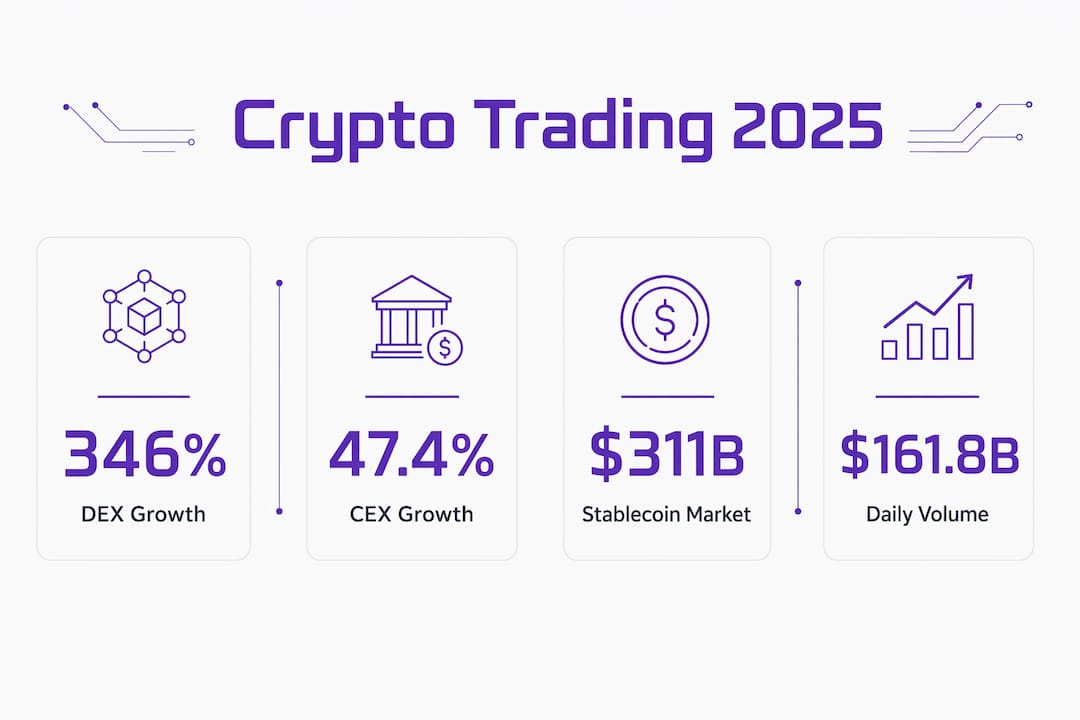
The data reflects this clearly. DEX perpetual trading volume surged 346% in 2025, while CEX perpetual volume grew 47.4%. DEX trading reached $6.7 trillion compared to CEX’s $86.2 trillion. The gap is still large, but the directional trend is unmistakable. Decentralized venues are absorbing a growing share of sophisticated, high-frequency activity.
Institutional entry also accelerated through ETF inflows and custody infrastructure. Regulated custody solutions gave large allocators the operational confidence to hold digital assets at scale. Permissioned liquidity pools with optional KYC are now standard for institutional DeFi participants, balancing privacy with compliance requirements. This bifurcation between permissioned and permissionless DeFi is one of the defining structural features of the current market.
| Metric | 2025 Figure |
|---|---|
| DEX perpetual volume growth | 346% |
| CEX perpetual volume growth | 47.4% |
| Total DEX trading volume | $6.7 trillion |
| Total CEX trading volume | $86.2 trillion |
Pro Tip: If you trade perpetuals, monitor the DEX-to-CEX volume ratio monthly. A sustained shift toward DEX dominance signals deeper liquidity fragmentation and changes optimal execution routing.
What role do stablecoins and tokenized assets play in 2025?
Stablecoins are no longer a convenience layer. They are core financial infrastructure. The stablecoin market cap rose 48.9% in 2025, reaching $311 billion. That growth rate reflects genuine adoption across B2B settlements, cross-border remittances, and on-chain payment rails, not speculative inflows.
PYUSD, PayPal’s stablecoin, grew 48.4% to reach a $3.6 billion market cap. Its expansion signals that traditional fintech players now treat stablecoins as a serious payment product. For traders, this matters because stablecoin depth directly affects on-chain liquidity and spread efficiency across major trading pairs.
Tokenized real-world assets represent the next structural growth phase. Tokenization of real-world assets drives institutional adoption by expanding regulated market access to assets like Treasury bills, private credit, and real estate. Tokenized funds also improve operational efficiency, reducing settlement times and administrative overhead for fund managers.
Key developments in this area include:
- Tokenized U.S. Treasury products offering on-chain yield with regulated backing
- Private credit tokenization giving institutional traders access to previously illiquid instruments
- Real estate tokenization enabling fractional ownership and 24/7 secondary market trading
- Supply chain finance assets moving on-chain for programmable settlement
The practical implication for traders is portfolio-level. Tokenized assets reduce correlation to speculative altcoin cycles. Allocating a portion of a portfolio to tokenized real-world assets introduces yield-bearing, lower-volatility positions that can offset drawdowns during crypto-specific corrections.
In what ways is AI transforming next-gen crypto trading strategies in 2025?
AI has moved from a marketing term to a functional trading infrastructure layer. AI agents now manage multi-chain liquidity and risk in real time, executing intent-based orders across venues without manual intervention. The model shift is from reactive human execution to self-optimizing systems that operate on probabilistic pattern evaluation and rule-based logic.

Intent-based execution models use solver networks for trade routing and settlement, reducing manual complexity in multi-chain environments. A trader sets the desired outcome, and the solver network identifies the optimal path across liquidity sources. This removes the need to manually monitor multiple DEXs and CEXs simultaneously.
For traders adapting to this environment, a practical framework looks like this:
- Define your execution rules clearly. AI systems perform best when given precise entry, exit, and position-sizing parameters. Vague strategies produce inconsistent outputs.
- Separate signal generation from execution. Use machine learning models for pattern recognition and probability scoring. Use automated bots for the actual trade execution.
- Build in circuit breakers. AI agents operating in volatile markets need hard limits on drawdown and position concentration. Automated systems without constraints can amplify losses as fast as they generate returns.
- Monitor model drift. Crypto market regimes change. A model trained on 2023 data may perform poorly in a 2025 institutional-dominated market. Regular recalibration is not optional.
Pro Tip: Platforms like Darkbot let you run AI-driven trading strategies across multiple exchanges simultaneously, applying consistent rule sets without manual oversight. This is the practical application of the AI execution model described above.
AI agents act as system architects, prioritizing risk-adjusted returns over price prediction. The distinction matters. An AI system that chases price targets will fail in sideways or mean-reverting markets. A system built around risk-adjusted execution logic performs more consistently across market regimes.
How are regulatory developments influencing crypto trading environments in 2025?
Regulatory clarity is now a market catalyst, not just a compliance burden. The GENIUS Act established a framework that improves institutional confidence by defining rules for tokenized assets, stablecoin issuance, and compliant DeFi protocols. Defined rules reduce legal uncertainty, which directly lowers the risk premium institutional allocators assign to crypto positions.
Key regulatory developments shaping trading environments include:
- The GENIUS Act providing a federal framework for stablecoin issuance and reserve requirements
- Permissioned DeFi pools with KYC compliance becoming the standard for institutional participation
- Stablecoin regulatory frameworks in the EU under MiCA creating a parallel compliance structure
- Compliance-ready DEXs emerging as a distinct category, separate from fully permissionless protocols
Regulatory frameworks, though sometimes strict, are essential catalysts for institutional confidence and broader adoption.
The challenge for traders is navigating the split between permissionless and compliance-ready DeFi. Permissionless protocols offer maximum flexibility but carry regulatory risk. Compliance-ready protocols offer institutional-grade legal certainty but may restrict certain strategies or require identity verification. Understanding this distinction is critical for managing regulatory risk in your trading operations.
What market opportunities and risks should traders consider in 2025?
The crypto market cap declined 23.7% in 2025 to $3.0 trillion, even as daily trading volume peaked at $161.8 billion. High volume during a price correction signals active repositioning, not capitulation. Traders who read this correctly found opportunities in spread trading and momentum strategies during the drawdown period.
| Opportunity | Risk |
|---|---|
| Tokenized real-world assets | Lower liquidity in early-stage tokenized markets |
| Stablecoin yield strategies | Regulatory changes to reserve requirements |
| AI-automated execution | Model drift in changing market regimes |
| Institutional DeFi pools | Counterparty risk in permissioned protocols |
| DEX perpetual trading growth | Smart contract vulnerabilities |
Speculative altcoins carry a different risk profile than tokenized real assets. Altcoins with no underlying utility or cash flow are purely sentiment-driven. Tokenized assets have identifiable underlying value. Mixing both in a portfolio without clear allocation rules creates unmanaged correlation risk during broad market selloffs.
Structured risk management separates durable traders from those who cycle in and out of the market. Automated decision-making removes emotional execution errors. Algorithmic trading approaches apply consistent logic regardless of market sentiment, which is particularly valuable during high-volatility periods when manual traders tend to make reactive, poorly-timed decisions.
Emerging strategies worth monitoring include hedging with tokenized Treasury products, spread trading between correlated assets on DEX and CEX venues, and momentum strategies calibrated to institutional order flow patterns rather than retail sentiment indicators.
Key Takeaways
The future of crypto trading in 2025 is defined by institutional adoption, stablecoin infrastructure growth, AI-driven execution, and regulatory frameworks that collectively shift the market from speculation toward structured, utility-based trading.
| Point | Details |
|---|---|
| Institutional adoption reshapes markets | DEX perpetual volume surged 346%, signaling deeper liquidity fragmentation across venues. |
| Stablecoins are core infrastructure | The stablecoin market cap reached $311 billion, supporting B2B settlements and on-chain liquidity. |
| AI enables systematic execution | AI agents manage multi-chain risk in real time, replacing manual execution with rule-based logic. |
| Regulatory clarity drives confidence | The GENIUS Act and MiCA create frameworks that reduce legal uncertainty for institutional traders. |
| Risk management is non-negotiable | Mixing speculative altcoins with tokenized assets without allocation rules creates unmanaged correlation risk. |
What I’ve learned about trading in a maturing crypto market
The traders I see struggle most in 2025 are the ones still operating with a 2021 mental model. They chase narrative-driven altcoin cycles, ignore position sizing, and treat AI tools as magic price predictors. None of that works in an institutionally-driven market.
What actually works is treating crypto like any other asset class that rewards process over prediction. The industry’s evolution toward institutional reality is not a threat to active traders. It is a structural improvement. Deeper liquidity, clearer rules, and better execution infrastructure benefit disciplined traders more than they benefit speculators.
I am genuinely cautious about the AI hype cycle within crypto trading. AI systems are excellent at executing defined rules consistently and evaluating probabilistic patterns across large data sets. They are not good at predicting black swan events or navigating genuinely novel market conditions. Traders who understand this distinction use AI as a force multiplier for their own systematic logic. Traders who misunderstand it hand over control to a black box and are surprised when it fails.
The most durable edge in 2025 is not a better algorithm. It is the discipline to define your rules clearly, automate their execution, and recalibrate when market regimes change. That is a process edge, and it compounds over time in ways that chasing the next narrative never does.
— Grisha
Darkbot automates the discipline that 2025’s market demands
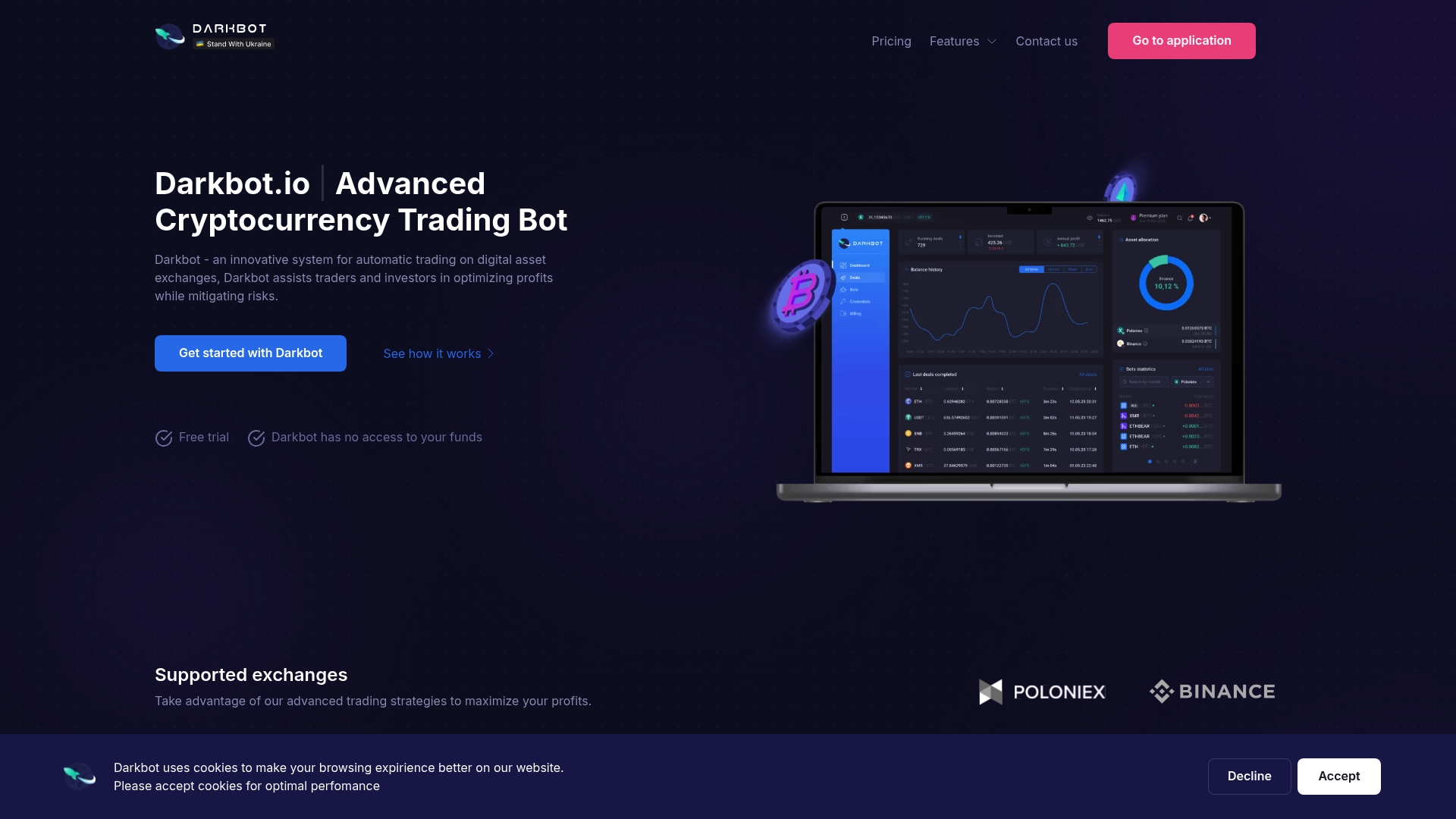
The structural shifts covered in this article, from AI-driven execution to multi-exchange strategy automation, require a platform built for systematic trading rather than manual guesswork. Darkbot is an AI-powered crypto trading automation platform designed for traders who want consistent, rule-based execution across multiple digital asset exchanges. It supports strategy customization, automated portfolio rebalancing, and real-time analytics without requiring constant manual oversight. Whether you are adapting to institutional market dynamics or managing risk across tokenized and speculative assets, Darkbot provides the execution infrastructure to apply your strategy with consistency. Explore Darkbot’s automated trading platform to see how systematic execution fits your 2025 trading approach.
FAQ
What defines the future of crypto trading in 2025?
The future of crypto trading in 2025 is defined by institutional adoption, stablecoin infrastructure growth, tokenized real-world assets, and AI-driven execution systems replacing manual trading. Regulatory clarity from frameworks like the GENIUS Act further accelerates this structural shift.
How much did DEX trading volumes grow in 2025?
DEX perpetual trading volume grew 346% in 2025, reaching $6.7 trillion, while CEX perpetual volume grew 47.4% to $86.2 trillion. The DEX-to-CEX ratio shift signals growing institutional activity on decentralized venues.
What is the role of stablecoins in 2025 crypto markets?
Stablecoins function as core financial infrastructure, with the market cap reaching $311 billion after 48.9% growth in 2025. They support B2B settlements, cross-border payments, and on-chain liquidity across major trading pairs.
How do AI trading agents work in crypto markets?
AI trading agents manage multi-chain liquidity and execute intent-based orders using rule-based logic and probabilistic pattern evaluation. They prioritize risk-adjusted execution consistency rather than price prediction.
What is the difference between permissioned and permissionless DeFi?
Permissioned DeFi protocols require KYC verification and comply with regulatory standards, making them suitable for institutional traders. Permissionless protocols offer full open access but carry regulatory uncertainty that institutional allocators typically cannot accept.
Recommended

Start trading on Darkbot with ease
Come and explore our crypto trading platform by connecting your free account!
Free plan available • No credit card required